CorelixRF | RF Systems Solutions
Custom RF Power Amplifier Manufacturer | 30 MHz–6 GHz OEM / ODM Solutions | CorelixRF
CorelixRF — Custom RF Power Amplifier Manufacturer

Custom RF Power
Amplifier
Manufacturer

30 MHz to 6 GHz · 30–200W · OEM / ODM
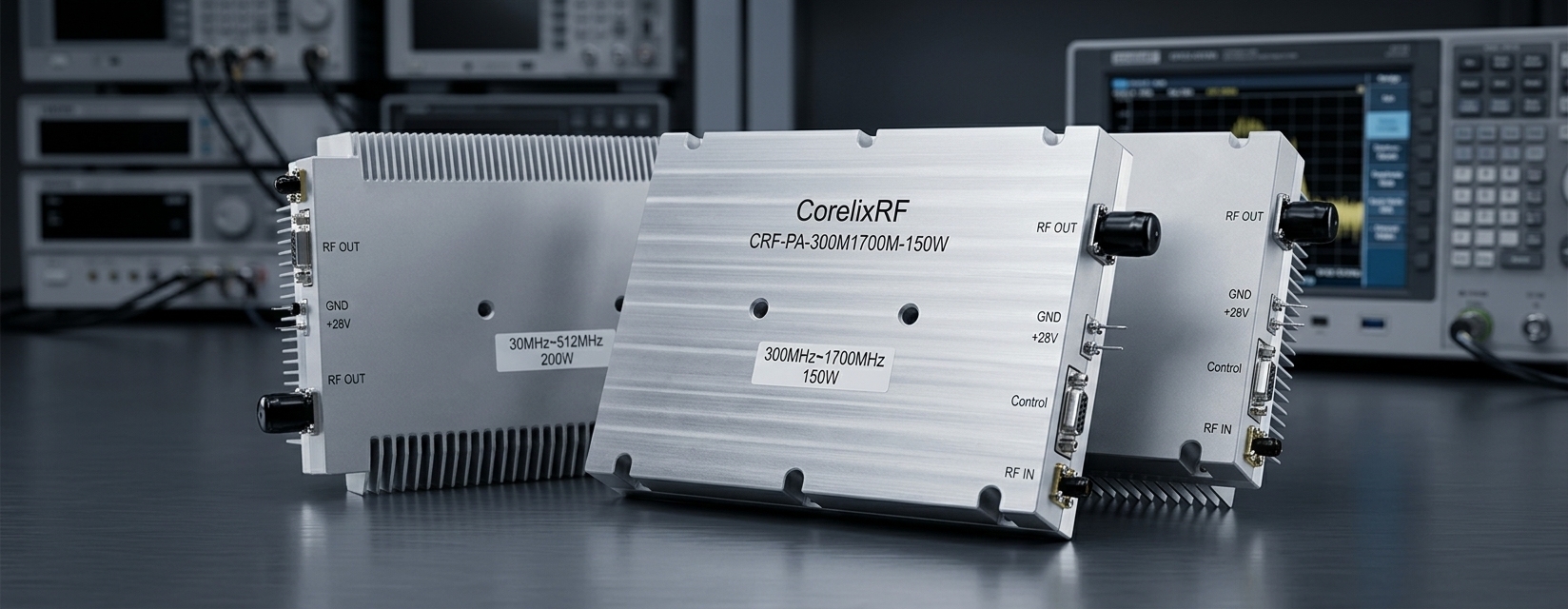
CorelixRF engineers and manufactures custom RF power amplifiers to your frequency, power, supply voltage, connector, mechanical, and thermal requirements. Standard platforms available for faster evaluation — custom development supported from prototype through production.
30 Yrs RF Manufacturing
400 Person Manufacturing Team
24H Reply Target
OEM ODM Ready
CorelixRF custom RF power amplifier module
Hero Image
RF Power Amplifier — Main Product Shot
Recommended: 800×600 px, product on dark bg
// Custom Coverage Range CorelixRF Engineering Active
30 – 512 MHz Standard + Custom OEM
300 – 1700 MHz Standard + Custom OEM
300 – 2700 MHz Standard + Custom OEM
2000 – 6000 MHz Standard + Custom OEM
AVAILABLE OUTPUT POWER TIERS
30W
50W
100W
150W
200W
DEFAULT: Air Cooling · SMA/N
CUSTOM: Connector / Mech / Thermal
30 YRS RF Manufacturing Experience
OEM/ODM In-House Engineering & Production
24H Engineering Response Target
ISO 9001 Certified Quality System
NDA Available on Request
Project Constraints We Recognize

Why Standard Catalog Products Often Fall Short

Procurement engineers and system integrators regularly encounter these obstacles. If any of these describe your current project, you're in the right place.

ISSUE 01 // FREQUENCY
Standard band doesn't match your system frequency
Your target frequency falls between standard product bands, or you need tighter sub-band coverage. Catalog SKUs don't match.
ISSUE 02 // POWER SUPPLY
Available supply voltage doesn't match standard module specs
Your power rail doesn't match standard module specs. Adding a DC–DC converter introduces efficiency loss, thermal risk, and integration complexity.
ISSUE 03 // MECHANICAL
Chassis space and connector positions are constrained
Your chassis limits the module footprint, height, or connector position. Standard form factors don't fit without mechanical workarounds.
ISSUE 04 // THERMAL
Thermal interface design risk is unaddressed
A datasheet thermal resistance number doesn't tell you what happens at your specific cold plate interface. Unaddressed thermal risk is a common field failure root cause.
ISSUE 05 // CONSISTENCY
Prototype performance doesn't match production builds
Prototype units perform to spec; production batches vary. You need documented BOM control, production traceability, and a supplier who doesn't switch components mid-run.
ISSUE 06 // COMMUNICATION
Sales support, not engineering communication
You need to discuss PA architecture, gain flatness, and thermal integration — not read a datasheet with a sales rep. Direct engineering contact matters.
How CorelixRF Responds

Engineering Responses to Real Project Constraints

Each issue has a direct answer. We're not pitching a general OEM service — we're addressing specific technical obstacles your project may be facing.

Project Issue
Frequency range doesn't match standard band boundaries
Our Response
Custom frequency definition from the proposal stage. We discuss start/stop, gain flatness across the band, and in-band ripple tolerance. Standard platforms serve as baselines for faster evaluation.
Project Issue
System supply voltage doesn't match standard VDC spec
Our Response
Supply voltage is a customization parameter, not a fixed constraint. We design to your supply rail, with appropriate bias circuitry and protection levels specified as part of the custom development scope.
Project Issue
Module size, connector position, or mounting geometry is constrained
Our Response
Mechanical envelope, connector type, and mounting pattern are part of the customization spec. Provide your size limit and interface drawing. We design around your chassis, not the other way around.
Project Issue
Thermal interface risk is not addressed by the supplier
Our Response
We review thermal integration as part of the proposal. Baseplate flatness tolerances, mounting torque recommendations, and thermal contact guidance are included in the technical package — not left to the buyer to figure out.
Project Issue
Sample-to-production consistency concern
Our Response
Production follows the validated engineering and test process. We aim for BOM continuity and raise supply concerns before volume commitment — not mid-production.
Project Issue
Need engineering discussion, not just a quotation
Our Response
When you submit specs, the RF engineering team reviews them directly. Engineering team responses typically on the next business day cover architecture recommendation, thermal approach, and realistic performance estimates — not just a price number.
OEM · ODM · Custom Engineering

What CorelixRF Can Customize for Your Project

Standard platforms exist to help you evaluate performance and accelerate timelines. But the amplifier going into your system can be matched to your exact requirements across all of these parameters.
01 // FREQUENCY
Frequency Range
Custom start/stop, gain flatness tolerance, in-band ripple. 30 MHz to 6 GHz coverage capability.
02 // POWER
Output Power
Target Pout, P1dB vs Psat specification, PAE optimization, CW or pulsed operating mode.
03 // SUPPLY
Supply Voltage
Design to your system rail. VDC, current budget, VSWR protection level, over-temperature behavior.
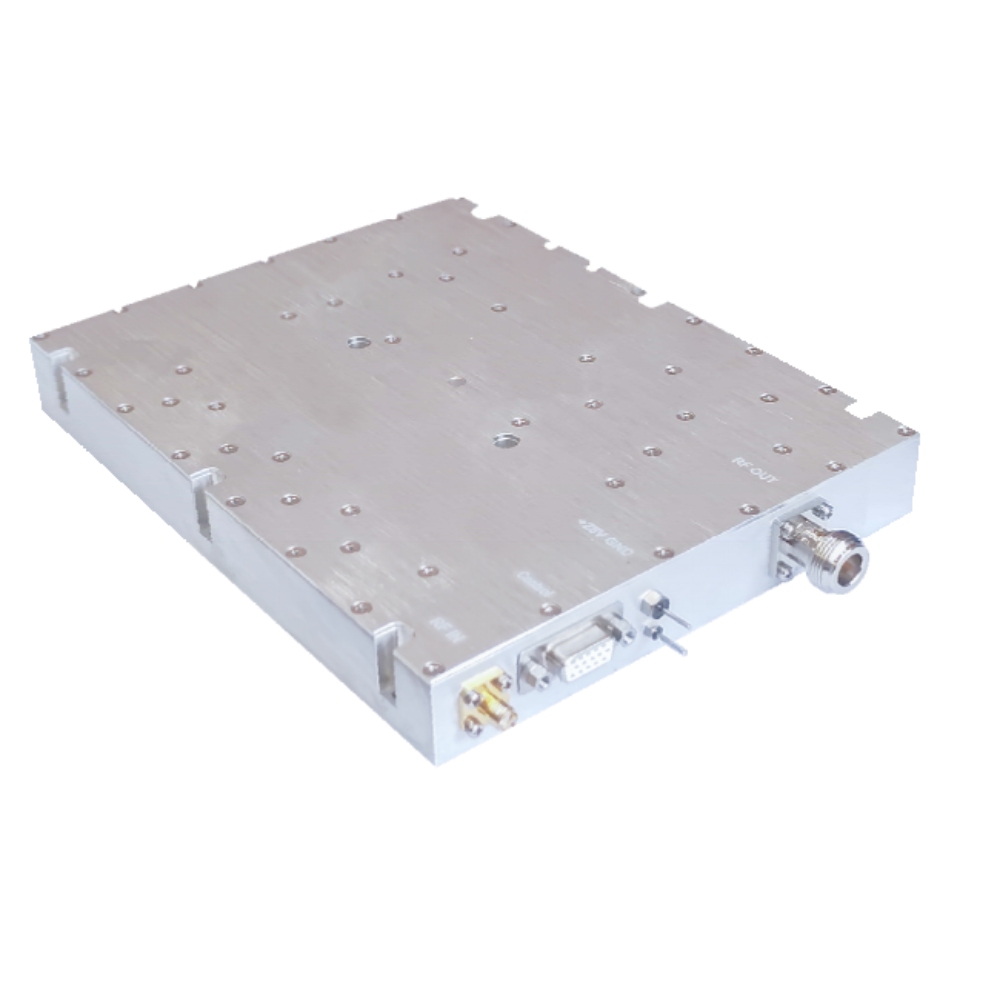
04 // CONNECTOR
Connector Type and Position
SMA, N-Type, SMA-K, or application-specific RF connectors. Position and orientation to your interface drawing.
05 // MECHANICAL
Mechanical Envelope
Size limits, mounting hole pattern, baseplate design, height clearance. We design to fit your chassis, not the other way.
06 // THERMAL
Thermal Interface
Baseplate material and flatness spec, thermal contact area optimization, cold plate mating geometry.
07 // MODE
Operating Mode
CW, pulsed (duty cycle and PRF), gain control, RF enable interface, sequencing requirements.
08 // VALIDATION
Validation Package
Prototype test data, production acceptance test spec, lot sampling plan, documentation format for OEM integration.
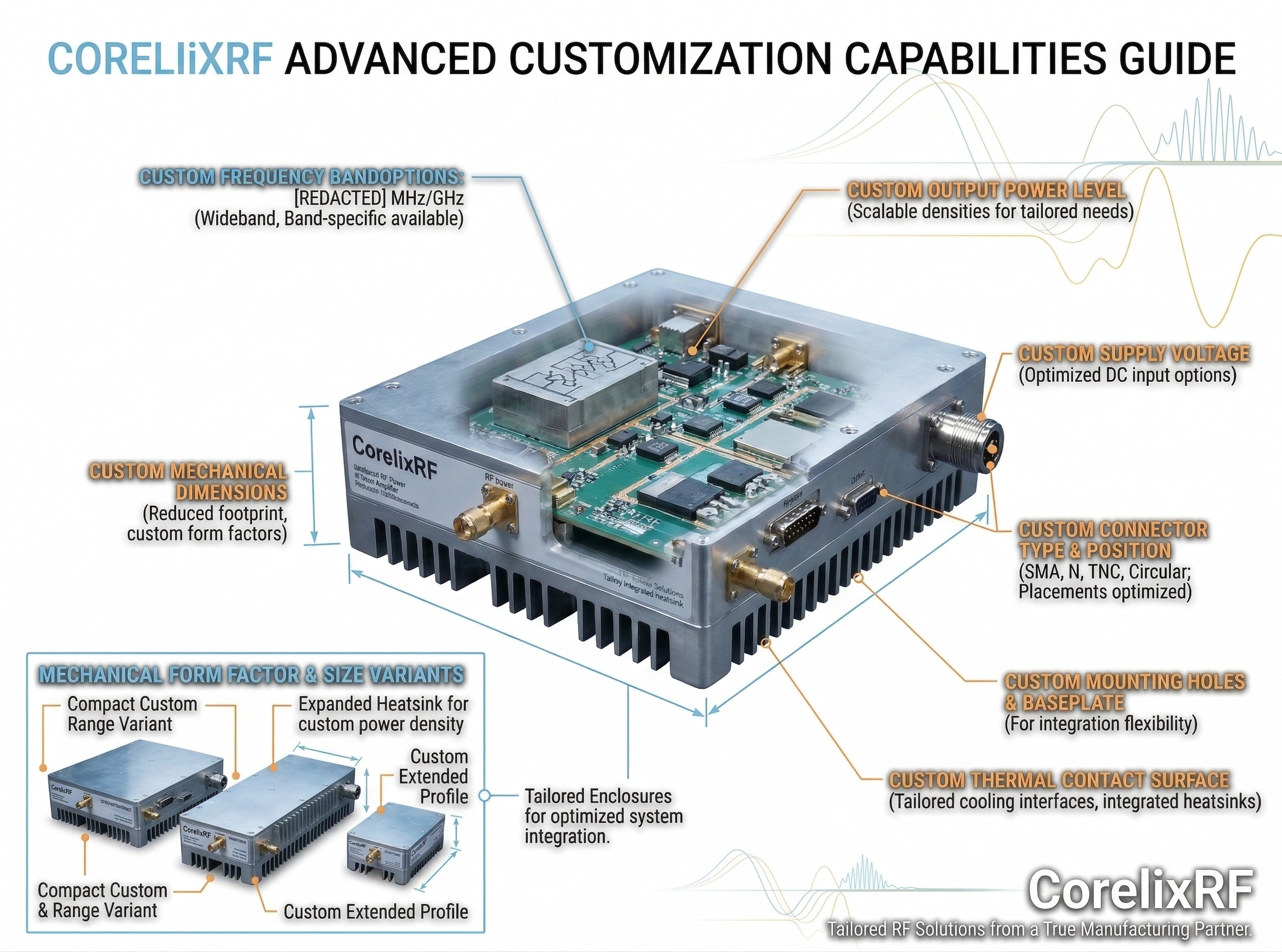
Annotated RF power amplifier showing customizable parameters
Customizable Amplifier — Annotated
Product photo + callout labels for all 8 custom params
Recommended: 800×600 px
Custom Development Workflow
01
Submit Specifications
Frequency range, target power, supply voltage, mechanical envelope, connector, quantity, and timeline. Rough or partial specs are fine as a starting point — we'll ask the right questions.
02
Engineering Proposal
RF architecture recommendation, thermal approach, initial performance estimate, and commercial outline. Engineering team response typically on the next business day.
03
Prototype Validation
Working prototype with full test data: power, harmonic, VSWR, gain flatness across the band. Iterate before committing to production volume.
04
Production Delivery
Production follows the validated engineering and test process. We aim for BOM continuity and flag component concerns before volume commitment. No sourcing surprises mid-run.
30
YRS
RF Manufacturing Experience
400
PERSON
Manufacturing Operation
ISO
9001
Certified Quality System
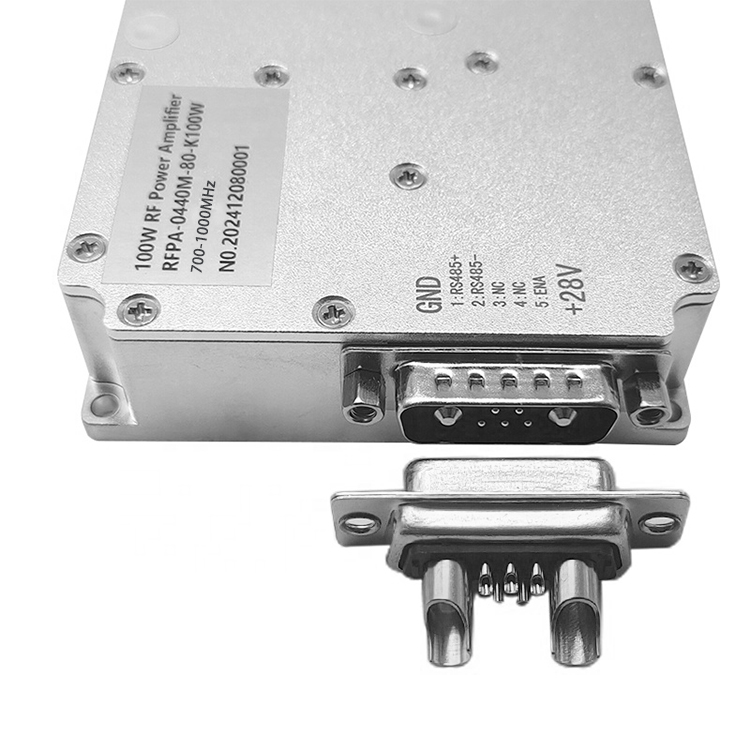
RF connector and baseplate close-up
Connector / Baseplate Close-up
Macro: SMA or N-type connector, or machined baseplate
Aspect 1:1

Have specs ready? Talk directly to the engineering team.

Even a rough frequency range, power level, and voltage spec is enough to start an engineering conversation. Engineering reply typically on the next business day.

Standard Platform Reference

Standard Platforms as a Starting Point for Custom Projects

These platforms represent CorelixRF's validated frequency and power baselines. They help buyers evaluate performance quickly and give our engineering team a known starting point for custom development. They do not represent the limit of what we can build.
Note for OEM and custom project buyers: The standard platforms below are reference points, not fixed SKU limits. If your system requires a different frequency sub-band, non-standard VDC, alternate connector, or modified mechanical envelope — those are customization parameters. Share your requirements →
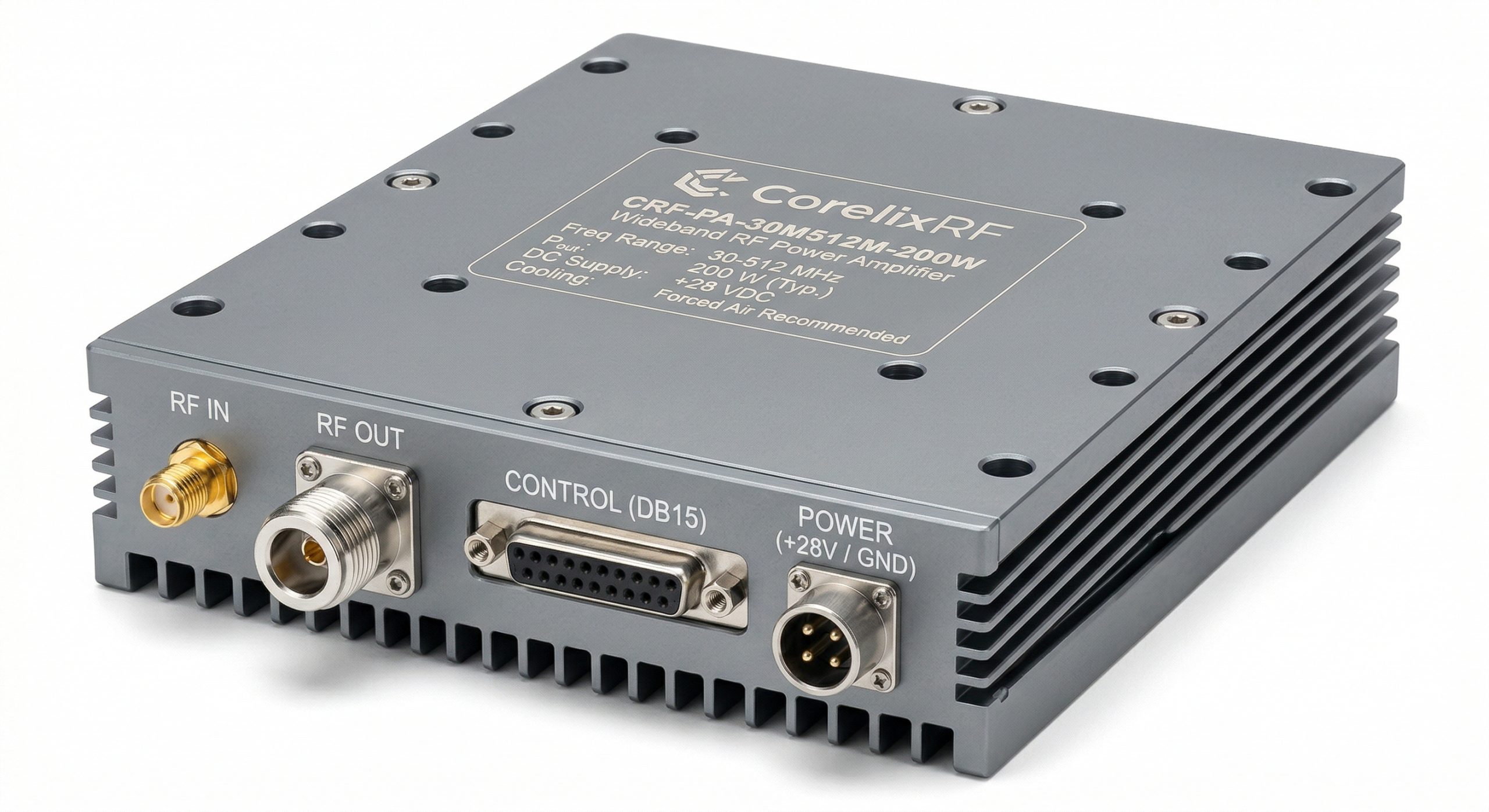
30-512 MHz RF power amplifier module
30–512 MHz Module Photo
30 – 512 MHz
30W · 50W · 100W · 150W · 200W
28 VDC ≤ 1.8 VSWR SMA / N Air Cooling

Wideband VHF/UHF coverage. Compact 125×59×21.5 mm module at 30–50W. Suitable as baseline for custom sub-band or VDC variants.

View 30–512 MHz Models
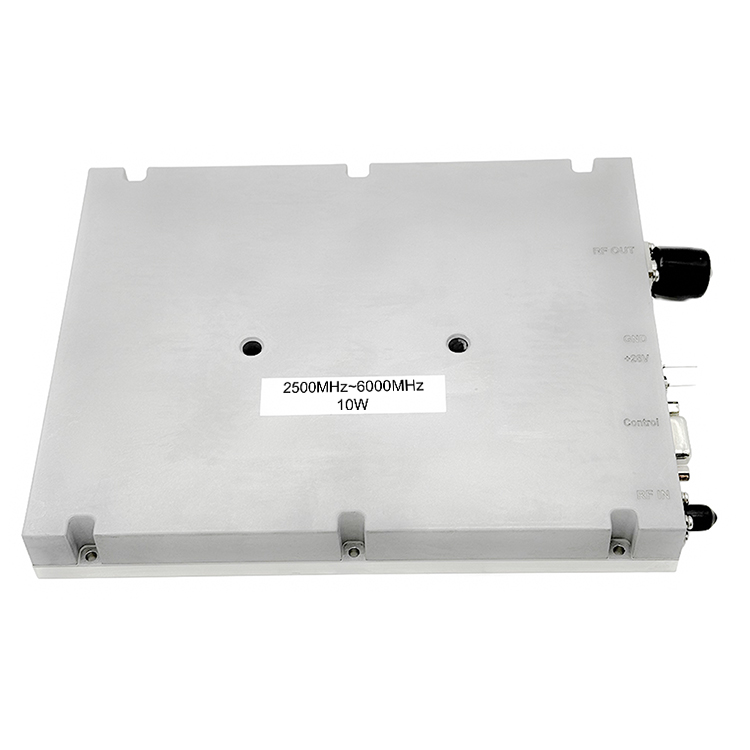
300-1700 MHz RF power amplifier module
300–1700 MHz Module Photo
300 – 1700 MHz
30W · 50W · 100W · 150W · 200W
28 VDC ≤ 1.8 VSWR SMA / N Air Cooling

Multi-band broadband coverage. Frequently used as a baseline for communications front-end and wideband RF subsystems requiring consistent gain flatness.

View 300–1700 MHz Models
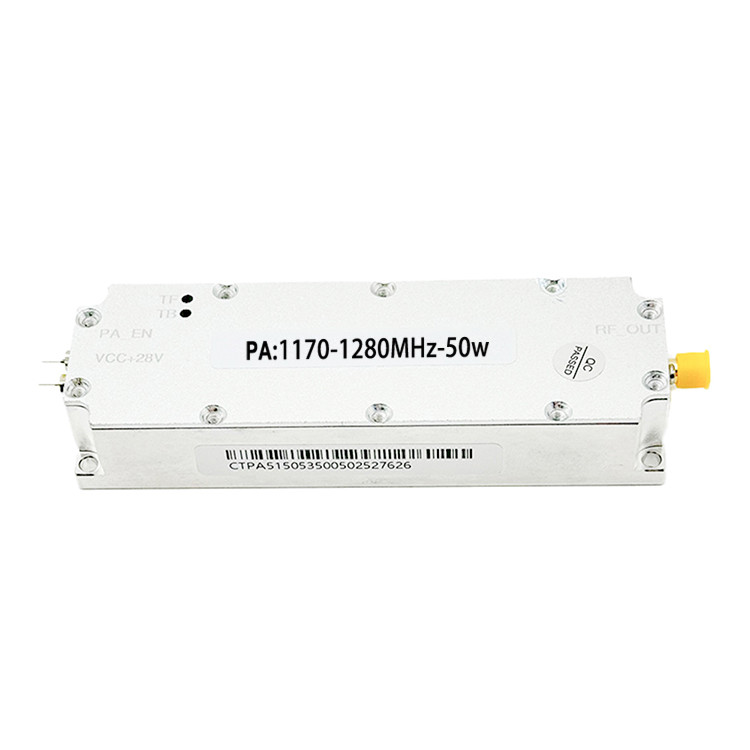
300-2700 MHz RF power amplifier module
300–2700 MHz Module Photo
300 – 2700 MHz
30W · 50W · 100W · 150W · 200W
28 VDC ≤ 1.5–1.8 VSWR SMA / N Air Cooling

Extended wideband coverage for multi-standard RF integration. One of our most requested standard series — also a strong starting point for extended band OEM builds.

View 300–2700 MHz Models
2-6 GHz RF power amplifier module
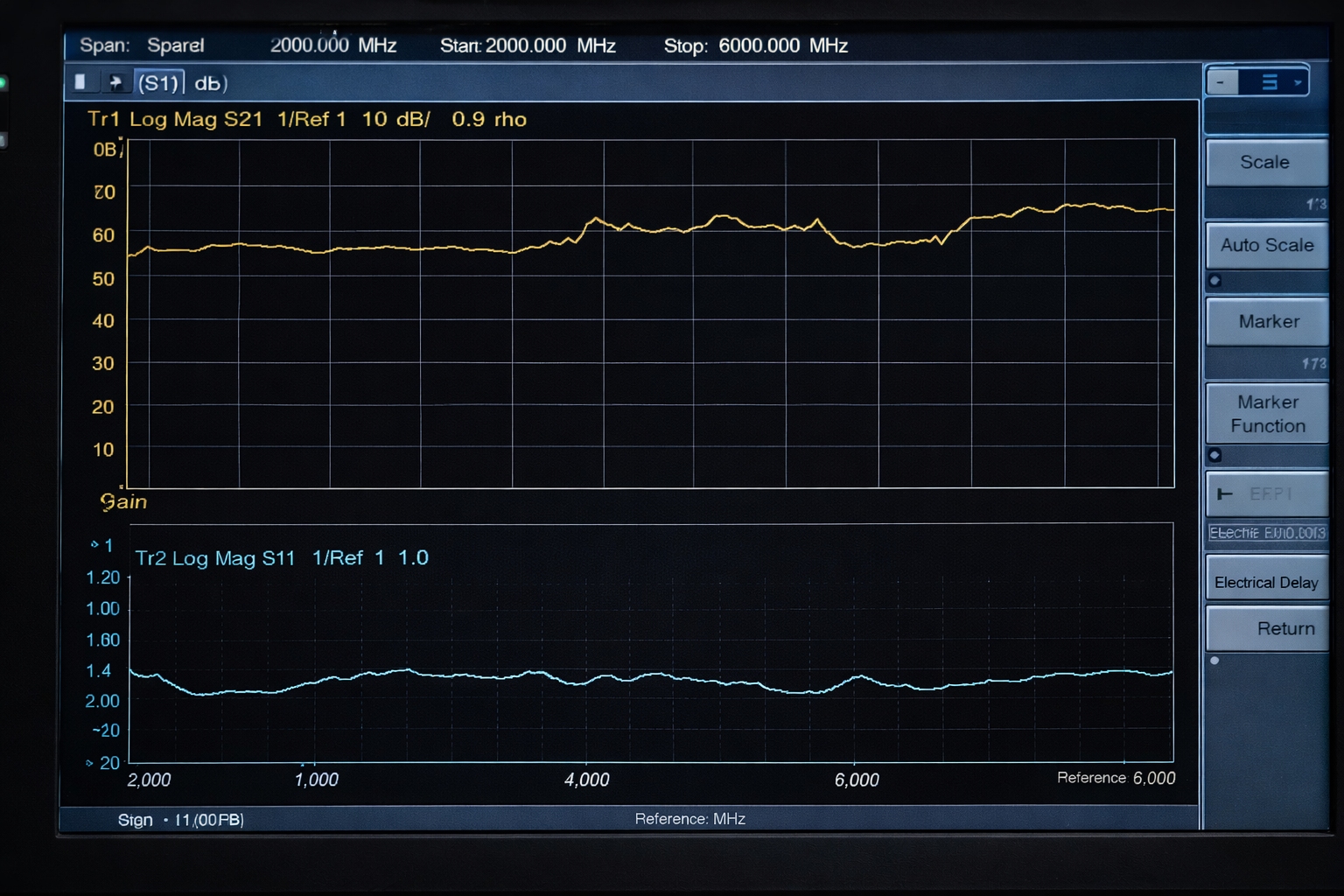
2–6 GHz Module Photo
2000 – 6000 MHz
30W · 50W · 100W · 150W · 200W
36–58 VDC ≤ 1.8 VSWR SMA / N Air Cooling

S/C-band wideband. Supply voltage varies per model (36–58V range). Use matrix filter to confirm VDC match, or contact us to discuss a version matched to your supply rail.

View 2–6 GHz Models
Standard Platform Specifications

Full Product Matrix — Standard Models

Filter by frequency band, output power, and supply voltage. All models support OEM customization. Use the "Request Datasheet" link to submit specs and receive technical documentation.

Model Freq Range (MHz) Pout (W) Pout (dBm) Pin (dBm) VSWR Harmonics VDC Imax (A) Size (mm) Weight (kg) Cooling Connector Datasheet Quote
CRF-PA-30M512M-30W 30–512 30 45±1 0–8 ≤ 1.8 ≥ 10 dBc 28 ≤ 4 125×59×21.5 ≤ 0.5 Air Cooling SMA/N Request DS RFQ
CRF-PA-30M512M-50W 30–512 50 47±1 0–8 ≤ 1.8 ≥ 10 dBc 28 ≤ 9 125×59×21.5 ≤ 0.5 Air Cooling SMA/N Request DS RFQ
CRF-PA-30M512M-100W 30–512 100 50±1 0–8 ≤ 1.8 ≥ 10 dBc 28 ≤ 18 200×158×25 ≤ 1.4 Air Cooling SMA/N Request DS RFQ
CRF-PA-30M512M-150W 30–512 150 52±1 0–8 ≤ 1.8 ≥ 10 dBc 28 ≤ 20 200×158×25 ≤ 1.4 Air Cooling SMA/N Request DS RFQ
CRF-PA-30M512M-200W 30–512 200 53±1 0–8 ≤ 1.8 ≥ 10 dBc 28 ≤ 30 200×158×25 ≤ 1.4 Air Cooling SMA/N Request DS RFQ
CRF-PA-300M1700M-30W 300–1700 30 45±1 0–8 ≤ 1.8 ≥ 10 dBc 28 ≤ 3 125×59×21.5 ≤ 0.5 Air Cooling SMA/N Request DS RFQ
CRF-PA-300M1700M-50W 300–1700 50 47±1 0–8 ≤ 1.8 ≥ 10 dBc 28 ≤ 7 125×59×21.5 ≤ 0.5 Air Cooling SMA/N Request DS RFQ
CRF-PA-300M1700M-100W 300–1700 100 50±1 0–8 ≤ 1.8 ≥ 10 dBc 28 ≤ 14 200×158×25 ≤ 1.4 Air Cooling SMA/N Request DS RFQ
CRF-PA-300M1700M-150W 300–1700 150 52±1 0–8 ≤ 1.8 ≥ 10 dBc 28 ≤ 22 200×158×25 ≤ 1.4 Air Cooling SMA/N Request DS RFQ
CRF-PA-300M1700M-200W 300–1700 200 53±1 0–8 ≤ 1.8 ≥ 10 dBc 28 ≤ 29 200×158×25 ≤ 1.4 Air Cooling SMA/N Request DS RFQ
CRF-PA-300M2700M-30W 300–2700 30 45±1 0–8 ≤ 1.8 ≥ 10 dBc 28 ≤ 4 125×59×21.5 ≤ 0.5 Air Cooling SMA/N Request DS RFQ
CRF-PA-300M2700M-50W 300–2700 50 47±1 0–8 ≤ 1.8 ≥ 10 dBc 28 ≤ 9 125×59×21.5 ≤ 0.5 Air Cooling SMA/N Request DS RFQ
CRF-PA-300M2700M-100W 300–2700 100 50±1 0–8 ≤ 1.5 ≥ 10 dBc 28 ≤ 18 200×158×25 ≤ 1.4 Air Cooling SMA/N Request DS RFQ
CRF-PA-300M2700M-150W 300–2700 150 52±1 0–8 ≤ 1.5 ≥ 10 dBc 28 ≤ 20 200×158×25 ≤ 1.4 Air Cooling SMA/N Request DS RFQ
CRF-PA-300M2700M-200W 300–2700 200 53±1 0–8 ≤ 1.8 ≥ 10 dBc 28 ≤ 36 200×158×25 ≤ 1.4 Air Cooling SMA/N Request DS RFQ
CRF-PA-2G6G-30W 2000–6000 30 45±1 0–8 ≤ 1.8 ≥ 10 dBc 36–46V ≤ 4 125×59×21.5 ≤ 0.5 Air Cooling SMA/N Request DS RFQ
CRF-PA-2G6G-50W 2000–6000 50 47±1 -1–6 ≤ 1.8 ≥ 10 dBc 40–58V ≤ 12 200×158×25 ≤ 1.4 Air Cooling SMA/N Request DS RFQ
CRF-PA-2G6G-100W 2000–6000 100 50±1 -7–6 ≤ 1.8 ≥ 10 dBc 41–51V ≤ 24 200×158×25 ≤ 1.4 Air Cooling SMA/N Request DS RFQ
CRF-PA-2G6G-150W 2000–6000 150 52±1 0–8 ≤ 1.8 ≥ 10 dBc 43–58V ≤ 27 200×158×25 ≤ 1.4 Air Cooling SMA/N Request DS RFQ
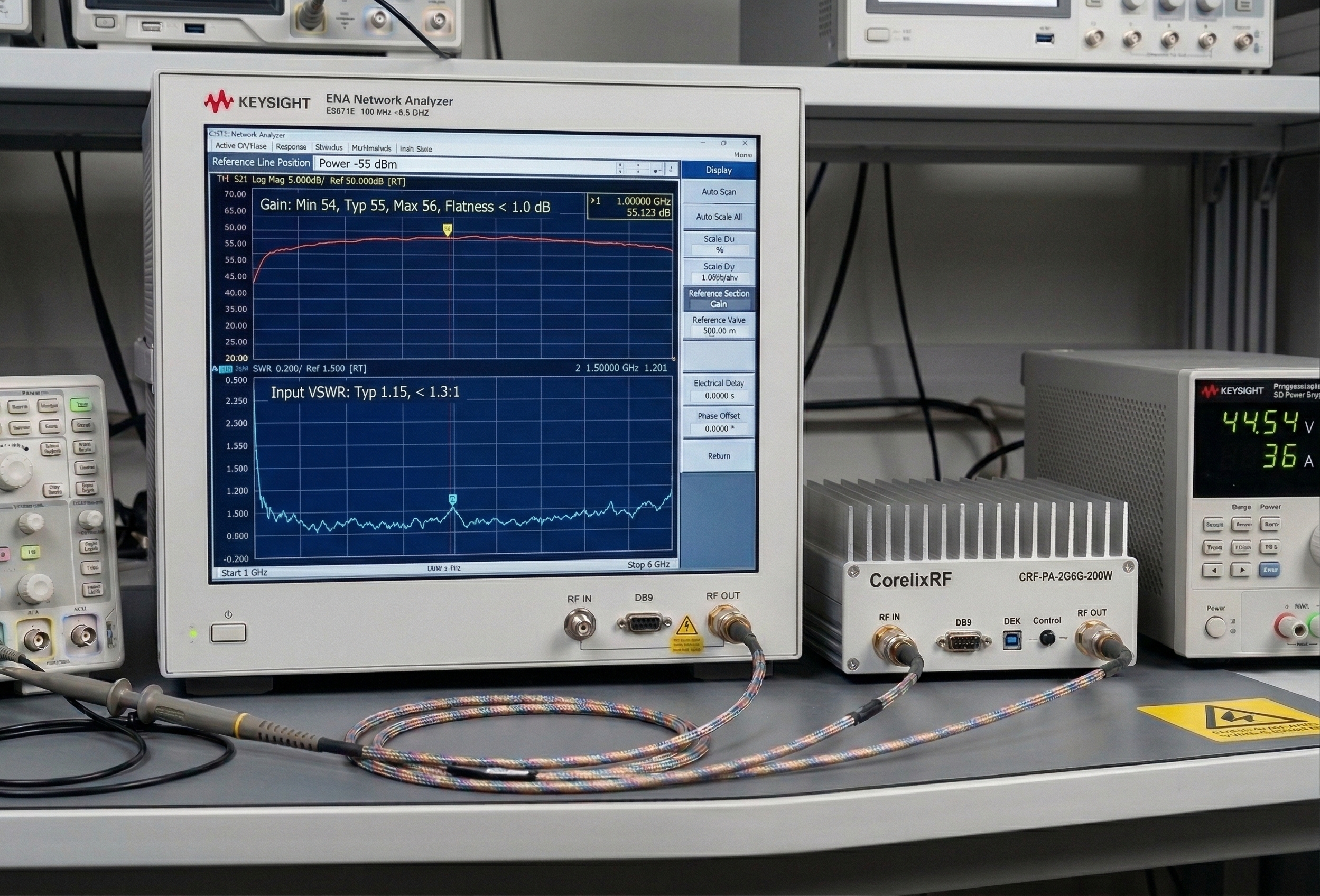
CRF-PA-2G6G-200W 2000–6000 200 53±1 0–8 ≤ 1.8 ≥ 10 dBc 44–54V ≤ 36 200×158×25 ≤ 1.4 Air Cooling SMA/N Request DS RFQ
Need different specs? All parameters in this table — frequency, power, VDC, connector, mechanical envelope — are customization options. Share your requirements and the engineering team will respond on the next business day with an architecture recommendation. Submit Custom Specs →
Why CorelixRF

Why CorelixRF Is Relevant to Your Amplifier Project

This is not a generic about-us section. These are the specific reasons CorelixRF is suited for OEM, system integration, and project-based amplifier development.
Engineering Communication, Not Sales Desks
Specs submitted to CorelixRF go to the RF engineering team — not a quoting desk, not a reseller. The people responding designed the hardware. Unusual requirements get addressed in the first response.
Manufacturing Happens In-House
Design, assembly, test, and shipment from our own facility. BOM continuity managed for our standard product families across production runs — relevant when prototype-to-production traceability is a requirement.
Standard Platforms Accelerate Custom Projects
Standard models are validated engineering baselines. A custom project starting from a proven platform has thermal modeling, gain flatness, and PA stage architecture already characterized — reducing development time.
Prototype to Production Without Surprise Gaps
Production builds are intended to match the validated prototype in BOM and process. We aim for consistent test verification and assembly across runs and raise component availability concerns before volume commitment rather than mid-production.
Thermal and Mechanical Integration Awareness
A datasheet thermal resistance figure doesn't tell you what happens at your cold plate interface. We review thermal integration at proposal stage — baseplate flatness, TIM, mounting torque — because most high-power RF field failures are thermal, not electrical.
OEM and ODM Project Handling
We have an established workflow for OEM integration projects: engineering proposal, NDA handling, prototype test data, production acceptance spec, and export documentation. We've done this repeatedly and the process is not something we're building as we go.
Test Data Available Before Commit
Sample test reports (redacted) for standard models available on request. Custom prototypes include full measurement data across the band — power, harmonic, VSWR, gain flatness — before production commitment.
GaN Technology for Reliable Wideband Performance
Our standard modules use GaN solid-state PA devices, selected for their efficiency at wideband frequencies, ruggedness under VSWR mismatch, and thermal performance at elevated junction temperatures — generally offering advantages over older GaAs MESFET or LDMOS architectures at comparable power levels.
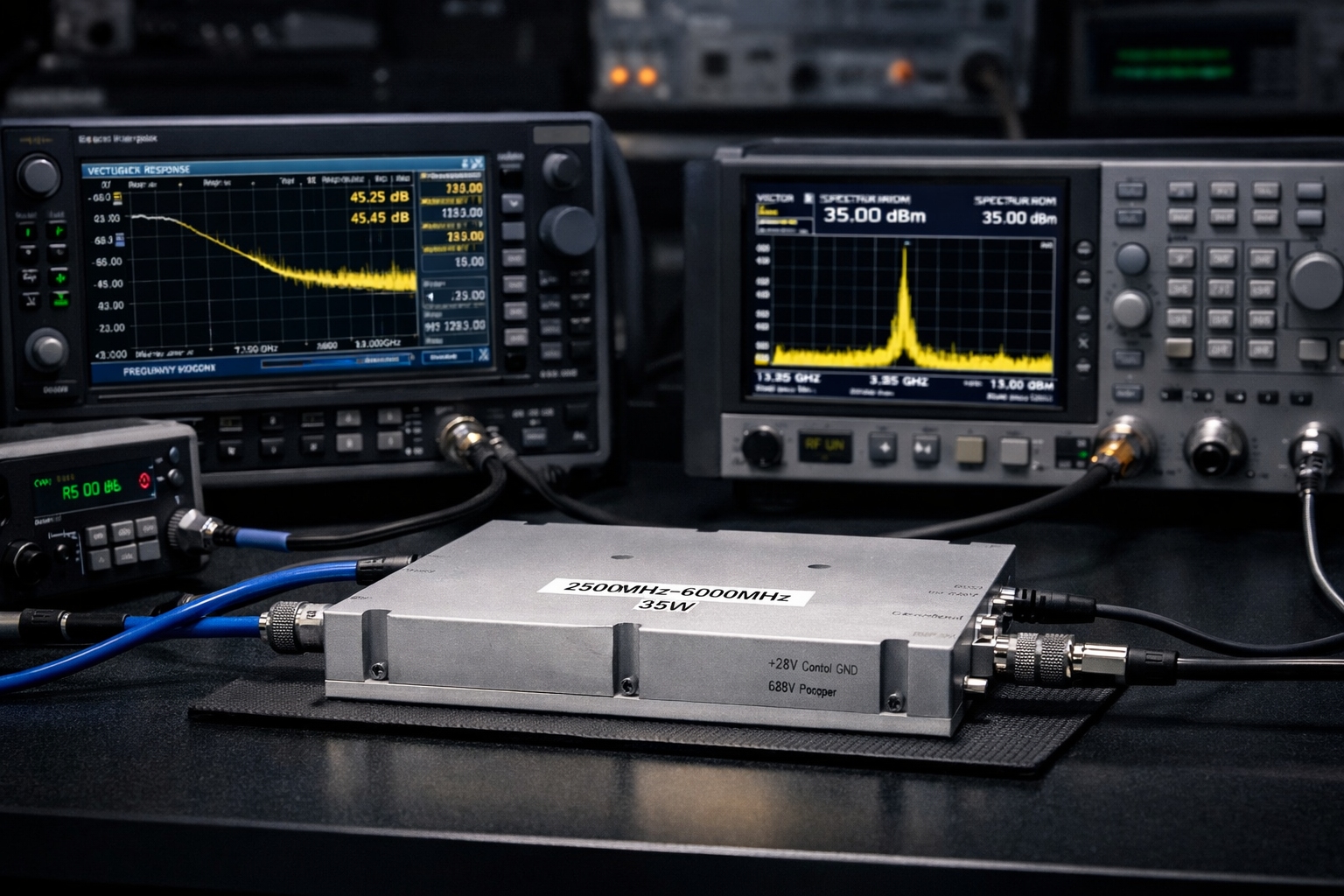
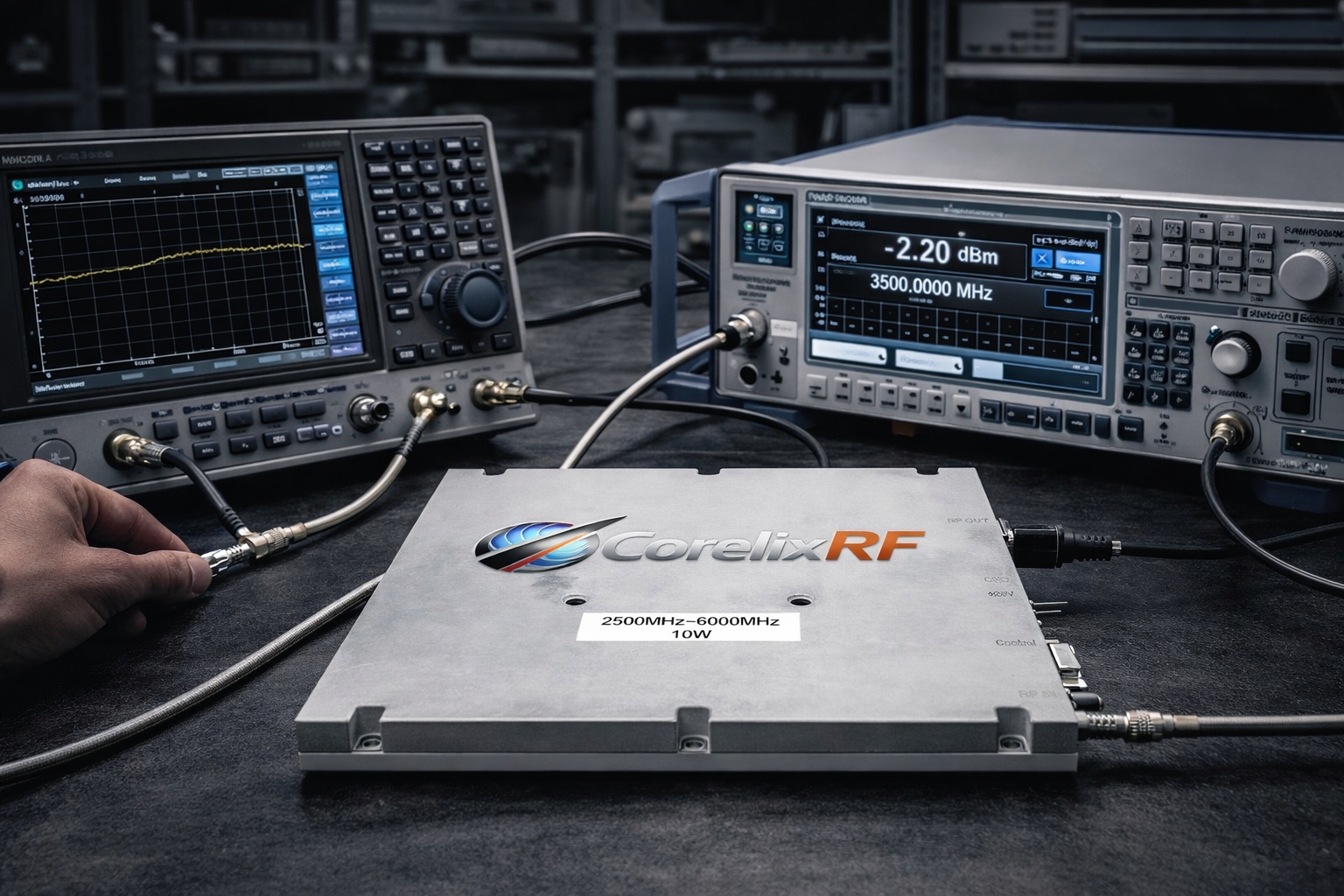
CorelixRF engineering team at RF test bench
Why CorelixRF — Main Trust Image
Suggest: test bench scene, engineering team, or assembly floor
Recommended: 1200×675 px
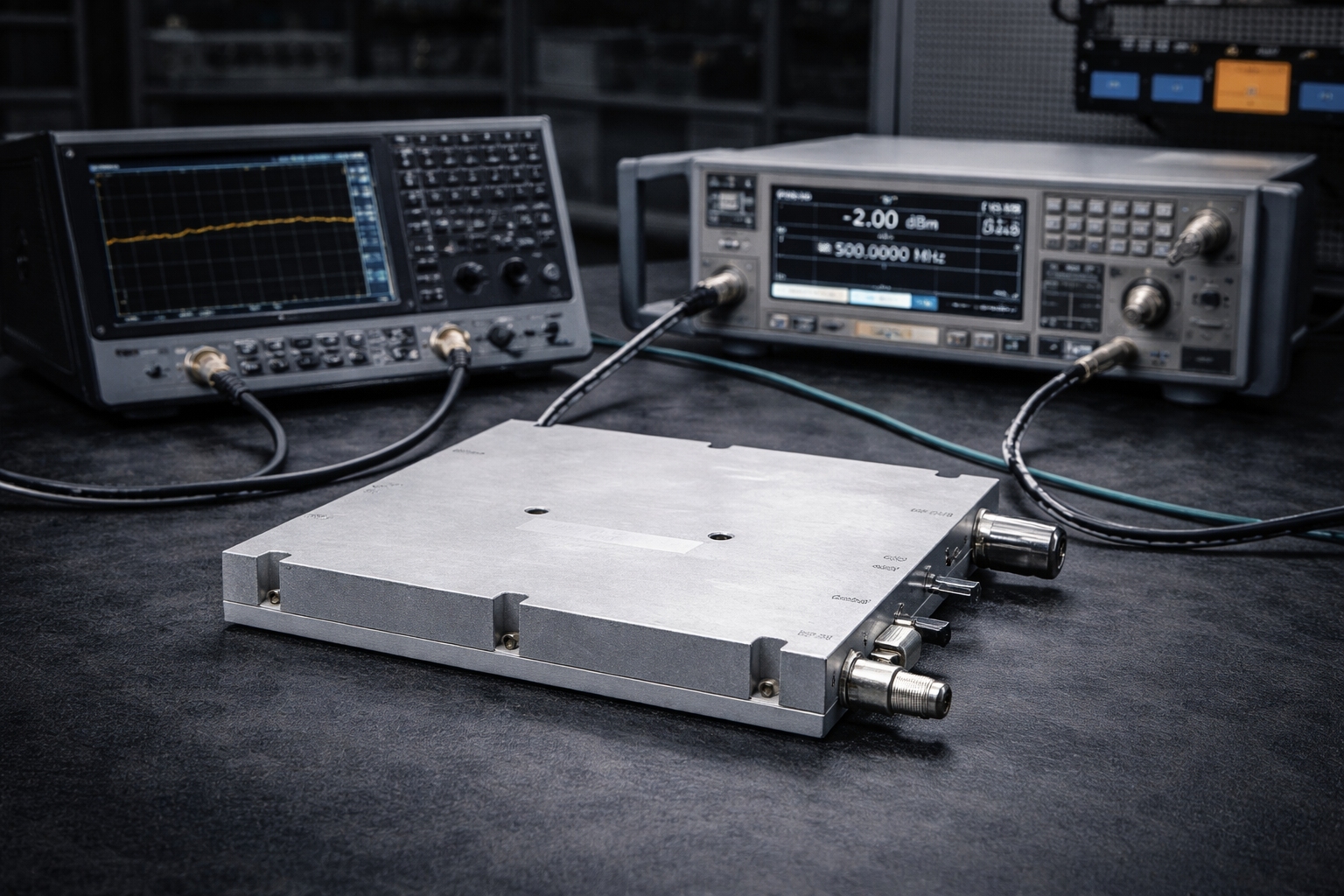
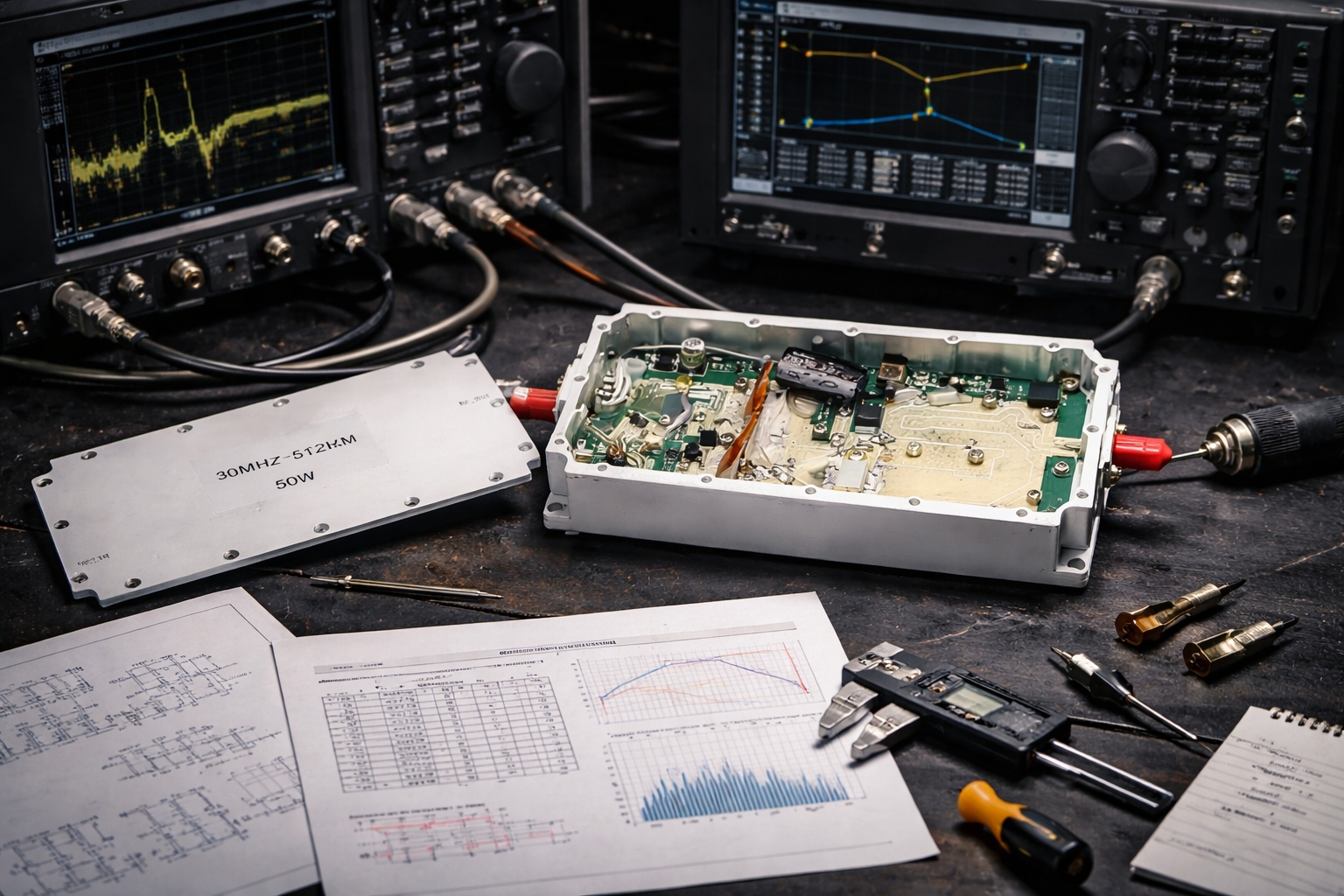
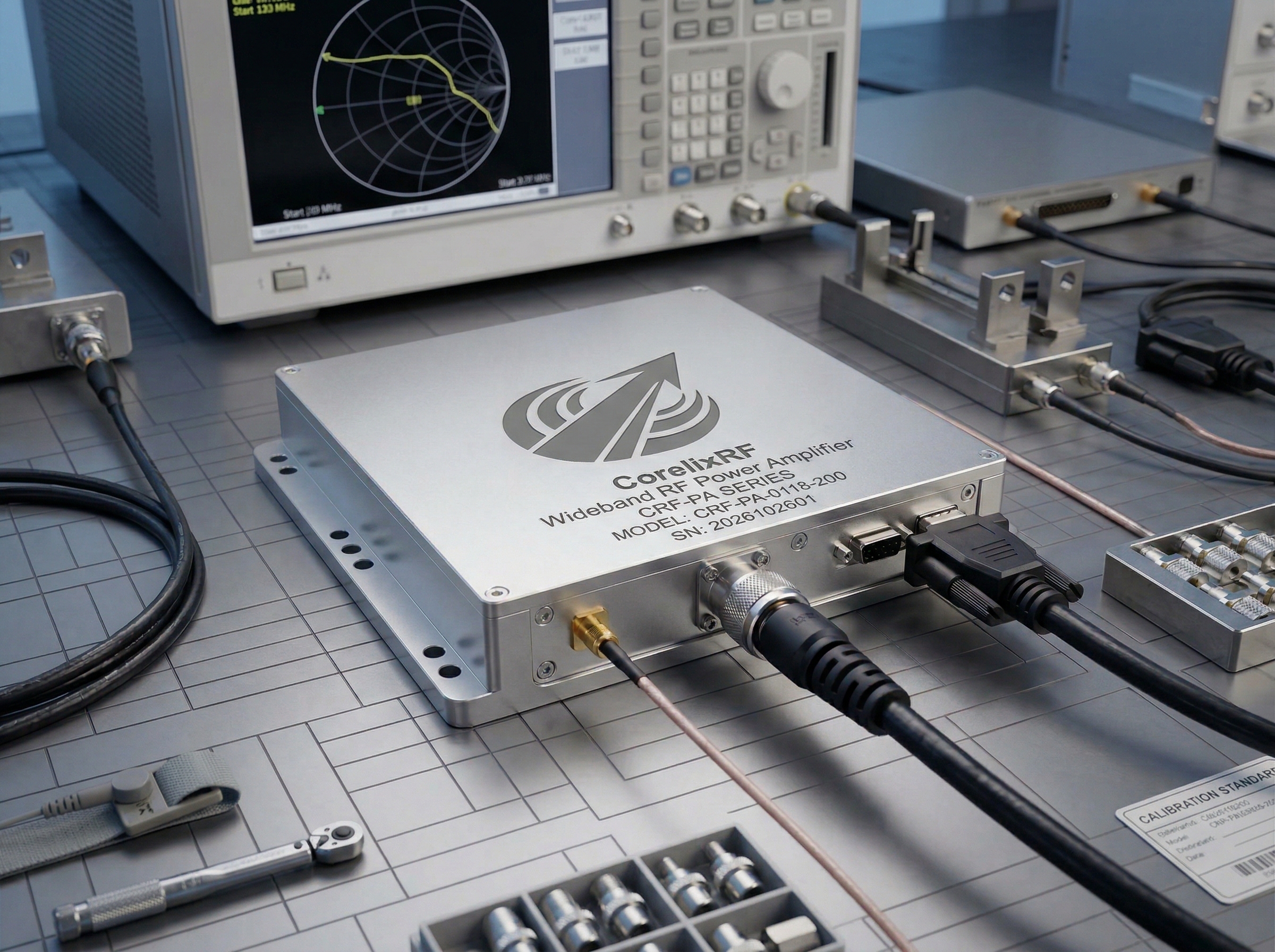
CorelixRF finished RF amplifier module
Support Image 1
Finished module / product close-up
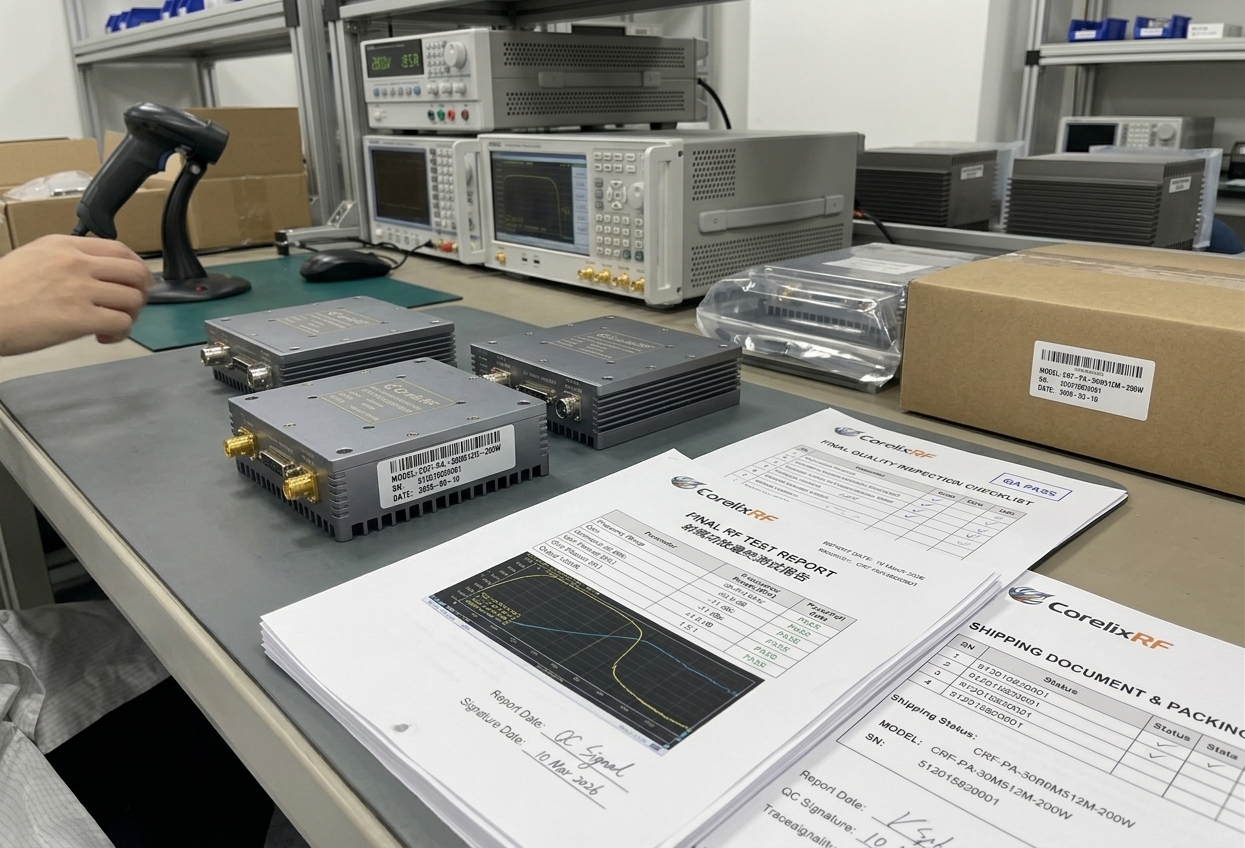
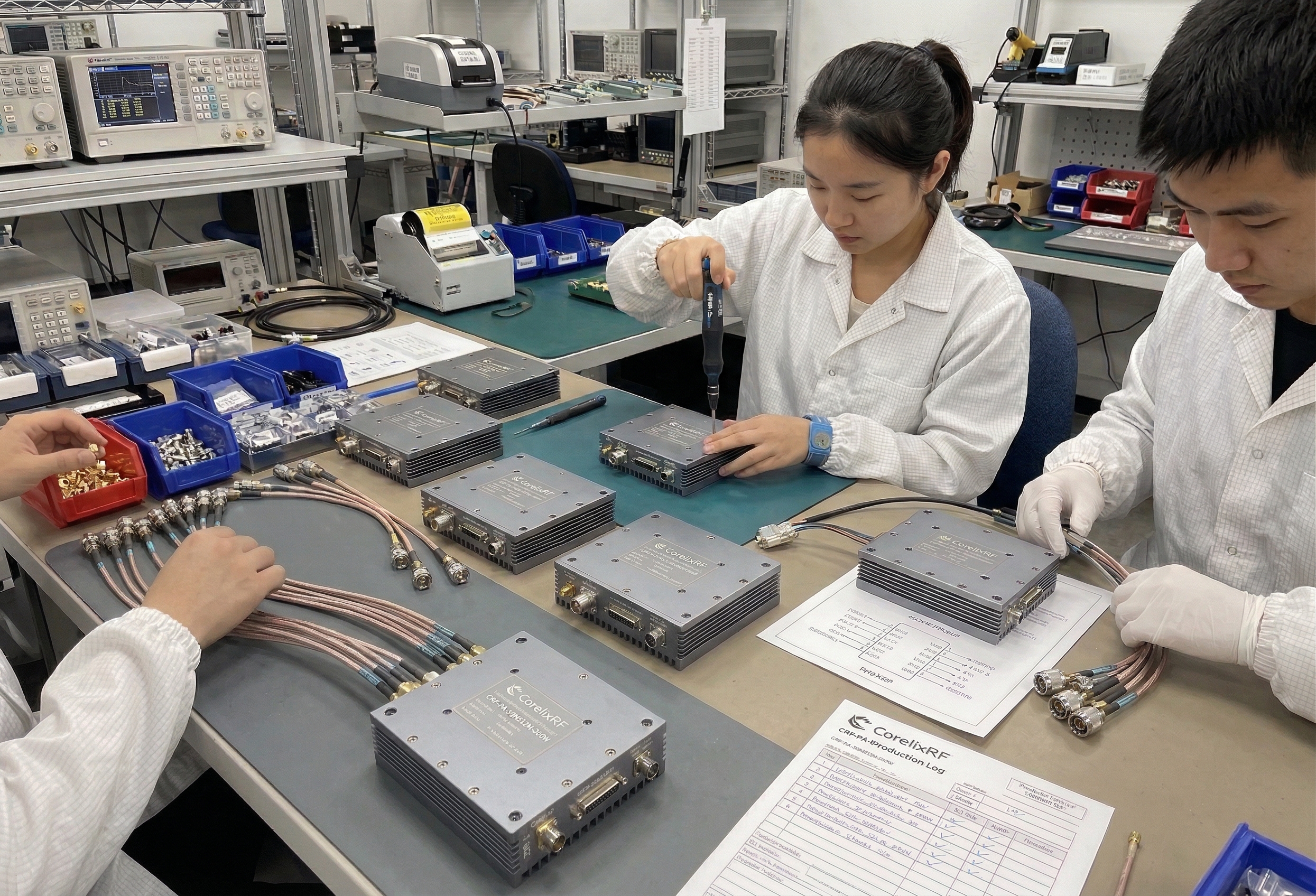
CorelixRF assembly and quality control
Support Image 2
Assembly / QC inspection scene
Engineering Validation

Validation Process That Reduces Your Procurement Risk

Test data and validation documentation exist to give buyers confidence before committing to production volume. Here's what CorelixRF provides at each stage.
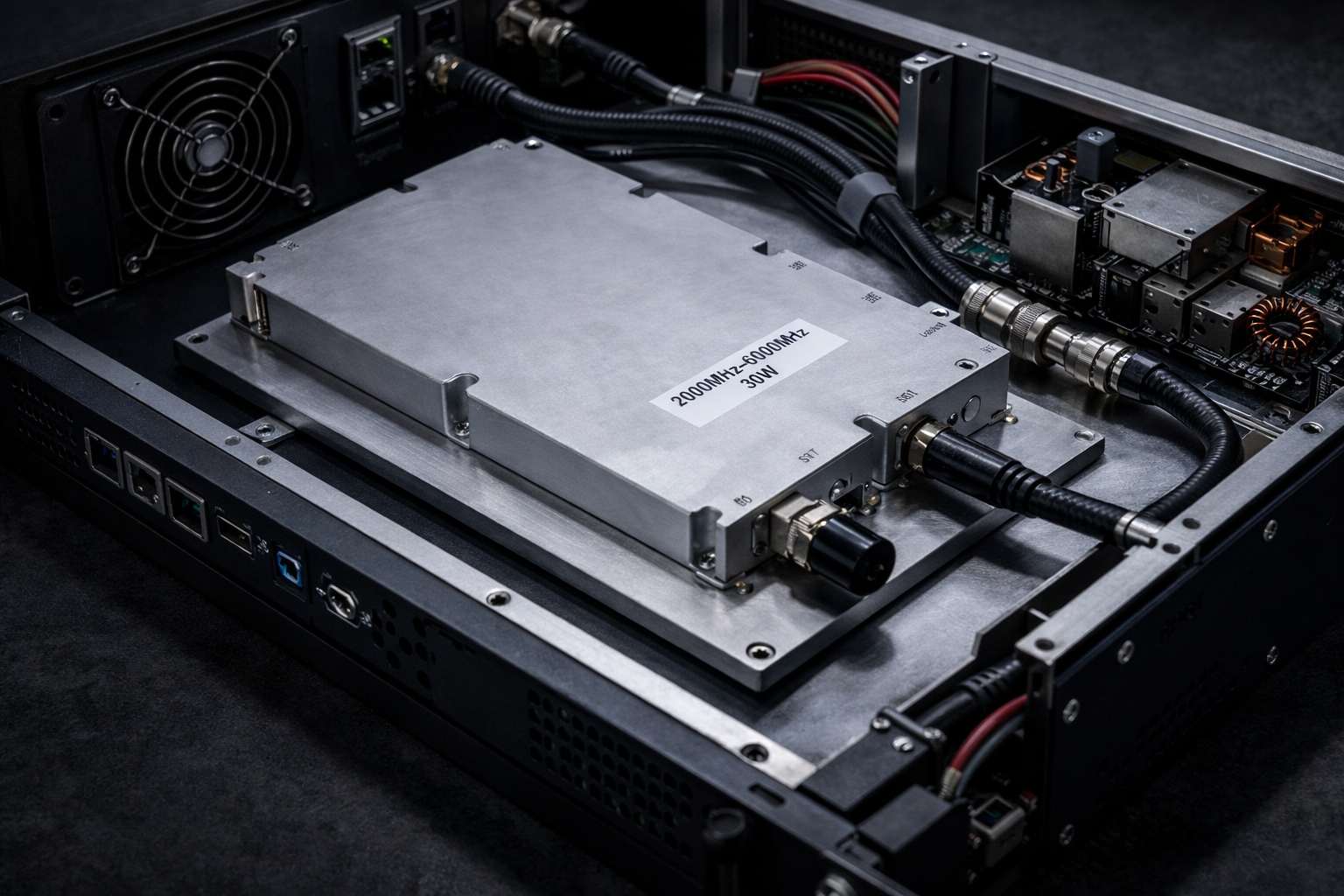
Prototype-Oriented Engineering Review
Custom project proposals include a review of RF architecture, thermal approach, and realistic performance estimates. Problems identified at proposal stage cost significantly less to address than problems found after prototype build.
Full Test Data on Custom Prototypes
Prototype deliverables include measurement data for power output, harmonic suppression, VSWR, and gain flatness across the full frequency range. You receive data, not just a working unit — so your engineering team can verify against spec before production commitment.
Thermal and Mechanical Awareness Built In
Thermal interface parameters are reviewed at the proposal stage, not left for the buyer to resolve. Baseplate flatness tolerances, TIM material guidance, and mounting recommendations are part of the technical documentation package.
Production Consistency Documentation
Burn-in screening, lot-level test data, and traceability records are available for qualifying projects. Production acceptance test specs are defined jointly with OEM customers — not applied unilaterally after the first batch ships.
Default Module Specifications
RF ConnectorSMA or N-Type
Cooling InterfaceAir Cooling
VSWR Protection≤ 1.8 Standard
Harmonic Suppression≥ 10 dBc (most)
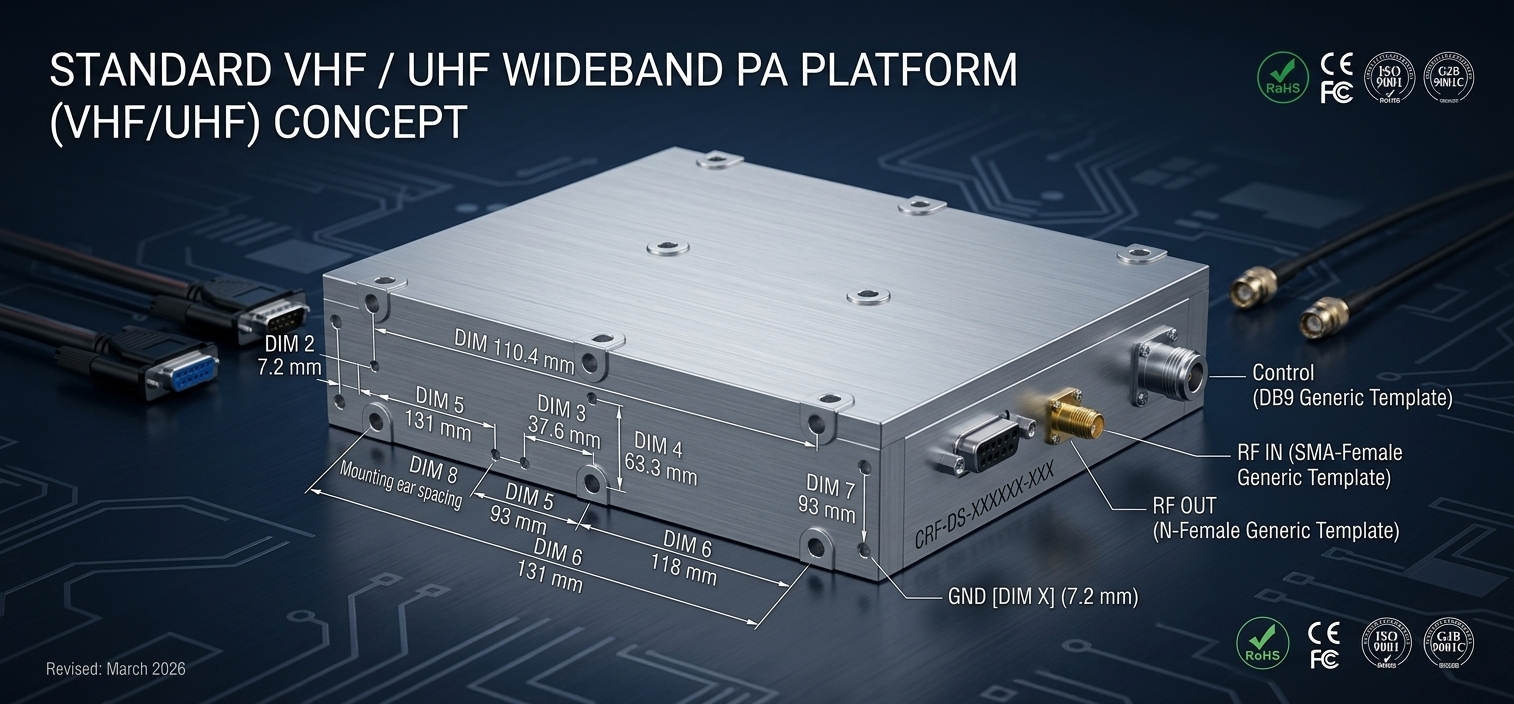
Compact Form (30–50W)125 × 59 × 21.5 mm
Standard Form (100–200W)200 × 158 × 25 mm
Primary Supply (28V bands)28 VDC
2–6 GHz Supply Range36 – 58 VDC (varies)
CustomizationOEM / ODM Available
Test DataAvailable on Request
Thermal Efficiency Index
Minimal Optimal Max
⚡ POWER SUPPLY NOTE — Size your PSU at 1.2–1.5× the rated Imax for adequate headroom. For 2–6 GHz models, confirm exact VDC requirement per model before ordering.
Application Scenarios

Projects Where CorelixRF Custom Amplifiers Are Relevant

These are the project types where custom RF power amplifier development makes engineering and commercial sense, and where CorelixRF has direct experience.
OEM RF system integration
App: OEM RF System Integration
01 // OEM INTEGRATION
OEM RF System Integration
System integrators building RF platforms often require amplifiers that fit specific chassis geometries, supply rails, and connector interfaces. Standard catalog products require mechanical workarounds that add cost and reliability risk. A purpose-built module eliminates this.
Broadband communications RF front-end
App: Broadband Communications Front-End
02 // BROADBAND COMMS
Broadband Communications Front-Ends
Wideband communications systems operating across multiple frequency allocations need amplifiers with consistent gain flatness across the band. Custom gain equalization and sub-band coverage optimization are practical engineering requirements, not special requests.
Laboratory RF spectrum testing setup
App: Lab / Spectrum Testing Equipment
03 // LAB AND TEST
Laboratory and Spectrum Testing Equipment
Test amplifiers for conducted or radiated RF work require specific frequency coverage, clean harmonic performance, and reliable gain characteristics. Repeatability and test report traceability matter — which is why test equipment builders tend to prefer factory-direct engagement over distributor supply chains.
Ruggedized electronics RF module in sealed chassis
App: Ruggedized / Harsh-Environment Electronics
04 // RUGGEDIZED ELECTRONICS
Ruggedized and Harsh-Environment Electronics
Air-cooled designs with integrated heatsink fins are suited to open-frame and ventilated enclosures. Custom mechanical and thermal specifications for air-cooled modules are a standard part of CorelixRF's development capability.
Custom RF amplifier project development
App: Project-Based Custom Development
05 // PROJECT-BASED DEVELOPMENT
Project-Based Custom Amplifier Development
Some projects need a single amplifier variant that doesn't exist anywhere in a catalog. Whether it's an unusual frequency split, a non-standard power level, or integration constraints that rule out commercial off-the-shelf options, we engage with these requirements directly.
Integration-constrained RF platform
App: Integration-Constrained RF Platform
06 // INTEGRATION-CONSTRAINED
Integration-Constrained RF Platforms
Platforms where space, weight, or thermal budget constraints rule out standard amplifier modules. Custom form-factor development — reduced height, modified baseplate, relocated connectors — is available as part of OEM project scope.
Procurement Guidance

Common RF Amplifier Procurement Mistakes — And How to Avoid Them

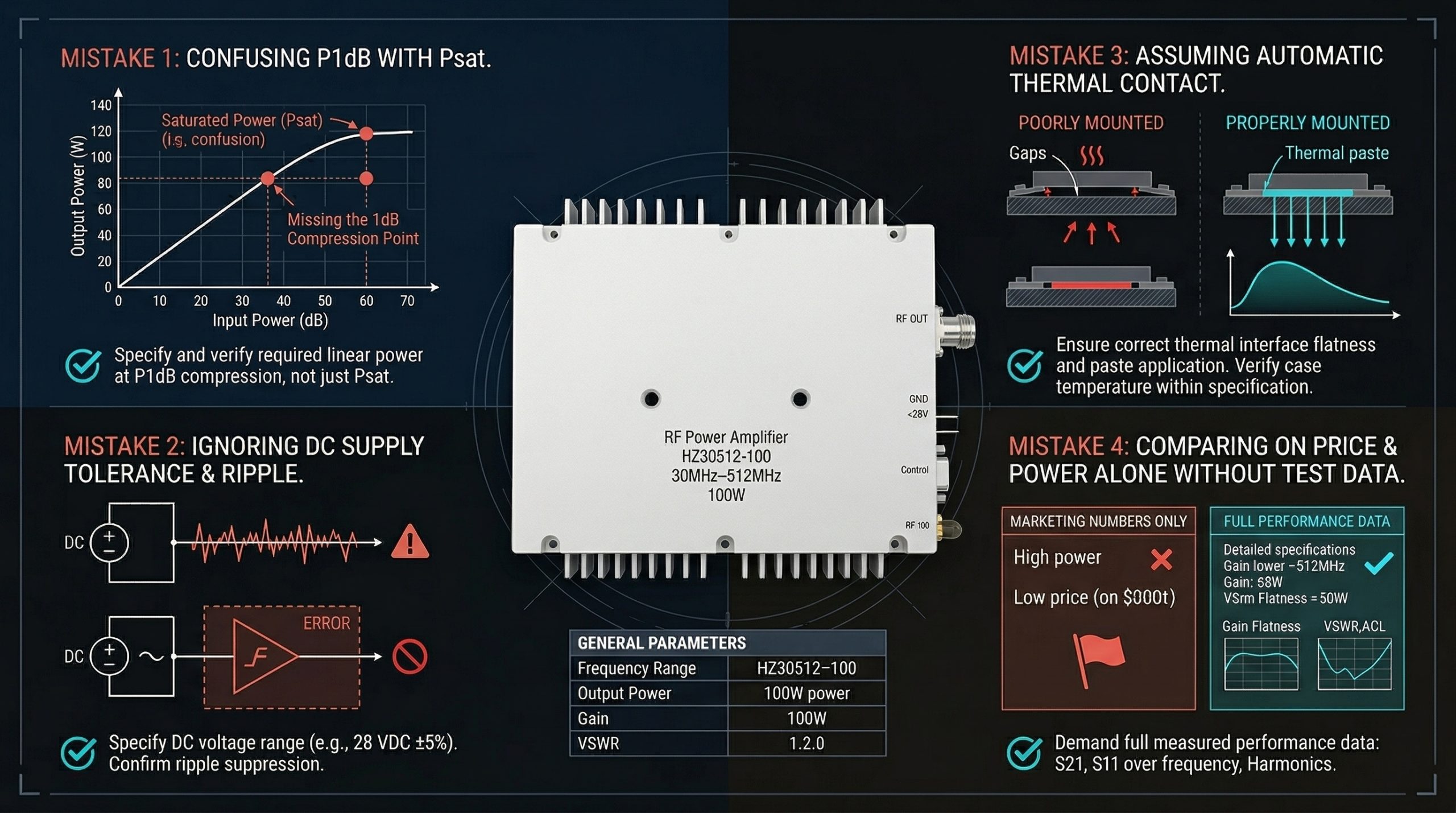
These mistakes are worth knowing about before you place a first order or commit to a supplier. They're not obvious from a datasheet, but they affect project outcomes consistently.
RF amplifier procurement checklist or Psat vs P1dB diagram
Procurement Pitfalls Visual
Suggest: Psat vs P1dB curve diagram, or procurement checklist infographic
Keep minimal — support role only
PITFALL 01 // SPECS
Confusing Psat with P1dB
Psat is the saturated output ceiling. P1dB is the boundary of linear operation — gain compressed by 1 dB. Specifying Psat for a linear system, or comparing P1dB from one vendor against Psat from another, produces incorrect power budget assumptions and unexpected distortion.
PITFALL 02 // SUPPLY
Ignoring Supply Voltage Tolerance and Ripple
RF amplifier power stages are sensitive to supply ripple and voltage droop under load. A PSU that delivers nominal voltage at idle but droops 3V under peak current demand will cause amplitude modulation and spectral regrowth. Size your PSU at 1.2–1.5× Imax and specify adequate output capacitance. High ripple on the supply rail degrades output spectral quality.
PITFALL 03 // THERMAL
Assuming Thermal Contact Is Automatic
Proper surface contact is essential. Uneven cold plates, inadequate thermal interface material, or insufficient mounting torque all increase contact resistance. Most RF amplifier failures in fielded systems are thermal — with root cause at the baseplate-to-chassis interface.
PITFALL 04 // EVALUATION
Comparing on Price and Power Alone
Same frequency and power rating doesn't mean equivalent performance. Gain flatness, harmonic profile, VSWR sensitivity, and production consistency vary significantly. Request test data for the parameters that matter to your integration before comparing vendors.
PITFALL 05 // VALIDATION
Skipping Prototype Validation Before Production Commitment
Prototype validation costs a fraction of a non-conforming production batch. For custom development or a first buy, a prototype stage with complete test data significantly reduces production risk. Rework or scrap costs almost always exceed the prototype investment.
PITFALL 06 // SUPPLY CHAIN
No Visibility Into Production Supply Chain
Distributors may not control BOM or component sourcing. Mid-run component substitutions without engineering review happen. Buying direct from the manufacturer eliminates this risk for repeat orders.
Manufacturing and Delivery

Factory-Direct Manufacturing and Reliable Export Delivery

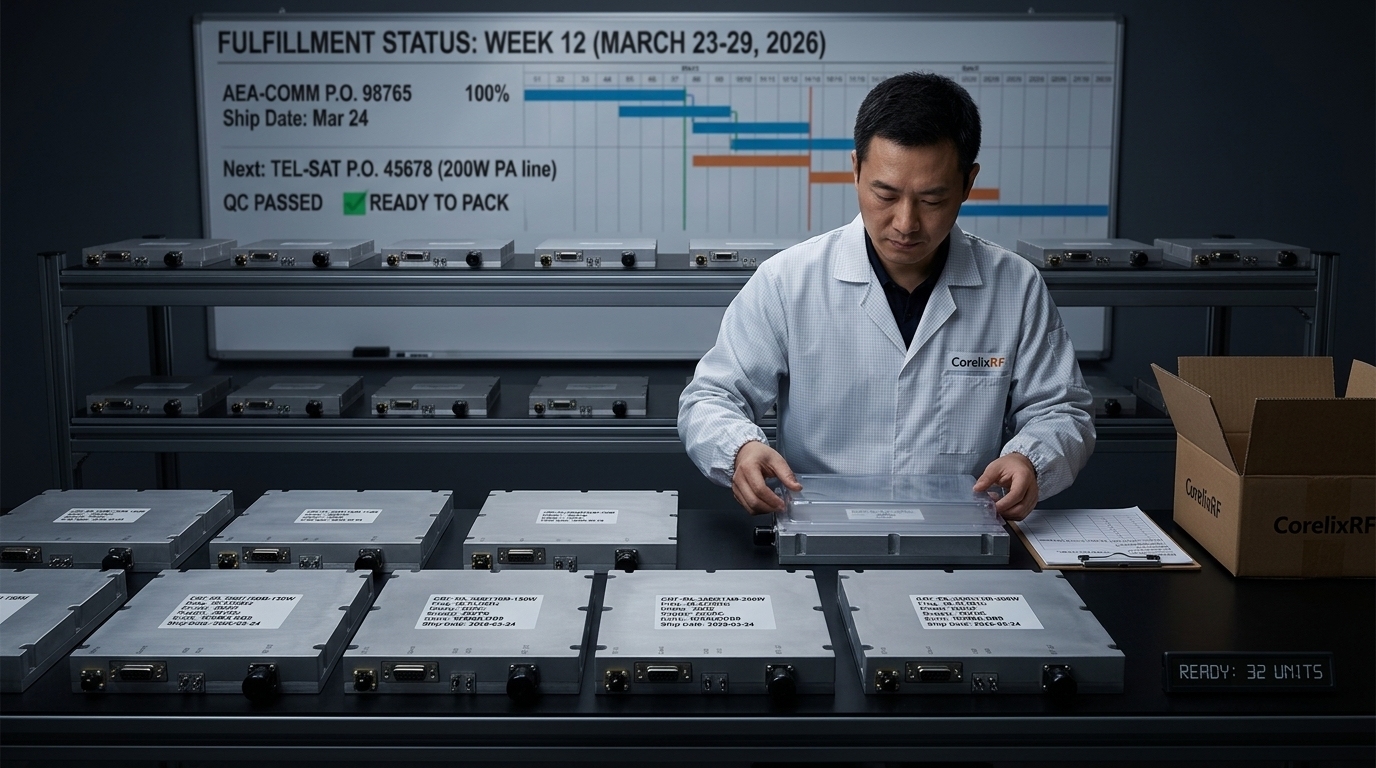
CorelixRF manufactures, assembles, tests, and ships from our own facility. This section covers the operational side of what we can deliver.
CorelixRF manufacturing workshop floor
Factory Workshop / Production Floor
In-House Manufacturing
Design, assembly, and test under one roof. No third-party subcontractors for core PA module production. Consistent process control from prototype to volume production.
RF module assembly process
Assembly / Production Process
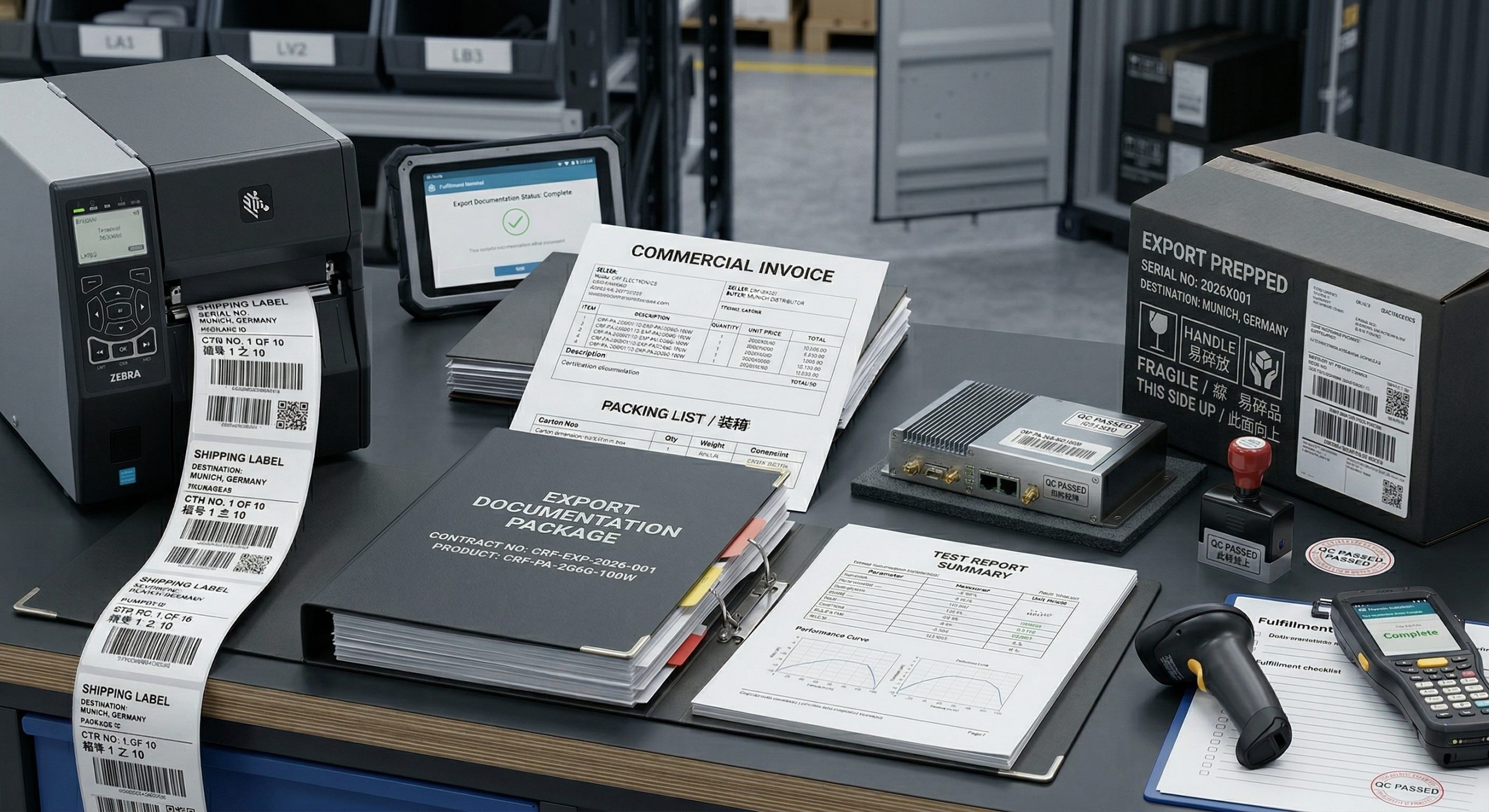
Export-Ready Documentation
Commercial invoice, packing list, test reports, and compliance documentation prepared to standard export requirements. Export experience with buyers in North America, Europe, Middle East, and Asia-Pacific.
RF module protective packaging
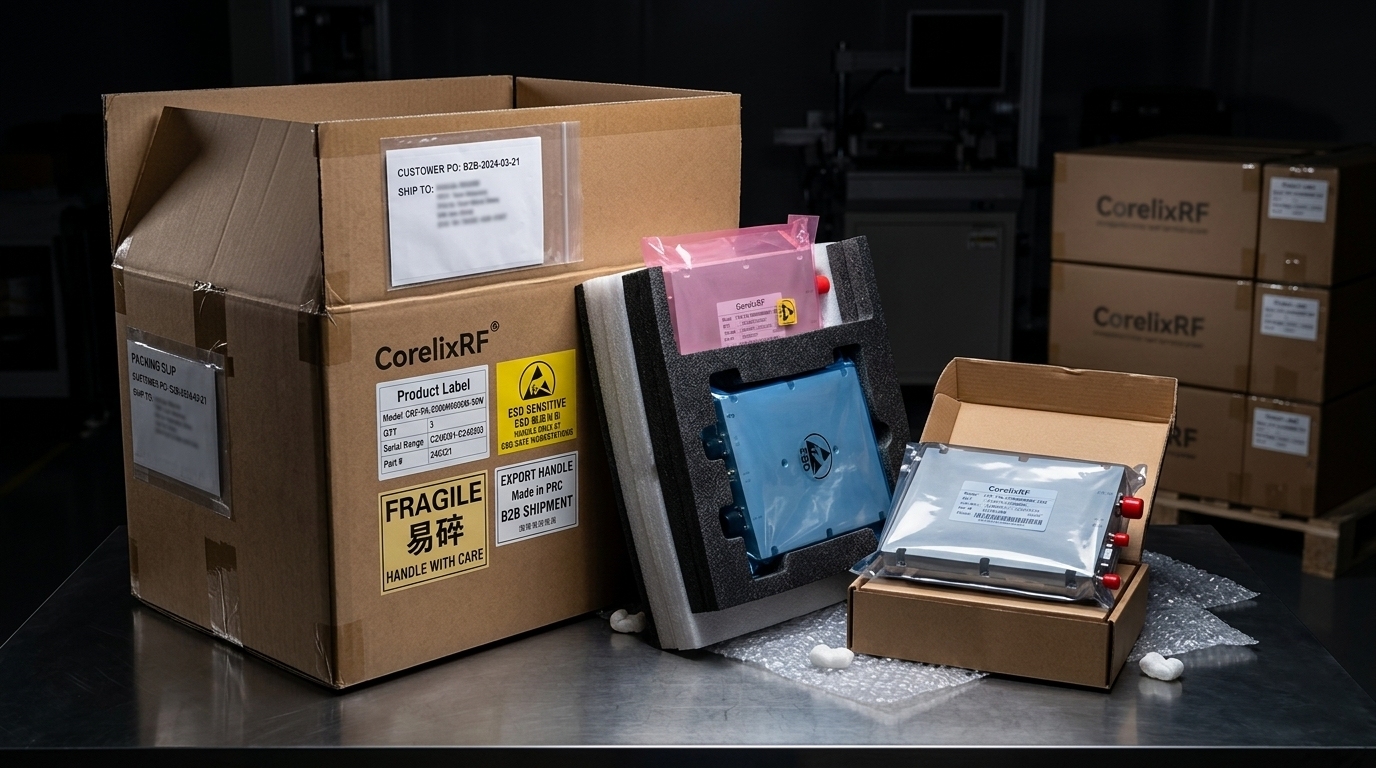
Protective Packaging / ESD Pack
Protective Packaging
RF modules shipped in ESD-protective, mechanically secure packaging. Connector protection caps included as standard. Custom labeling and packaging specifications available for OEM projects.
Export shipment ready for delivery
Shipment / Export Logistics
Lead Time Transparency
Lead times for standard models and custom projects communicated clearly at quotation stage. Production capacity planning discussed openly for volume buyers. No bait-and-switch on lead time after order confirmation.
Quality System

Quality System and Documentation Support

Certifications are the floor, not the ceiling. What matters is how the quality system supports OEM project handling and documentation requirements.

ISO 9001 quality management certificate
Cert Thumbnail 1
ISO 9001 Certificate
CERTIFICATION
ISO 9001 Quality Management
Manufacturing processes operate under an ISO 9001-certified quality management system. Production records, non-conformance handling, and corrective action procedures are documented and auditable.
RF amplifier test data and traceability records
Cert Thumbnail 2
Test Report / Traceability Record
DOCUMENTATION
Test Data and Traceability
Production acceptance test reports are available at lot level for qualifying OEM customers. Traceability records maintained per production batch. Custom documentation formats supported for OEM integration packages.
NDA and quality system documentation
Cert Thumbnail 3 / QS Support
NDA / Confidential Documentation
OEM PROJECT HANDLING
NDA and Confidentiality
Non-disclosure agreements available at the inquiry stage for custom development projects. Customer-specific designs and specifications are treated as proprietary and not shared with third parties.
Engineering FAQ

Questions Engineers and Procurement Buyers Actually Ask

Straight answers on the specification and procurement questions that affect integration decisions.

What's the difference between Psat and P1dB, and which should I specify?
P1dB is the output level at which gain compresses by 1 dB — it defines the boundary of linear operation. Psat is the saturated output level where the amplifier cannot produce more power regardless of drive level. For linear systems (communications, low-distortion applications), specify P1dB. For pulsed or saturation-mode applications, specify Psat. Most CorelixRF standard models are rated at Psat (±1 dBm). P1dB data is available on request with your RFQ.
How do I determine whether I need a standard or custom amplifier?
Start with the standard platform matrix. If your frequency band, power level, and supply voltage all match a standard model, and the mechanical envelope fits your chassis, a standard model is the faster and lower-risk path. If any of those parameters don't match, or if you have specific connector, thermal, or documentation requirements, a custom development conversation is warranted. We can help evaluate which path makes more sense once we see your requirements.
What do you need from me to provide an accurate quotation?
For a standard model: frequency range, output power (W), supply voltage, quantity, and target delivery date — that's sufficient for pricing and lead time. For custom development, also include: operating mode (CW or pulsed), input drive level, gain flatness requirements, mechanical size constraints, connector preference, and whether this is for prototype evaluation or production volume. Rough specs are fine as a starting point.
How do I size my power supply for a CorelixRF module?
Size your PSU at 1.2–1.5× the rated Imax in the matrix. This accounts for inrush current at enable, thermal variation, and supply ripple effects. For 28V models, a well-regulated 28V supply is standard. For 2–6 GHz models, the supply voltage range varies per model (36–58V) — confirm the exact VDC requirement from the matrix before ordering. High ripple on the supply rail degrades output spectral quality and can cause gain compression artifacts.
How does the air-cooled module integrate with my system?
All standard models use air cooling via an integrated heatsink. Ensure adequate airflow around the module (recommend ≥ 1 m/s forced air for 100–200W models at full CW output). For 100–200W modules, the heatsink fin geometry and airflow direction are shown on the mechanical outline drawing. Custom thermal solutions — including heatsink modifications and connector repositioning — are available on OEM builds.
Can you provide test data before production commitment?
Yes. Sample test reports (redacted lot data) for standard models are available on request with your RFQ. For custom development projects, the prototype deliverable includes a complete test data package covering power, harmonic, VSWR, and gain flatness across the frequency range. For volume production, acceptance test specs and lot sampling plans are defined jointly with the buyer before production commitment.
Why does the 2–6 GHz series have different supply voltages per model?
Wideband S/C-band PA designs at different power tiers require different supply optimization for efficiency and thermal performance. The 36–58V range across the 2–6 GHz family reflects each model's specific PA stage architecture and GaN device operating point. Use the matrix VDC column to filter by your available supply rail — or contact us to discuss a custom version designed to match your specific supply voltage.
What is included in the OEM / custom development scope?
Custom development scope typically covers: engineering proposal with architecture and thermal approach, NDA handling, prototype build with full test data package, iteration cycle if required, production qualification, acceptance test spec definition, and volume production delivery. We have an established workflow for this — it's not assembled case-by-case. The scope and timeline are defined at proposal stage, not discovered as the project progresses.
Direct Engineering Contact

Talk Directly to Engineering

Your specifications go directly to the CorelixRF RF engineering team. Not a quoting desk. Not a reseller. The people who respond design and build these modules. Engineering reply typically on the next business day.

Submit Technical Specifications
Tell us what your project requires. Even rough specifications are a sufficient starting point. All submissions are treated as strictly confidential.
Engineering reply typically on the next business day. All submissions treated as strictly confidential. NDA available on request.
What to Include in Your Submission
01
Frequency Range (Start / Stop)
Even approximate — we can recommend the best-fit standard band or propose a custom split.
02
Output Power Target (W) and Operating Mode
CW or pulsed. If pulsed, duty cycle and PRF if known. Whether Psat or P1dB is the operative spec.
03
Supply Voltage and Current Budget
Especially important for 2–6 GHz projects where VDC varies significantly by model.
04
Mechanical and Thermal Constraints
Size envelope, connector type and position, mounting method, cold plate interface requirements.
05
Quantity and Target Delivery
Prototype evaluation vs. production volume affects lead time, pricing structure, and scope of test data package.
// CorelixRF Commitment
Engineering reply typically on the next business day
You speak directly to the design team — not a reseller
Sample test reports available on request
OEM / ODM from prototype through production
NDA available. All submissions treated as confidential.
ISO 9001 certified manufacturing process
30 years of RF manufacturing experience
Submit Specs