
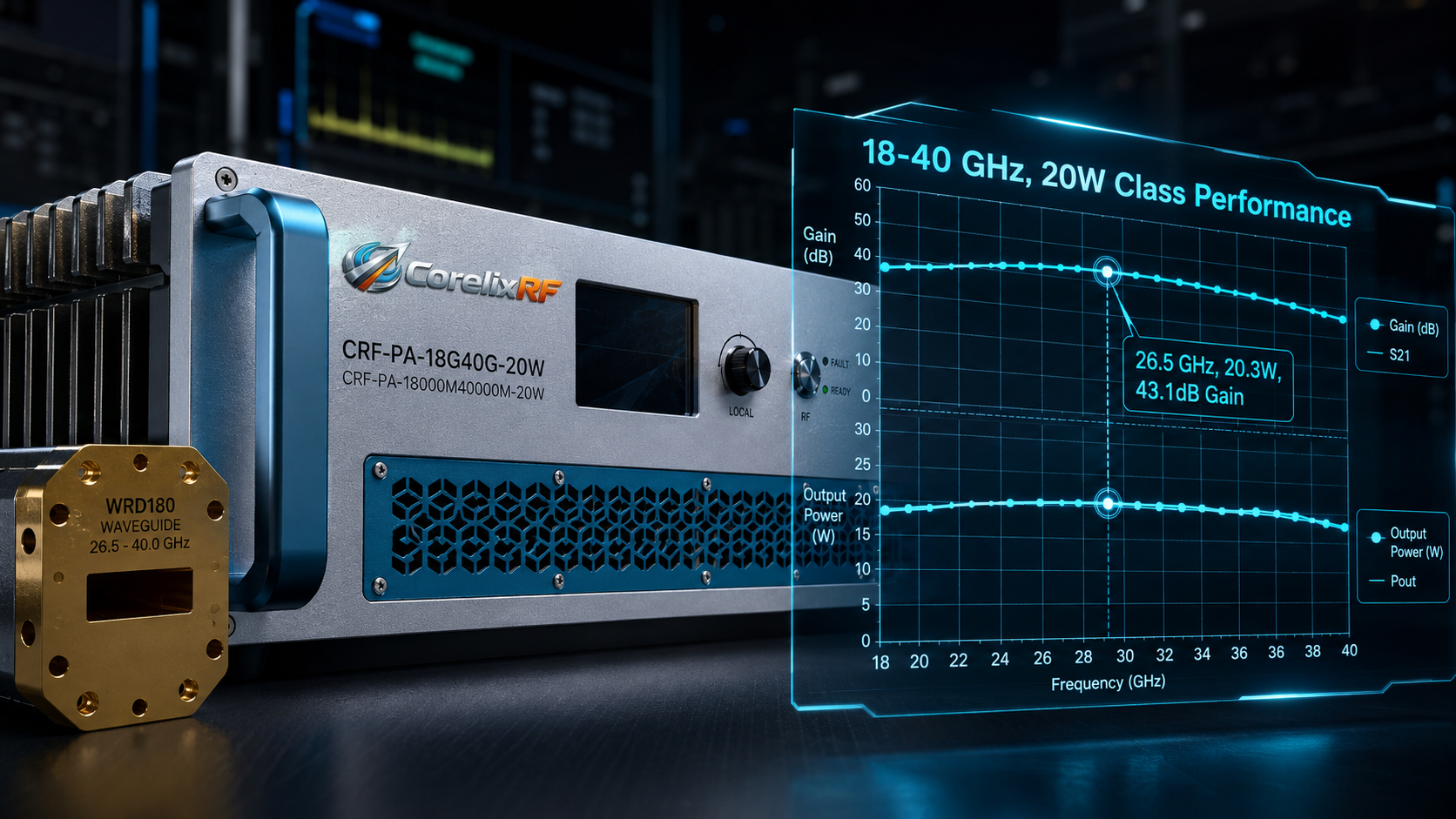
The CRF-PA-18000M40000M-20W is a CorelixRF 18-40 GHz standard model class for engineers who need a 20 W millimeter-wave RF amplifier starting point. It is listed on CorelixRF’s 18-40 GHz RF power amplifier page as a 20 W class with 43 dB gain, WRD180 RF output, and 19-inch 3U enclosure format.
The page identifies its best-fit use as mmWave communication testing, medium-power RF validation, and broadband RF chain evaluation.
This is a more precise article angle than a generic microwave guide. The model name, frequency span, output class, gain class, output interface, and enclosure format give engineering buyers a concrete path for RFQ discussions.
Why 18-40 GHz Selection Needs Model-Level Review
At 18-40 GHz, amplifier selection becomes sensitive to details that can be secondary at lower frequencies. Connector loss, waveguide transitions, gain behavior, rack airflow, test setup, and measurement uncertainty can all affect the actual delivered power. CorelixRF’s 18-40 GHz page warns that output power is only one part of the decision and that connector path, control interface, cooling method, and rack configuration should be confirmed before quotation.
The CRF-PA-18000M40000M-20W sits above the low-power 5 W class and below the 40 W and 70 W classes. That can make it a practical choice for medium-power validation where a compact 3U rack format is desirable but the 5 W class is not enough.
Interface Planning: WRD180 Output
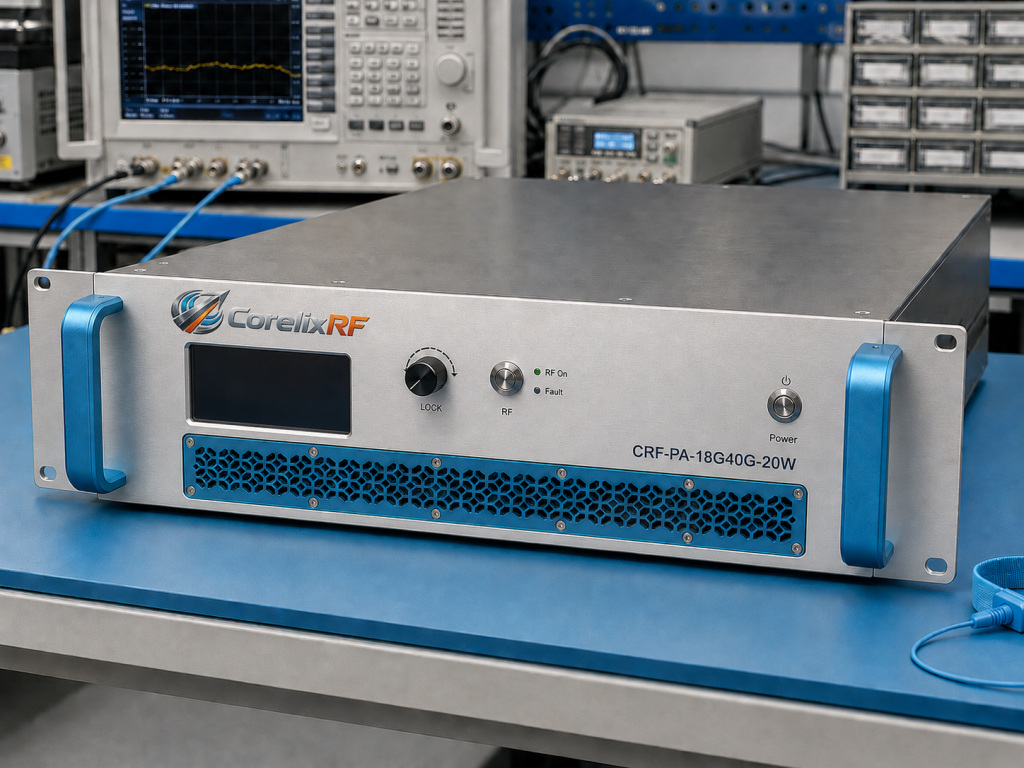
CorelixRF publicly lists WRD180 as the RF output path for the 20 W model class. That immediately makes interface planning part of the selection process. The RF input, waveguide output, adapters, couplers, loads, and measurement equipment must all be reviewed together. A mismatch or transition issue can reduce delivered power and create confusing test results.
When sending an RFQ, include the intended output interface path, load type, cable or waveguide plan, measurement method, and whether the amplifier will be integrated into a rack test system or used on a bench.
Gain and Broadband Behavior
The page lists 43 dB gain for the 20 W class. For broadband 18-40 GHz work, the headline gain value should be followed by a request for frequency-dependent behavior. Engineers should ask how gain and output power vary across the target band, especially if the system will sweep a wide frequency range.
If the project only needs a focused sub-band, CorelixRF states that custom frequency window review is available. A focused configuration may be more appropriate than full-band 18-40 GHz operation when the test requirement is narrower.
Rack, Cooling, and Control Interface
The CRF-PA-18000M40000M-20W is listed as a 19-inch 3U enclosure class. That helps integration teams plan rack space early. However, rack height alone does not answer airflow, control, alarm, or service-access questions. CorelixRF lists RS485 / LAN / GPIB options for the 18-40 GHz platform, and final control interface can vary by project.
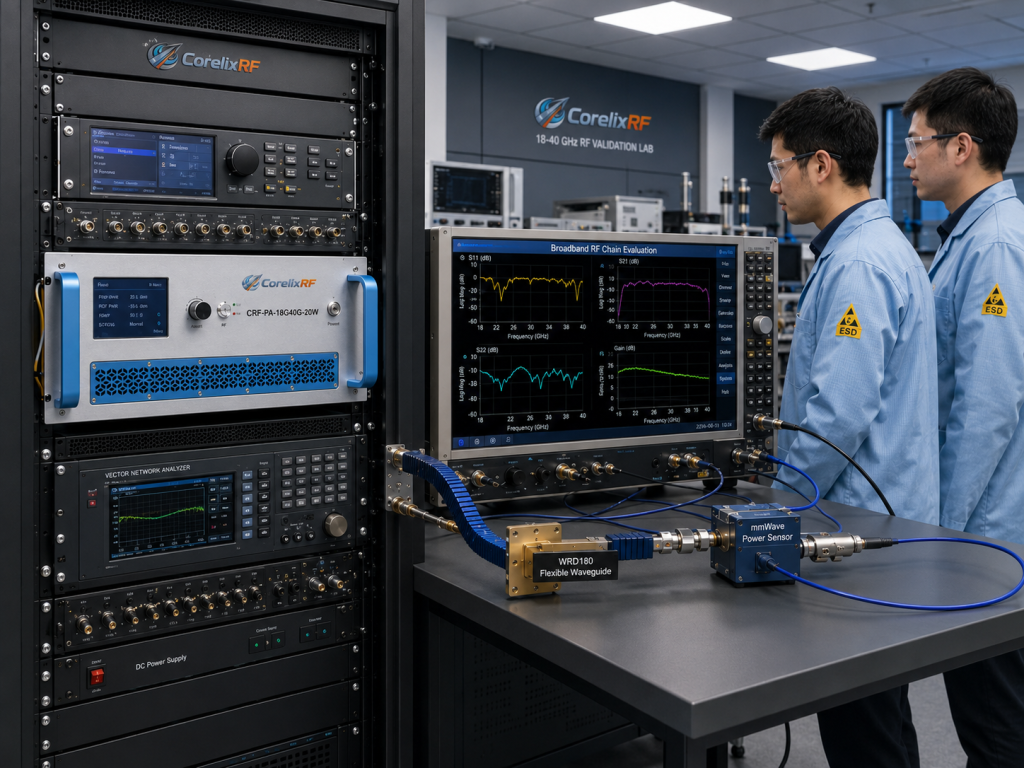
If the amplifier will be part of automated test equipment, include remote-control expectations, monitoring requirements, interlock needs, and alarm handling in the RFQ. If it will run for long sessions, include duty cycle, ambient temperature, and rack airflow conditions.
Best-Fit Applications
CorelixRF describes this model class as suitable for mmWave communication testing, medium-power RF validation, and broadband RF chain evaluation. It can also be relevant to high-frequency module testing and front-end evaluation when the target band overlaps 18-40 GHz. For lower-power driver-stage validation, compare the 5 W class. For higher-power rack testing, compare the 40 W or 70 W classes on the same 18-40 GHz amplifier page.
For broader mmWave programs outside this range, use the millimeter-wave amplifier path.
For company-level capability context, review high frequency capability and manufacturing and engineering.
FAQ
What is the CRF-PA-18000M40000M-20W?
It is an 18-40 GHz, 20 W standard model class in CorelixRF’s CRF-PA-18000M40000M series, publicly listed with 43 dB gain, WRD180 output, and 19-inch 3U enclosure format.
What is it best used for?
CorelixRF lists it for mmWave communication testing, medium-power RF validation, and broadband RF chain evaluation.
Why does WRD180 output matter?
The output interface affects delivered power, measurement setup, load matching, rack integration, and adapter selection. It should be confirmed before quotation.
Can CorelixRF review a different control interface?
Yes. The platform page lists RS485, LAN, and GPIB options, with final control configuration confirmed during project review.