
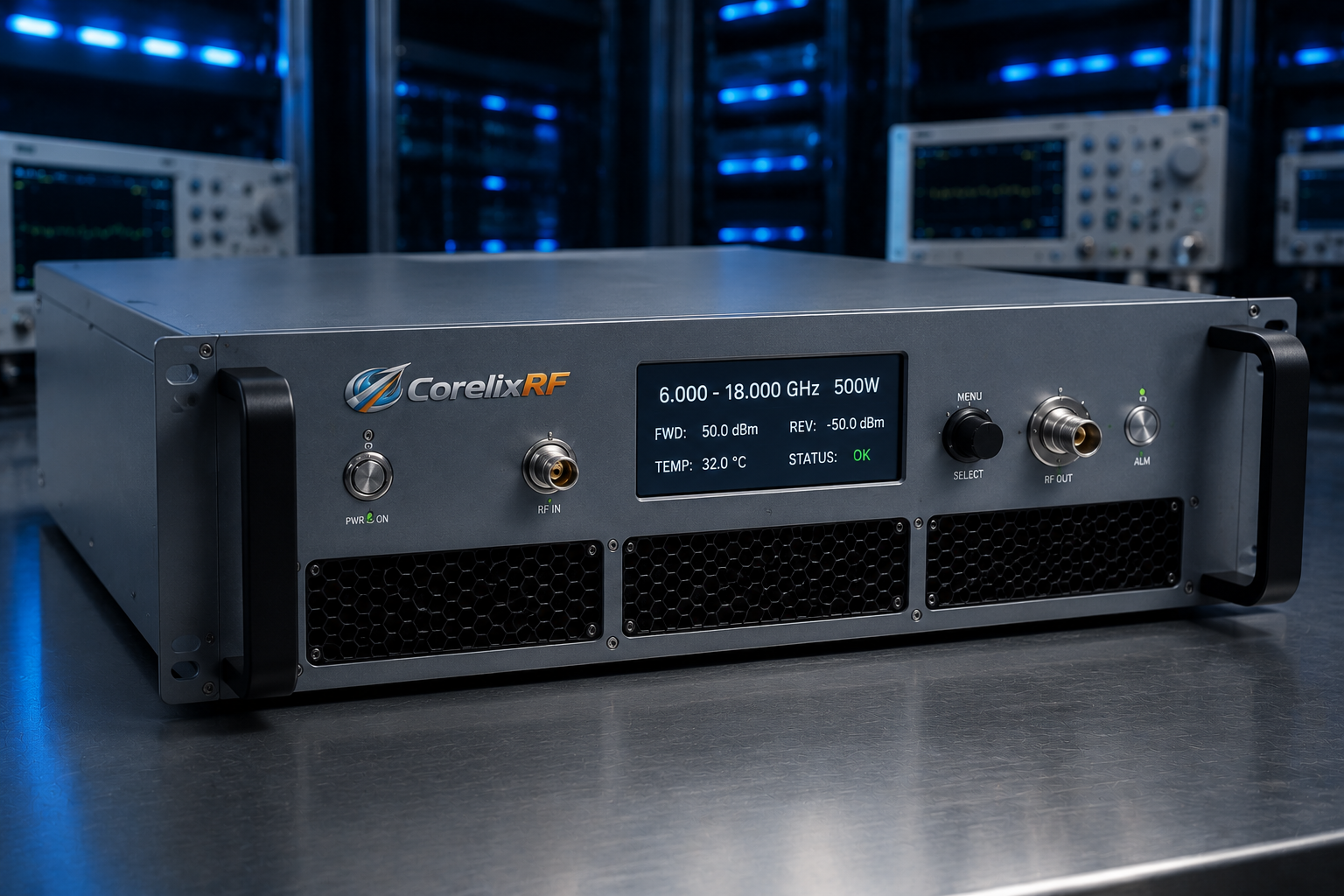
A 6-18 GHz GaN RF amplifier is selected very differently from a lower-frequency module. At C, X, and Ku-band-related frequencies, connector transitions, output interface, rack format, cooling, gain, and control environment can become as important as rated output power. CorelixRF’s local CRF-PA-6000M18000M datasheets show a broad family ranging from miniature 10W and 16W units to rack and waveguide-output systems.
This rewritten article uses local datasheet data instead of generic assumptions. The available files include compact SMA-Female input/output models, N-Female rack units, SMA-F / N-F module-style units, and high-power WRD500 / WRD650 waveguide-output models. Buyers should treat these as starting configurations for engineering review, not interchangeable blocks.
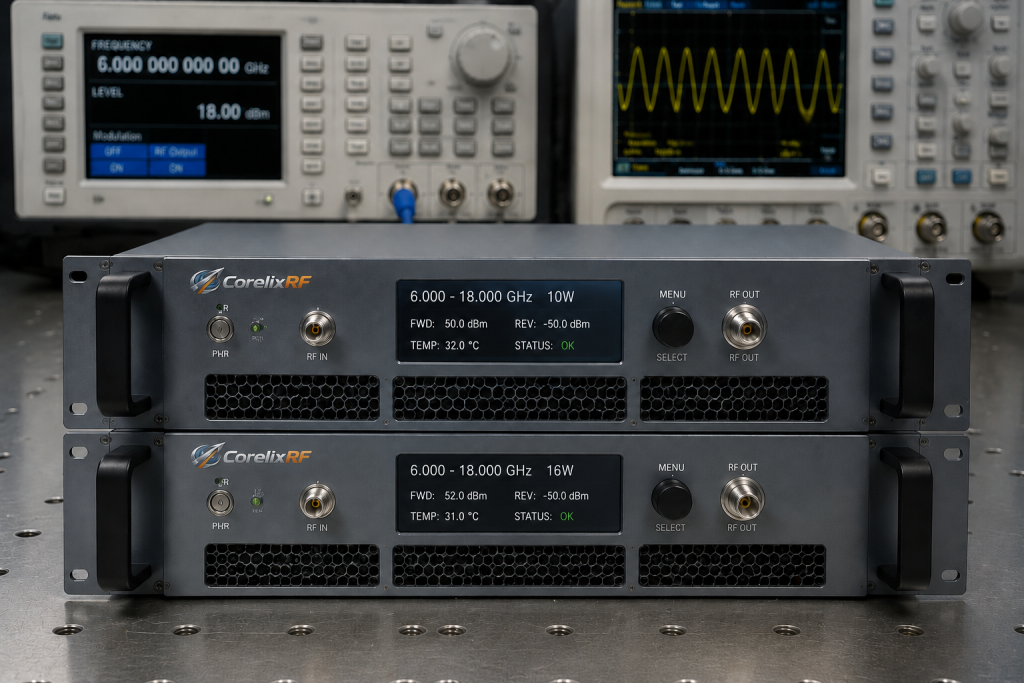
Verified Model Examples From Local Datasheets
| Model | Frequency | Rated output | Gain reference | RF output / package |
|---|---|---|---|---|
| CRF-PA-6000M18000M-10W | 6-18 GHz | 10 W | 40 dB | SMA-Female out, miniature chassis |
| CRF-PA-6000M18000M-16W | 6-18 GHz | 16 W | 42 dB | SMA-Female out, miniature chassis |
| CRF-PA-6000M18000M-50W | 6-18 GHz | 50 W | 50 dB | SMA-F in / N-F out, 330 x 200 x 60 mm |
| CRF-PA-6000M18000M-100W | 6-18 GHz | 100 W | 50 dB | SMA-F in / N-F out, 440 x 370 x 120 mm |
| CRF-PA-6000M18000M-200W | 6-18 GHz | 200 W | 53 dB | SMA-F in / WRD500 out, 320 x 320 x 200 mm |
| CRF-PA-6000M18000M-300W | 6-18 GHz | 300 W | 50 dB | SMA-F in / WRD500 out, 320 x 230 x 120 mm |
| CRF-PA-6000M18000M-500W-M | 6-18 GHz | 500 W | 57 dB | SMA-F in / WRD500 out, RF PA module |
The broader local folder also includes rack-oriented 25W, 30W, 40W, 50W, 80W, 100W, 200W, 250W, 300W, 500W, and 1000W references with N-Female or WRD650 output options. Because several filenames represent different mechanical versions for the same power class, final selection should be confirmed against the exact datasheet and drawing.
Connector and Output Interface Are Selection Criteria
The datasheets show three practical interface tiers. Low-power 10W and 16W models use SMA-Female input and output. Mid-power module configurations use SMA-F input with N-F output, which is practical for many test benches and integrated RF chains. Higher-power models shift to WRD500 or WRD650 waveguide outputs, which changes the downstream cable, adapter, coupler, load, and measurement plan.
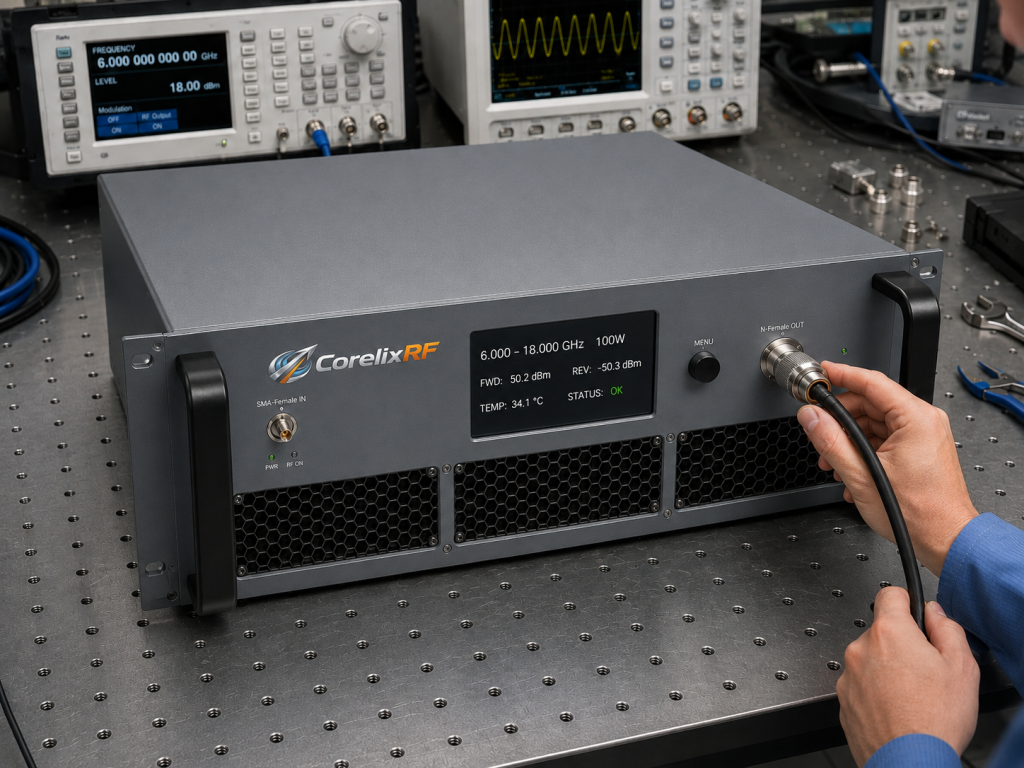
This is why a 6-18 GHz RFQ should describe the complete RF path. If the power target is measured after a waveguide transition, cable run, or antenna feed, that reference plane should be stated. For high-frequency RF capability, the amplifier, source, filters, switches, couplers, load, and control system should be reviewed together.
Package and Cooling Review
The 6-18 GHz family spans miniature chassis, compact modules, 3U/4U/5U/6U rack units, and TBD high-power formats. A small 10W amplifier and a 500W waveguide-output module are not just different wattage choices; they are different integration problems. The higher the power class, the more important airflow, rack clearance, supply capacity, duty cycle, and load protection become.
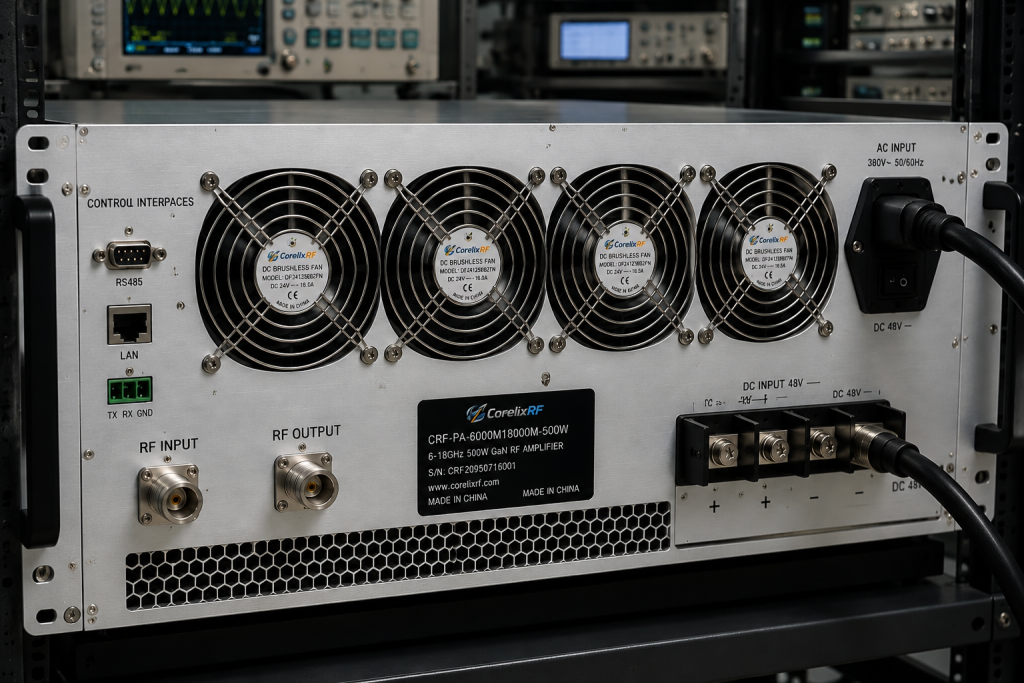
For automated test systems, specify control needs early. Some public and local descriptions reference RS485 and LAN options on rack-level configurations, while module-level configurations may require project-specific control review.
Application Fit
Use the compact models for source boosting, bench-level microwave validation, and lower-power RF chain development. Use 50W to 100W modules when the project needs stronger output while retaining manageable connector formats. Use 200W and above only after confirming waveguide path, cooling, rack space, and measurement method.
FAQ
1、Does the local data support 6-18 GHz high-power options?
Yes. The local folder includes datasheets for compact, mid-power, rack, module, WRD500, and WRD650 output configurations.
2、Which output interface appears on higher-power models?
WRD500 and WRD650 waveguide outputs appear on several higher-power configurations.
3、Is every 6-18 GHz model the same mechanical style?
No. The datasheets include miniature chassis, compact modules, rack-mount units, and project/TBD formats.
4、What should be included in the RFQ?
Include frequency range, output reference plane, power target, input drive, connector or waveguide path, cooling, rack limits, duty cycle, control needs, and data package requirements.
5、Can one article list every possible 6-18 GHz configuration?
No. The family is broad, and several power classes have multiple mechanical variants. Final selection should reference the exact datasheet file.
Request 6-18 GHz Engineering Review
Send the required frequency window, output power, waveguide or connector path, cooling condition, and control requirements for model-level review.