
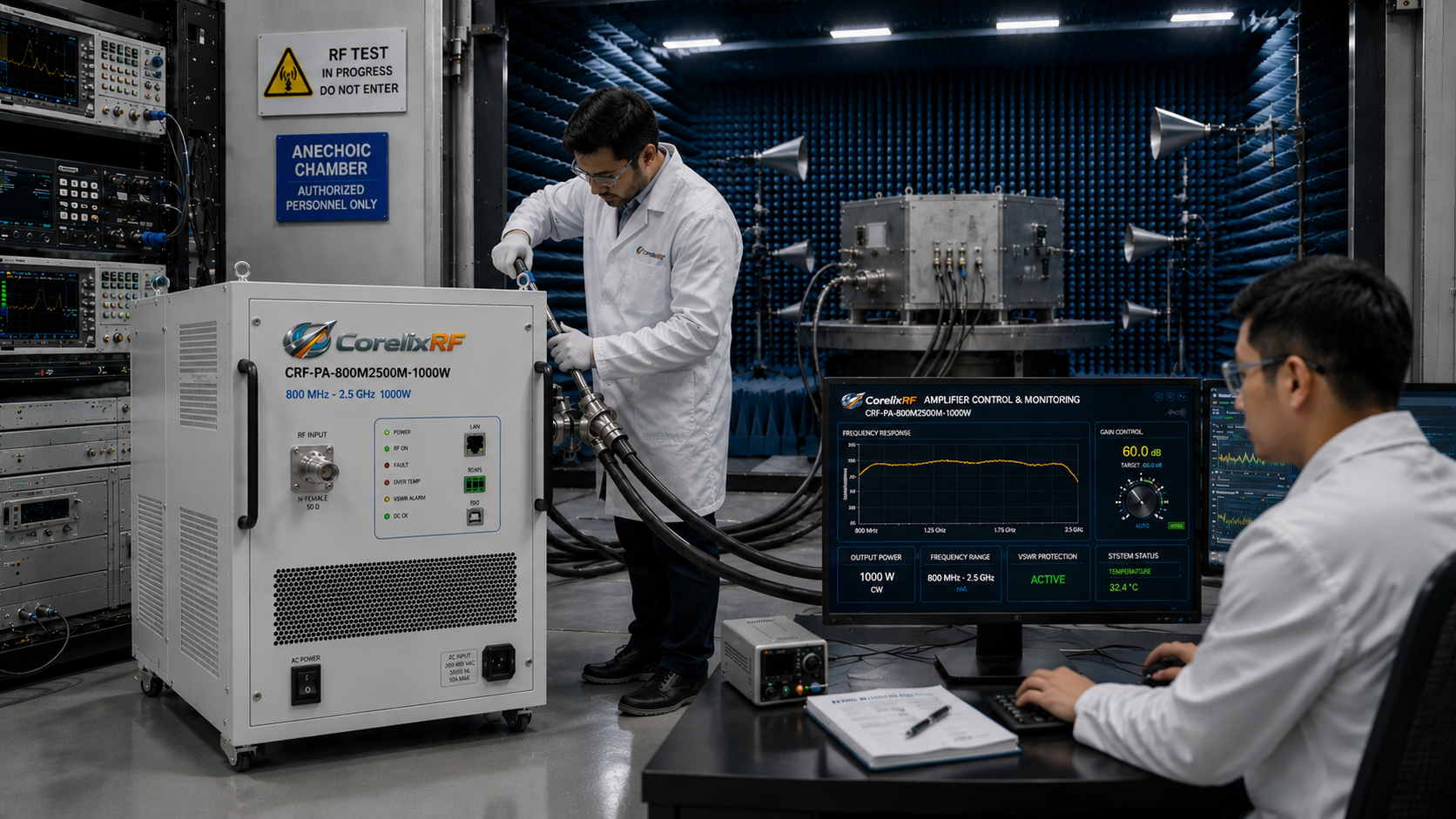
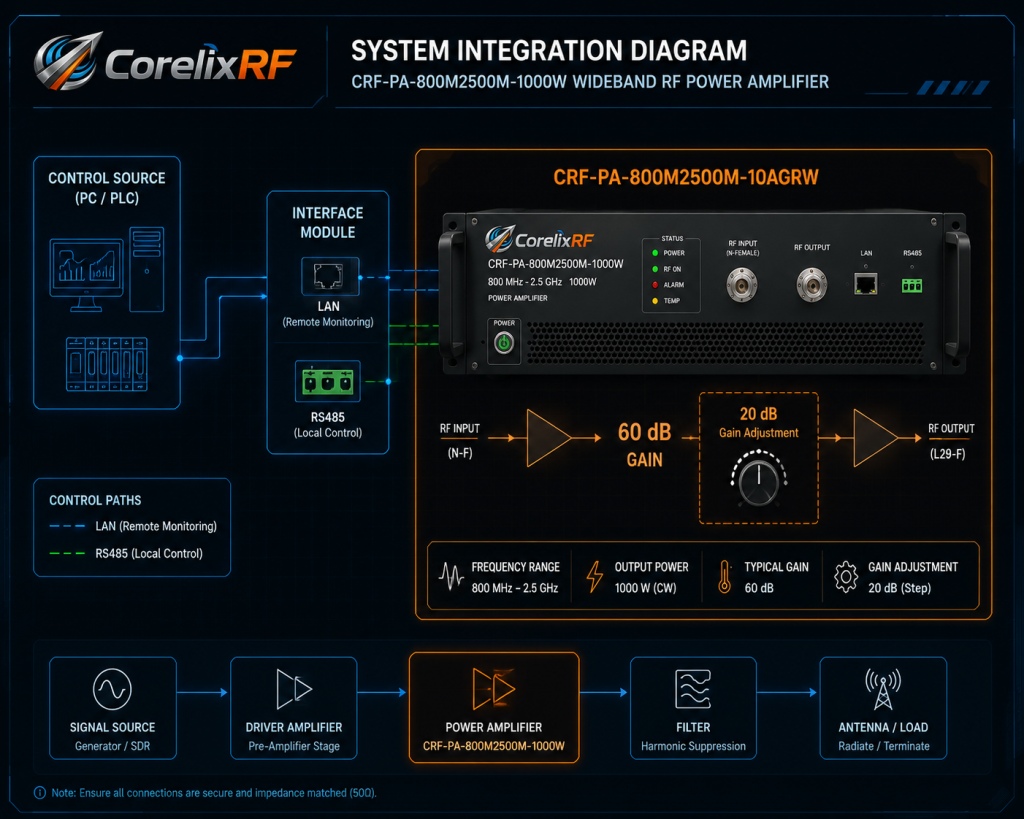
An 800 MHz to 2.5 GHz 1000W wideband RF amplifier is a high-power choice for teams that need one amplifier platform to cover a broad lower-microwave band. The CorelixRF CRF-PA-800M2500M-1000W datasheet lists 800-2,500 MHz frequency coverage, 1000 W rated output power, 60 dB gain, up to 20 dB gain adjustment, N-Female input, L29-Female output, RS485/LAN control, and an air-cooled cabinet configuration.
This type of broadband RF power amplifier is most useful when a project cannot be served by a narrowband module. It can support system-level testing, communication development, interference or EW evaluation, aerospace control work, and high-power lab instrumentation where the band plan spans more than one octave.
What makes this 0.8-2.5 GHz amplifier different
The first differentiator is the combination of bandwidth and power. Covering 800 MHz to 2.5 GHz at 1000 W creates a different integration problem than a small driver amplifier or a lower-power lab stage. The RF chain must be planned around power handling, thermal load, connector choice, gain control, and remote operation.
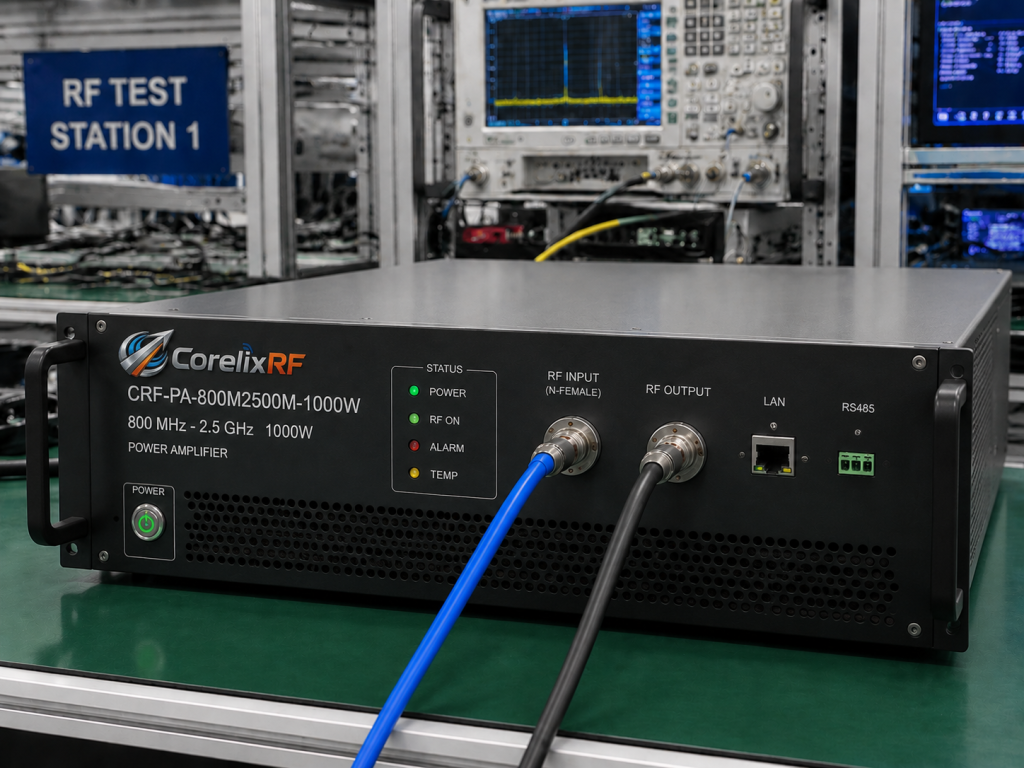
The local specification identifies the amplifier as a GaN SSPA platform. It also lists 60 dB gain and a 20 dB maximum gain control range. That makes it relevant for test systems where the input source may be a synthesizer, signal generator, exciter, or custom RF front end. The gain control range gives the operator or control system room to align output level without changing the full input chain.
System integration considerations
The datasheet lists a cabinet format with final dimensions subject to the production unit. It also lists 250 kg weight. Those two details affect the procurement and installation plan. Engineering should decide whether the amplifier will sit in a fixed lab area, a shielded enclosure, a rack line, or a system cabinet before asking for final mechanical documentation.
Cooling also deserves early attention. A 1000 W RF output amplifier with 7,000 W listed power consumption will generate substantial heat. The cooling path, room ventilation, service clearance, and operating temperature target should be reviewed with the same care as RF performance.
Monitoring and protection
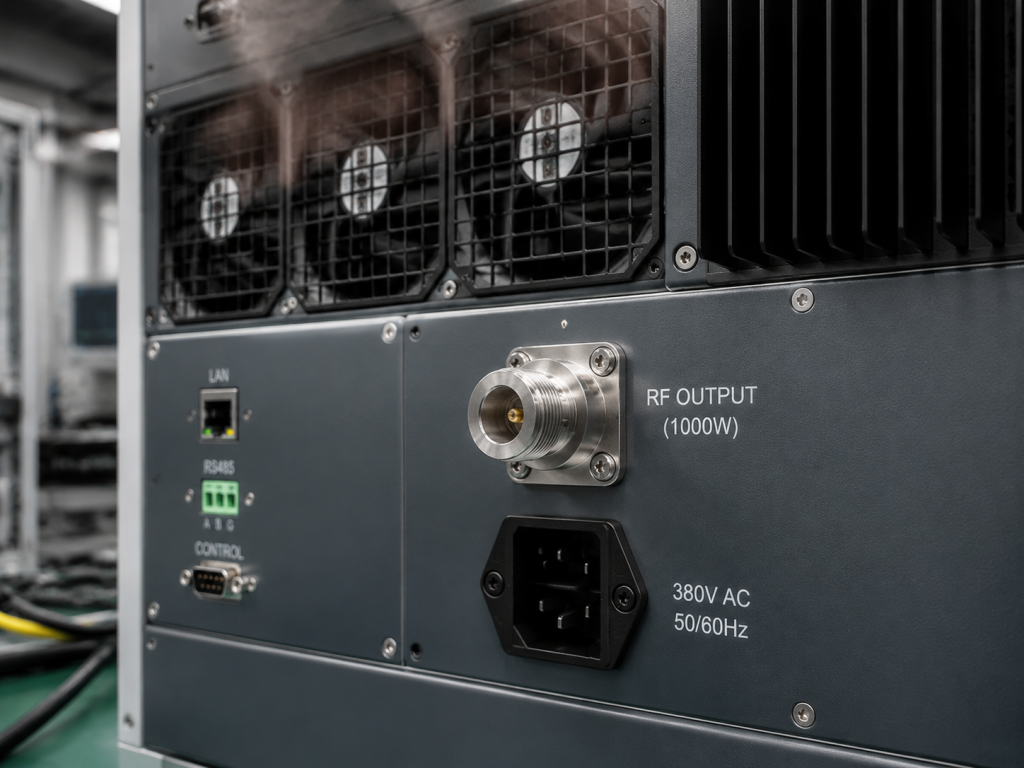
The source document lists real-time temperature monitoring, real-time current monitoring, optional forward/reverse power monitoring, optional LAN remote monitoring, alarm and fault protection, over-temperature protection, over-drive protection, over-voltage protection, and VSWR protection. These are valuable for automated testing and remote operation, especially when the operator cannot stand near the RF load during operation.Protection functions work best when the rest of the system is designed responsibly. Use properly rated loads, couplers, and cables. Define mismatch exposure and expected operating sequence. If the amplifier will run into a chamber, antenna, or switching network, include that context in the RFQ request.
Where this amplifier fits
The 800 MHz to 2.5 GHz range is attractive for projects that cross cellular, telemetry, navigation-adjacent, defense, and broadband communication test regions. The amplifier is not positioned here as a certified system or guaranteed application solution. Instead, it is a high-power RF building block that can be reviewed for test and measurement instrumentation, communication systems, RF interference or EW system-level testing, and aerospace control systems.
A good purchasing conversation should define not only the frequency and power target, but also the expected waveform, output duty, control interface, connector direction, maximum input drive, and required diagnostics. CorelixRF can then confirm whether this wideband SSPA configuration is suitable or whether a custom amplifier review should adjust the mechanical or control details.
How engineers should frame the acceptance test
For a 1000 W wideband amplifier, acceptance testing should be discussed before purchase. The project team should define which frequencies are tested, how output power is measured, what drive level is used, how long each test point runs, and which alarms or monitoring values are recorded. If the amplifier will be used with modulated signals, the team should also define whether acceptance is based on CW power, saturated power, linear output, or another project-specific criterion.
This is also the right time to define documentation needs. Some buyers need only a datasheet and factory test result. Others need a mechanical drawing, control protocol, connector pinout, power input detail, and a production test record. Stating those requirements early helps prevent late-stage delays, especially for cabinet-class systems where shipping, installation, and facility readiness are part of the schedule.
FAQ
What is the rated output power of the CRF-PA-800M2500M-1000W?
The local datasheet lists 1000 W rated RF output power over 800 MHz to 2.5 GHz.
What gain does the specification list?
The datasheet lists 60 dB gain with up to 20 dB gain adjustment.
Is this a rack amplifier or cabinet amplifier?
The source document lists a cabinet configuration, with final dimensions subject to the production unit.
What RF connectors are shown?
The input connector is listed as N-Female and the output connector is listed as L29-Female.
Can it be used for EMC or EW style system testing?
The listed applications include RF interference / EW system-level testing. Final suitability depends on waveform, duty cycle, load, monitoring, and protection requirements.