
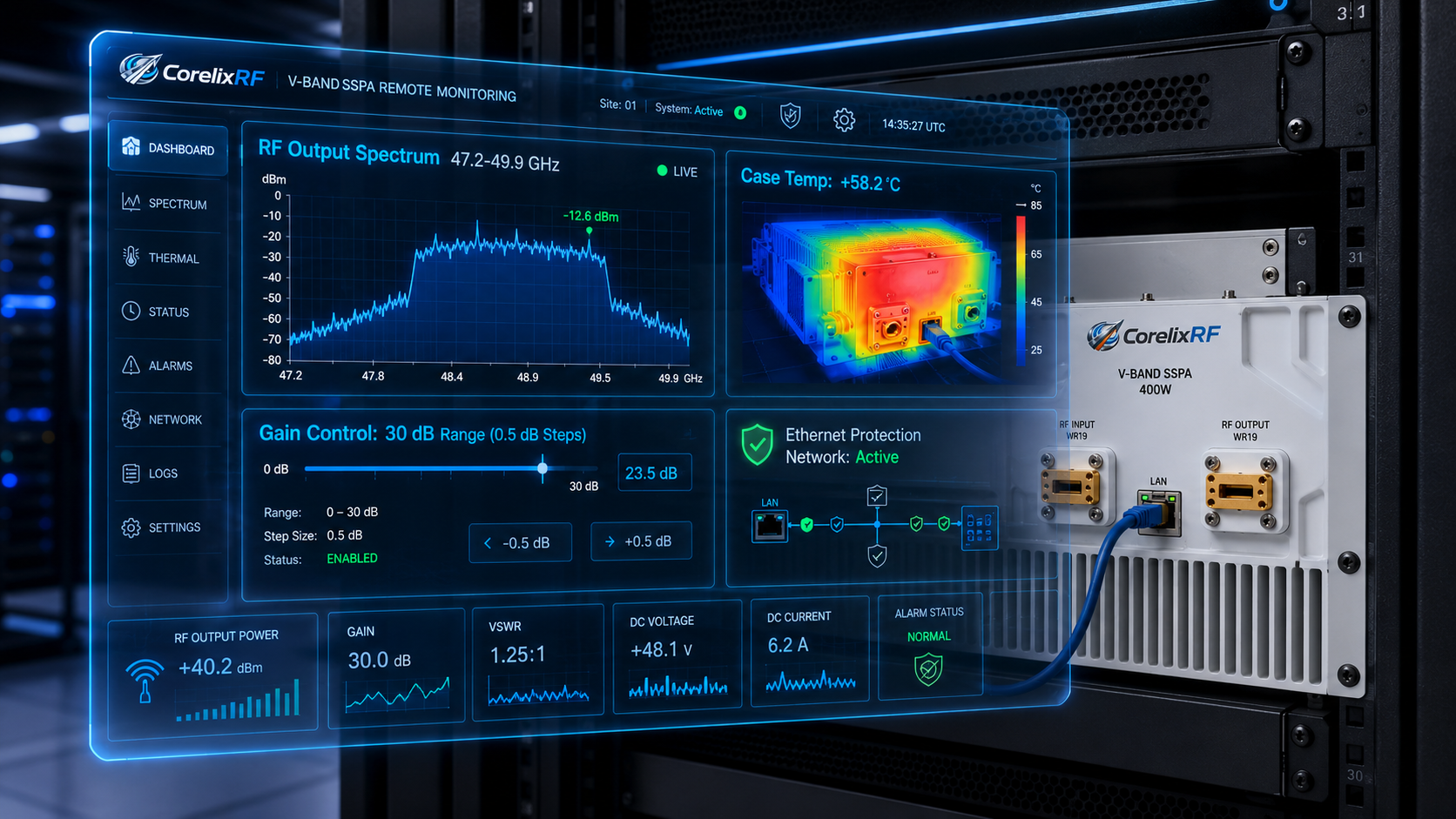
A 47.2-49.9 GHz 400W V-band SSPA is a specialized amplifier for high-power millimeter-wave projects where frequency, waveguide interface, gain control, thermal design, and remote monitoring all matter. The CorelixRF CRF-PA-47200M49900M-400W datasheet lists 47.2-49.9 GHz frequency coverage, 400 W rated output power, at least 56 dBm saturated output, 70 dB small-signal gain, 30 dB gain control, WR19 input/output, Ethernet communication, and an IP65 package.
This is not a general lab driver amplifier. It is a high-power solid state power amplifier for V-band systems where small mechanical or RF interface errors can become expensive. The RFQ should therefore be more detailed than a simple request for frequency and wattage.
Why V-band SSPA selection needs extra detail
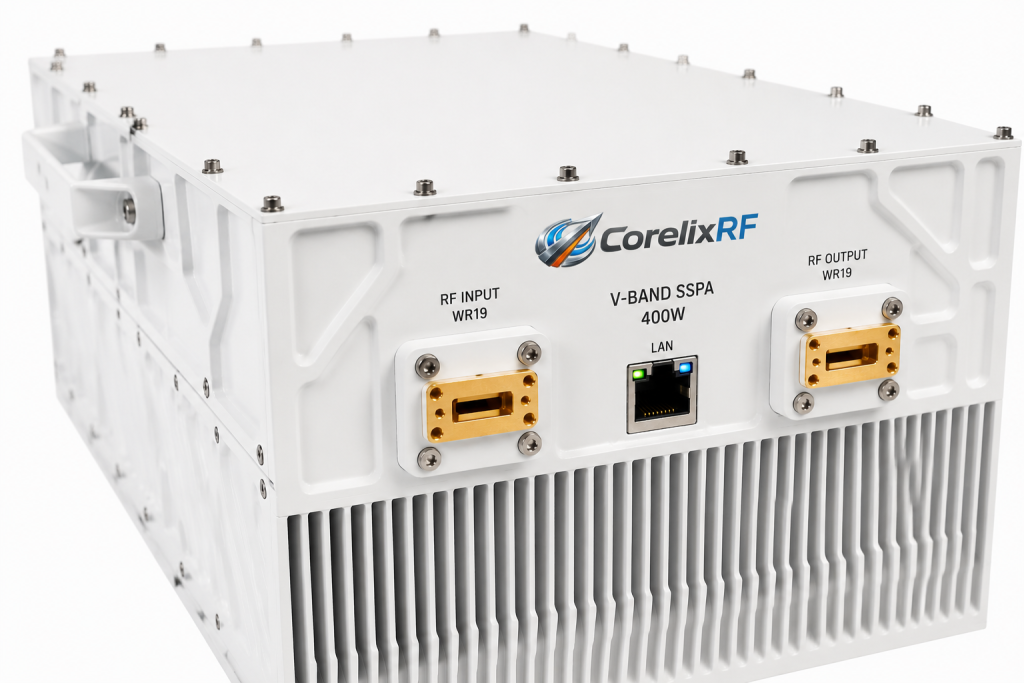
At 47.2-49.9 GHz, waveguide interfaces, group delay, flatness, and mechanical alignment become central. The source datasheet lists WR19 input and output, gain flatness limits across 100 MHz and 1000 MHz spans, and group delay characteristics. Those details are especially relevant for communication system integration, test and measurement instrumentation, aerospace control systems, and RF interference system-level testing.
The amplifier is described as a GaN V-band solid-state RF power amplifier. GaN is valuable in high-power RF design, but the project team still needs to qualify the complete system around the amplifier. That includes the RF source, waveguide path, loads, couplers, monitoring, thermal environment, and software control.
What to define before requesting a V-band quote
A millimeter wave amplifier RFQ should define the exact RF frequency plan, required output power at the load, operating temperature, input signal level, modulation type, expected duty cycle, waveguide layout, and monitoring data needed by the host system. If the system needs long-term stability, the 24-hour power stability requirement should be discussed with the complete thermal profile.
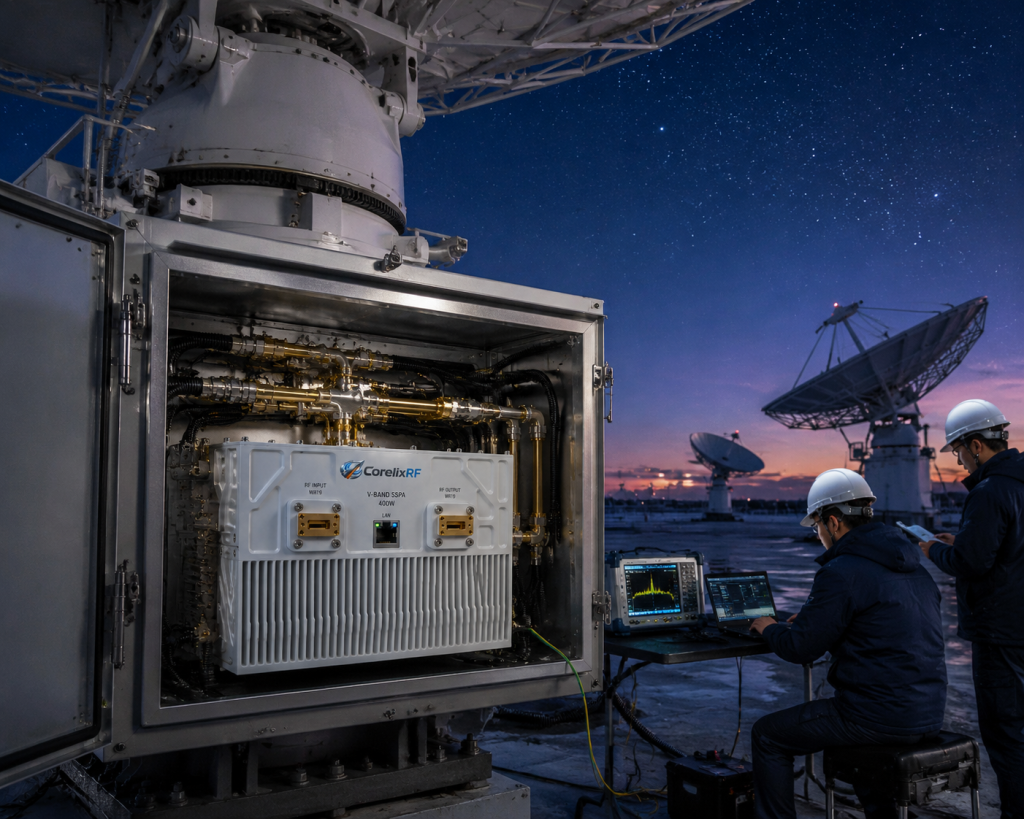
Because this amplifier uses WR19 interfaces, the surrounding waveguide components must match the required frequency, power, and mechanical tolerances. Do not treat waveguide transitions as an afterthought. Loss, mismatch, and alignment can reduce useful output power or trigger protection behavior.
Monitoring and protection
The datasheet lists real-time temperature monitoring, real-time current monitoring, gain control, remote-control support, status monitoring and detection, alarm and fault protection, input/output detection, over-temperature protection, and IP65 dust and water protection. These functions support system integration, but the final safety logic should still include project-specific interlocks and operating procedures.
Good-fit project profiles
The source document lists V-band high-power RF systems, test and measurement instrumentation, communication system integration, and aerospace control systems. For SEO and procurement clarity, the best search-intent match is not just “V-band amplifier.” It is a specific need such as “47.2-49.9 GHz 400W V-band SSPA,” “WR19 high power amplifier,” or “400W millimeter wave amplifier for system testing.”
CorelixRF should receive enough project context to determine whether the standard configuration fits or a custom RF amplifier variant should be reviewed. That context should include mechanical envelope, RF interface requirements, control interface, environmental rating, and documentation expectations.
Integration risks that are easy to underestimate
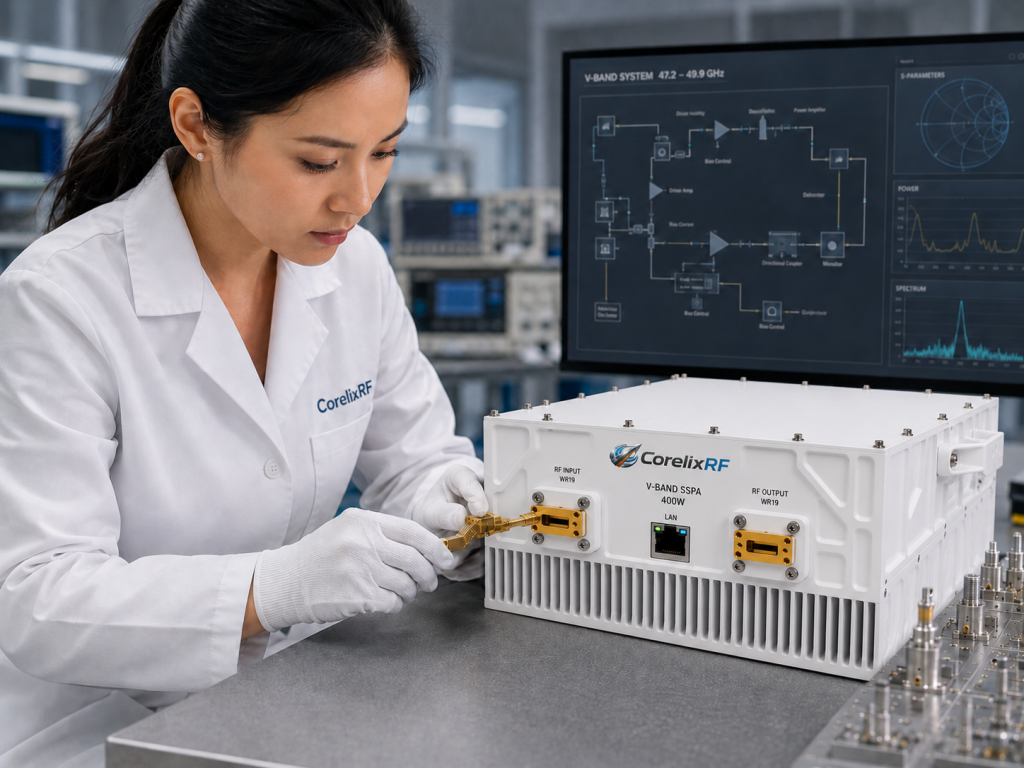
V-band power amplifiers place unusual pressure on the mechanical and RF design. A connectorized microwave amplifier can often tolerate a simple cable swap during troubleshooting. A WR19 V-band system is less forgiving. Waveguide bends, flanges, transitions, load quality, and installation alignment all influence delivered power and mismatch behavior. For that reason, the RFQ should describe the intended waveguide path and not only the amplifier output power.
Thermal and environmental details also matter. The datasheet lists operation from -40 to +60 C and IP65 support, but the final system still needs a realistic heat rejection plan. If the amplifier is installed outdoors, in a shelter, or near other high-power electronics, the customer should provide ambient temperature, airflow, enclosure, duty cycle, and service requirements. If the system is laboratory based, clarify whether it will operate continuously, in bursts, or only during measurement windows.
Control software should be planned with the same care. Ethernet monitoring is valuable only if the host system records the right values and responds correctly to alarms. Define what operators need to see, what faults stop operation, and how recovery should be handled.
FAQ
What frequency range does this V-band amplifier cover?
The local datasheet lists 47.2 GHz to 49.9 GHz.
What output power is listed?
The source document lists 400 W rated output power and at least 56 dBm saturated output power.
What RF interface is used?
The datasheet lists WR19 input and output.
Does the amplifier support remote control?
Yes. The source specification lists Ethernet communication and remote-control support.
Is IP65 listed in the source document?
Yes. The datasheet describes IP65 dust and water protection for this configuration.