
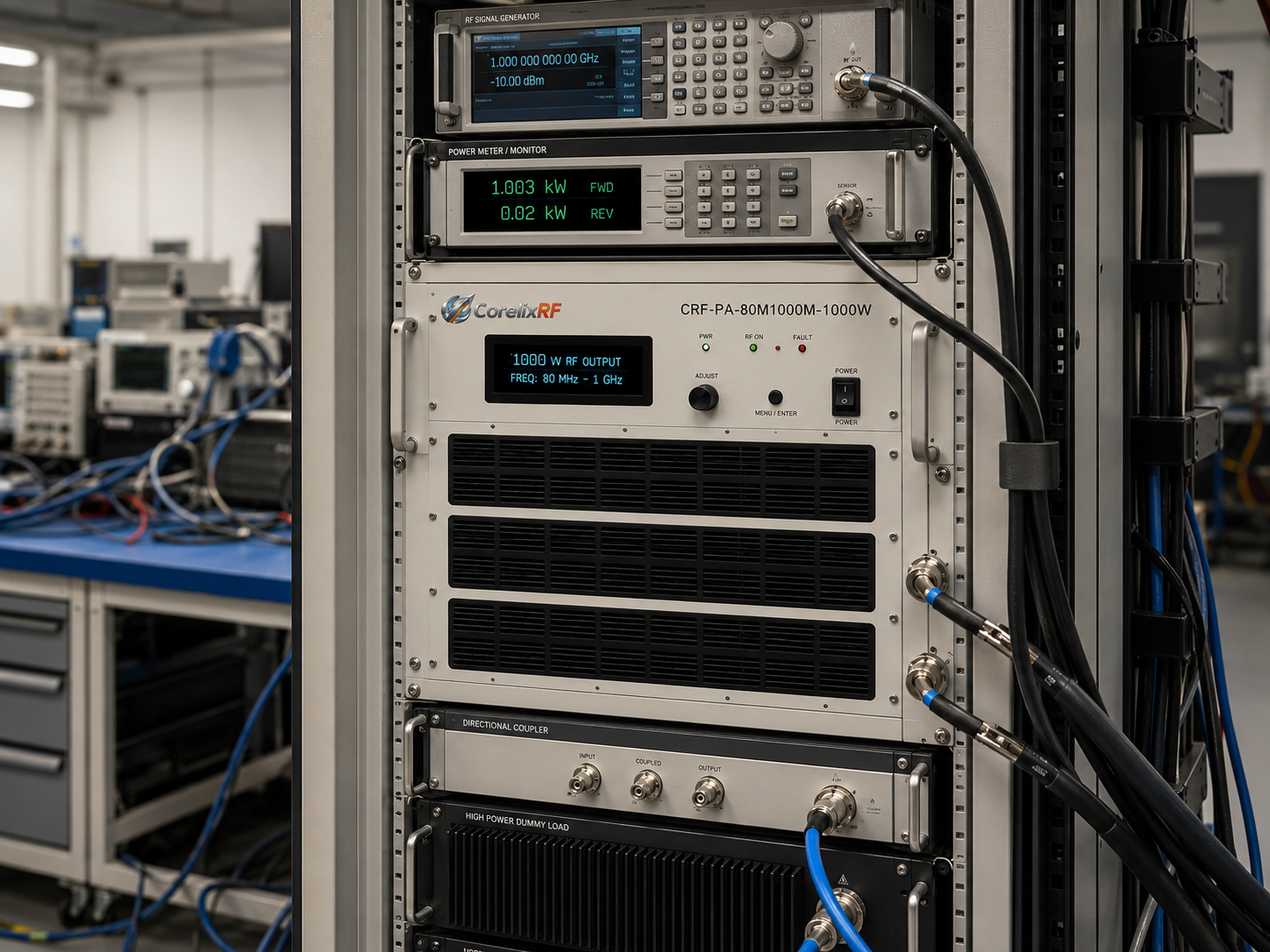
An 80 MHz to 1 GHz 1000W EMC RF amplifier is typically evaluated when a test system needs high RF power across a multi-octave band. The CorelixRF CRF-PA-80M1000M-1000W datasheet describes an LDMOS solid-state RF power amplifier covering 80 MHz to 1 GHz with 1000 W minimum RF output power, 60 dB minimum small-signal gain, N-Female input, 7/16-F output, RS485/LAN control, AC 380 V input, and air cooling.
This makes the amplifier relevant for high-power EMC RF amplifier planning, RF interference or EW system-level testing, communication system evaluation, and test and measurement instrumentation. The final project fit depends on the required standard, field strength target, antenna, load, modulation, duty cycle, and chamber configuration.
Why 80 MHz to 1 GHz coverage matters
The 80 MHz to 1 GHz span is broad enough to cover many radiated immunity and lower microwave system-level test needs. Instead of changing amplifiers for every band segment, a wideband SSPA can simplify the RF chain. That benefit is only useful when the amplifier, antennas, couplers, cables, power meters, and protection logic are selected as one system.
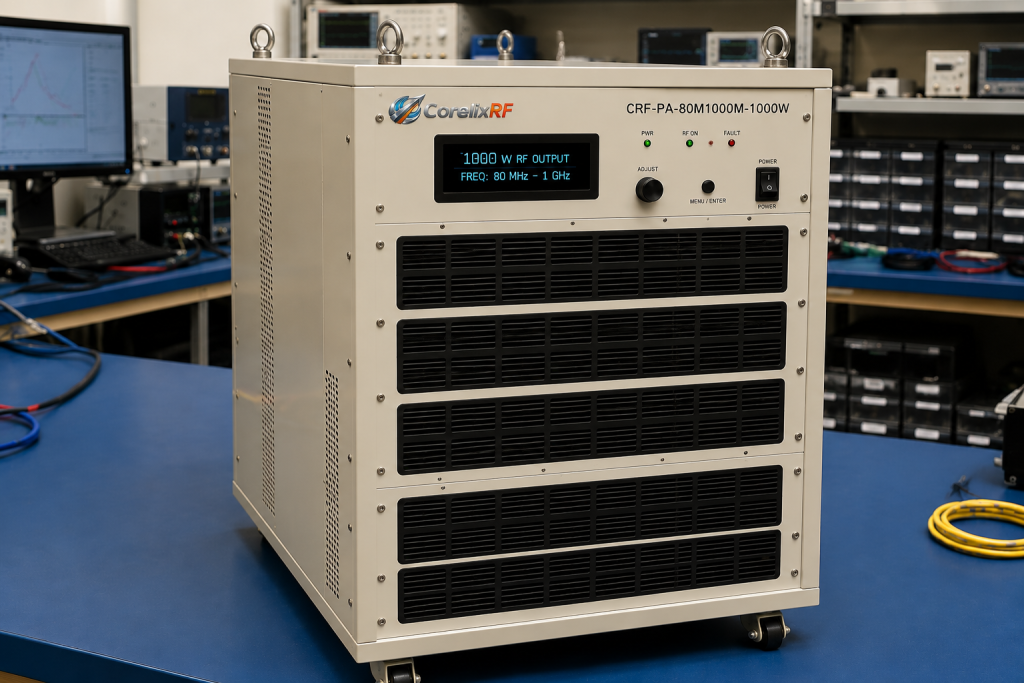
The local datasheet identifies the amplifier as an LDMOS SSPA platform. It lists 60 dB minimum gain and up to 20 dB gain control. Those values are important for test repeatability because the operator may need to tune field strength or output level while keeping the drive source in a controlled range.
EMC system integration questions
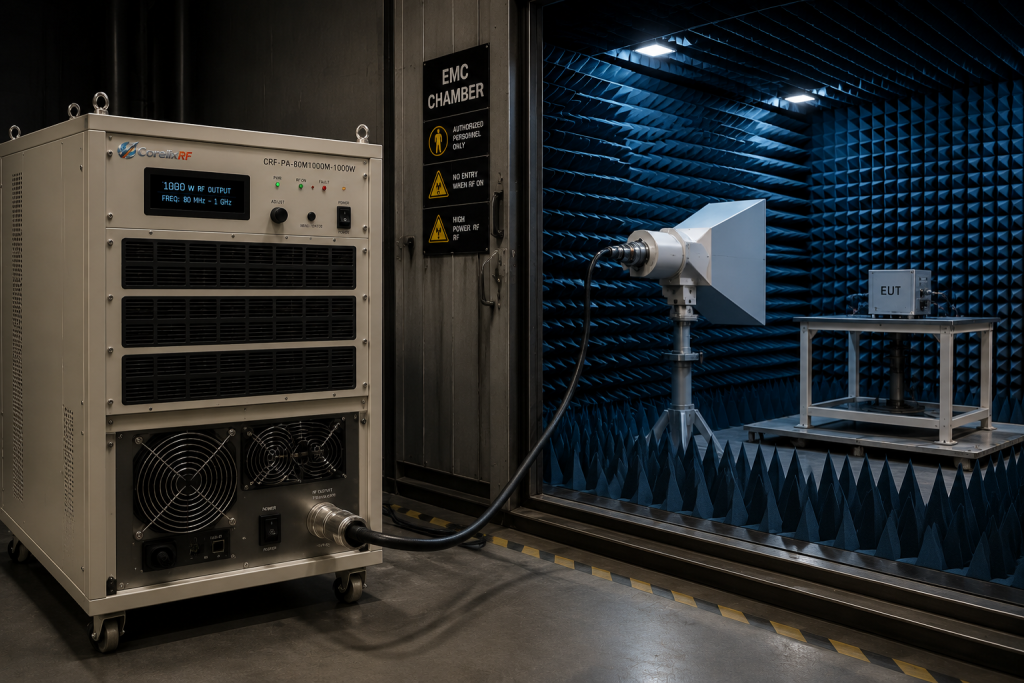
For immunity work, the amplifier is only one part of the field-generation chain. The engineering team should define target field strength, antenna factor, chamber size, cable losses, directional coupler location, power meter strategy, mismatch expectations, and test dwell time. The amplifier power rating alone does not guarantee a field result.
For communication or EW system-level testing, define whether the signal is CW, swept, modulated, pulsed, or multi-tone. The source document lists a noise floor value, harmonic and spurious limits, and gain flatness, but the project still needs a waveform-specific review.
Monitoring and protection functions
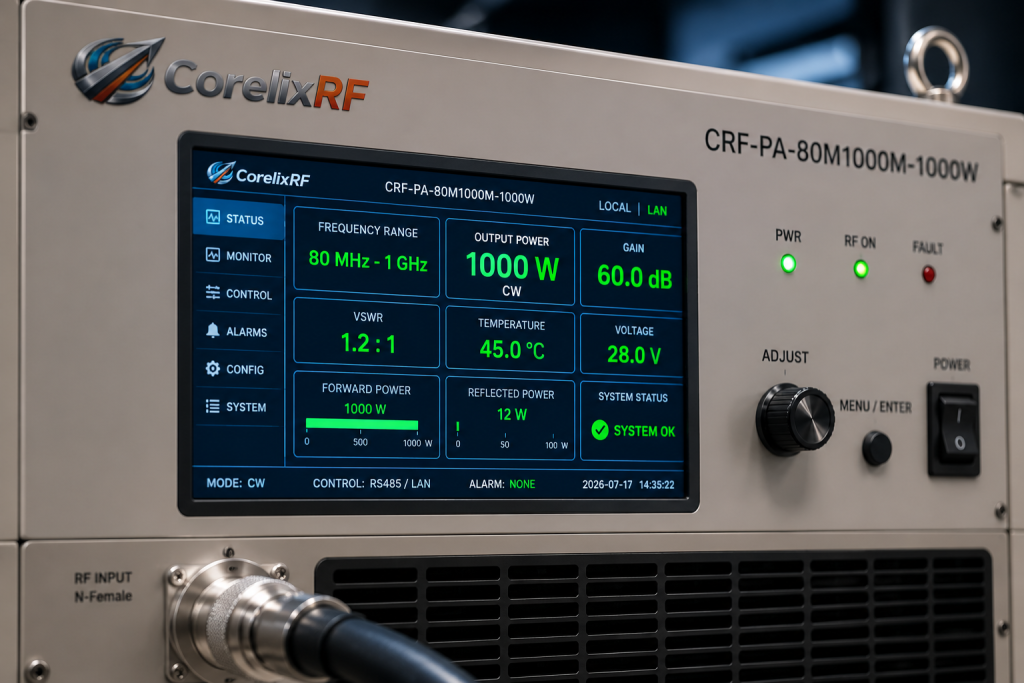
The datasheet lists real-time temperature monitoring, real-time current monitoring, optional forward/reverse power monitoring, optional LAN remote monitoring, alarm and fault protection, over-temperature protection, over-voltage protection, and VSWR protection. These features are particularly useful for EMC setups where the RF equipment may be operated from outside the chamber or from a centralized control station.
A custom RF amplifier review should clarify whether GPIB programmable control, forward/reverse power monitoring, or other project-specific options are required. The source document notes optional GPIB programmable control interface and LAN remote monitoring support, so these should be discussed before purchase.
Practical RFQ guidance
When requesting an 80 MHz to 1 GHz 1000 W amplifier, include the required output power at each critical frequency, duty cycle, expected load mismatch, antenna type, chamber or system topology, control interface preference, and documentation requirements. If the amplifier is part of a larger RF power amplifier system, include the source, switching, load, and measurement chain.
This article does not claim compliance certification, inventory, or customer deployment. It stays with what the local specification supports: an 80 MHz to 1 GHz LDMOS SSPA with 1000 W minimum output, 60 dB minimum gain, RS485/LAN control, air cooling, monitoring, and protection functions.
How to avoid under-specifying an EMC amplifier request
Many EMC amplifier RFQs are too short. A request that says only “80 MHz to 1 GHz, 1000 W” leaves out the details that decide whether the final system will be practical. The amplifier supplier needs to understand the antenna, chamber, cable losses, target field strength, modulation, dwell time, and control method. Without those details, the wattage target can look correct on paper while the complete test system still lacks margin.
The RFQ should also state whether the amplifier will be used for formal pre-compliance work, internal stress testing, production screening, or research. Those use cases can require different monitoring depth and different documentation. A research bench may prioritize flexibility and access to control values. A production or compliance-oriented setup may prioritize repeatability, protection behavior, and operator workflow.
Because the datasheet lists optional monitoring and programmable control features, procurement should identify which options are required before quotation. Doing that early is usually faster than revising the control and measurement plan after the amplifier has already been specified.
FAQ
What frequency range is listed for the CRF-PA-80M1000M-1000W?
The local datasheet lists 80 MHz to 1 GHz.
What technology is used?
The source document describes the amplifier as an LDMOS SSPA platform.
What output connector is listed?
The datasheet lists a 7/16-F output connector on the rear panel.
Is forward/reverse power monitoring included?
The source lists forward/reverse power monitoring as optional. Confirm the required monitoring configuration during RFQ.
Can this be used for EMC immunity systems?
It can be reviewed for EMC and system-level RF testing, but final suitability depends on the complete test setup, required field strength, antenna, waveform, and duty cycle.