
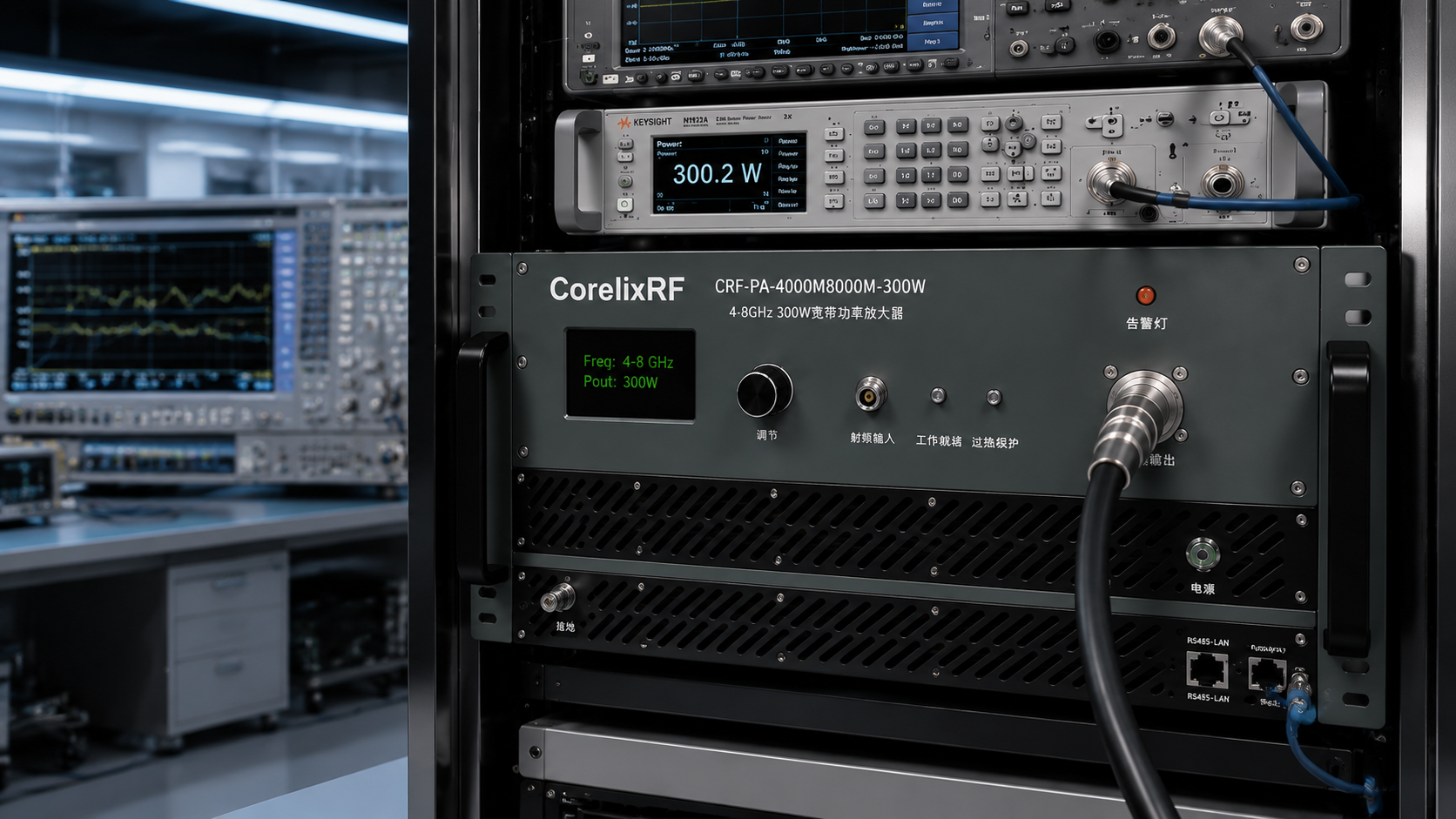
A 4-8 GHz 300W wideband RF power amplifier is a practical match when a test system needs C-band coverage without moving immediately into a much larger kilowatt-class cabinet. The CorelixRF CRF-PA-4000M8000M-300W datasheet describes a GaN solid-state RF power amplifier covering 4,000 MHz to 8,000 MHz with 300 W rated output power, 57 dB minimum small-signal gain, N-Female input, 7/16-Female output, RS485/LAN control, AC 220 V supply, forced-air cooling, and a 5U rack-mount form factor. For buyers comparing a wideband RF power amplifier against a more customized test-chain design, those details set the first decision boundary.
Why 4-8 GHz Coverage Is Useful
The 4-8 GHz range is often selected when an engineering team needs coverage across C-band test points, communication-system evaluation, RF interference or EW system-level testing, and aerospace-control electronics. A broader amplifier can reduce equipment changes during test, while a narrower amplifier can sometimes improve efficiency or simplify filtering. The right choice depends on the operating window, target output power, waveform, load condition, and acceptable gain variation.
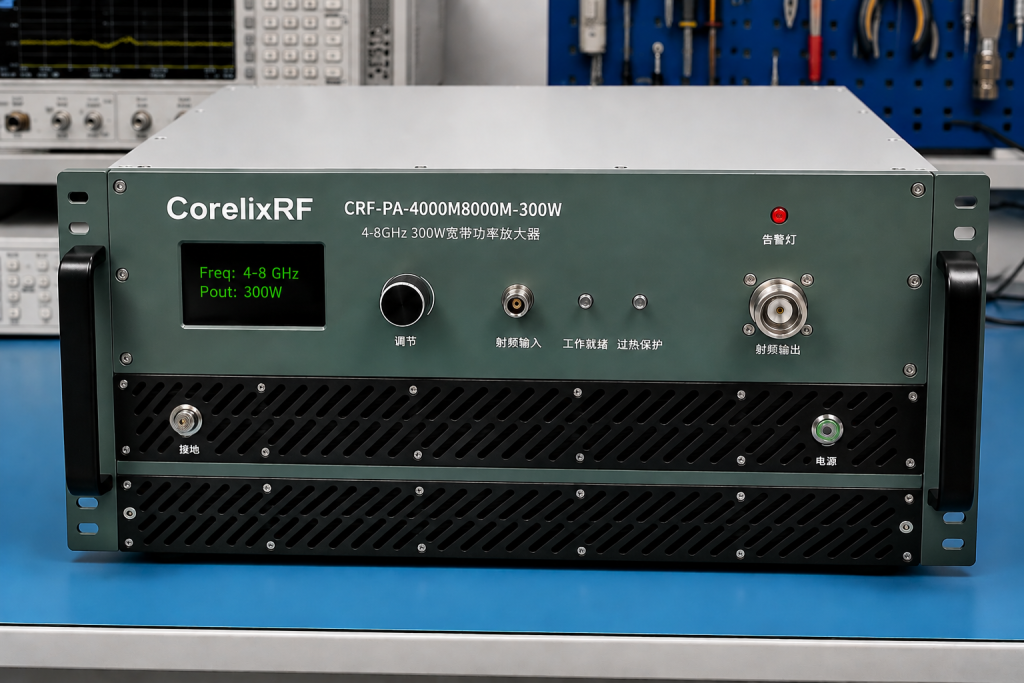
The local datasheet positions the CRF-PA-4000M8000M-300W as a GaN SSPA platform for high-power RF systems. That means the article should not sell it as a generic desktop accessory. It should frame the amplifier as a rack-mounted RF power block that needs drive-level planning, cooling review, output-connector review, and measured data before final approval.
Datasheet-Backed Parameters to Review
The specification lists 4,000-8,000 MHz frequency range, 300 W output power, 57 dB minimum small-signal gain, -4 to +4 dB small-signal gain flatness, 0 dBm maximum input power, -15 dBc harmonics, and -60 dBc spurious performance. It also identifies 50 ohm input impedance with 2:1 VSWR reference, N-Female RF input, 7/16-Female RF output, RS485/LAN control, AC 220 V plus or minus 10 percent at 50/60 Hz, 0 to +50 degrees C operating temperature, and forced-air cooling.
These are strong RFQ anchors, but they are not a substitute for a project review. Before purchase, ask CorelixRF for measured output power, gain, gain flatness, spectrum, thermal behavior, and control details for the exact configuration. In a high frequency RF amplifier project, measured curves across the operating band are more useful than a single headline output-power number.
5U Rack-Mount Integration
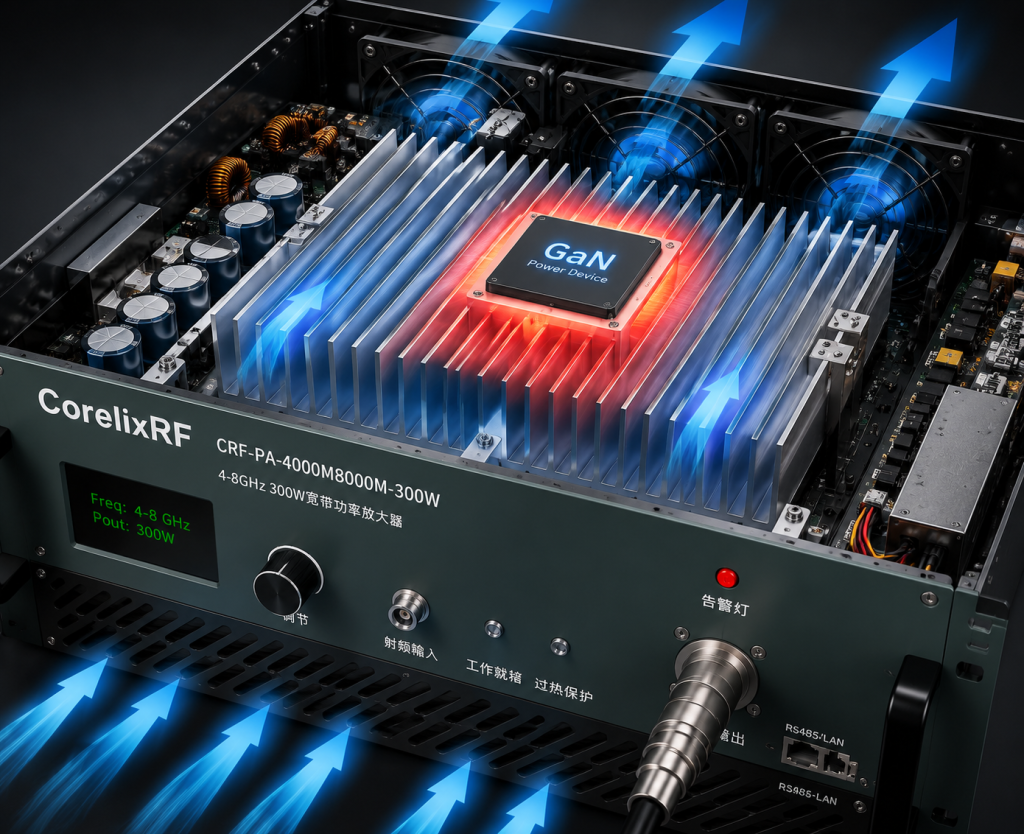
The 5U rack-mount form factor matters because it affects installation space, airflow clearance, cable routing, service access, and operator safety. The buyer should confirm rack depth, air intake and exhaust paths, AC supply availability, grounding, and access to the RF input and output before planning a final system layout. A 300 W amplifier is easier to place than a very high-power cabinet, but it still needs disciplined thermal and RF handling.
Control, Monitoring, and Protection
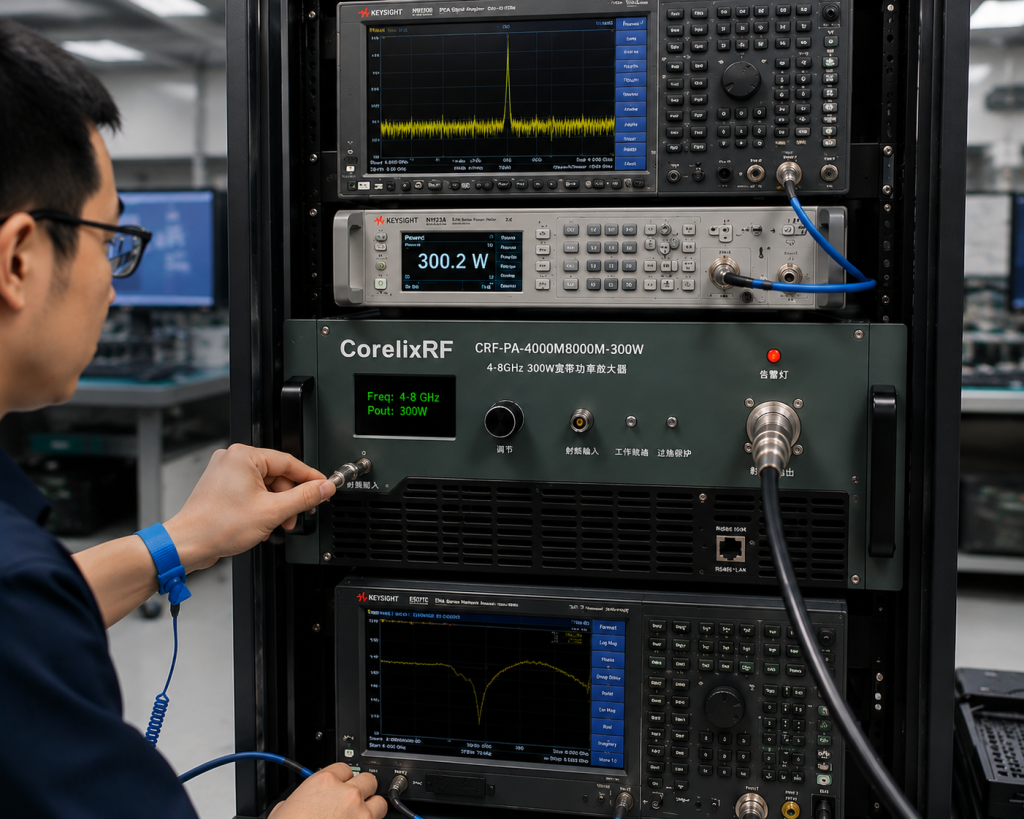
The datasheet references real-time temperature monitoring, real-time current monitoring, optional forward and reverse power monitoring, optional LAN remote monitoring, alarm and fault protection, temperature monitoring and alarm, current monitoring and alarm, over-drive protection, and optional forward/reverse power monitoring. These features are useful when the amplifier is part of an automated RF testing and validation platform, because software and operators need visibility into amplifier state before a mismatch or drive-level error damages downstream hardware.
How Engineers Should Compare Alternatives
If the project only needs 2-6 GHz, a 2-6 GHz amplifier family may be a closer fit. If the project extends into higher X-band or Ku-band ranges, a 6-18 GHz amplifier direction may be more appropriate. The 4-8 GHz 300 W model is most relevant when the required band sits inside the 4-8 GHz window and the system can support rack-mount forced-air integration.
RFQ Checklist for a 4-8 GHz 300W Amplifier
A useful request should include the exact operating frequencies, target output power at the amplifier output or at the load, input drive level, waveform type, duty condition, expected load VSWR, required gain-control behavior, available AC power, control interface preference, cooling and rack constraints, connector path, couplers, cables, loads, and required factory test data. If the mechanical package, connector layout, monitoring behavior, or control interface needs to change, submit it as a custom RF amplifier review rather than assuming a standard model can be changed late in procurement.
The article should stay conservative for SEO and sales use. Do not claim certifications, inventory status, field deployments, or guaranteed acceptance-test outcomes unless a separate public document supports them. The strongest message is that the datasheet provides a credible GaN SSPA starting point and that CorelixRF can review measured data, interfaces, and project constraints before quotation.
For editorial review, the most important point is to keep the article tied to engineering selection intent. A buyer searching for a 4-8 GHz 300W amplifier is usually trying to compare RF power, frequency coverage, cooling format, control access, and evidence requirements before contacting a supplier. The draft should therefore encourage a clean technical request rather than broad promotional claims. That framing helps CorelixRF receive better-qualified inquiries and gives engineers a practical checklist for the first discussion.
FAQ
What frequency range does the CRF-PA-4000M8000M-300W cover?
The local datasheet lists 4,000 MHz to 8,000 MHz.
What output power is listed?
The datasheet lists 300 W rated output power.
What RF connectors are listed?
The datasheet lists N-Female input and 7/16-Female output.
What control interfaces are listed?
The specification lists RS485 and LAN control.
What should be checked before ordering?
Review measured RF data, rack airflow, AC power, load match, connector ratings, control protocol, and protection behavior for the final configuration.