
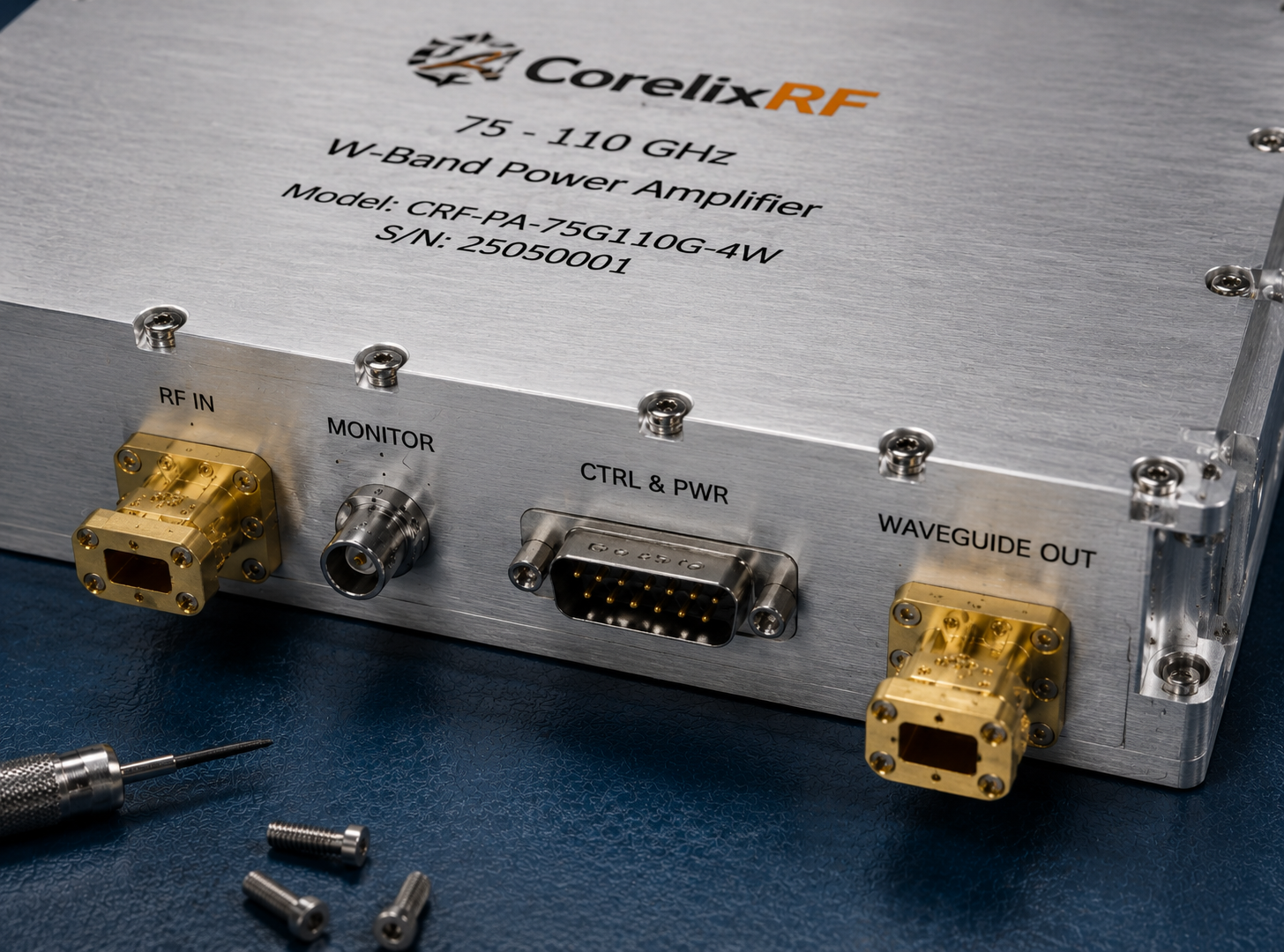
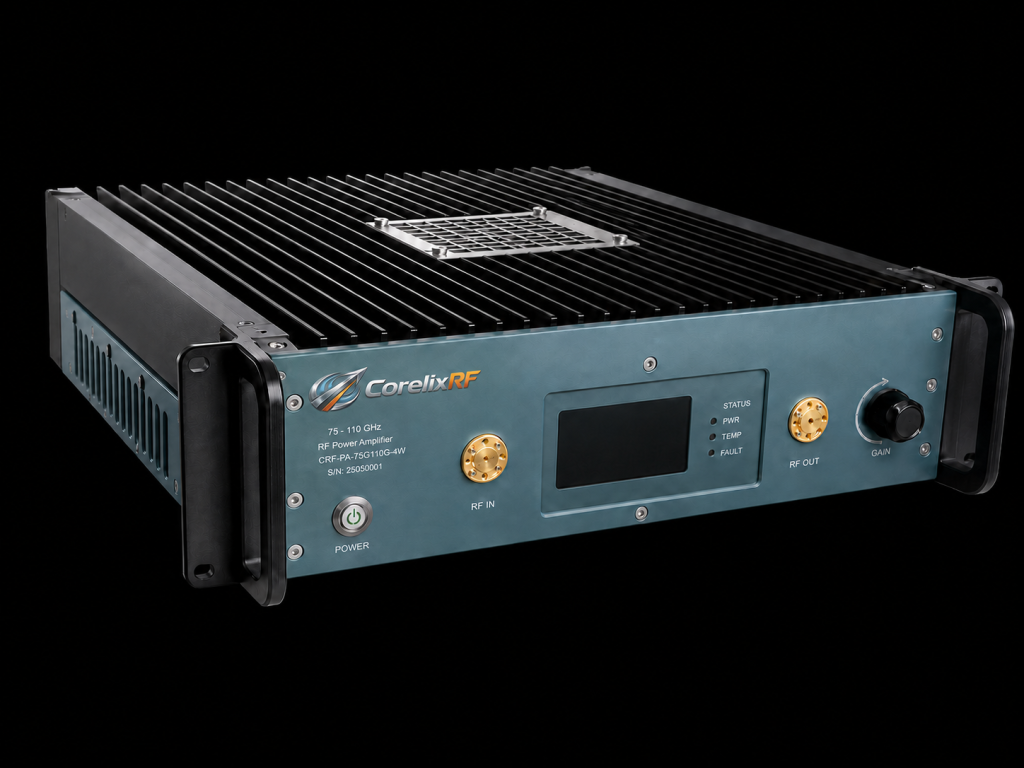
The CRF-PA-75G110G-4W is a public representative model name in CorelixRF’s 75-110 GHz W-band millimeter-wave amplifier platform family. CorelixRF publicly lists CRF-PA-75G110G options including 1W, 2W, 3W, and 4W, while stating that detailed specifications, test data, and datasheets are released after engineering inquiry review.
For W-band projects, this inquiry-based approach is important. At 75-110 GHz, interface selection, waveguide transitions, fixture loss, calibration method, thermal structure, and measured data can decide whether an amplifier is suitable. A public model name helps start the review, but it should not be treated as a complete integration specification.
Why W-Band RFQ Details Matter
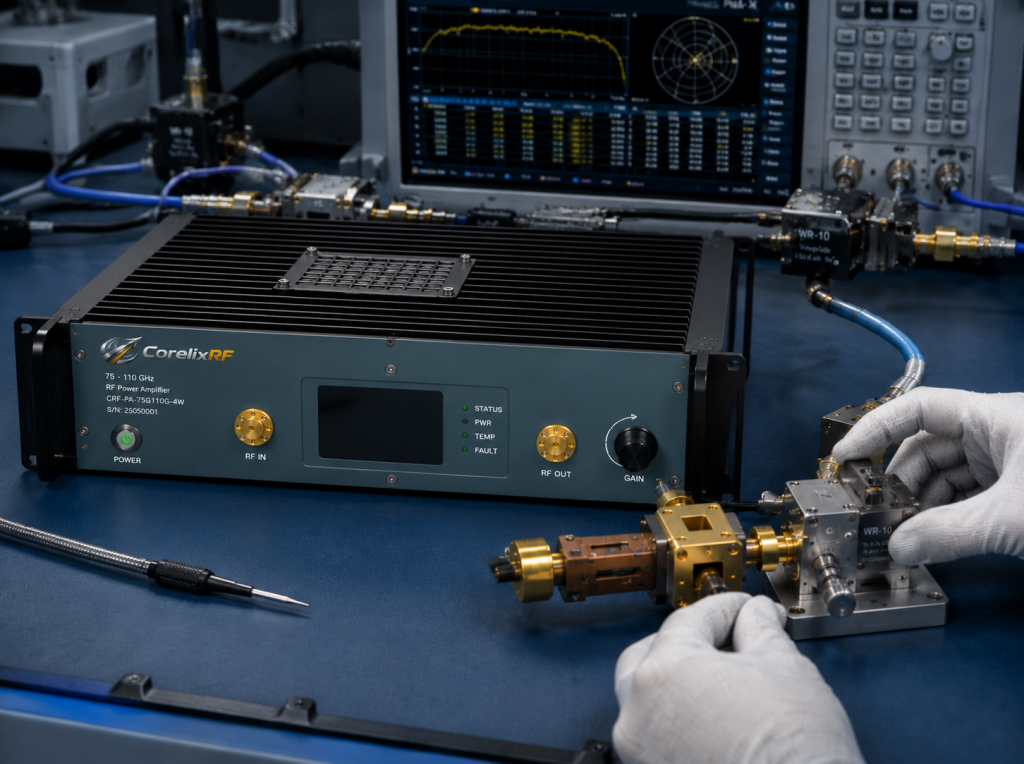
W-band systems are sensitive to mechanical and RF path details. Small changes in waveguide alignment, transitions, adapters, or load condition can affect measured output and repeatability. A good RFQ for CRF-PA-75G110G-4W should therefore describe the full test setup instead of only requesting a datasheet.
Relevant uses may include W-band component testing, high-frequency communication research, radar front-end validation, mmWave sensing evaluation, and laboratory RF chain development. Each use case may require different output evidence, interface drawings, or control behavior.
Frequency Requirement
The public platform family covers 75-110 GHz. Buyers should state whether they need the full W-band span or a narrower section such as a component test window or communication experiment band. Full-span review may require different documentation than spot-frequency validation.
If the project needs multiple operating bands, list them separately. If only one short range is required, do not hide that behind a broad 75-110 GHz request.
Output and Interface Review
The model name includes 4W, but the output point must be defined. At W-band, the useful power at the device under test may be lower than amplifier output after transitions and fixture loss. Provide the expected waveguide or interface path, load type, calibration approach, and measurement point.
CorelixRF’s mmWave page emphasizes coaxial or waveguide interface review. For a 75-110 GHz project, include waveguide standard if known, mechanical envelope, adapter plan, load rating, and whether the amplifier connects to an antenna, fixture, extender, or test load.
Cooling, Control, and Data
Even at single-digit wattage, W-band hardware can require careful thermal and mechanical planning. State CW or pulsed operation, duty cycle, operating duration, ambient temperature, enclosure condition, and airflow limits.
Control requirements should include enable logic, remote interface, monitoring expectations, and any need for integration with a test station. Ask for datasheet, gain and output data, mechanical outline, interface reference, cooling requirement, and factory test evidence after submitting the application details.
How to Position This Inquiry
The CRF-PA-75G110G-4W is best positioned as a W-band project review path. If the system is below 75 GHz, CorelixRF lists other mmWave families such as 50-65 GHz, 50-75 GHz, and 65-75 GHz. If the system stays below 40 GHz, the standard 18-40 GHz RF power amplifier page may be more appropriate.
FAQ
Is CRF-PA-75G110G-4W publicly listed?
Yes. CorelixRF publicly lists CRF-PA-75G110G representative options including 4W.
What frequency family does it belong to?
It belongs to the 75-110 GHz W-band mmWave platform family.
Are datasheets publicly downloadable?
No. CorelixRF states that detailed specifications, test data, and datasheets are provided after inquiry review.
What should be included in the inquiry?
Include frequency window, output measurement point, interface, load path, operating mode, duty cycle, cooling condition, control needs, documentation requirements, and project stage.