
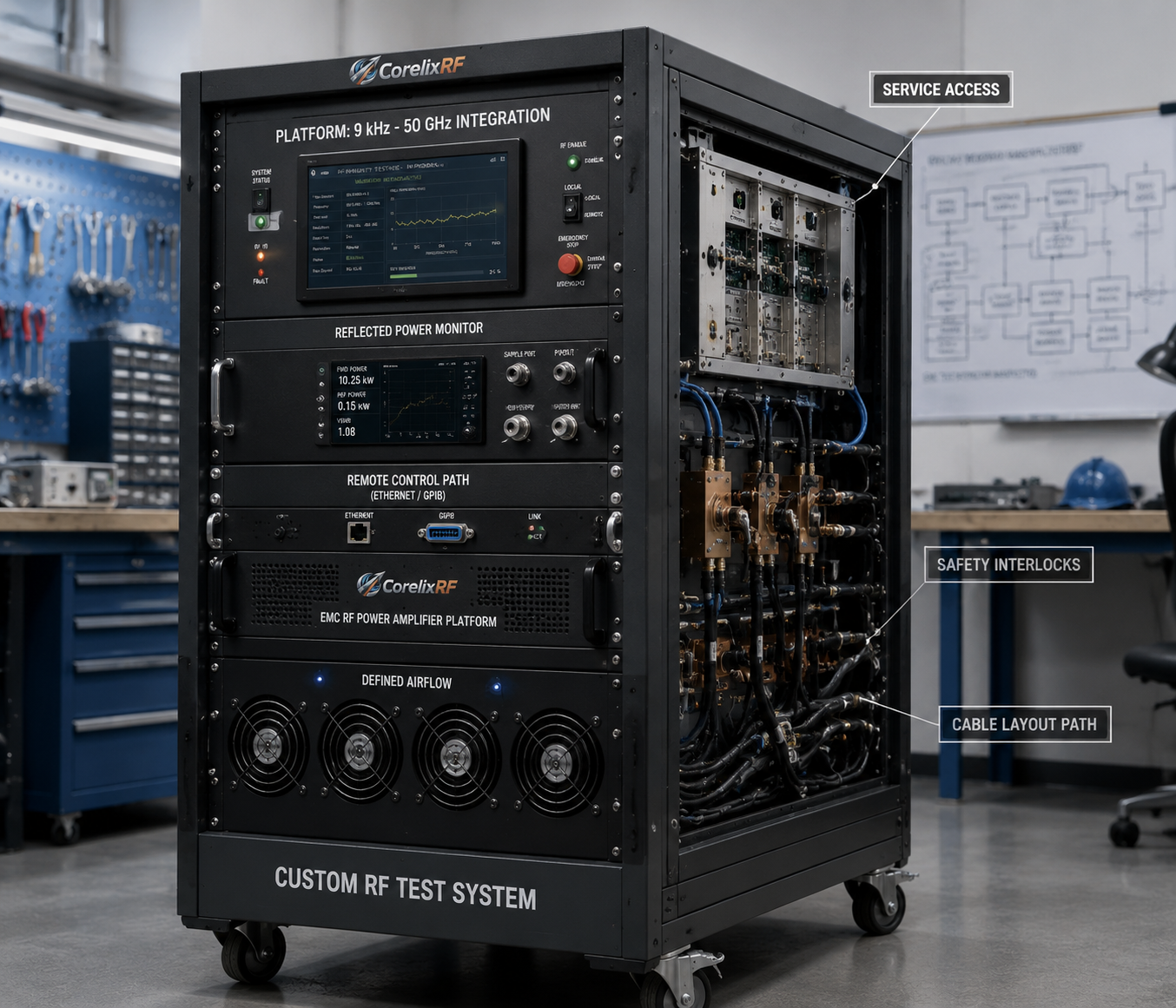
EMC RF amplifier selection is different from general amplifier procurement because the amplifier must support a defined test environment. Full-band output power, load mismatch, reflected power, thermal stability, duty cycle, cooling margin, rack integration, and documentation all matter. A buyer comparing EMC amplifier options should focus on the required test condition, not only the largest rated output number.
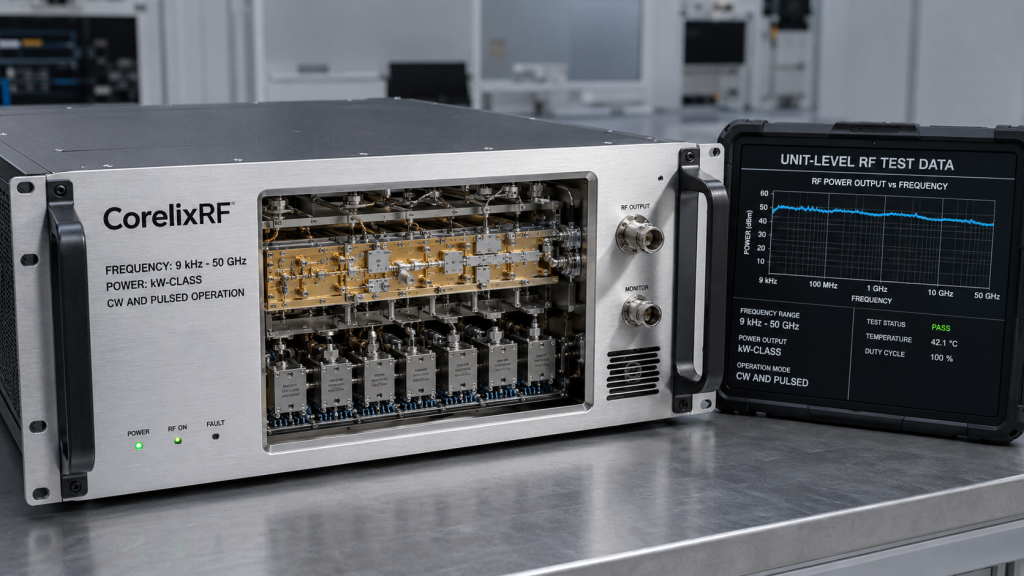
CorelixRF provides factory-direct EMC RF amplifier platforms for laboratory, compliance, RF immunity-related test environments, and custom RF test systems. The platform review spans 9 kHz to 50 GHz, with W-level to kW-level options, CW or pulsed operation review, rack or module integration, OEM / ODM customization, and unit-level RF test data support.
Core EMC Amplifier Review Questions
Start with the test standard or internal validation method. Then define the required frequency range, field or power target, load condition, modulation or waveform, duty cycle, test duration, cooling environment, and documentation package.
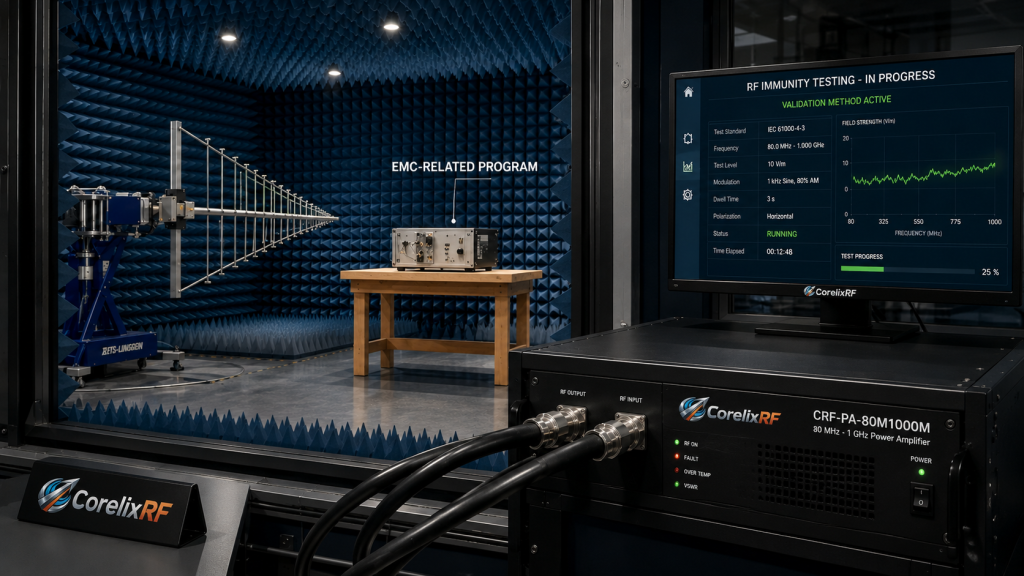
For EMC-related programs, the amplifier may see difficult load conditions. Reflected power and VSWR risk should be reviewed early. Cooling should also be reviewed because RF immunity testing can require sustained operation across multiple frequencies.
Representative Platform Windows
CorelixRF lists several EMC platform directions:
Low-frequency EMC amplifiers: 9 kHz-100 MHz, 9 kHz-250 MHz, or 9 kHz-400 MHz, with 50 W up to 3.5 kW class options. These are relevant for conducted immunity, low-frequency EMC platforms, and high-power RF delivery.
UHF / broadband EMC amplifiers: 20 MHz-1 GHz, 80 MHz-1 GHz, or 100 kHz-1 GHz, with 20 W to 2 kW options. These fit RF immunity systems, laboratory RF amplification, and EMC-related test platforms.
High-power mid-band platforms: 400 MHz-1 GHz, 350 MHz-6 GHz, or 600 MHz-6 GHz, with 16 W to 1.5 kW options. These support broadband RF power delivery and system-level validation.
Microwave EMC amplifiers: 700 MHz-18 GHz, 2-18 GHz, or 6-18 GHz, with 3 W to 1 kW options depending on configuration. These are relevant for high-frequency laboratory RF testing and advanced RF environments.
Why Full-Band Output Data Matters
EMC work cannot rely on a single spot-frequency output claim. Buyers should ask how output power behaves across the required frequency range and under realistic load conditions. A test system may need stable performance at multiple frequency points, not only a maximum number on a datasheet.
This is also why documentation matters. Unit-level RF data, output power review, gain behavior, VSWR observations, thermal notes, and mechanical documentation can reduce risk before procurement.
Rack and System Integration
EMC amplifiers are often installed in racks or integrated into larger test systems. The buyer should define rack height, airflow, remote control, connector path, cable layout, safety interlocks, and service access. If the test platform uses external antennas, couplers, chambers, or loads, those should be included in the review.
FAQ
What frequency range can CorelixRF review for EMC amplifiers?
CorelixRF presents EMC amplifier review from 9 kHz to 50 GHz, depending on platform and project requirements.
What power levels are available?
The EMC platform direction includes W-level to kW-level options, with selected representative ranges up to 3.5 kW class.
Why is EMC amplifier selection project-specific?
Frequency range, power target, load condition, duty cycle, CW or pulse operation, cooling, rack integration, and documentation needs vary by test system.