
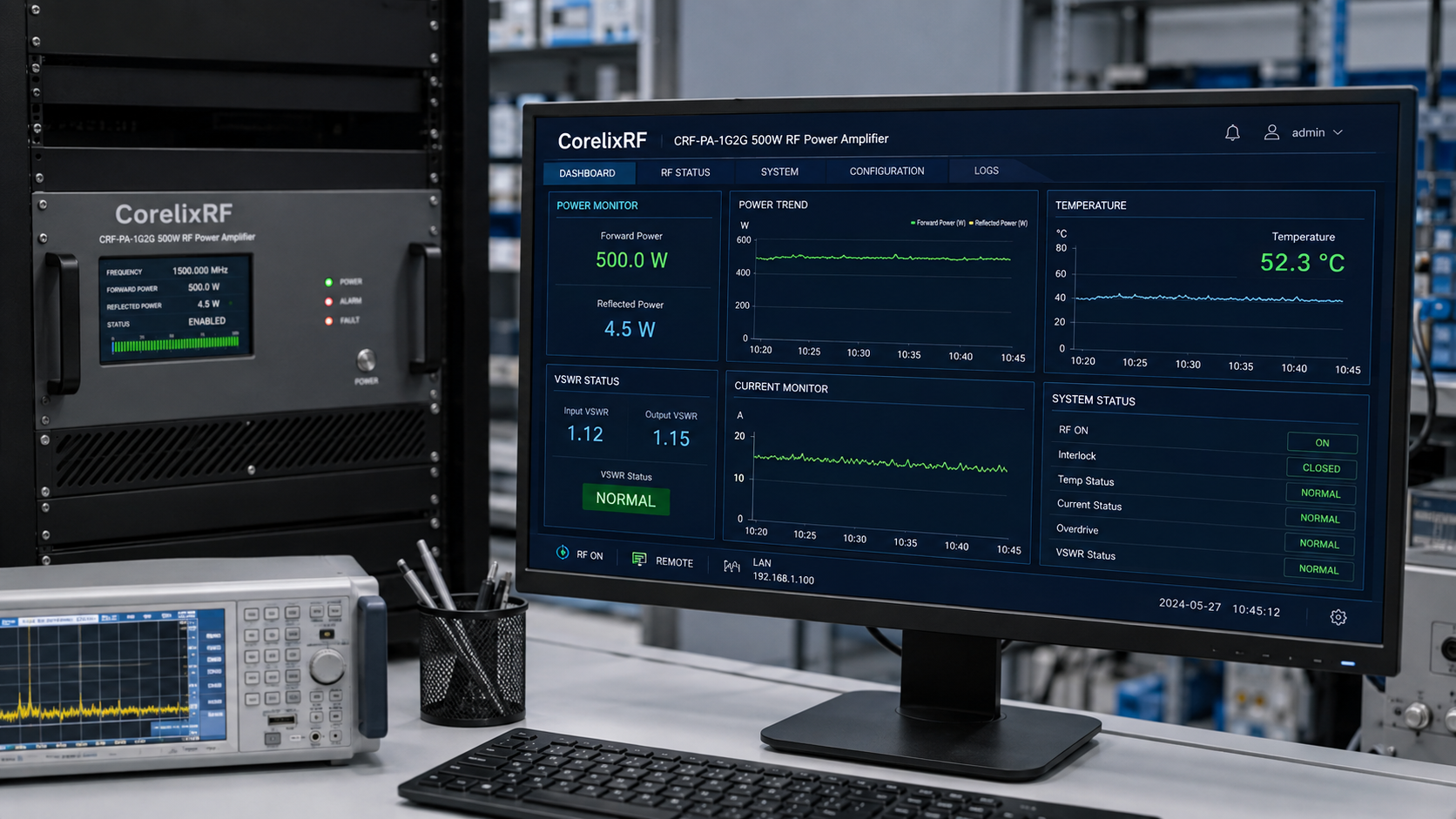
A 1-2 GHz 500W RF power amplifier should be reviewed as a facility item, not only as an RF line item. The CorelixRF CRF-PA-1000M2000M-500W covers 1,000 to 2,000 MHz, provides 500 W rated output power, uses GaN technology, lists 57 dB minimum gain, offers up to 20 dB gain adjustment, and is built in a 6U rack-mount air-cooled configuration.
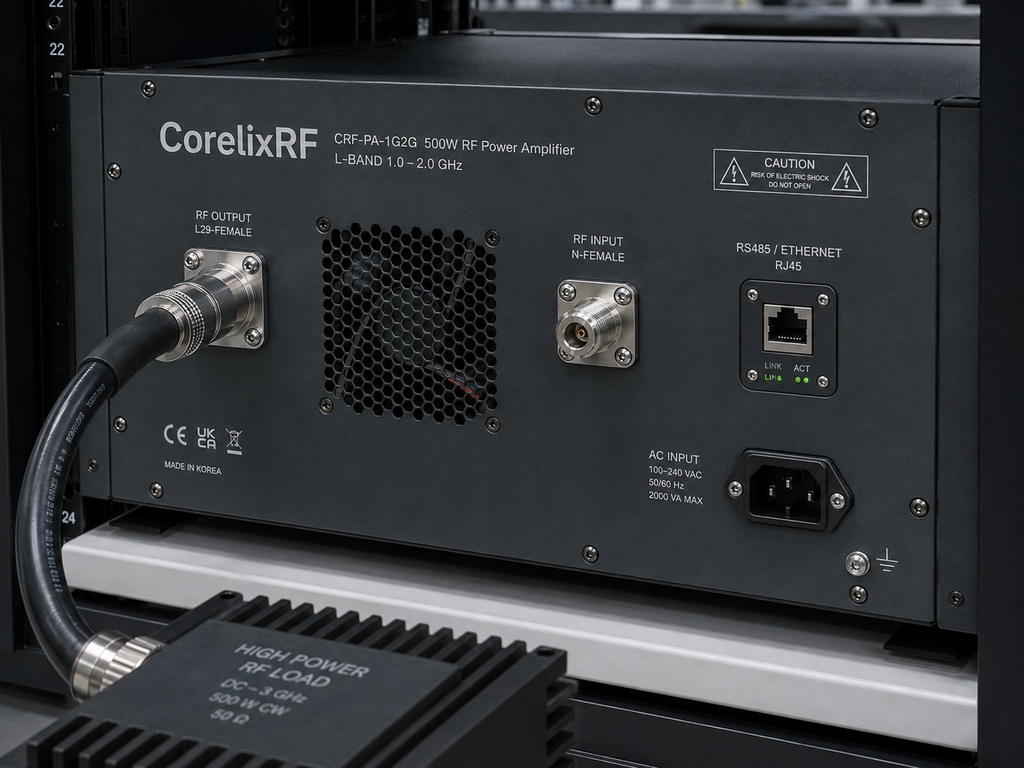
The datasheet also lists N-Female RF input, L29-Female RF output, RS485/LAN control, AC 380 V input, 3,000 W typical power consumption, and a typical weight of 55 kg. Those values make this a serious L-band high-power amplifier project. A good RFQ should confirm the facility, rack, source, load, monitoring, and acceptance plan before price comparison begins.
Requirement 1: AC Power Must Be Released Before RF Work
The listed supply is AC 380 V +/-10%, 50/60 Hz through a three-phase five-wire aviation connector. That requirement should be checked by the site owner before the quote is finalized. The purchase file should identify breaker capacity, grounding, connector ownership, power cable routing, lockout practice, and where the amplifier will be energized for incoming inspection.
A buyer searching for a high power RF amplifier may start with output wattage, but facility power is usually the first practical gate. If the rack cannot support the supply and heat load, the amplifier cannot be accepted safely even when the RF specification is correct.
Requirement 2: The L29 Output Path Needs a Defined Owner
The input connector is N-Female and the output connector is L29-Female on the rear panel. The output path must be reviewed for power rating, cable loss, adapter quality, bend radius, directional coupler limits, load rating, and reflected-power behavior. Do not let a low-cost adapter become the weak point in a 500 W L-band system.
- Confirm the RF load or antenna path before first PA enable.
- Keep the source level below the listed 5 dBm maximum input power.
- Document the input calibration plane and output measurement plane.
- Check whether forward and reverse power monitoring are included.
- Write an alarm response before automated sweeps are allowed.
This brief is not a scoring tool. It is a requirements brief for the facility owner, RF engineer, and buyer. Each requirement should have an owner, an evidence file, and a release condition before the amplifier is ordered. That keeps the article focused on site readiness rather than procurement scoring.
Requirement 3: The 6U Rack Position Must Be Approved
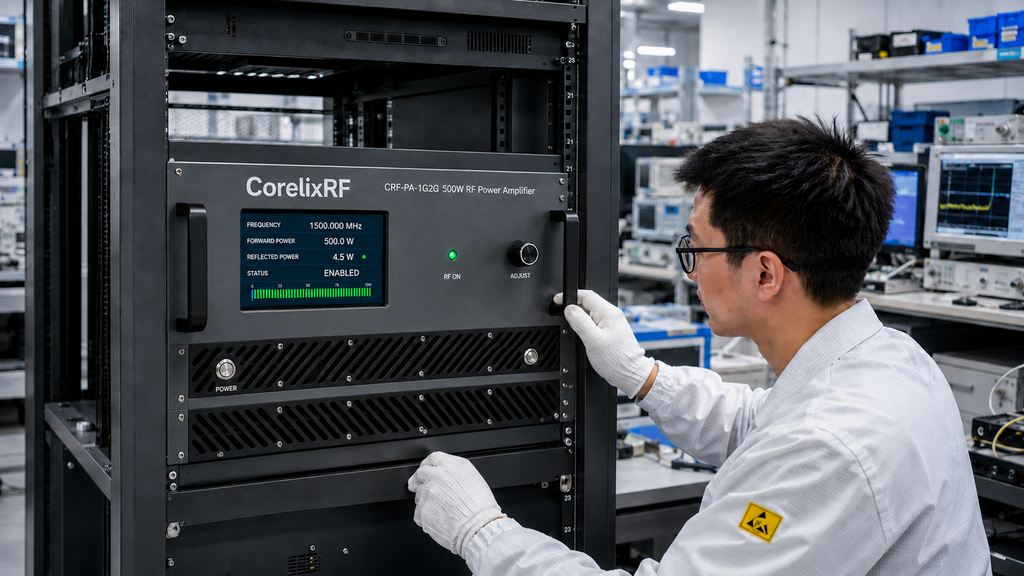
The 6U rack-mount format and 55 kg typical weight require mechanical planning. The site should confirm rack rail capacity, lifting method, rear service clearance, airflow direction, and temperature around neighboring equipment. Air cooling is part of the operating condition, not a minor accessory.
If the amplifier will be installed in a mobile or dense system, CorelixRF should review the mechanical constraints through technical contact before the drawing is locked. A stable rack plan reduces commissioning delays and avoids later retesting caused by thermal uncertainty.
Requirement 4: Remote Control Must Match the Site Workflow
The model lists RS485/LAN control, real-time temperature monitoring, real-time current monitoring, optional forward/reverse power monitoring, optional input power detection, and optional LAN remote monitoring. A manual bench and an automated test rack need different monitoring packages. The RFQ should say whether the host system only enables the amplifier or also logs gain setting, current, temperature, and fault state.
Protection functions include alarm and fault protection, over-temperature protection, over-drive protection, over-voltage protection, and VSWR protection and alarm functions. These protections reduce risk, but the lab still needs a sequence for disabling the source and amplifier after a fault.
Requirement 5: Acceptance Evidence Must Be Named in Advance
The acceptance package should include final mechanical drawing, source power limit, RF load information, frequency-point test data, gain-control state, current and temperature logs, harmonic and spurious notes, and the exact monitoring options included. The datasheet lists -3 dB to +3 dB gain flatness, -13 dBc harmonics, and -60 dBc spurious performance, with values subject to final production test and configuration.
For buyers comparing several L-band options, a lower-power SDR RF amplifier may be enough for waveform development, while this 500 W platform is more appropriate when the rack needs high output power and facility-controlled operation.
The final checklist should be signed by engineering and procurement. Engineering confirms the RF chain and safety sequence. Procurement confirms the model, optional features, documentation needs, and delivery configuration. That split keeps the purchase order aligned with the actual test rack.
Facility Brief Closeout
Before releasing the order, convert the checklist into a one-page closeout record. The record should list the amplifier model, operating band, rated output power, AC input requirement, connector plan, rack location, airflow owner, control interface, monitoring options, and acceptance data expected from the shipped unit. This reduces late questions after the amplifier arrives and gives receiving a clear basis for inspection.
The closeout should also state what is outside the order. If forward/reverse power monitoring, input power detection, GPIB control, special protocol support, or extra documentation are not included, say so explicitly. That prevents optional features from becoming assumed features during commissioning and keeps the published article claim aligned with the actual datasheet and quote.
For a 500 W L-band rack, the highest-risk handoff is often between the RF engineer and the facility owner. The engineer may focus on output power and gain while the facility owner focuses on AC service, heat, weight, access, and safety. Put both views into the same closeout document so neither group assumes the other has already solved the practical installation details.
FAQ
What frequency range and power are listed?
The model covers 1,000 to 2,000 MHz with 500 W rated RF output power.
What output connector is used?
The datasheet lists an L29-Female RF output connector.
What supply is listed?
The listed supply is AC 380 V +/-10%, 50/60 Hz.
Why is facility readiness important?
The amplifier uses a 6U rack format, high output power, and significant power consumption, so power, cooling, rack support, and RF load planning affect safe acceptance.