
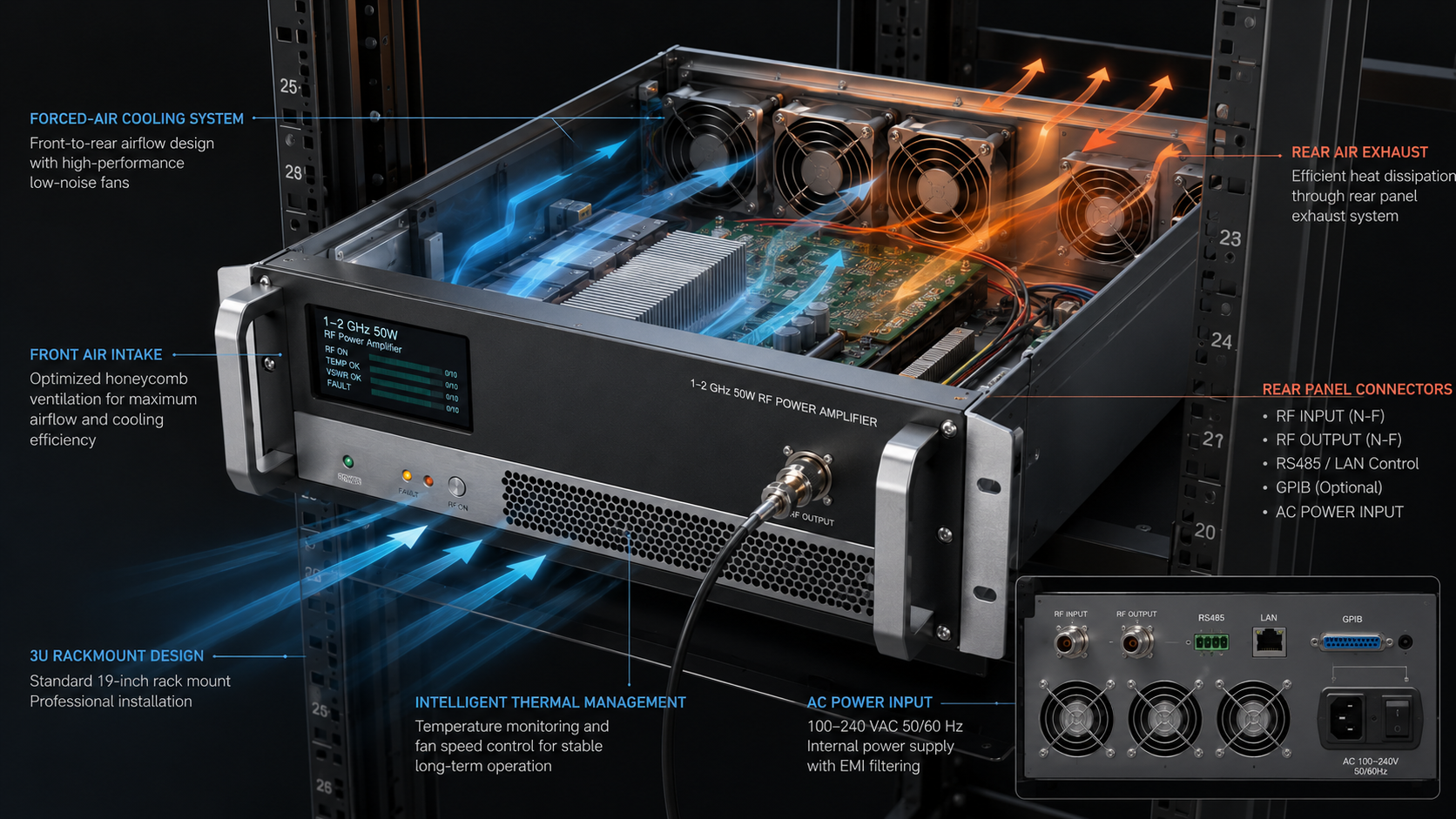
A 1-2 GHz 50W RF power amplifier is often selected when an L-band bench needs more output power without moving into a large pulsed system. The CorelixRF CRF-PA-1000M2000M-50W covers 1,000 to 2,000 MHz, provides 50 W rated output power, and uses a 3U rack-mount air-cooled format. The datasheet lists SMA-Female input and output connectors, 47 dB minimum gain, up to 20 dB gain adjustment, RS485/LAN control, AC 220 V input, and 500 W typical power consumption.
This audit is written for engineers and purchasing teams who need a practical acceptance path before a rack is built. The amplifier is not just a box with gain. It must match the signal source, load, rack airflow, control system, monitoring plan, and documentation package. If those items are missed, a technically suitable GaN SSPA can still create avoidable integration delays.
Scorecard Line 1: Application Fit
The 1-2 GHz range can appear in communication testing, L-band laboratory stimulus, subsystem validation, and RF interference or EW system-level test environments. The datasheet lists test and measurement instrumentation, communication systems, RF interference/EW testing, and aerospace control systems as intended application areas. The buyer should state which of those conditions is closest to the real project, because the acceptance plan changes with waveform, duty condition, and load environment.
For a fixed communication bench, gain repeatability and remote control may matter most. For a broader test bench, the team may care more about sweep behavior, gain control range, and how alarms are recorded. If the project uses an SDR or programmable source, review the source level and waveform path with the SDR + amplifier integration guidance before setting the first drive limit.
Scorecard Line 2: Drive Discipline
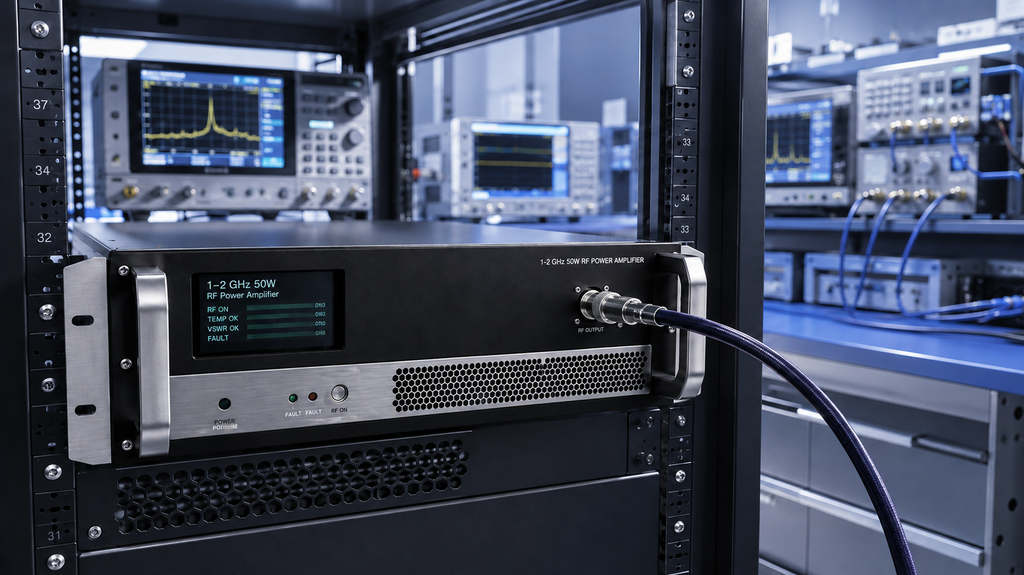
The listed maximum input power is 5 dBm. That value should be written into the bench procedure and, where possible, enforced with attenuation or source-level limits. A 47 dB minimum gain amplifier can convert a small source mistake into a large output-side problem. First-power testing should begin with the RF source disabled, the load connected, and the control system able to read current and temperature.
- Record source power at the amplifier input reference plane.
- Verify the 50 ohm RF path and load rating before enabling the PA.
- Check cable and adapter loss from 1,000 to 2,000 MHz.
- Set a conservative gain-control value for first RF output.
- Capture output power, current, temperature, and alarm status at each test point.
Use a simple score from 0 to 2 for each line before the RFQ is sent. Zero means the requirement is missing, one means it is partly defined, and two means it is documented with an owner. A total score below seven should trigger an engineering review before purchasing asks for price and lead time. This scorecard format keeps the article focused on decision readiness instead of reading like a generic product overview.
Scorecard Line 3: Rack Readiness
The source data lists a 3U rack-mount mechanical form factor, air cooling, and 16 kg typical weight. That makes the rack audit more than a dimensional check. Airflow direction, rear clearance, cable bend radius, AC feed, ground practice, and service access should all be reviewed before installation. A rack with poor air movement can reduce confidence in temperature readings and long-duration test stability.
CorelixRF’s contact page asks buyers to share frequency range, output power, operating mode, load condition, cooling requirement, connector preference, and control interface. That matches the practical review needed here. When the rack is still flexible, use CorelixRF engineering review to confirm the right path rather than forcing a standard 3U unit into a space that was designed for a smaller module.
Scorecard Line 4: Control and Monitoring
The datasheet lists real-time temperature monitoring, real-time current monitoring, optional forward/reverse power monitoring, optional input power detection, and optional LAN remote monitoring. Those optional items should be decided before quotation. A manual bench may only need basic monitoring and alarms. An automated validation rack may need forward and reverse power values in the test log so a mismatch event can be traced after a long run.
The built-in protection list includes alarm and fault protection, over-temperature protection, over-drive protection, over-voltage protection, and VSWR protection and alarm functions. Those functions reduce risk, but they do not remove the need for a written fault response. Define whether the controller turns off the source, disables PA enable, stops a sweep, or requires operator acknowledgement.
Scorecard Line 5: Commercial Completeness
A focused RFQ for this solid state RF power amplifier should include the operating band, 50 W output requirement, CW or pulse condition, source power, desired gain-control behavior, connector plan, rack constraints, operating temperature, monitoring options, and documentation needs. If the output will feed an antenna, include the antenna/load condition and known VSWR concerns.
The best outcome is not simply receiving a datasheet. The best outcome is a documented baseline: final mechanical drawing, control protocol if applicable, and test data that match the ordered configuration. That gives engineering and procurement a shared file for installation, acceptance, and later maintenance.
Acceptance Record for Purchasing
Procurement should keep the acceptance record simple enough that a non-RF buyer can verify it, but detailed enough that the lab can repeat it later. A practical record includes the exact model, serial or project reference after quotation, supply voltage, cooling state, RF load, frequency points, input drive, gain setting, measured output power, current, temperature, and alarm state. When this file is attached to the purchase package, future reorders and service questions become easier to resolve.
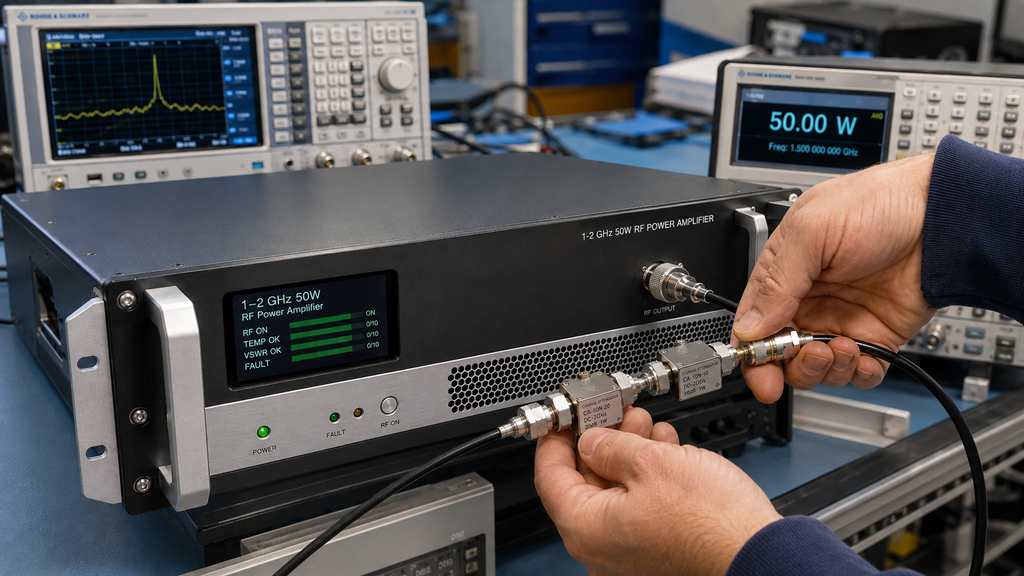
The same file should note which features are optional and which are included in the quoted configuration. Forward/reverse power monitoring, input power detection, LAN remote monitoring, and GPIB control should not be implied unless they are explicitly included. That distinction protects both the buyer and the supplier because the installed rack behavior will match the documented configuration.
FAQ
What frequency range does the CRF-PA-1000M2000M-50W cover?
It covers 1,000 to 2,000 MHz with 50 W rated RF output power.
What connectors are listed?
The datasheet lists SMA-Female input and SMA-Female output connectors.
What control interfaces are listed?
RS485 and LAN are listed for control.
What should be confirmed before ordering?
Confirm waveform mode, source level, rack airflow, monitoring options, control protocol, and documentation needs.