
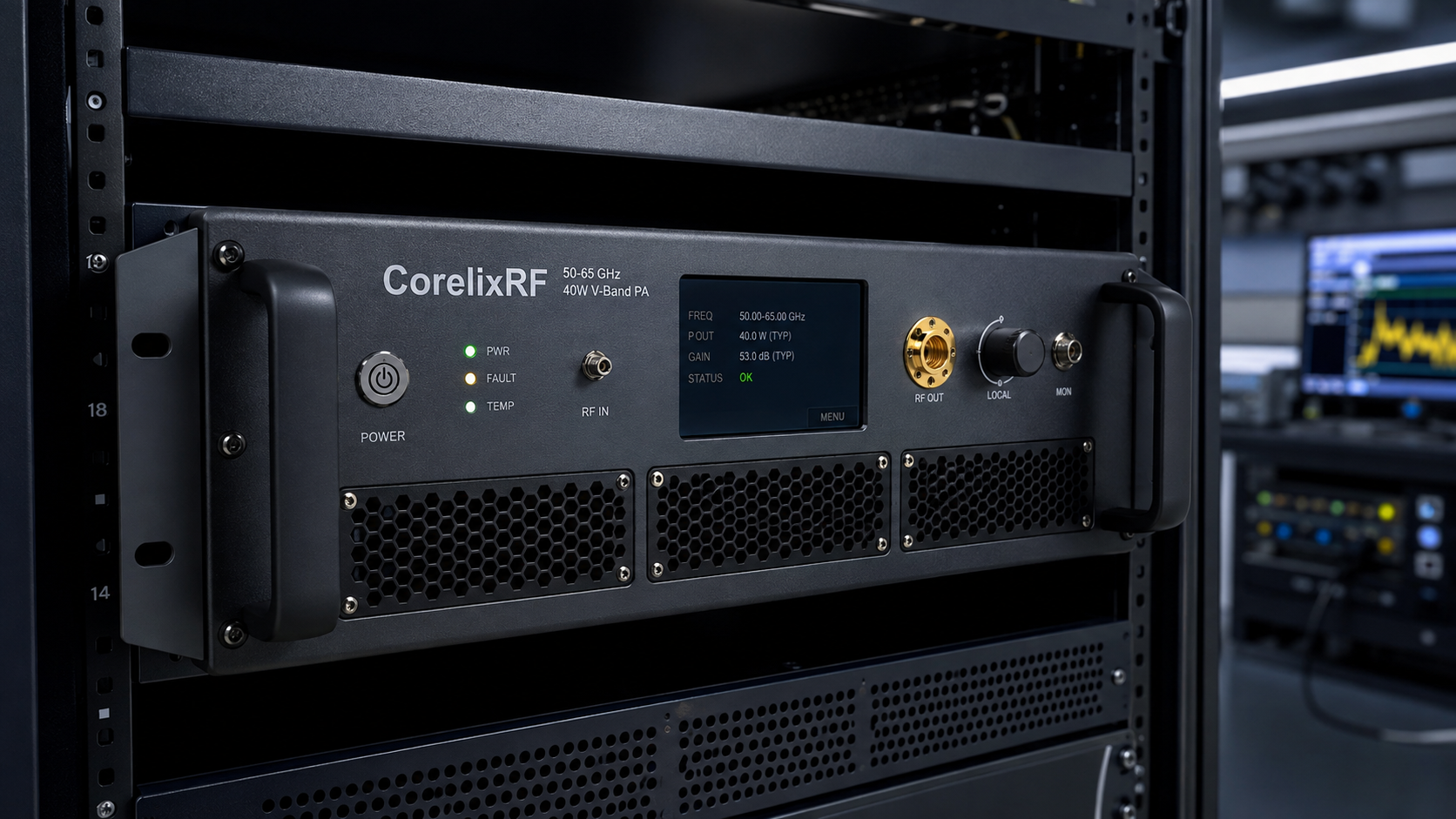
To: RF procurement, system engineering, and test rack owners. Subject: RFQ readiness for the CorelixRF CRF-PA-50000M65000M-40W, a 50-65 GHz V-band power amplifier with 40 W output power. This memo is intentionally written for decision alignment. The hardware is technical, but the purchase risk is cross-functional: RF engineering owns the frequency plan, mechanical engineering owns the WR15 path, software owns remote control, and procurement owns quote completeness.
Executive Decision
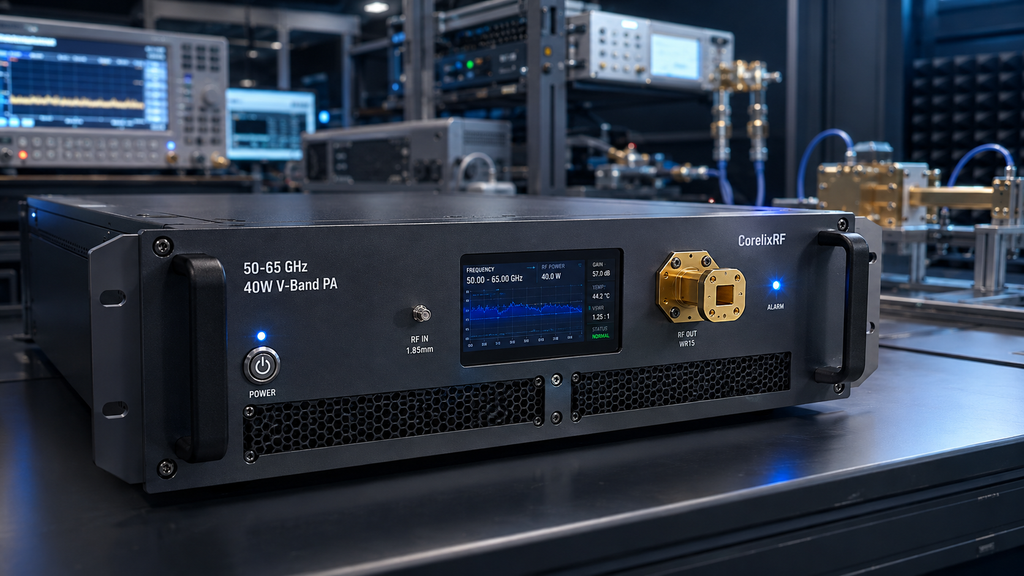
Proceed with a quote request only when the system needs a 50-65 GHz, 40 W V-band amplifier and the rack can support a 19-inch 4U forced-air configuration. The datasheet lists 46 dB minimum small-signal gain, -8 dB to +8 dB small-signal gain flatness, up to 15 dB gain control range, 1.85 mm female RF input, WR15 output, RS485 and LAN control, and AC 220 V +/-10% power input. Those details make the model a serious mmWave power amplifier purchase, not an accessory.
Why This RFQ Needs Management Attention
V-band systems fail late when ownership is unclear. One team may assume the WR15 output is a simple connector choice. Another may assume LAN control is ready by default. A third may assume the rack has enough airflow because it has open slots. The RFQ must make these assumptions explicit. Otherwise the amplifier can arrive before the rack, software, waveguide support, or acceptance procedure is ready.
Commercial Risk of an Incomplete RFQ
The cost of a weak RFQ is not limited to a wrong part number. It can create schedule loss, retesting, fixture redesign, and unclear acceptance responsibility. For a RF power amplifier at 50-65 GHz, the measurement chain is expensive and sensitive. If source level, waveguide alignment, cooling condition, and control protocol are not defined in advance, the team may spend the acceptance window separating amplifier behavior from setup error.
Required RFQ Attachments
- Operating band and whether 40 W is required across the full 50-65 GHz range or at selected points.
- Input source power, sweep method, waveform condition, and expected gain setting.
- WR15 output connection plan, waveguide support, flange access, and service clearance.
- Rack slot, airflow direction, ambient temperature, and neighboring heat sources.
- RS485 or LAN control preference, monitoring needs, alarm behavior, and fault reset process.
- Acceptance test plan, calibration plane, and required final production data.
Technical Basis for the Memo
The CRF-PA-50000M65000M-40W is built on advanced GaN technology and is positioned for test and measurement instrumentation, communication systems, RF interference system-level testing, and aerospace control. Harmonics are listed at -20 dBc and spurious at -60 dBc. Operating temperature is listed from 0 deg C to +50 deg C. Real-time temperature monitoring, real-time current monitoring, optional forward/reverse power monitoring, and optional LAN remote monitoring are listed. Protection includes alarm and fault functions, over-temperature, over-drive, over-voltage, and VSWR protection and alarm functions.
Decision Boundary
If the requirement changes frequency range, interface, enclosure, monitoring, cooling direction, or acceptance condition, the team should not stretch the standard RFQ. It should request custom RF amplifier review. If the project instead needs a lower mmWave band, compare the requirement with CorelixRF’s 18-40 GHz RF amplifier platform before locking the V-band path.
Action Requested
Before purchase, assign one owner for RF performance, one owner for rack and waveguide integration, one owner for control software, and one owner for acceptance data. Send CorelixRF the complete operating case instead of only the model name. That will make the quote more useful and reduce the risk of late engineering clarification.
Memo Addendum: Approval Gate
The purchase should have an approval gate before the quote is finalized. RF engineering should approve the 50-65 GHz output requirement and measurement plane. Mechanical engineering should approve WR15 support, rack access, and airflow. Software should approve RS485 or LAN control expectations. The test owner should approve acceptance data and fault recovery. Procurement should then send the complete package instead of collecting those answers after supplier review has already started.
This approval gate is especially useful for high-power V-band racks because the amplifier is rarely the only long-lead or high-risk item. Waveguide hardware, loads, couplers, power measurement equipment, and control software may all need schedule coordination. A complete memo gives CorelixRF a clearer technical picture and gives the buyer a better internal record of why the 40 W WR15 configuration was selected.
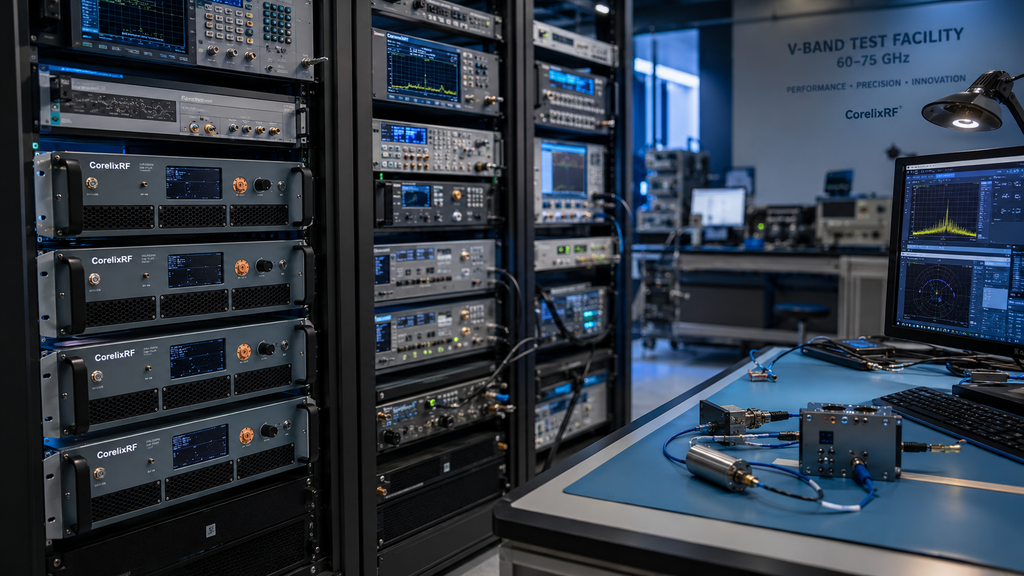
The memo should close with a simple business test: can the receiving team install, power, control, load, measure, and safely stop the amplifier on day one? If the answer is no, the purchase package is incomplete. That does not mean the model is wrong. It means the organization has not yet prepared the rack, waveguide path, control interface, and acceptance procedure needed for a 40 W V-band amplifier. This question is direct, but it prevents expensive hardware from waiting on avoidable internal coordination. It also gives procurement a clear reason to pause until engineering confirms readiness and the lab schedule is realistic. That pause is cheaper than rework.
FAQ
Why is this treated as a cross-functional purchase?
Because RF performance, waveguide mechanics, rack cooling, software control, and acceptance testing all affect success.
What output interface is listed?
The output interface is WR15, with a 1.85 mm female RF input.
Does the model support LAN control?
Yes. The datasheet lists RS485 and LAN control.
Why use a memo format?
A memo format helps procurement and engineering align ownership before ordering a high-power V-band rack amplifier.