
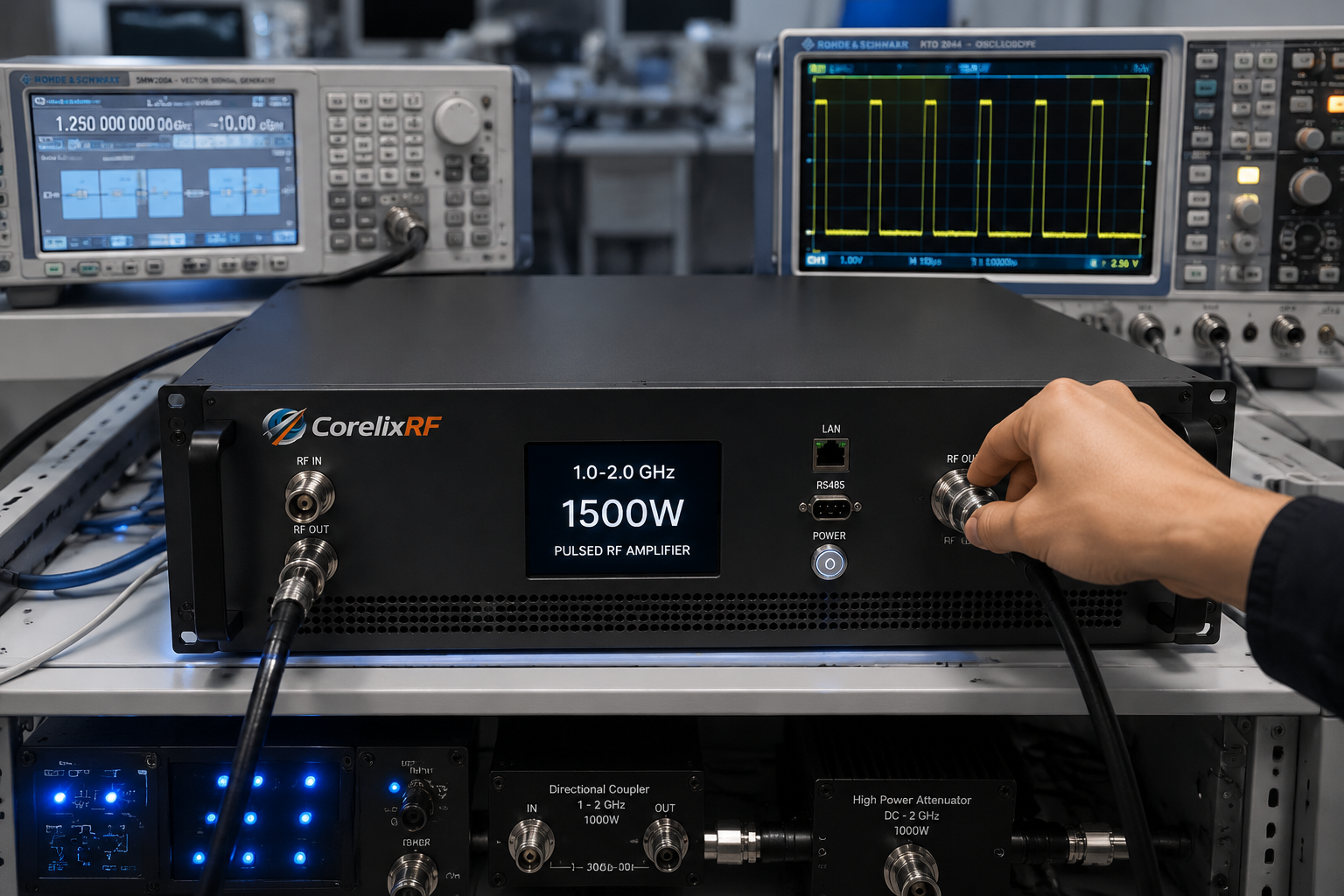
The CRF-PA-1000M2000M-1500W pulsed RF amplifier is a high-power L-band platform for projects where pulse behavior is as important as frequency and rated output. A buyer may begin with “1.5 kW pulsed amplifier,” but a safe RFQ must also define pulse width, duty cycle, pulse repetition behavior, cooling, control, protection, load condition, and the documentation needed before shipment.
CorelixRF lists the pulsed RF amplifier platform as covering 1.0-3.2 GHz model options from 300 W to 1500 W. In the standard model table, CRF-PA-1000M2000M-1500W is listed for 1000-2000 MHz, 1500 W rated output, 62 dB gain, 1-50 microsecond pulse width, 5% duty cycle, RS485/LAN control, and 19-inch 5U / 35 kg structure.
Pulse context comes before output power
For a high-power pulsed RF amplifier, rated output power does not stand alone. A 1500 W pulse condition must be reviewed together with pulse width, duty cycle, pulse frequency, thermal margin, protection behavior, and input drive level.
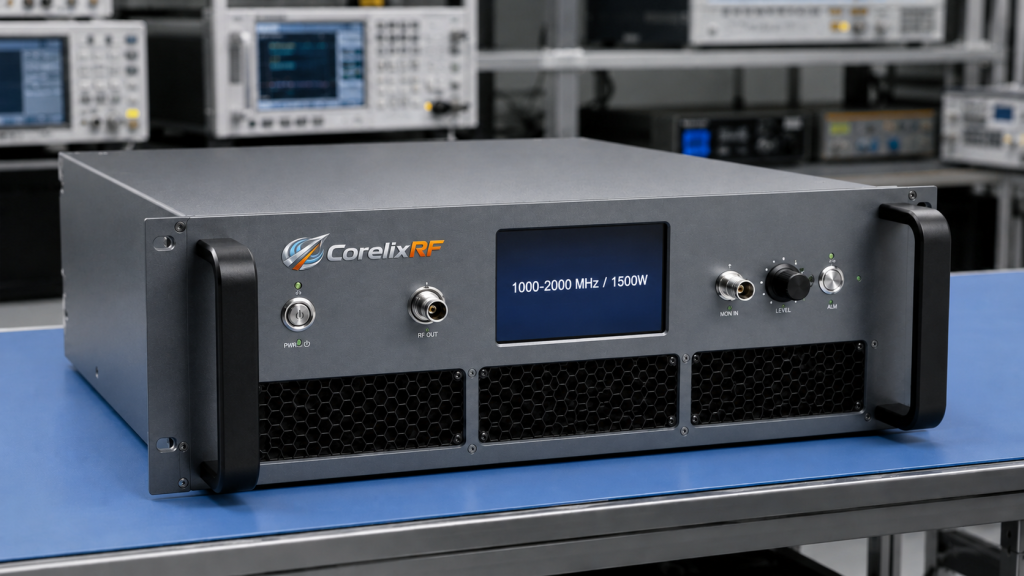
The listed 1-50 microsecond pulse width and 5% duty cycle are model-level references. If the project needs a different pulse shape, longer pulse width, higher duty cycle, different pulse repetition frequency, or special timing behavior, the RFQ should state those needs directly. CorelixRF notes that custom pulsed RF amplifier configurations can be reviewed when pulse condition, interface, or mechanical structure differs from the listed platform.
L-band frequency coverage
The 1000-2000 MHz range can support L-band RF output, communication test platforms, RF chain validation, and system-level pulsed RF projects. However, the buyer should specify whether the whole 1-2 GHz range is needed or whether the system uses a narrower band inside that range.
If the project is narrowband, a sub-band review may help align gain, output power, thermal behavior, and validation points. If the project requires full-band operation, request measured data and acceptance points across the required range.
Gain, drive level, and system chain
The model is listed with 62 dB gain. This is useful for drive calculations, but the source chain must still be defined. Provide signal generator or SDR output level, pulse modulation path, driver stages, attenuators, filters, switches, and any blanking or timing control requirement.
Overdrive should be avoided, especially in a high-power pulse system. Ask CorelixRF to review input level, enable timing, pulse gating, and protection logic with the actual system architecture.
Mechanical and cooling review
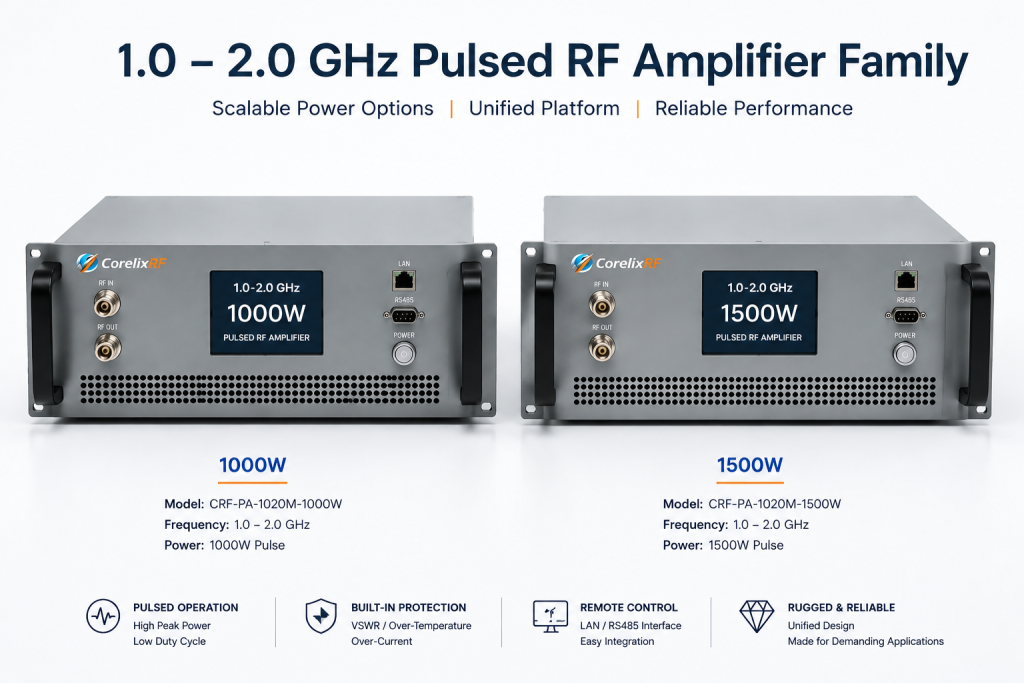
The listed 19-inch 5U, 35 kg structure tells buyers that this is a rack-level amplifier, not a small module. Plan rack space, lifting/installation process, airflow, AC or DC distribution if applicable, rear-panel access, RF cable routing, and service clearance before quotation.
Thermal review should include ambient temperature, pulse duty condition, operating duration, airflow path, rack ventilation, and whether the amplifier will run in repeated test cycles. Duty cycle changes can significantly affect cooling needs.
Control and monitoring
RS485/LAN control is listed for the CRF-PA-1000M2000M-1500W. Define whether the system needs remote enable, forward/reverse power monitoring, alarm status, input power detection, pulse control logic, or automated test integration. CorelixRF notes that control and monitoring options can be reviewed for pulsed RF projects.
FAQ
What is the CRF-PA-1000M2000M-1500W?
It is a CorelixRF 1000-2000 MHz pulsed RF amplifier platform with 1500 W rated output listed for high-power L-band RF projects.
What pulse condition is listed?
CorelixRF lists 1-50 microsecond pulse width and 5% duty cycle for this model.
What gain is listed?
The pulsed amplifier table lists 62 dB gain for CRF-PA-1000M2000M-1500W.
What control interface is available?
RS485/LAN control is listed for this platform.
What should be included in the RFQ?
Send frequency range, rated output, pulse width, duty cycle, pulse frequency, gain, input level, connector, control interface, cooling method, rack limits, quantity, and application.
Conclusion
The CRF-PA-1000M2000M-1500W should be specified as a pulse system, not just a 1500 W amplifier. Frequency range, pulse condition, thermal margin, control interface, protection logic, rack format, and validation data all need early review before production or integration.