
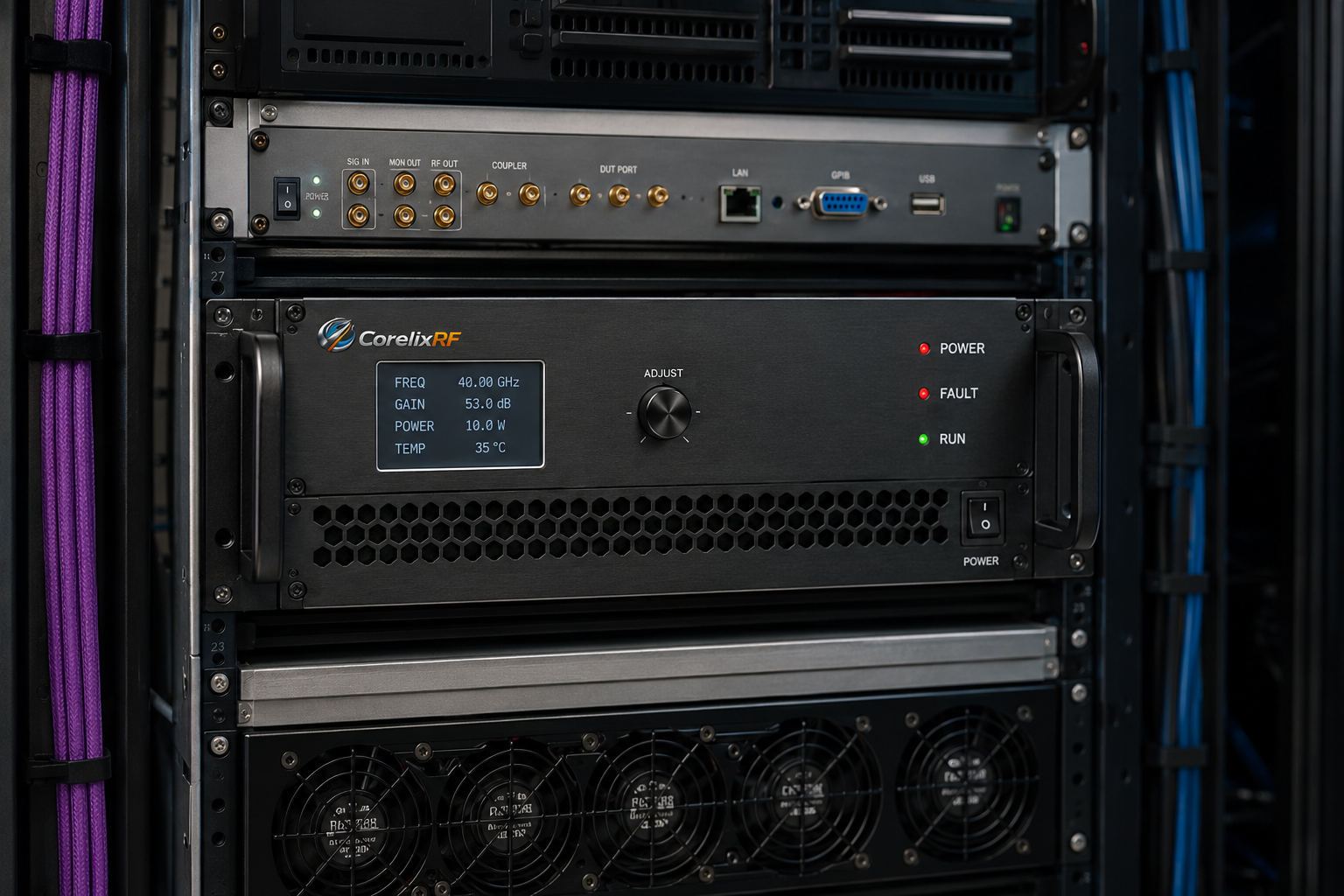
An 18-40 GHz 20W RF power amplifier is selected for a different class of problem than a lower-frequency broadband module. At mmWave frequencies, connector transitions, waveguide output, cable loss, rack airflow, gain behavior, and measurement setup can all change the power that actually reaches the device under test. A usable amplifier selection must therefore combine frequency, output power, interface, cooling, and test evidence rather than relying on output power alone.
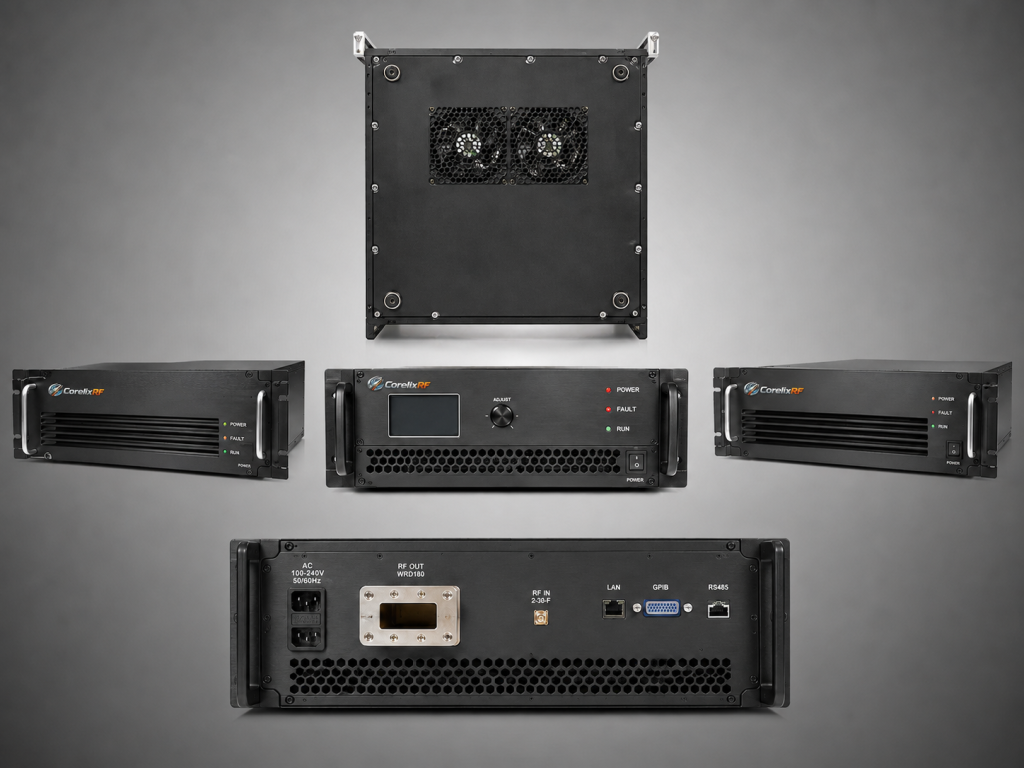
CorelixRF lists the CRF-PA-18000M40000M-20W as part of its 18-40 GHz standard model range. The public product page identifies 18-40 GHz coverage, 20 W output power, 43 dB gain, WRD180 RF output, and a 19-inch 3U enclosure for the 20 W class. It also notes that the 18-40 GHz series uses 2.92 mm-F input, RS485/LAN/GPIB options, and rack or custom chassis review depending on the project.
Why 18-40 GHz Amplifiers Require More Review
At 18-40 GHz, the RF path is sensitive to more than amplifier specifications. Cable length, adapter quality, waveguide transitions, load match, fixture design, and measurement calibration can materially affect delivered power. A buyer may search for a mmWave RF amplifier and compare wattage, but the real selection should start with the complete path from signal source to DUT or antenna.
CorelixRF’s 18-40 GHz RF power amplifier page frames this correctly. It emphasizes full-band power behavior, connector or waveguide path, measurement setup loss, rack and cooling fit, control interface, and data before ordering. Those are practical engineering checks for Ka-band and broader mmWave testing.
Where the 20W Class Fits
The 20 W model class can be considered for mmWave communication testing, medium-power RF validation, and broadband RF chain evaluation. It provides more output than a compact low-power driver class, while remaining within a 19-inch 3U format according to the public listing. That can make it a useful starting point when the test setup needs significant output but does not require the larger 40 W or 70 W rack classes.
However, 20 W at 18-40 GHz still requires serious integration planning. The WRD180 output path should be checked against the downstream waveguide, transitions, load, or antenna system. If the user expects coaxial output, the connector transition and power behavior should be reviewed before purchase. If the project uses a waveguide load or chamber path, the mechanical fit and calibration plan should be defined early.
Questions to Answer Before RFQ
A strong RFQ for this amplifier should include the exact frequency window, output power target, input signal level, RF input and output interface, rack size limit, cooling preference, control interface, application, quantity, and project stage. If the system does not need the full 18-40 GHz band, tell the engineering team the actual sub-band. A focused-band review may create a better technical path than selecting full-band coverage by default.
The contact page is the right CTA destination because it asks for frequency, output power, operating mode, supply, cooling, connector, control interface, and documentation needs. For broader system context, CorelixRF’s high-frequency platform path also helps buyers compare 6-18 GHz and 18-40 GHz options before committing to a specific model.
Test Bench and System Integration Notes
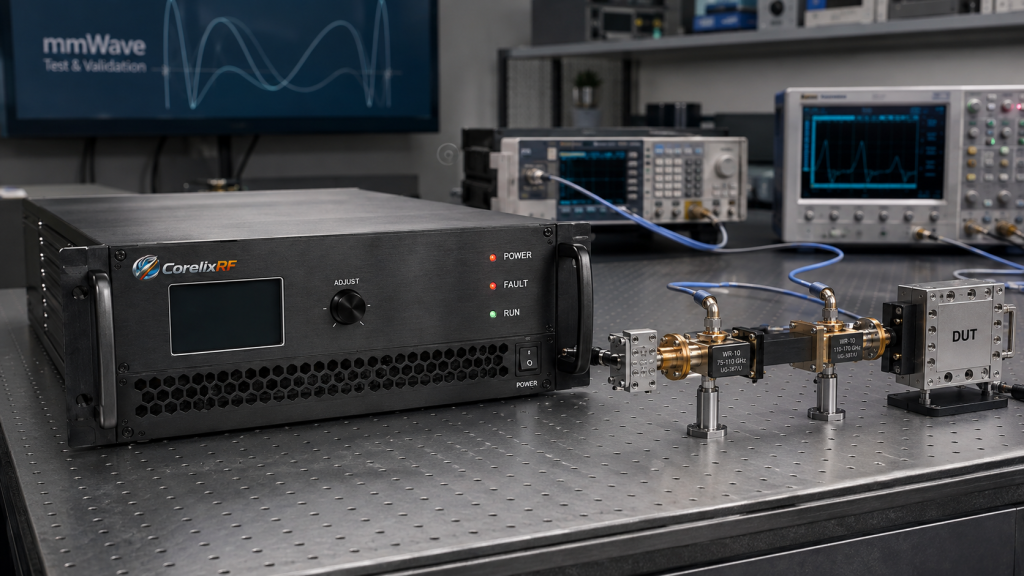
Before applying RF power, confirm that the load path is rated for the expected frequency and power. At mmWave frequencies, a connector that looks mechanically compatible may still create excessive loss or mismatch if it is not appropriate for the band. Engineers should also document adapter stack-up, cable or waveguide loss, coupler coupling factor, calibration plane, and DUT protection limits.
Thermal planning is also important. Rack-mounted mmWave power amplifiers need controlled airflow and installation clearance. If the amplifier will be installed in a production rack, chamber room, or automated station, control interface and monitoring requirements should be included in the initial review.
FAQ
What is the focus keyword for this article?
The focus keyword is 18-40 GHz 20W RF power amplifier.
What model is discussed?
This article discusses CorelixRF CRF-PA-18000M40000M-20W, a publicly listed 18-40 GHz model class with 20 W output power and 43 dB gain.
Why does WRD180 output matter?
WRD180 indicates a waveguide output path for the listed 20 W class. The downstream waveguide, transition, load, or antenna setup must be checked during integration.
Is full 18-40 GHz coverage always required?
Not always. If the project only needs a focused sub-band, that should be shared during RFQ so the engineering team can review the best platform path.
What should be requested with the quotation?
Ask for datasheets, measured data where available, gain and output behavior, connector or waveguide configuration, cooling details, control interface information, and documentation support.