
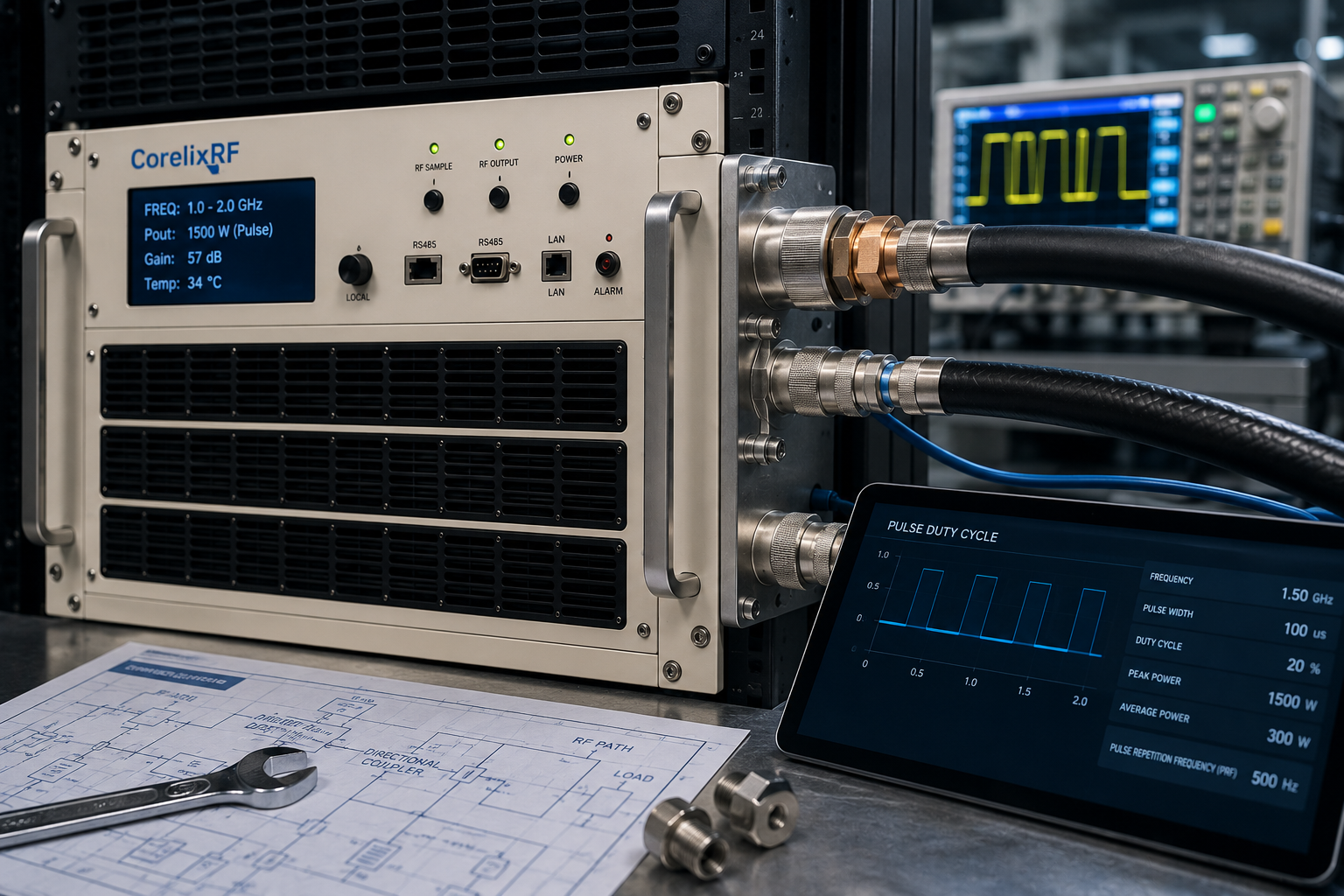
High-power pulsed RF projects are not selected the same way as ordinary CW amplifier modules. A 1000-2000 MHz 1500W pulsed RF amplifier must be reviewed as part of a pulse system: waveform timing, pulse width, duty cycle, load condition, cooling, protection behavior, control interface, rack structure, and test procedure all affect whether the amplifier can be integrated reliably.
CorelixRF publishes CRF-PA-1000M2000M-1500W as a pulsed RF amplifier platform covering 1000-2000 MHz with 1500 W rated output, 62 dB gain, 1-50 us pulse width, 5% duty cycle, RS485/LAN control, and a 19-inch 5U structure with a listed 35 kg weight. These public specifications make it a useful starting point for L-band high-power RF testing, communication validation, radar-related pulse work, and system-level integration where a standard low-power amplifier cannot provide the required pulse output.
Why Pulse Conditions Control the Selection
In pulsed RF systems, output power is only one part of the requirement. Pulse width, duty cycle, pulse repetition behavior, rise/fall behavior, blanking/control logic, thermal accumulation, and load mismatch exposure can be just as important. A 1500 W pulse amplifier may be suitable for one test profile and unsuitable for another if the timing conditions differ.
That is why CorelixRF positions its pulsed RF amplifier page around pulse condition review before production. The listed model provides a baseline, but engineering confirmation should still include the required pulse width, duty cycle, control interface, power supply, monitoring functions, and mechanical configuration.
L-Band Applications That Need More Than a Driver
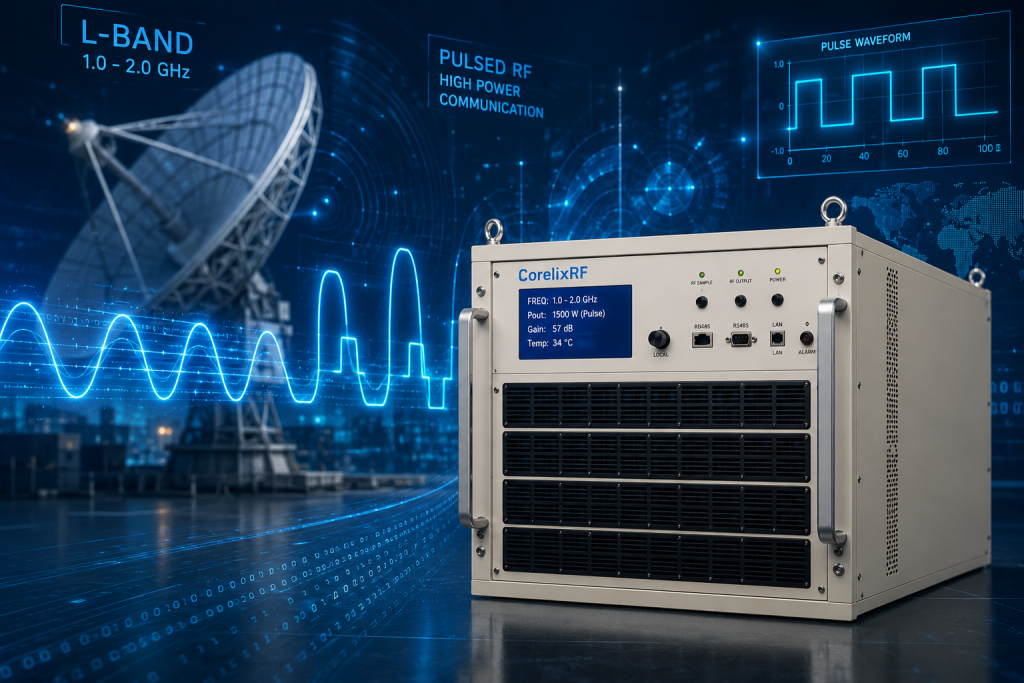
The 1000-2000 MHz range is relevant to many L-band RF projects, including communication test systems, RF chain validation, front-end evaluation, and pulsed subsystem development. At this power level, the amplifier is typically not a casual bench accessory. It becomes a rack-mounted RF subsystem that must be planned around RF safety, cooling, control, and load protection.
For procurement teams, this distinction matters. A buyer may search for an L-band RF amplifier and find many low-power modules, but a 1500 W pulsed platform requires a more complete RFQ. The output connector path, cable rating, load handling, and reflected-power protection assumptions should be reviewed before selection. If the project involves an antenna, RF exposure controls and site procedures should also be part of the discussion.
Integration Details to Confirm
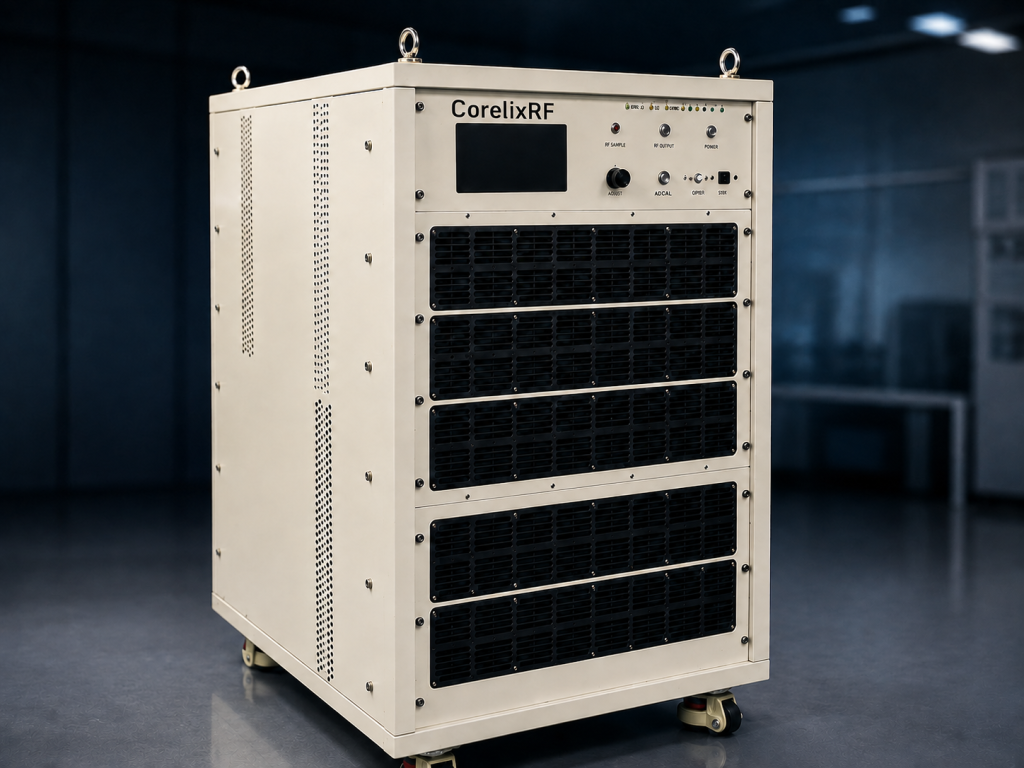
The CRF-PA-1000M2000M-1500W public listing includes RS485/LAN control and a 19-inch 5U format. These details point to rack-level integration rather than simple module mounting. Engineering teams should confirm available rack space, airflow direction, AC or DC power arrangements where applicable, remote command requirements, interlock needs, and how the amplifier will be monitored during tests.
The load path deserves special attention. A high-power pulsed amplifier should be paired with a suitable attenuator, coupler, load, antenna, or DUT path. Reflected power can create risk if the load is mismatched or disconnected. Before applying RF drive, the team should confirm power ratings across the pulse condition, not only average power.
CorelixRF’s contact page asks for frequency range, output power, operating mode, load condition, connector preference, control interface, application, and project stage. Those inputs are exactly the information needed for a pulsed amplifier review.
Standard Model or Custom Pulse Review?
The public model is a useful baseline, but not every pulsed project fits the same pulse timing. If the requirement changes pulse width, duty cycle, repetition rate, control logic, enclosure, or cooling method, a custom pulsed RF amplifier review is more appropriate than assuming the standard platform applies.
The same logic applies when the project needs a different band. CorelixRF lists other pulsed platforms, including 1200-1400 MHz 500 W, 2700-3100 MHz 500 W, and 2900-3200 MHz 300 W models. A project in S-band should not be forced into an L-band amplifier selection. It should start with the actual frequency and pulse condition.
For broader amplifier choices, the RF amplifier platform page helps buyers compare CW, pulsed, EMC, UHF, microwave, and custom paths before opening an RFQ.
FAQ
What is the focus keyword for this article?
The focus keyword is 1000-2000 MHz 1500W pulsed RF amplifier.
What model is discussed in this article?
This article discusses CorelixRF CRF-PA-1000M2000M-1500W, a publicly listed 1000-2000 MHz pulsed RF amplifier platform with 1500 W rated output.
Why are pulse width and duty cycle important?
Pulse timing affects thermal load, RF stress, power supply demand, protection behavior, and whether the amplifier can meet the actual test condition.
What control interfaces are listed for this model?
CorelixRF lists RS485/LAN control for CRF-PA-1000M2000M-1500W.
When should I request a custom pulsed amplifier review?
Request custom review when the required frequency, pulse width, duty cycle, repetition behavior, control interface, rack format, monitoring, or cooling path differs from the listed baseline.