
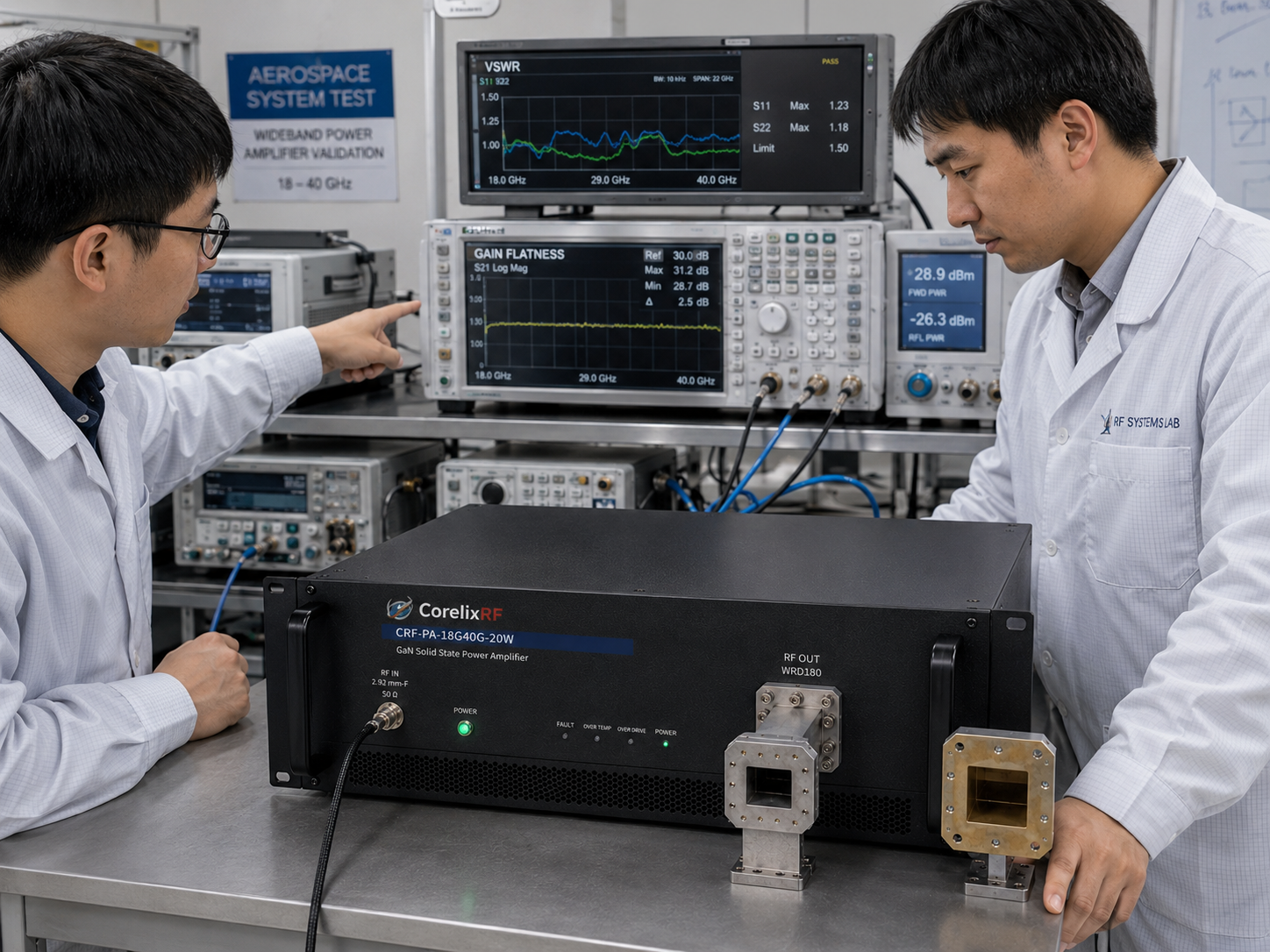
An 18-40 GHz microwave power amplifier is selected when engineers need broadband coverage into high microwave and millimeter-wave-adjacent test ranges. At these frequencies, amplifier selection becomes more sensitive to connector transitions, waveguide interfaces, gain flatness, cooling, and protection strategy.
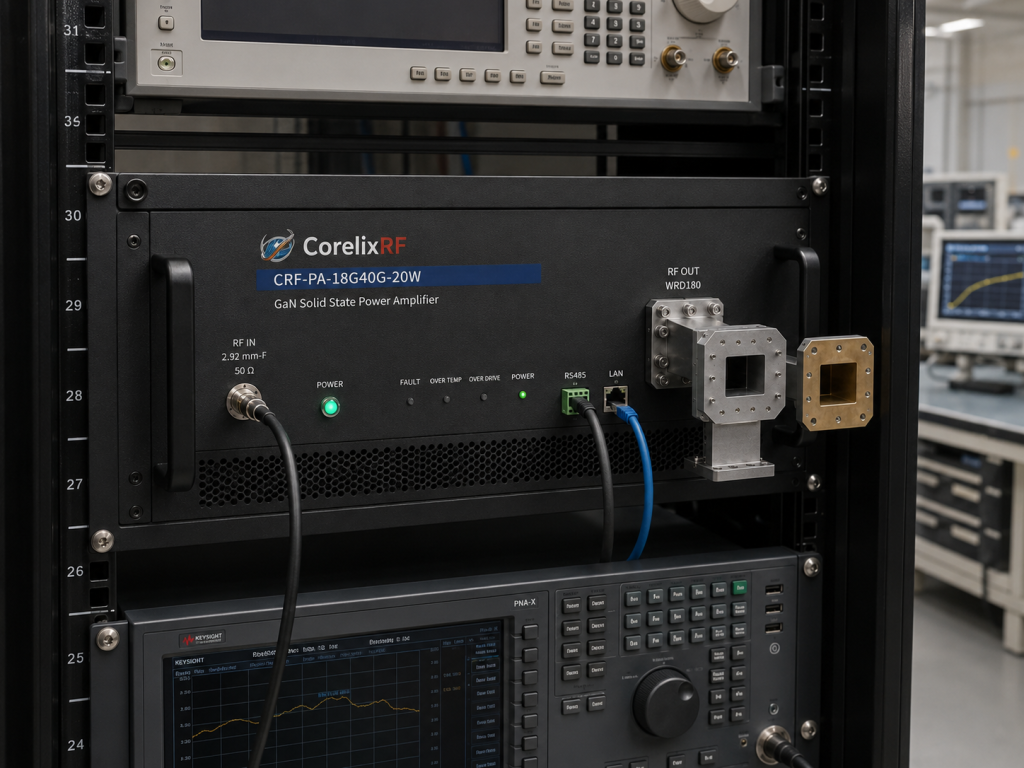
The CorelixRF CRF-PA-18G40G-20W is a GaN SSPA platform operating from 18 GHz to 40 GHz with 20 W saturated output power. The source data lists 43 dB minimum small-signal gain, -6 dB to +6 dB gain flatness, 15 dB gain adjustment, 2.92 mm-F input, WRD180 output, RS485 and LAN control, AC 220 V power, air cooling, and a 19-inch 3U mechanical form factor.
Why 18-40 GHz Requires Careful RF Planning
Wideband microwave operation is less forgiving than lower-frequency RF work. Cable loss, connector repeatability, waveguide transitions, thermal density, and load mismatch can all affect performance. A 20 W rating is meaningful, but it must be reviewed together with output interface, gain control, and operating conditions.
The CRF-PA-18G40G-20W supports test and measurement instrumentation, communication systems, RF interference system-level testing, and aerospace control applications. It is best reviewed as part of a complete RF chain rather than as a standalone power number.
Evaluate Output Interface and Gain Control
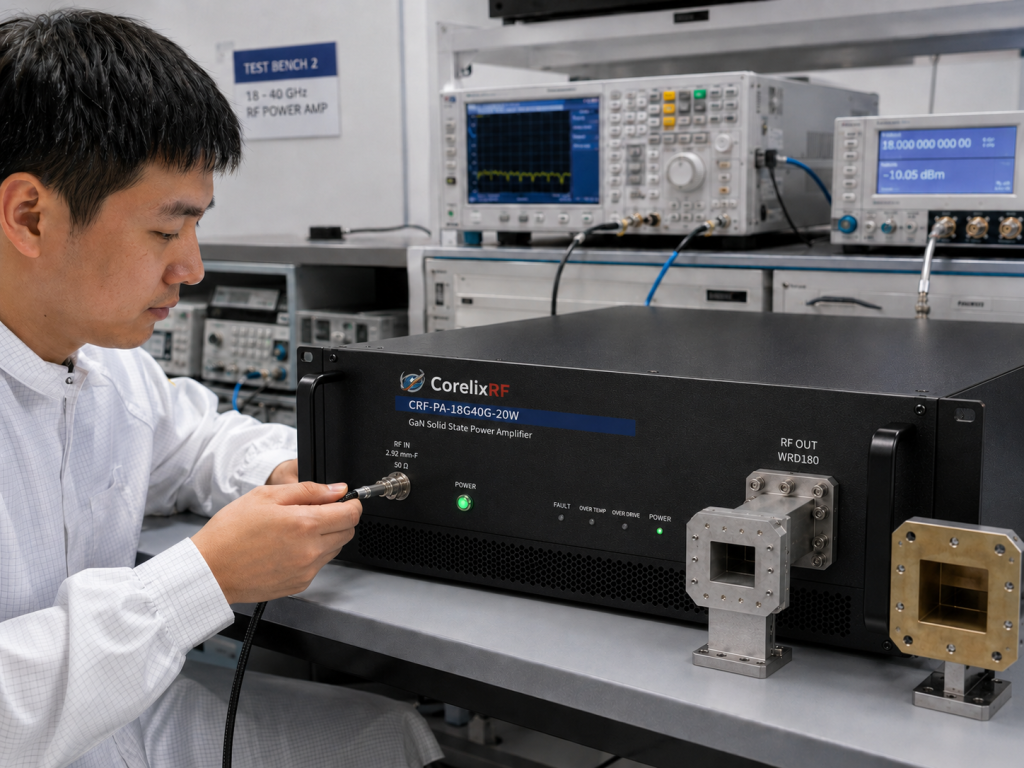
The listed input connector is 2.92 mm-F and the output interface is WRD180. This matters because high-frequency output paths often require careful mechanical alignment and low-loss transitions. Engineers should confirm the mating waveguide, adapters, calibration plane, and output measurement method before final testing.
The amplifier includes 15 dB gain adjustment. Gain control can help system integrators manage output power across frequency, compensate for path loss, or align the amplifier with a specific test profile. When ordering a custom RF amplifier, specify whether gain control should be manual, remote, step-based, or integrated into a larger controller.
Thermal and Rack Integration Considerations
The 18-40 GHz 20 W platform is listed as a 19-inch width, 3U height unit weighing approximately 14.5 kg. Power consumption is listed at about 450 W, and the cooling method is air cooling. These details are important for rack planning, airflow design, and long-duration operation.
Engineers should verify airflow direction, available cabinet ventilation, ambient temperature, and neighboring heat sources. Microwave power amplifiers can be sensitive to thermal stress, and stable cooling helps maintain predictable RF output while reducing system-level risk.
Protection Features for Microwave Systems
The source data includes alarm and fault protection, over-temperature protection, over-drive protection, VSWR protection, and optional forward/reverse power monitoring. These functions are useful because high-frequency test systems may include adapters, antennas, switches, and fixtures that can create mismatch events.
For acceptance testing, request test data for gain, gain flatness, harmonics, spurious performance, and output power. The source data lists -10 dBc maximum harmonics and -60 dBc maximum spurious performance. These values help engineers understand the amplifier’s suitability for sensitive RF test environments.
Project Review Checklist
Before selecting an 18-40 GHz microwave amplifier, provide the exact frequency points, output power target, waveform type, duty cycle, output interface, waveguide requirements, gain adjustment expectations, control interface, cooling environment, and protection requirements. CorelixRF can review final mechanical drawing, test data, and control protocol where applicable.
This type of wideband RF power amplifier is a good fit when a project requires high-frequency coverage, a rack-ready structure, remote control, and protection functions for system integration.
FAQ
What is the focus keyword?
The focus keyword is 18-40 GHz microwave power amplifier.
What output interface is used?
The source data lists WRD180 output and 2.92 mm-F input.
Is remote control supported?
The listed control interfaces include RS485 and LAN.