
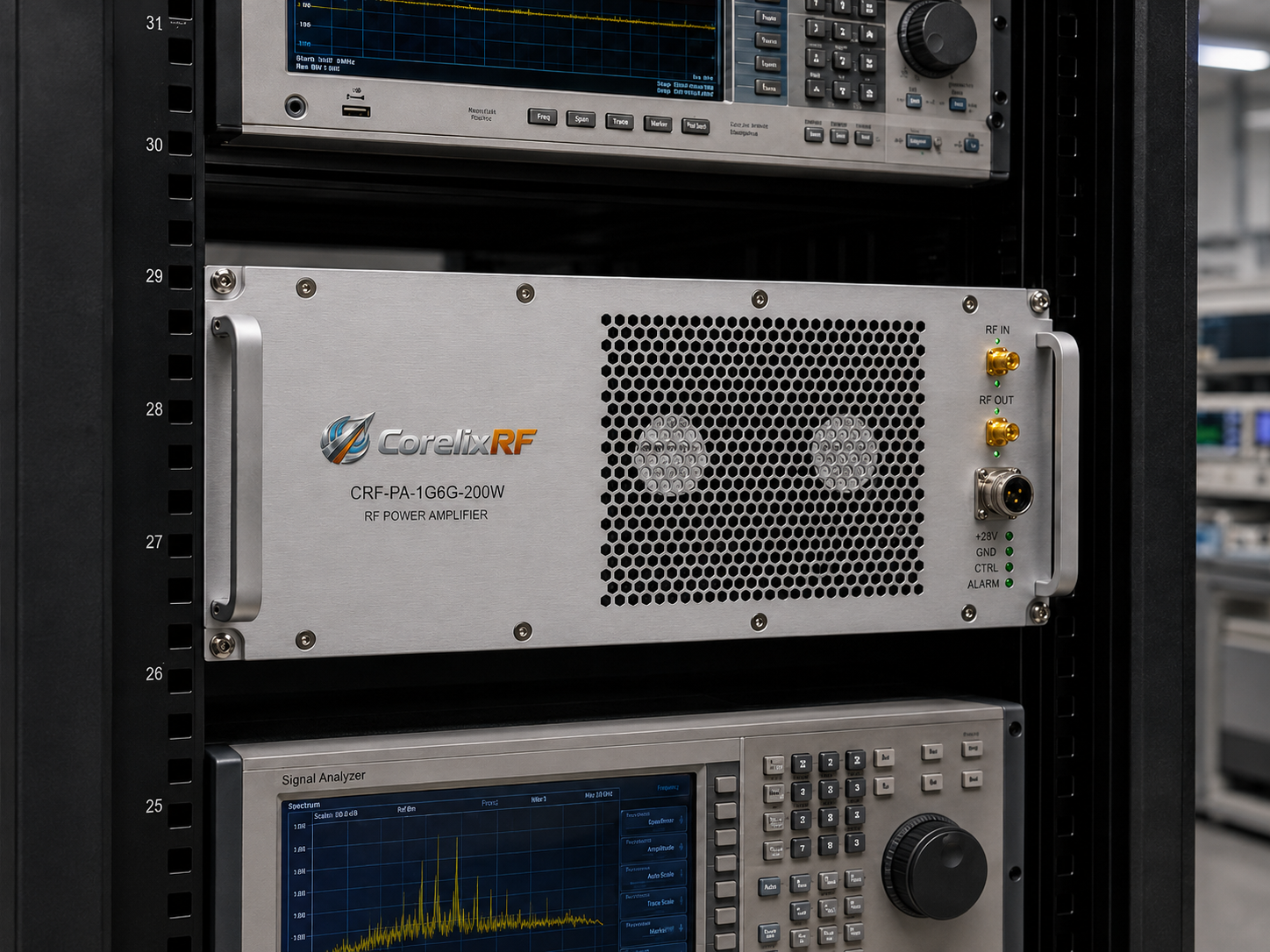
A 1-6 GHz 200W RF power amplifier is useful when an RF system needs high output power across lower microwave bands. This frequency range can support communication system validation, test and measurement instrumentation, RF interference system-level testing, and broadband RF platform integration.
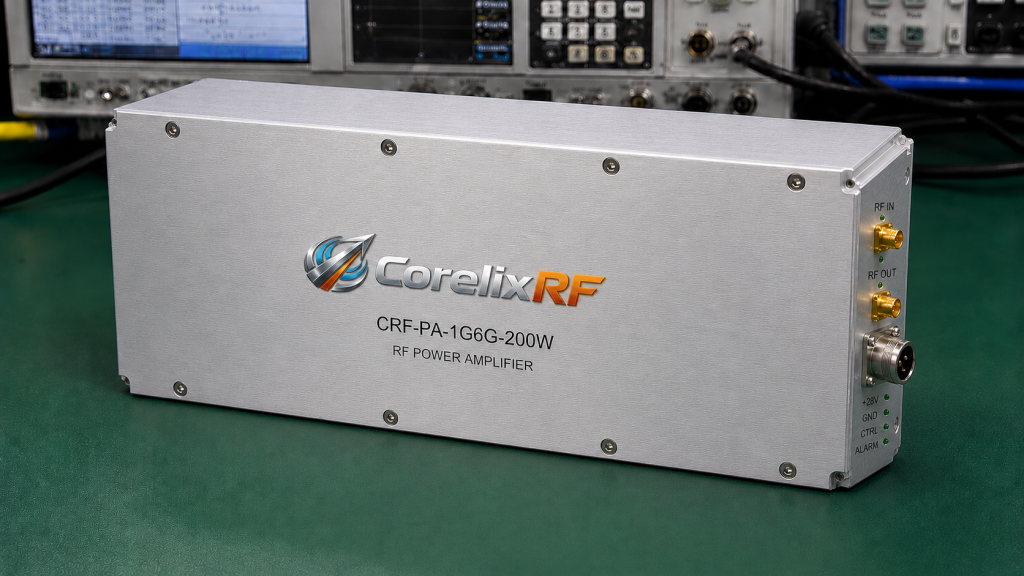
The CorelixRF CRF-PA-1000M6000M-200W operates from 1 GHz to 6 GHz and provides 200 W rated output power. It uses GaN SSPA technology, 53 dB minimum small-signal gain, ±5 dB gain flatness, SMA-F input, N-F output, RS485 control, 28 V DC supply, and forced-air cooling in a 400 x 300 x 80 mm mechanical form factor.
Why 1-6 GHz Coverage Is Valuable
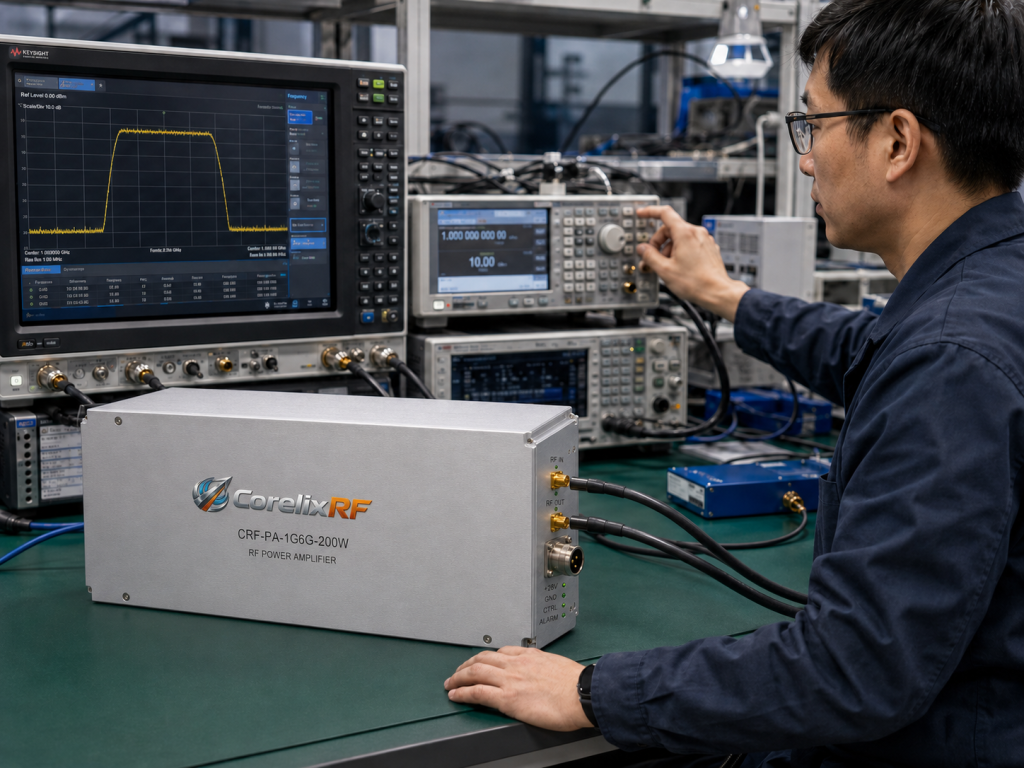
The 1-6 GHz range is commonly used in RF test environments where engineers need broadband coverage without switching hardware for every band. A 200 W amplifier in this range can support higher field-strength targets, larger test margins, and system validation tasks where lower-power modules are not enough.
However, high output power should be matched with careful thermal, electrical, and protection planning. Engineers should avoid selecting by wattage alone. The amplifier should be reviewed together with source level, load conditions, antenna or fixture behavior, and expected duty cycle.
Gain, Flatness, and Drive Level
The CRF-PA-1000M6000M-200W provides 53 dB minimum gain. This helps reduce the required input drive from the signal source. Gain flatness is listed at ±5 dB, which gives engineers a planning reference for broadband operation.
Maximum input power is specified at 0 dBm. In practice, this means the upstream source should include proper attenuation and level control. A controlled input path helps protect the RF power amplifier and reduces the risk of overdrive during automated or manual testing.
Cooling and Mechanical Integration
The mechanical form factor is 400 x 300 x 80 mm, with forced-air cooling. For a 200 W RF amplifier, cooling is not an afterthought. Airflow, heat exhaust, cabinet space, fan reliability, and ambient temperature should be part of the design review.
If the amplifier will be installed in a rack, vehicle platform, shielded room, or custom enclosure, the thermal path should be reviewed before final order. Forced-air cooling only works when the system layout provides enough air volume and prevents hot air recirculation.
Monitoring and Protection Functions
The platform includes real-time temperature monitoring, real-time current monitoring, alarm and fault protection, over-temperature protection, over-drive protection, over-voltage protection, and VSWR protection. Optional forward and reverse power monitoring can be reviewed based on project requirements.
These features are important in high-power broadband systems. Load mismatch, incorrect cabling, antenna faults, or operator error can create reflected power conditions. A good protection strategy helps reduce damage risk and supports safer test operation.
When to Request Customization
The source data notes that forward/reverse power monitoring, GPIB control, LAN control, and mechanical details can be reviewed according to project requirements. If the standard configuration does not match the system interface, CorelixRF can review a custom RF amplifier configuration for the application.
For the best review, provide frequency range, required output power, waveform, duty cycle, cooling method, interface requirements, cabinet constraints, operating temperature, and expected load VSWR. These details help determine whether the 1-6 GHz 200 W platform fits the project.
FAQ
What is the focus keyword?
The focus keyword is 1-6 GHz 200W RF power amplifier.
What cooling method is listed?
The amplifier uses forced-air cooling.
What control interface is included?
The listed standard control interface is RS485, with other interfaces reviewable for customization.