
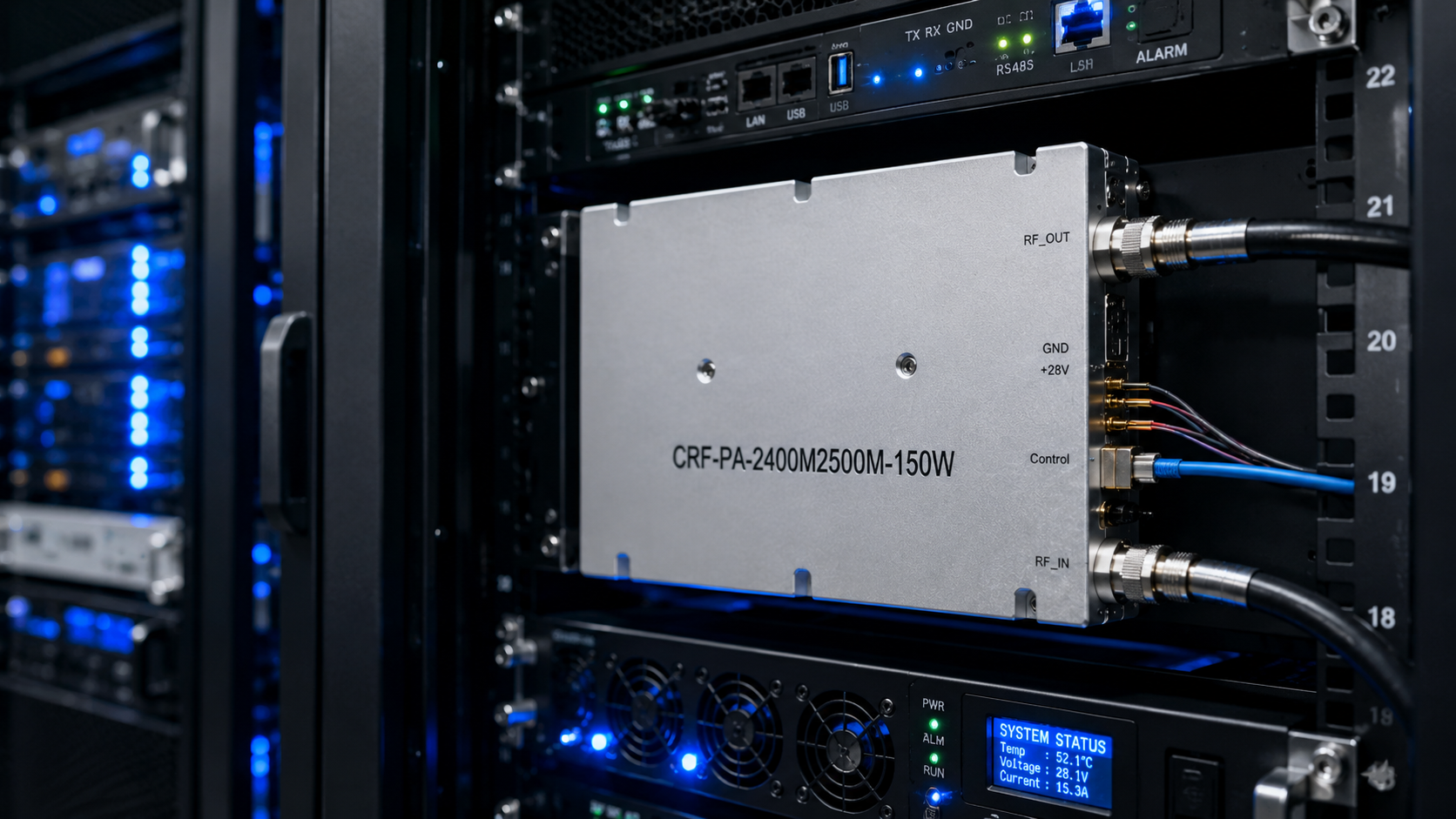
This article is written as an RFQ worksheet. The target product is the CorelixRF CRF-PA-2400M2500M-150W, a 2400-2500 MHz RF power amplifier using third-generation GaN transistor technology. Instead of starting with a polished product description, the worksheet starts with the information a buyer must provide before CorelixRF can make a practical recommendation for an ISM-band, communication, RF test, or project-specific RF source integration system.
Worksheet Line 1: Confirm the Frequency Job
Write the real operating band, not only the catalog band. The CRF-PA-2400M2500M-150W covers 2400-2500 MHz, while the V version frequency adjustment data lists 2170-2560 MHz and a 50-260 MHz bandwidth adjustment range. If the system only needs the narrow 2.4 GHz window, this model is a focused narrowband choice. If the same bench must work over multiple microwave bands, compare it with CorelixRF’s 2-6 GHz RF amplifier options before issuing the purchase request.
Worksheet Line 2: Define Output Power and Linearity Expectations
The datasheet lists 150 W rated CW output power and 120 W minimum output power. The RFQ should state whether the project accepts the minimum value under defined conditions or requires a tighter project-specific target. This is especially important when the amplifier supports a test fixture, production screen, or antenna path where delivered power after cable and filter loss is more important than amplifier port power alone.
Worksheet Line 3: Record Gain Control Requirements
The model lists 48 dB minimum gain, 50 dB typical gain, and 52 dB maximum gain. It also lists a 20 dB gain adjustment range with 0.5 dB step information. Procurement should ask who controls gain: a bench engineer, an embedded controller, or automated test software. A solid state power amplifier with adjustable gain is only useful when the host system knows how the setting is chosen, stored, and verified.
Worksheet Line 4: Cooling and Electrical Supply
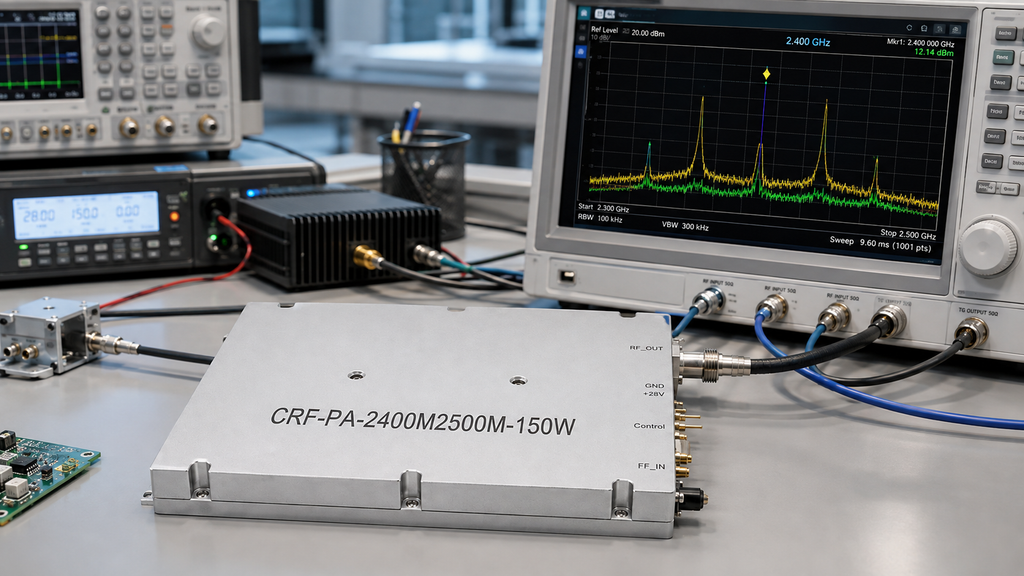
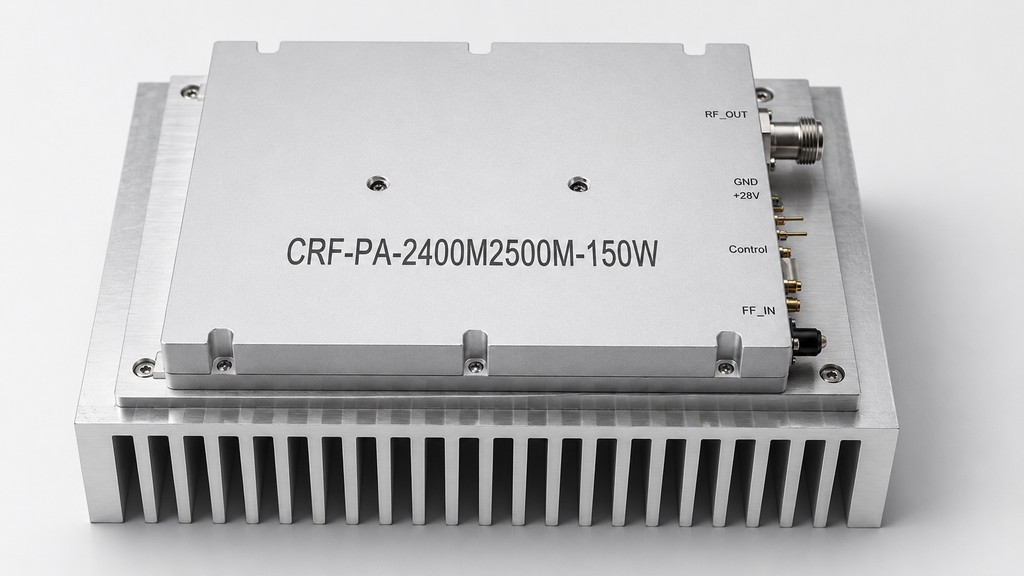
The electrical supply is +28 VDC nominal with a 24-32 V operating range. Current is listed at 22 A typical and 27 A maximum. The mechanical envelope is 200 x 158 x 25 mm with approximate 1.4 kg weight, and cooling is by external heat sink. The RFQ should attach the heat-sink drawing, airflow assumption, mounting plan, and power supply current limit. Without that information, the quote may be technically correct but incomplete for installation.
Worksheet Line 5: Monitoring and Fault Handling
Optional RS485 monitoring/control, forward and reverse power indicators from 0-3 V, and temperature analog output are listed. Built-in protection includes over-temperature shutdown and recovery, over-VSWR locked shutdown, over-voltage lock above 32 V, and over-current lock above 29 A. The RFQ should ask how these signals are reported and how a locked fault should be cleared. This is where a generic amplifier request becomes an engineering-ready procurement package.
Worksheet Line 6: Choose Standard or Custom Path
If the project needs a different connector layout, special control protocol, integrated source behavior, tighter environmental requirement, or mechanical packaging beyond the module baseline, route it to custom RF amplifier review. If the requirement stays inside the listed 2400-2500 MHz, 150 W, +28 VDC, external-heat-sink envelope, the standard model discussion can move faster.
Final RFQ Worksheet Summary
- Operating frequency and any guard-band requirement.
- Output power definition and measurement plane.
- Input drive level, waveform, and duty cycle.
- Gain adjustment method and remote-control needs.
- Heat sink, airflow, ambient temperature, and mounting plan.
- Fault reporting, reset logic, and acceptance data requirements.
This worksheet approach helps buyers avoid a common mistake: asking for a 150 W 2.4 GHz amplifier while leaving the RF chain undefined. CorelixRF can review the part more accurately when the request includes the system context around the amplifier.
Worksheet Scoring Before Supplier Review
Before sending the RFQ, score the request as complete or incomplete in six areas: frequency, power, drive level, thermal plan, control plan, and acceptance evidence. If any area is incomplete, do not hide the gap. Mark it as an engineering question for CorelixRF. This is more efficient than sending a clean-looking request that later requires several clarification rounds because the buyer did not define the load path, duty condition, or controller interface.
The worksheet should also identify the decision owner. Procurement may own price and lead-time comparison, but engineering owns whether the 150 W platform fits the real system. Software owns the RS485 or monitoring integration if those options are required. Mechanical engineering owns the heat sink and mounting path. Splitting those responsibilities before the quote keeps the amplifier selection grounded in the final build instead of only in the purchasing description.
The worksheet should include a short rejection rule. If the buyer cannot define the operating frequency, load condition, cooling surface, input drive level, and control method, the request is not ready for final quotation. That rule protects both sides. It gives CorelixRF the information needed for a meaningful review, and it protects the buyer from selecting a 2.4 GHz amplifier that fits the headline requirement but not the installation.
FAQ
Why is 2400-2500 MHz called out separately?
Because a fixed ISM-band requirement can be reviewed differently from a broad multi-band RF amplifier request.
What is the rated output power?
The datasheet lists 150 W rated CW output power.
Does the model support RS485?
Optional RS485 monitoring and control are listed.
What should procurement attach to the RFQ?
Attach frequency, output target, input level, cooling plan, control needs, fault behavior, and required acceptance data.