
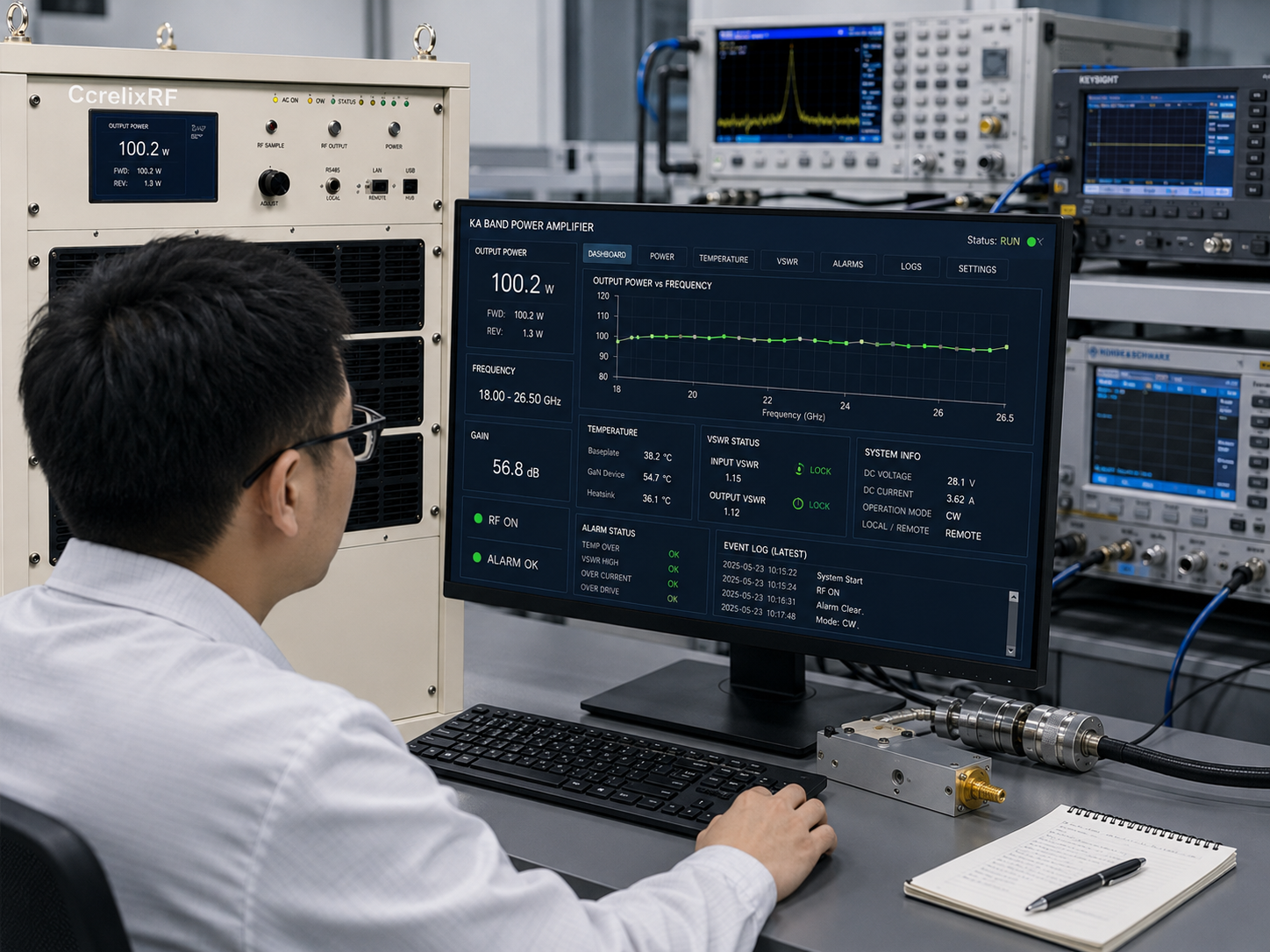
This procurement memo covers the CorelixRF CRF-PA-26500M40000M-500W, a 26.5-40 GHz 500W Ka-band RF amplifier for high-power microwave and mmWave test systems. The datasheet lists 26.5 to 40 GHz frequency coverage, 500 W rated output power, 57 dB minimum small-signal gain, 2.92mm-F input, WR28 output, RS485/LAN control, AC 380 V input, forced-air cooling, and a cabinet mechanical format with final dimensions to be confirmed.
At this power level and frequency range, procurement cannot be separated from engineering. The buyer must confirm the waveguide output path, load condition, cooling and facility power, gain-control needs, monitoring options, and final mechanical drawing before the purchase file is approved. A high-power Ka-band amplifier is a system item, not a simple catalog accessory.
Risk 1: Frequency Coverage Is Broader Than the Actual Need
The model spans the Ka-band region from 26.5 to 40 GHz. If the application uses the full range, the acceptance plan must include representative low, middle, and high frequency points. If the requirement is a smaller sub-band, the RFQ should say so because a custom or modified path may be more suitable. CorelixRF’s high-frequency capability page frames platform matching, power and gain review, thermal fit, and validation as the correct engineering sequence.
The source data lists -8 dB to +8 dB small-signal gain flatness. That figure should be handled realistically in system planning. The system may need calibration tables, frequency-dependent drive settings, or gain-control procedures. Procurement should ask what measured data will be delivered with the configured unit.
Risk 2: WR28 Hardware Is Left Out of the Purchase File
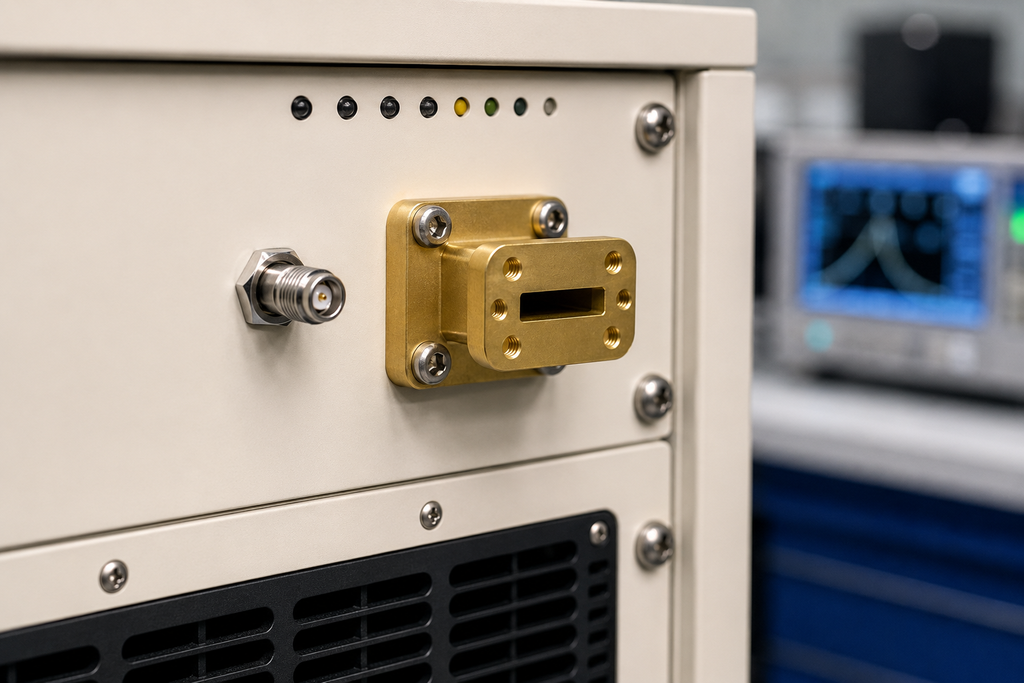
The output connector is WR28, while the input is 2.92mm-F. That means the output side must be planned around waveguide hardware, not ordinary coaxial habits. The purchasing file should include waveguide orientation, flange details, load or antenna interface, calibration plane, service clearance, and whether any transitions are included elsewhere in the system.
- Confirm WR28 output hardware and power handling.
- Define the measurement reference plane before acceptance.
- Review all waveguide bends, loads, couplers, and transitions.
- Confirm cabinet service access and cable routing.
- Document source power limit, gain-control setting, and alarm response.
Risk 3: Facility Power or Cooling Is Not Ready
The datasheet lists AC 380 V +/-10%, 50/60 Hz input and 8000 W power consumption. It also lists forced-air cooling and 0 deg C to +50 deg C operation. Those values require facility review before the order is released. Power availability, breakers, grounding, heat rejection, airflow clearance, and acoustic or service constraints should be checked by the installation owner.
A buyer searching for a high power RF amplifier may focus on output wattage, but the facility risk is often the more expensive surprise. Include site readiness as a procurement gate so the amplifier arrives to a prepared environment.
Risk 4: Optional Monitoring Is Assumed, Not Ordered
The model lists real-time temperature monitoring, real-time current monitoring, optional forward/reverse power monitoring, optional LAN remote monitoring, over-temperature protection, over-drive protection, over-voltage protection, and VSWR protection and alarm functions. If the rack controller must log forward and reverse power, do not leave it as an assumption. Put the requirement into the RFQ and final quote.
For automated test systems, RS485/LAN control should be reviewed with the control protocol, alarm handling, and operator workflow. If GPIB or a project-specific protocol is needed, the datasheet notes such support is available by customization review. That discussion belongs before the purchase order, not during site acceptance.
Risk Register Closeout
Approve procurement only after the engineering team has confirmed frequency coverage, output power target, source drive, WR28 output path, facility power, forced-air cooling, cabinet dimensions, monitoring package, control protocol, and required test data. If any of those points are unresolved, open a custom RF amplifier review with CorelixRF before finalizing the configuration.
This memo gives purchasing a defensible technical checklist. It also helps CorelixRF respond with the right documentation: final mechanical drawing, test data, control information, and any project-specific notes for integration.
Commercial File Notes
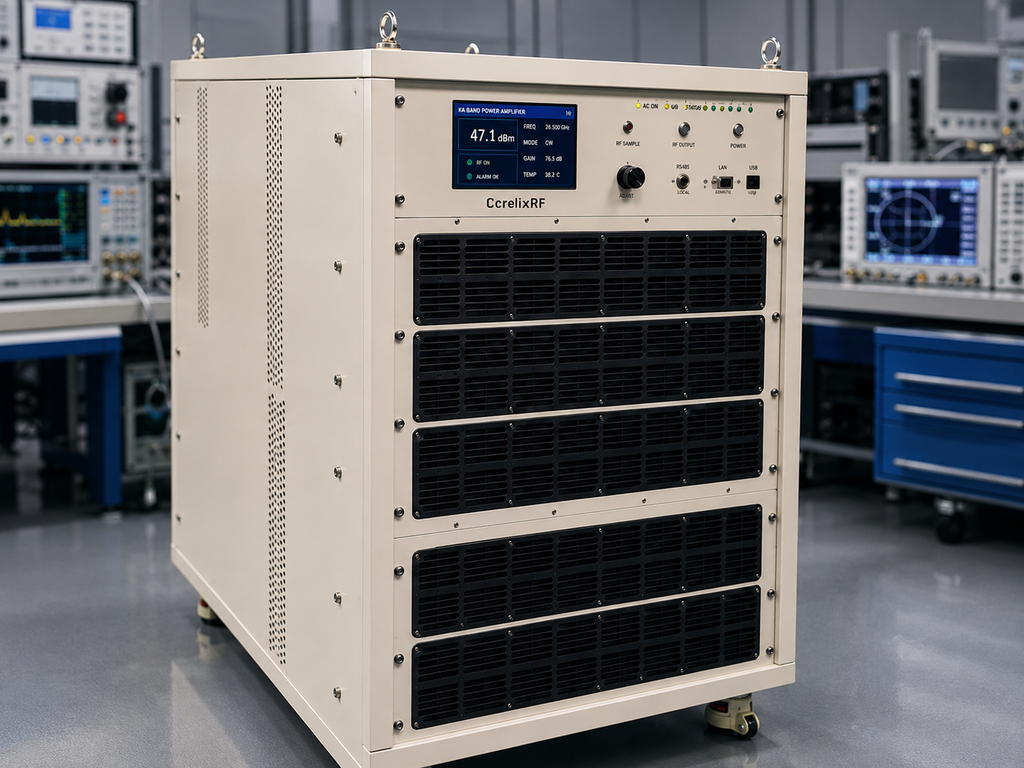
The commercial file should separate confirmed datasheet values from project-specific review items. Confirmed values include 26.5-40 GHz coverage, 500 W rated output power, 57 dB minimum gain, 2.92mm-F input, WR28 output, RS485/LAN control, AC 380 V supply, forced-air cooling, and the listed monitoring and protection functions. Project-specific items include final cabinet dimensions, installation drawing, optional monitoring, GPIB or custom protocol needs, and the final test report format.
This distinction prevents overpromising. It also keeps the SEO and sales message aligned with engineering reality: CorelixRF can support high-power Ka-band amplifier projects, but every installation still needs a documented review of waveguide path, facility readiness, cooling, control, and acceptance data.
Before final handover, the buyer should also define a retest trigger. Moving the cabinet, changing the WR28 load path, updating control software, or replacing a high-power coupler can justify a limited repeat of output power, reflected power, current, and temperature checks. That small rule keeps later maintenance from becoming an undocumented engineering investigation.
FAQ
What output power is listed for this Ka-band amplifier?
The datasheet lists 500 W rated output power from 26.5 to 40 GHz.
What RF connectors are listed?
The input is listed as 2.92mm-F and the output is listed as WR28.
What power supply is listed?
The source data lists AC 380 V +/-10%, 50/60 Hz.
Why should final dimensions be confirmed?
The cabinet dimensions are marked TBD, so installation planning should use the final project drawing.