
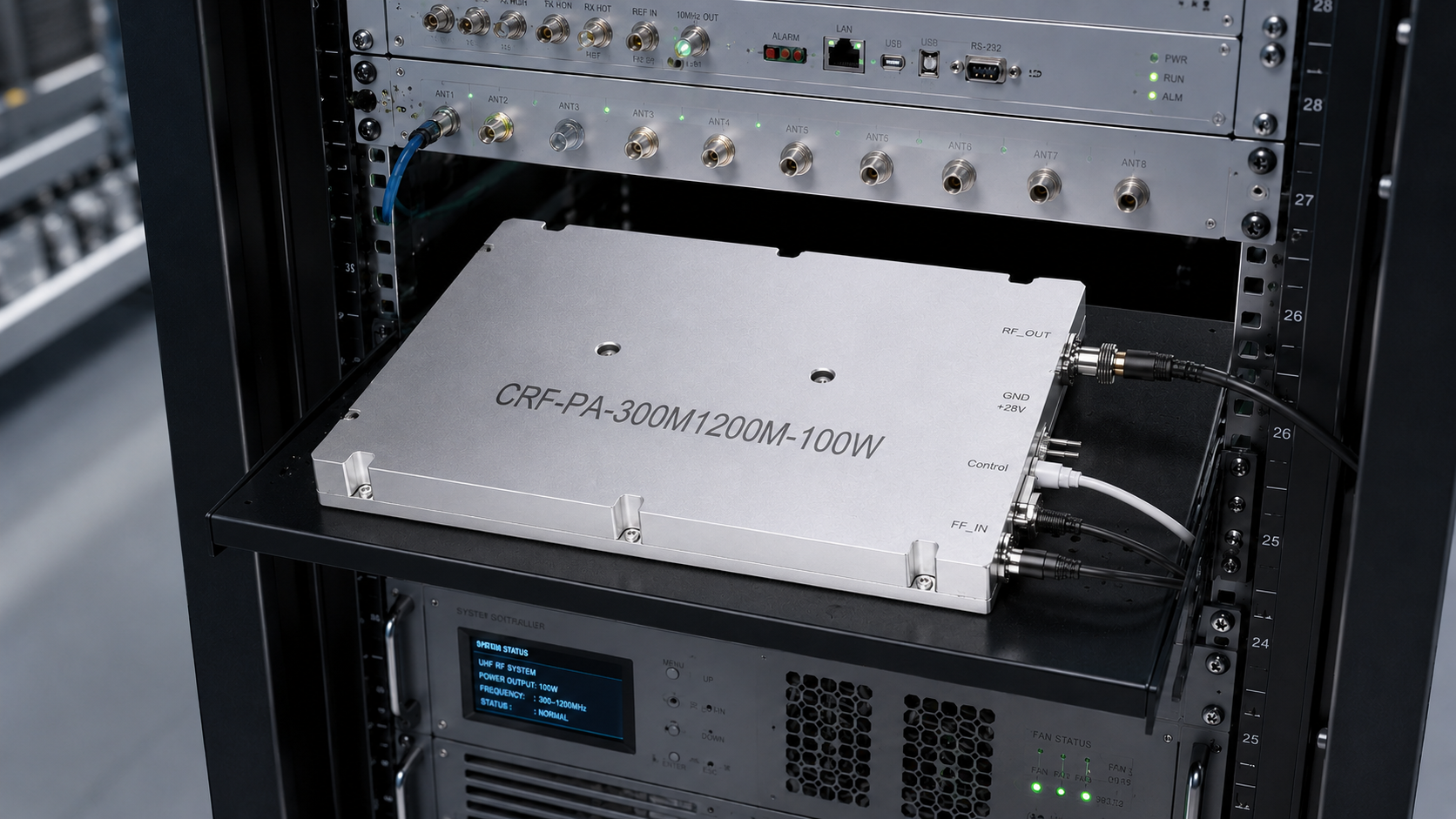
A 300-1200 MHz UHF RF power amplifier is often selected when a system needs focused UHF coverage without extending into a wider multi-band platform. This range can support communication testing, RF front-end validation, antenna evaluation, telemetry-related development, and customized signal amplification where the operating band is already known.
Compare CorelixRF UHF RF amplifier platforms by frequency coverage, output-power class, gain, cooling method and engineering-review path.
For many engineering teams, the value of a UHF amplifier is not only output power. The amplifier also needs to fit the available supply voltage, cooling path, enclosure space, connector plan, duty cycle, and measurement process. A module that works well on an open bench may require additional review before it is installed inside a cabinet, mobile platform, rack, or OEM subsystem.
CorelixRF lists the 300-1200 MHz platform direction with 30W, 50W, 100W, 150W, and 200W output options. That range gives buyers a practical starting point, but the correct model should be selected from the real operating condition instead of the highest available power class.
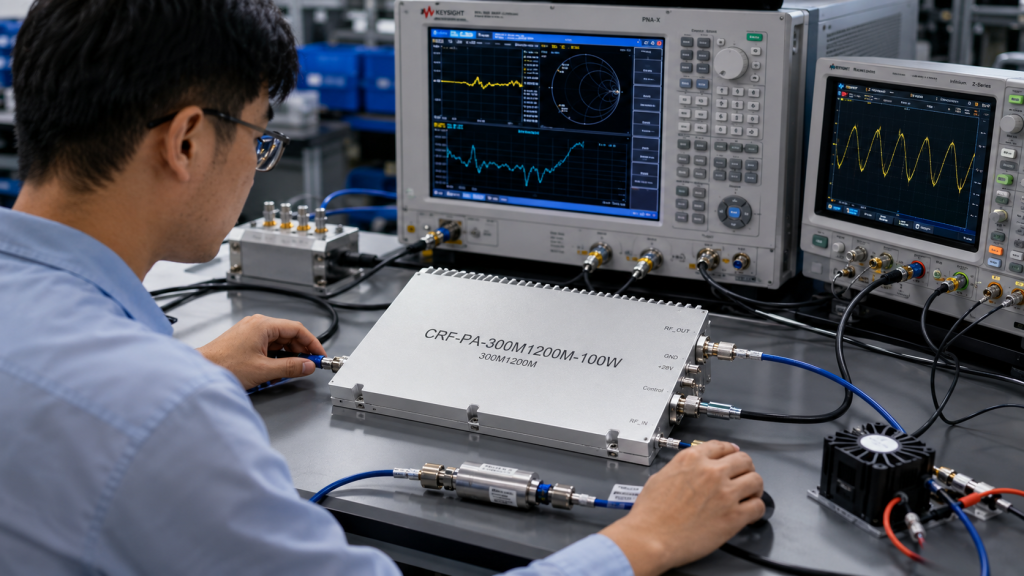
Start with the frequency window. If the system uses only part of the 300-1200 MHz range, it may be better to request a narrower review rather than defaulting to full-band coverage. A focused band can sometimes support better gain flatness, thermal behavior, or efficiency. This is especially relevant when the amplifier will be used repeatedly at a small group of channels or inside a fixed-frequency system.
Next, confirm the output power requirement. In UHF systems, power should be specified together with operating mode. CW operation, pulsed operation, swept testing, and modulated signals can create different thermal and RF stress. If the amplifier must run for long periods, the buyer should provide expected duty cycle, ambient temperature, airflow condition, and enclosure information.
Input drive level is another key point. The signal source, driver amplifier, filters, and cable losses should be reviewed before the final amplifier is chosen. If the available source drive is too low, the system may not reach target output power. If the drive level is too high, overdrive protection and gain-stage behavior need to be considered.
Load condition should also be defined early. Antennas, fixtures, cables, couplers, and filters may create mismatch. For higher-power UHF work, reflected power can affect stability, thermal rise, and long-term reliability. Buyers should describe whether the amplifier will drive a matched load, antenna, chamber setup, test fixture, or unknown field load.
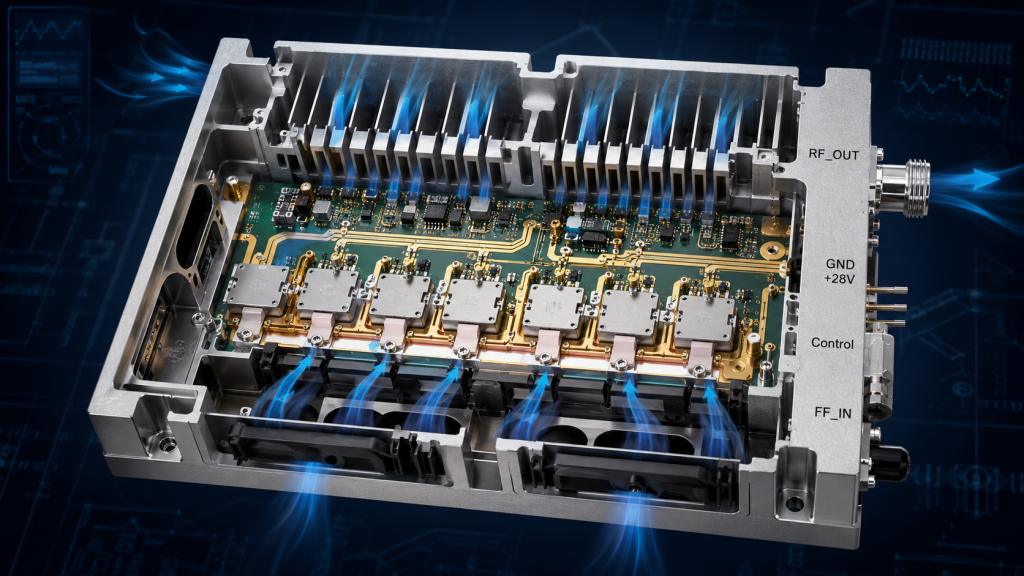
Mechanical integration is often overlooked during early RF selection. The engineering team should confirm mounting method, connector orientation, cable bend space, fan clearance, heat sink contact, and service access. If the amplifier will be used in an OEM product, request mechanical drawings before the purchase decision.
Documentation is also important for procurement. A serious RFQ should ask for a datasheet, available gain and output data, mechanical drawing, connector details, supply requirements, and any available unit-level validation information. This helps RF, purchasing, quality, and mechanical teams review the same technical basis.
For custom projects, provide the exact operating band, target output power, input drive level, operation mode, supply condition, connector preference, cooling environment, quantity, and documentation needs. This allows CorelixRF to review whether a standard UHF model is suitable or whether a custom amplifier configuration is a better fit.
FAQ
What is a 300-1200 MHz UHF RF power amplifier used for?
It is used for core UHF RF systems, communication test platforms, antenna evaluation, front-end validation, telemetry-related development, and customized RF signal amplification.
Why not choose a wider broadband amplifier?
A wider amplifier may be useful for multi-band systems, but a focused UHF platform can be a better match when the project only needs a defined UHF range.
What should be included in an RFQ?
Include frequency range, output power, input drive, duty cycle, operation mode, load condition, cooling, supply voltage, connector needs, quantity, and required test data.
When should customization be requested?
Customization should be requested when the required band, connector, housing, cooling, control method, or validation data differs from a standard platform.
Need to compare multiple UHF frequency and power options? View the complete UHF amplifier platform selection before preparing your RFQ.