
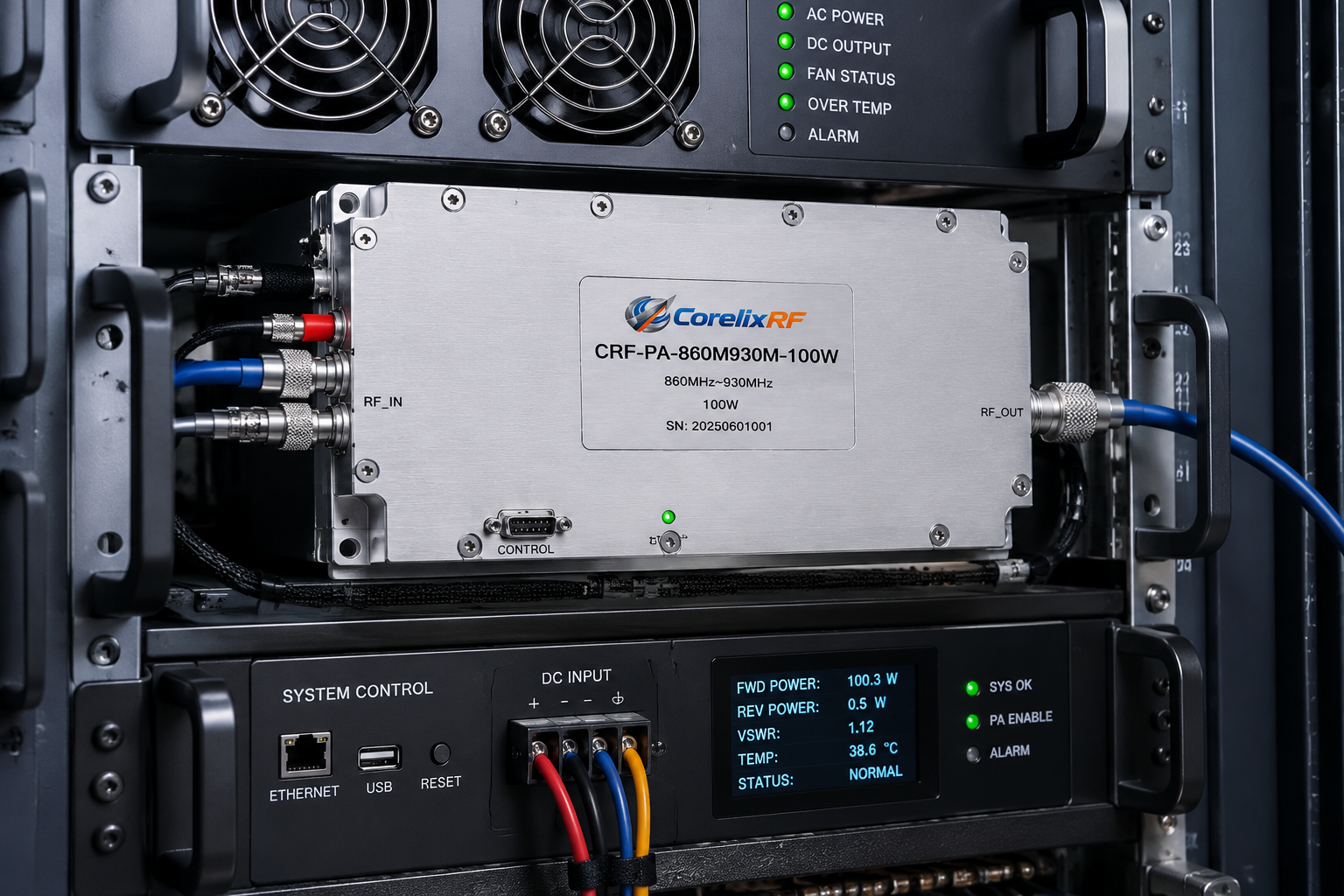
The CRF-PA-860M930M-100W is a representative CorelixRF narrowband RF amplifier model for fixed-band RF systems operating around 860-930 MHz. Unlike a wideband amplifier intended to cover many different bands, a narrowband amplifier is usually selected when the project already has a defined frequency window and needs stable output inside that range.
CorelixRF’s public narrowband amplifier table lists this model with 100W output, 48 dB typical gain, and a 160 x 120 x 25 mm size. It is also shown with M / V source or control versions. These details make the model relevant for engineering teams that need a practical starting point for UHF narrowband amplification, RF test platforms, communication systems, telemetry links, front-end modules, and OEM subsystem work.
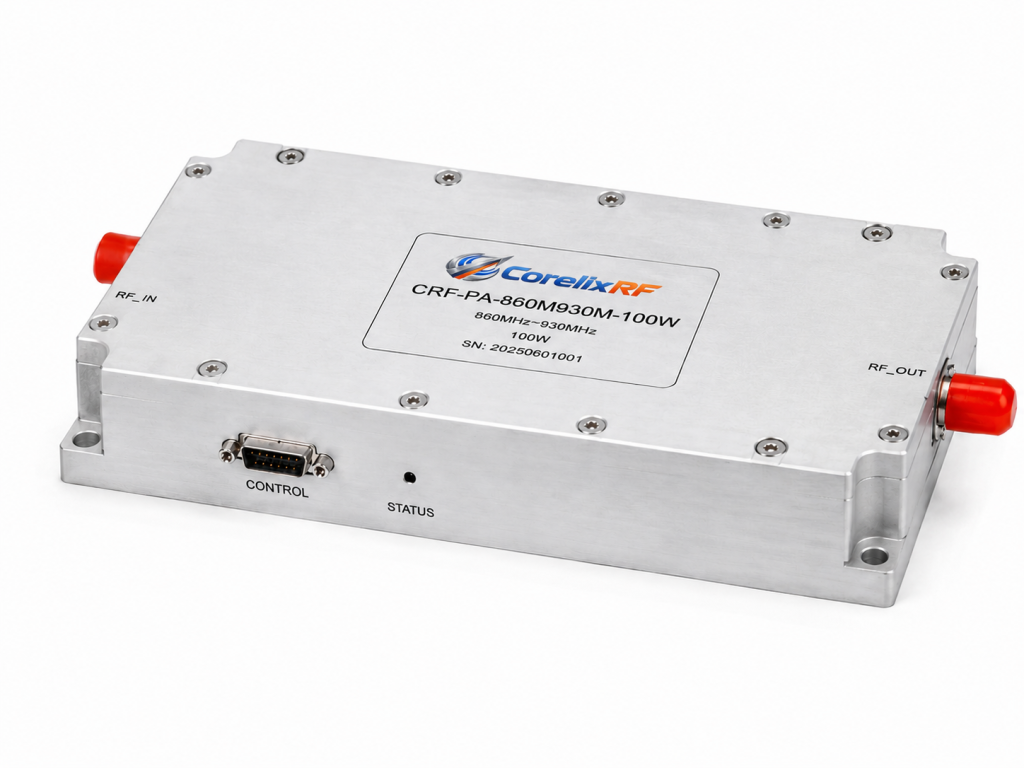
The main advantage of a narrowband RF amplifier is focus. When an amplifier does not need to cover an unnecessarily wide frequency span, the design can be reviewed around the actual system band. This can help with gain behavior, thermal planning, mechanical integration, and final validation. It can also make the technical conversation clearer during procurement because the buyer is not asking the amplifier to support unused frequencies.
Before selecting the CRF-PA-860M930M-100W or requesting a similar model, the first step is to confirm the exact operating band. A project described only as “around 900 MHz” is not detailed enough for final selection. The RFQ should state the required start and stop frequencies, the channels of interest, and whether performance is needed across the full 860-930 MHz window or a smaller subset.
Output power should be defined in context. A 100W amplifier may be suitable for many fixed-band systems, but the actual requirement depends on cable loss, antenna or load condition, test setup, duty cycle, and safety margin. If the system needs continuous operation, the buyer should describe operating duration, ambient temperature, airflow, and installation position.
Input drive level is equally important. The buyer should provide the available signal source output and any driver-stage information. If the amplifier is expected to work with a passive input path, VCO source, or controlled signal source, that should be stated clearly. The M / V source or control versions shown in the public table make this information especially relevant.
Control and integration requirements should be included early. If the amplifier will be placed inside an automated test system or an OEM product, the engineering team should review enable control, monitoring needs, connector orientation, mounting method, and power wiring before choosing the final configuration.
Load condition should not be ignored. Narrowband systems may drive antennas, filters, couplers, test fixtures, or matched loads. If mismatch events are expected, reflected power and protection behavior should be discussed before purchase. This is particularly important at higher output power.
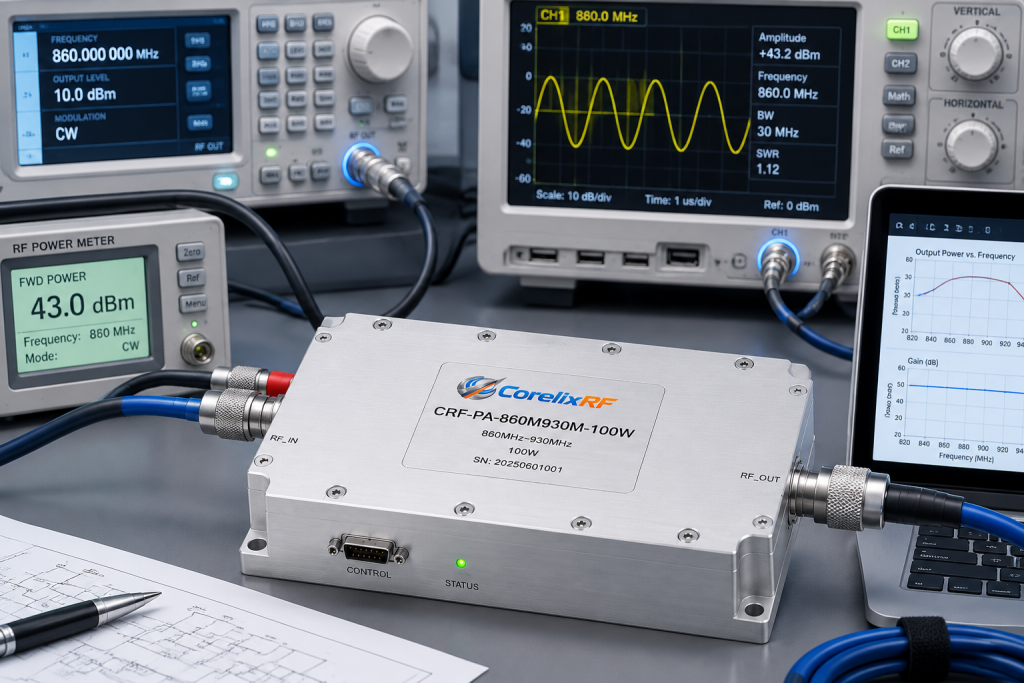
For quality and acceptance, ask for available documentation before order confirmation. Useful documents may include a datasheet, mechanical drawing, gain or output data, connector information, power requirements, and unit-level test data if available. These materials help reduce uncertainty during incoming inspection and system integration.
If the required frequency range, package size, connector type, control method, or documentation package is different from the public table, a custom narrowband amplifier review is the correct path. The strongest inquiry will include frequency, output power, gain target, source type, operation mode, duty cycle, cooling, load condition, and quantity.
FAQ
What frequency range does CRF-PA-860M930M-100W cover?
The representative public table lists 860-930 MHz.
What output power is shown for this model?
The public listing shows 100W output.
Why choose a narrowband amplifier instead of a broadband model?
Choose narrowband when the system has a defined operating band and does not need wide frequency coverage. A focused amplifier can be reviewed around the real application.
What should buyers provide before requesting a quote?
Provide frequency range, output power, source type, control needs, duty cycle, cooling condition, load environment, connector preference, and documentation requirements.