
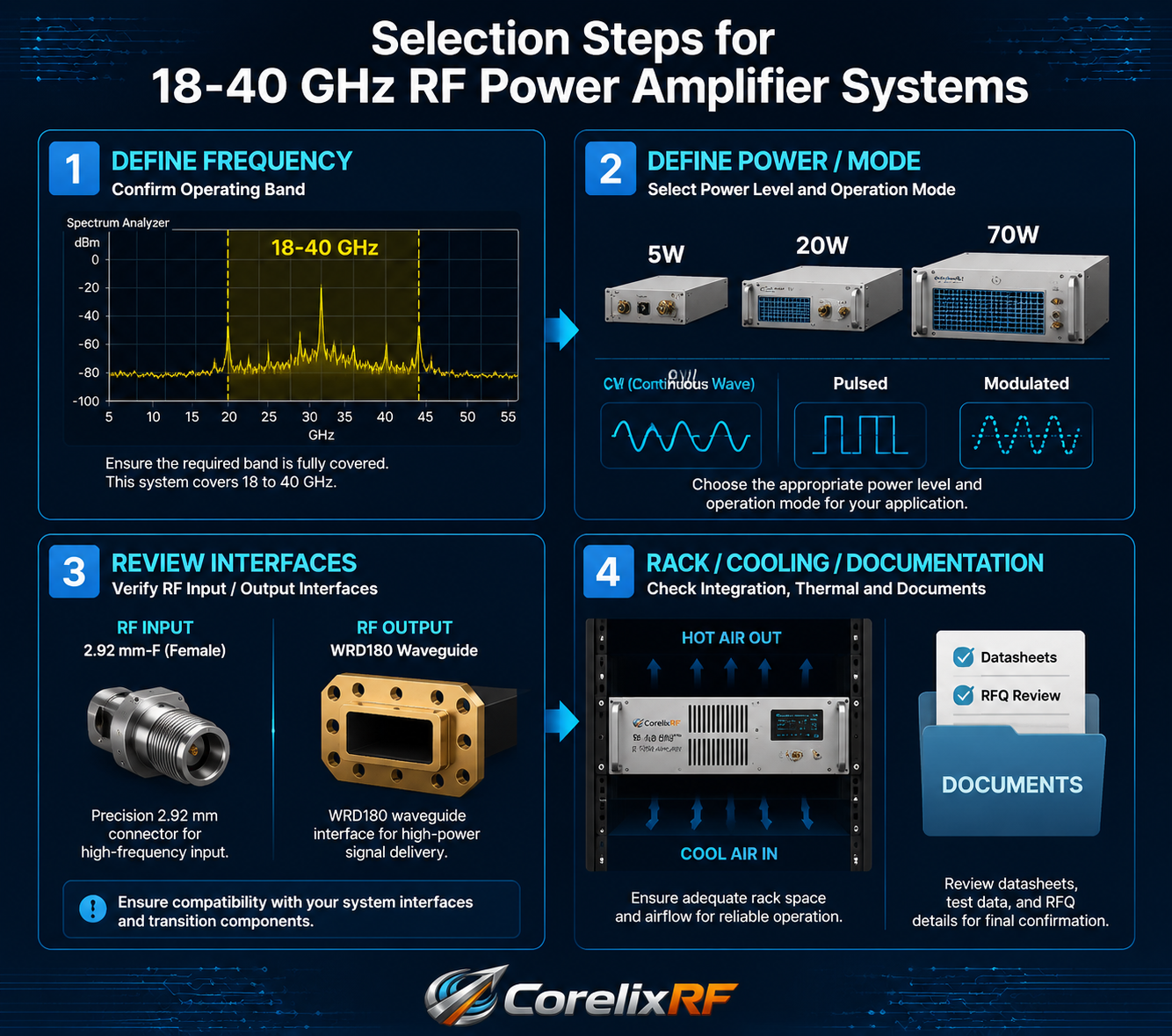
An 18-40 GHz RF power amplifier is selected for higher-frequency applications where standard lower-frequency RF amplifier platforms are no longer enough. This range can support Ka-band test platforms, mmWave communication validation, radar front-end review, high-frequency component testing, and advanced laboratory RF systems.
CorelixRF lists the CRF-PA-18000M40000M series with standard 5W, 20W, 40W, and 70W classes for 18-40 GHz applications. The public product information references 2.92 mm-F input, 2.92 mm-F or WRD180 output depending on power class, 19-inch 3U / 4U / 8U rack options, and RS485 / LAN / GPIB control review. These details are important because at this frequency range, the mechanical and interface choices can strongly affect the final system.
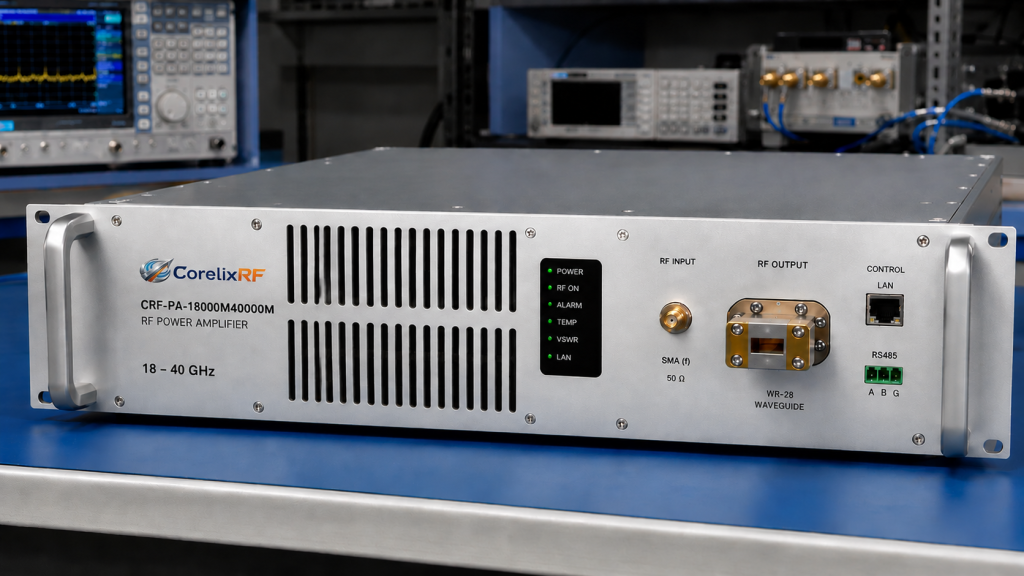
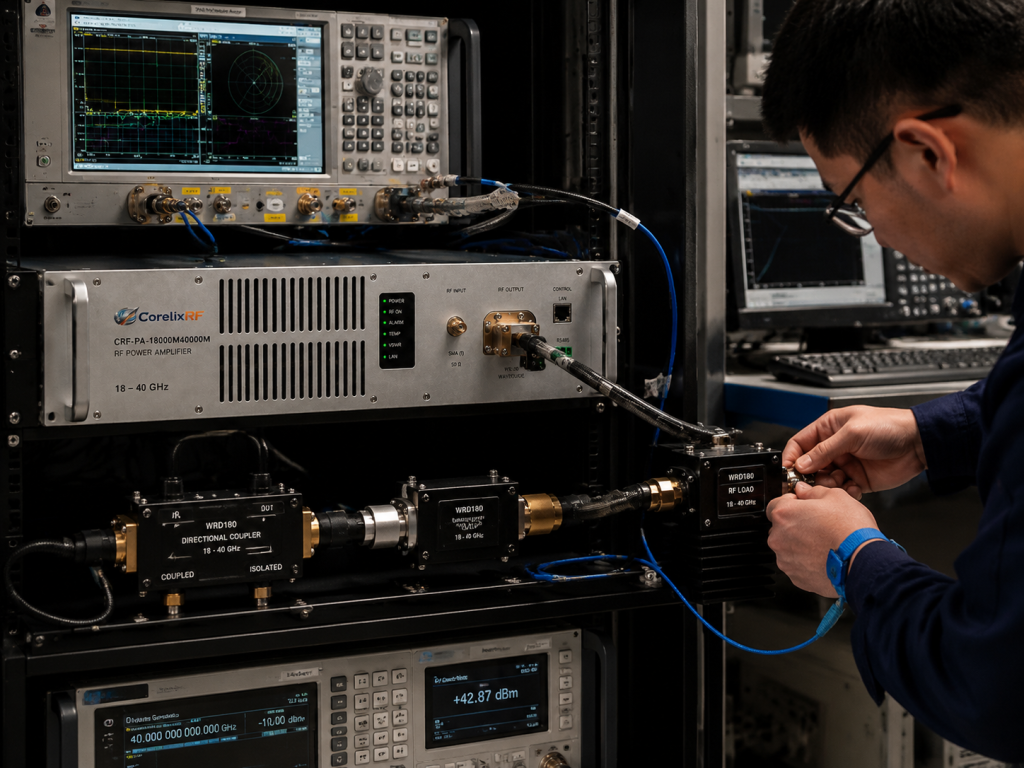
At Ka-band and mmWave frequencies, output power is only one part of the selection. Cable loss, connector repeatability, waveguide transition, rack layout, airflow, remote control, measurement calibration, and load condition can all affect delivered performance. A model that looks suitable from the power rating may still need additional review before it is used in a complete test chain.
The first selection step is to define the frequency requirement clearly. Some projects need full 18-40 GHz coverage, while others only need a smaller Ka-band window. If the project only uses a focused sub-band, state that in the inquiry. A sub-band review may allow a better match to gain flatness, output behavior, or practical test requirements.
The second step is to define output power and operating mode. A 5W unit and a 70W system are very different in size, cooling requirement, rack planning, and load protection needs. Buyers should specify whether the amplifier will operate CW, pulsed, swept, or under a particular modulation condition. They should also provide expected operating duration and environmental assumptions.
The third step is to review RF interfaces. At 18-40 GHz, connector choice matters. Low-power configurations may use coaxial interfaces, while higher-power systems may require waveguide output. The buyer should confirm test equipment interfaces, adapters, waveguide sections, attenuators, couplers, and load hardware before final model selection.
Rack integration should also be planned early. CorelixRF references 19-inch rack formats, including different rack heights depending on power class. For automated laboratories or production test systems, control interface requirements should be defined in the first RFQ. If RS485, LAN, or GPIB is needed, include the required monitoring and command expectations.
Cooling is another major factor. Higher-frequency, higher-power amplifiers require clear airflow planning. The rack inlet and outlet path, ambient temperature, duty cycle, and available installation space should be confirmed before procurement. If the system will be installed near other heat-producing equipment, this should be disclosed.
Documentation can reduce risk before purchase. For 18-40 GHz systems, useful documents include datasheets, mechanical outlines, connector details, control interface information, output and gain data, and available factory test records. These help buyers align RF engineering, test engineering, purchasing, and quality teams.
If the project has non-standard frequency coverage, rack limits, waveguide requirements, control needs, or acceptance criteria, do not treat the public model table as the final specification. Use it as a starting point and request an engineering review based on the real application.
FAQ
What power classes are listed for the 18-40 GHz series?
CorelixRF lists 5W, 20W, 40W, and 70W standard classes.
What output interfaces are mentioned?
The public product page references 2.92 mm-F and WRD180 output paths depending on model and project needs.
Is this platform suitable for Ka-band testing?
Yes. The 18-40 GHz range is relevant for Ka-band and mmWave engineering review.
What should be included in the first inquiry?
Include frequency range, output power, input drive, operation mode, connector or waveguide preference, rack limits, cooling, control interface, and test data needs.