
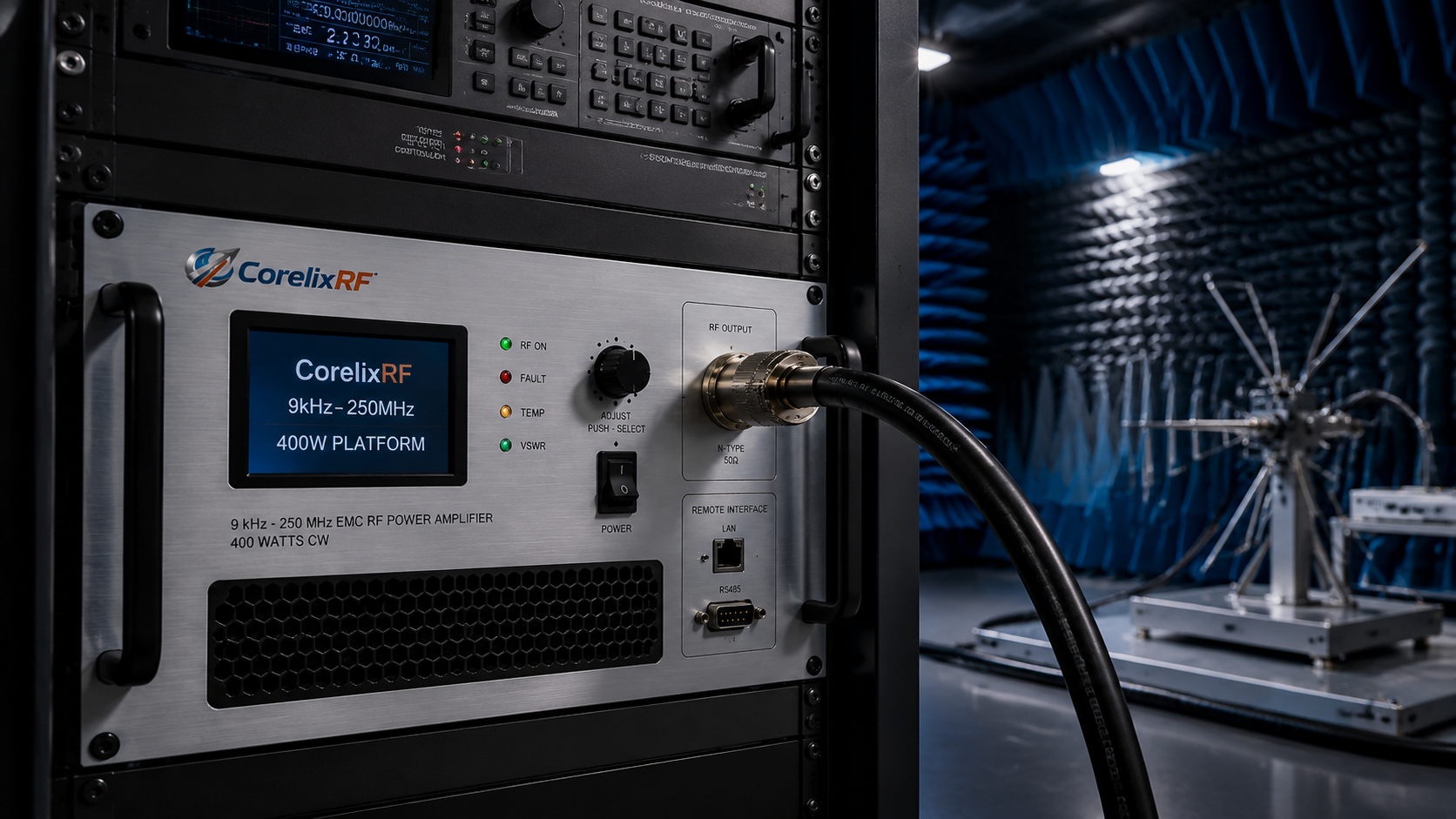
A 9 kHz-250 MHz EMC RF amplifier platform is used when low-frequency RF power is needed for EMC-related testing, conducted immunity work, laboratory validation, and custom RF test systems. Unlike a general-purpose communication amplifier, an EMC amplifier must be reviewed against the test method, load condition, coupling device, frequency sweep, and required field or injected power level.
CorelixRF lists a broad low-frequency EMC platform direction for 9 kHz-250 MHz with typical 100W / 400W power references. The EMC platform information also notes that final selection depends on frequency range, output power, CW or pulse operation, load environment, cooling margin, control interface, and documentation requirements.
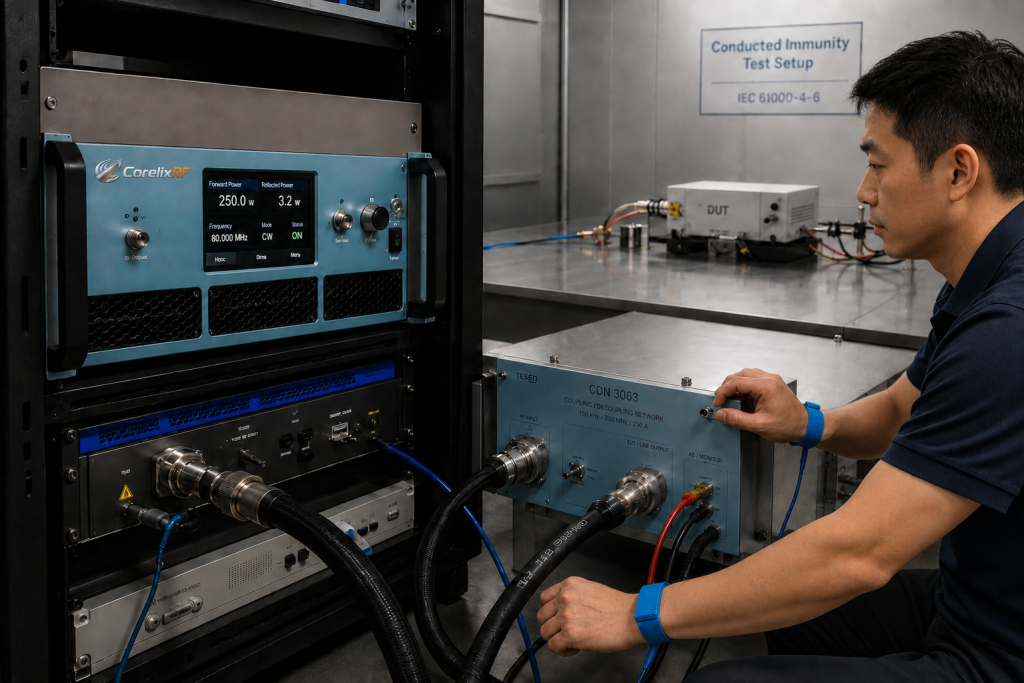
The most important starting point is the test requirement. EMC work can involve wide frequency sweeps, specific dwell times, defined power levels, and changing load conditions. The amplifier must be selected for the actual test setup rather than a simple wattage target. A 100W amplifier may be enough for one fixture, while another setup may need more power because of coupler loss, cable loss, mismatch, or test-level margin.
Frequency coverage should be stated clearly. The 9 kHz-250 MHz range is broad, and performance expectations may not be identical at every point. If the project only needs a portion of the range, the inquiry should specify the active band. If full-range coverage is required, the buyer should ask how output power, gain behavior, and protection are reviewed across the band.
Load environment is especially important for EMC testing. Amplifiers may drive coupling networks, fixtures, antennas, probes, transformers, or other test accessories. These loads can change impedance with frequency, which may create reflected power. Buyers should describe the test configuration and any expected mismatch condition so that protection behavior and power margin can be reviewed.
Operating mode also matters. EMC testing may require CW operation, swept operation, modulated signals, or defined test sequences. If the amplifier must run for long periods, thermal design becomes a critical part of selection. Provide duty cycle, ambient temperature, rack layout, airflow condition, and expected test duration.
Control and monitoring should be considered before purchase. A bench-only amplifier may not need the same control interface as an automated compliance or pre-compliance platform. If the system needs remote enable, monitoring, fault reporting, or integration with test software, these requirements should be included in the first inquiry.
Mechanical planning is another practical issue. EMC amplifiers may be installed in racks, shielded test environments, or lab stations where cable routing and airflow are constrained. Buyers should request dimensions, connector details, cooling requirements, and installation guidance before final selection.
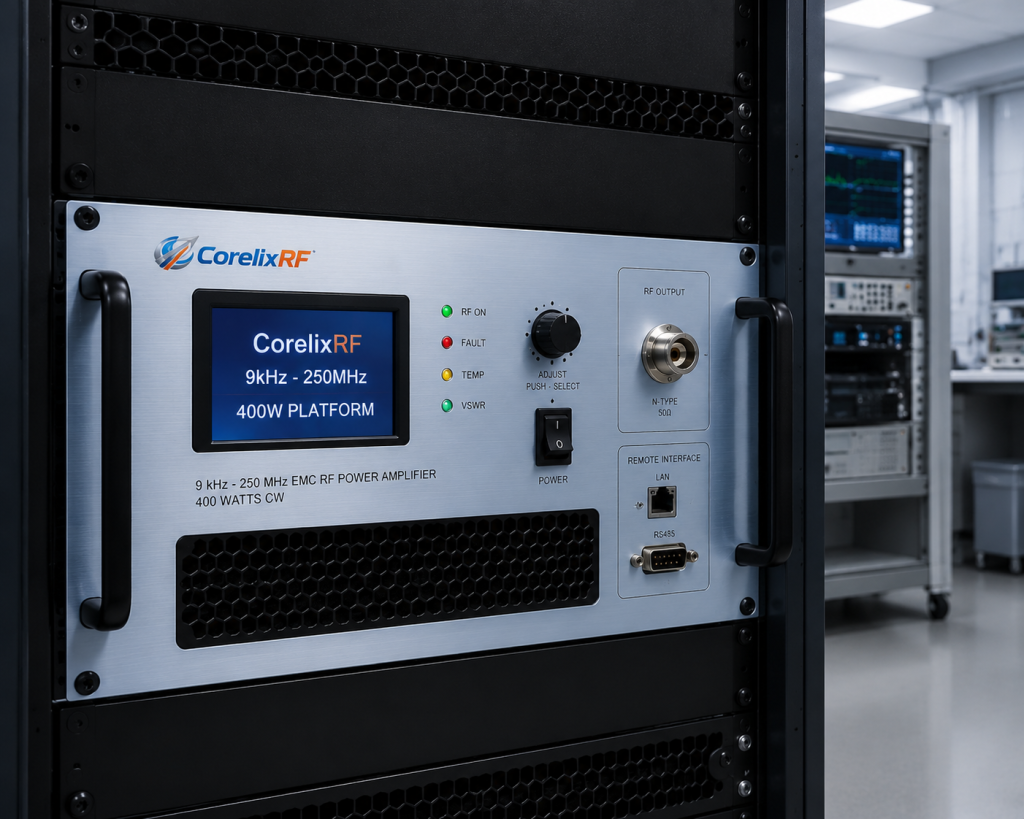
Documentation helps reduce uncertainty. For a low-frequency EMC amplifier, useful documents may include datasheets, output power information, gain data, mechanical drawings, control interface notes, protection details, and available unit-level test records. These can support purchasing review, lab preparation, and incoming inspection.
If the project requires a special frequency range, higher power, custom rack format, defined protection behavior, or specific validation report, the amplifier should be reviewed as a project configuration. CorelixRF can use the application details to determine whether a standard EMC platform is suitable or a custom configuration is required.
FAQ
What is a 9 kHz-250 MHz EMC RF amplifier used for?
It is used for low-frequency EMC testing, conducted immunity work, laboratory validation, and custom RF test systems.
What power references are shown?
CorelixRF lists typical 100W / 400W references for the 9 kHz-250 MHz EMC platform direction.
Why is load condition important?
EMC fixtures and coupling devices can create changing impedance and reflected power, so the amplifier must be reviewed against the real test setup.
What should be reviewed before purchase?
Review frequency range, output power, operation mode, load mismatch, cooling, rack fit, control interface, protection behavior, and required test data.