
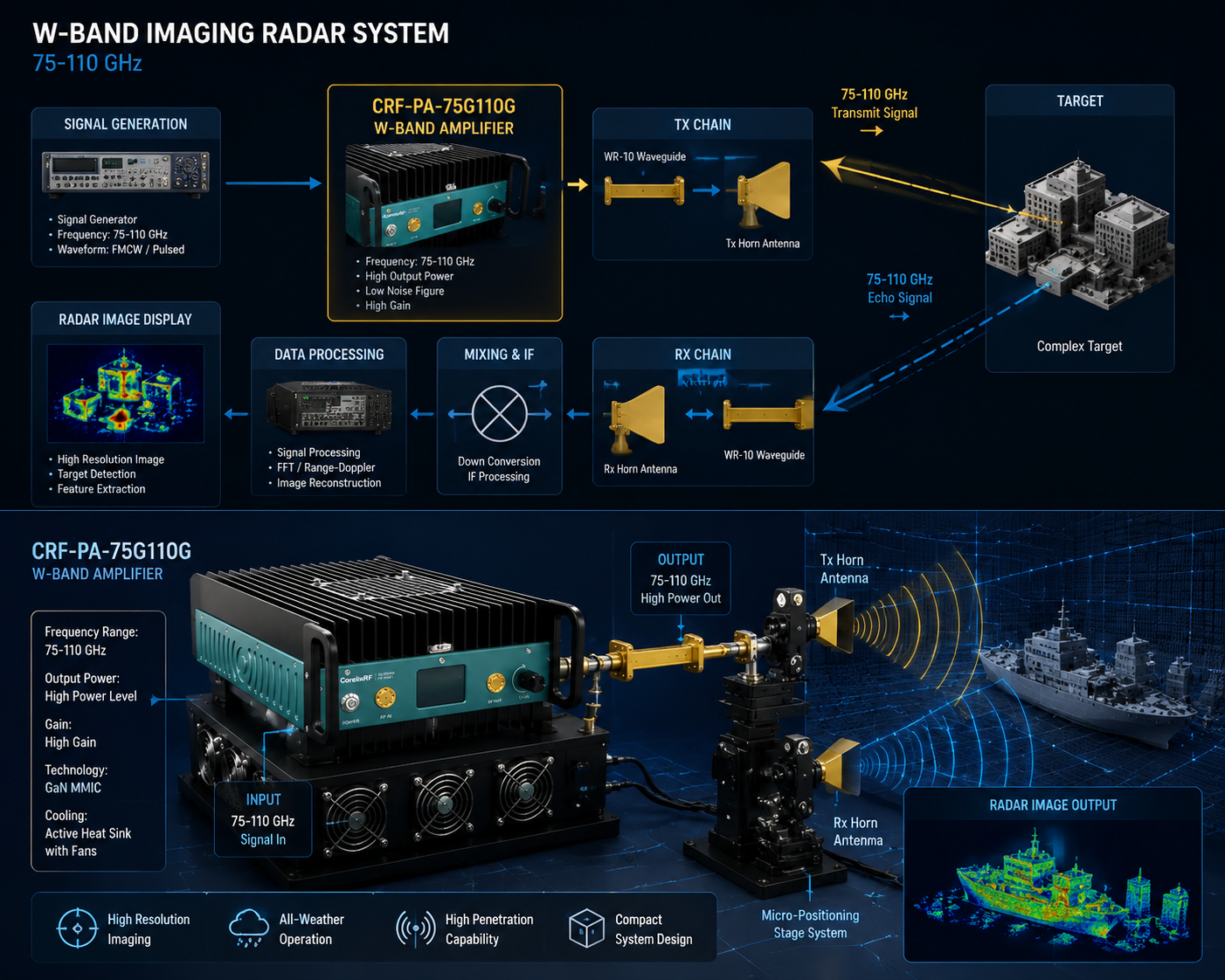
The CRF-PA-75G110G series is a CorelixRF W-band millimeter-wave amplifier platform for 75-110 GHz applications. This is a much more specialized topic than standard broadband RF amplifier selection, and it is relevant for advanced RF laboratories, mmWave test benches, high-frequency component validation, radar-related evaluation, sensing platforms, communication research, and OEM subsystem development.
CorelixRF’s public millimeter-wave amplifier page lists CRF-PA-75G110G as a 75-110 GHz W-band platform. Representative 1W, 2W, 3W, and 4W model names are shown for inquiry screening. The page also states that detailed specifications and datasheets are provided after inquiry review, which is appropriate for this frequency range because final configuration depends heavily on the application.
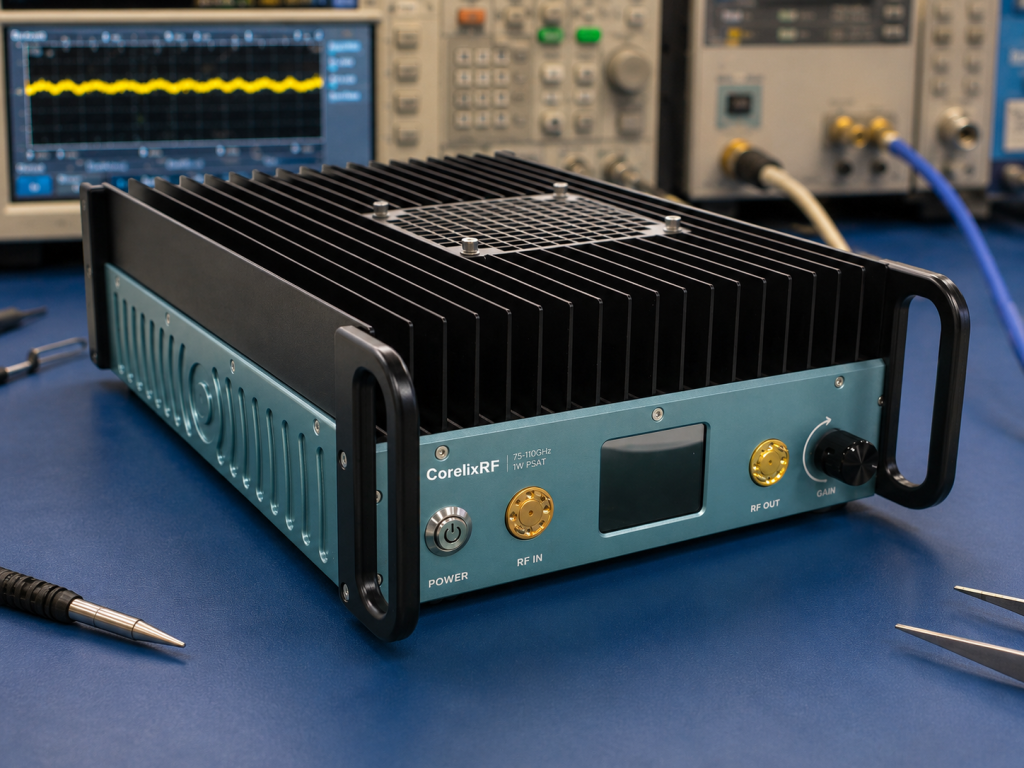
At W-band, amplifier selection is highly dependent on the complete test chain. Waveguide interface, transition loss, fixture design, thermal path, measurement calibration, detector or receiver setup, and load condition can all influence delivered performance. A buyer should avoid treating the public model name as a complete specification. It should be used as the starting point for an engineering review.
The first step is to define the target frequency window. Although the platform direction is 75-110 GHz, many projects only need a smaller portion of W-band. A narrow operating window may allow a better technical fit than a full-band request. The inquiry should state exact start and stop frequencies, priority test points, and whether output must be maintained across the whole range.
The second step is to define output power. At W-band, even a few watts can be technically significant. Power requirements should be tied to the measurement setup, path loss, antenna or waveguide hardware, and required margin. If the amplifier will be used for swept testing, pulsed work, or a specific waveform, that operating condition should be included.
The third step is interface planning. W-band systems typically require careful waveguide or mmWave interface review. The buyer should provide information about existing test equipment, adapters, waveguide components, attenuators, couplers, loads, and fixture constraints. Interface mismatch or transition loss can create a large difference between amplifier output and delivered power at the device under test.
Thermal and mechanical planning should also be reviewed early. W-band amplifiers may be used in compact lab setups, rack-based systems, or integrated test platforms. Cooling method, mounting position, airflow, heat sinking, and service access should be considered before the final configuration is selected.
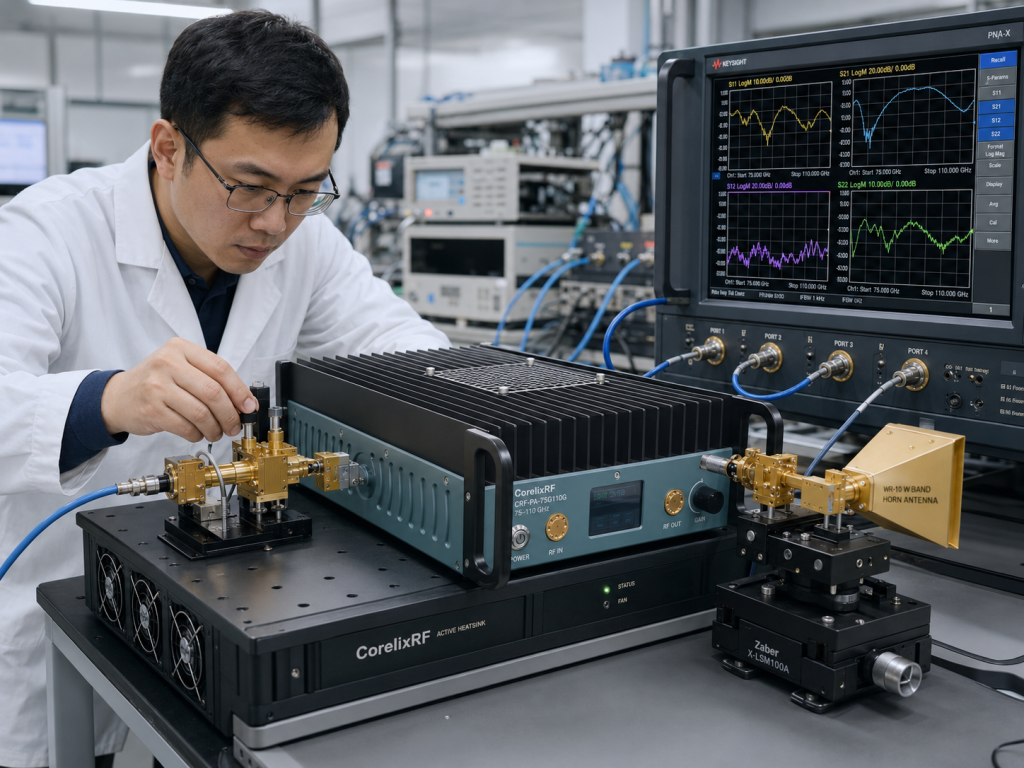
Control and monitoring requirements are another practical factor. If the amplifier will be part of an automated measurement station, the inquiry should describe enable control, monitoring needs, fault handling, and any system-level interface requirements. This helps prevent late-stage integration problems.
Documentation expectations should be stated clearly. For W-band projects, buyers may need datasheets, test curves, mechanical information, interface details, operating limits, and acceptance data. Because detailed specifications are provided after inquiry review, the buyer should give enough application context for CorelixRF to return the right technical information.
The strongest first inquiry for the CRF-PA-75G110G series includes target frequency window, output power target, operating mode, interface preference, available space, cooling condition, control needs, load environment, quantity, and required validation data. With that information, the supplier can review whether a representative model fits or whether a custom W-band amplifier configuration is needed.
FAQ
What frequency range does CRF-PA-75G110G cover?
CorelixRF lists the series as a 75-110 GHz W-band platform.
What output classes are shown publicly?
Representative 1W, 2W, 3W, and 4W model names are shown for inquiry screening.
Why are detailed specs provided after inquiry?
At W-band, final performance and configuration depend strongly on the target frequency window, interface, cooling, control, and test setup.
What should a W-band inquiry include?
Include target band, output need, operation mode, interface, cooling, control, load condition, quantity, and required test data.