
To: RF engineering, purchasing, and test-system stakeholders
Subject: Procurement review points for the CorelixRF CRF-PA-4000M8000M-500W 4-8 GHz C-band RF power amplifier
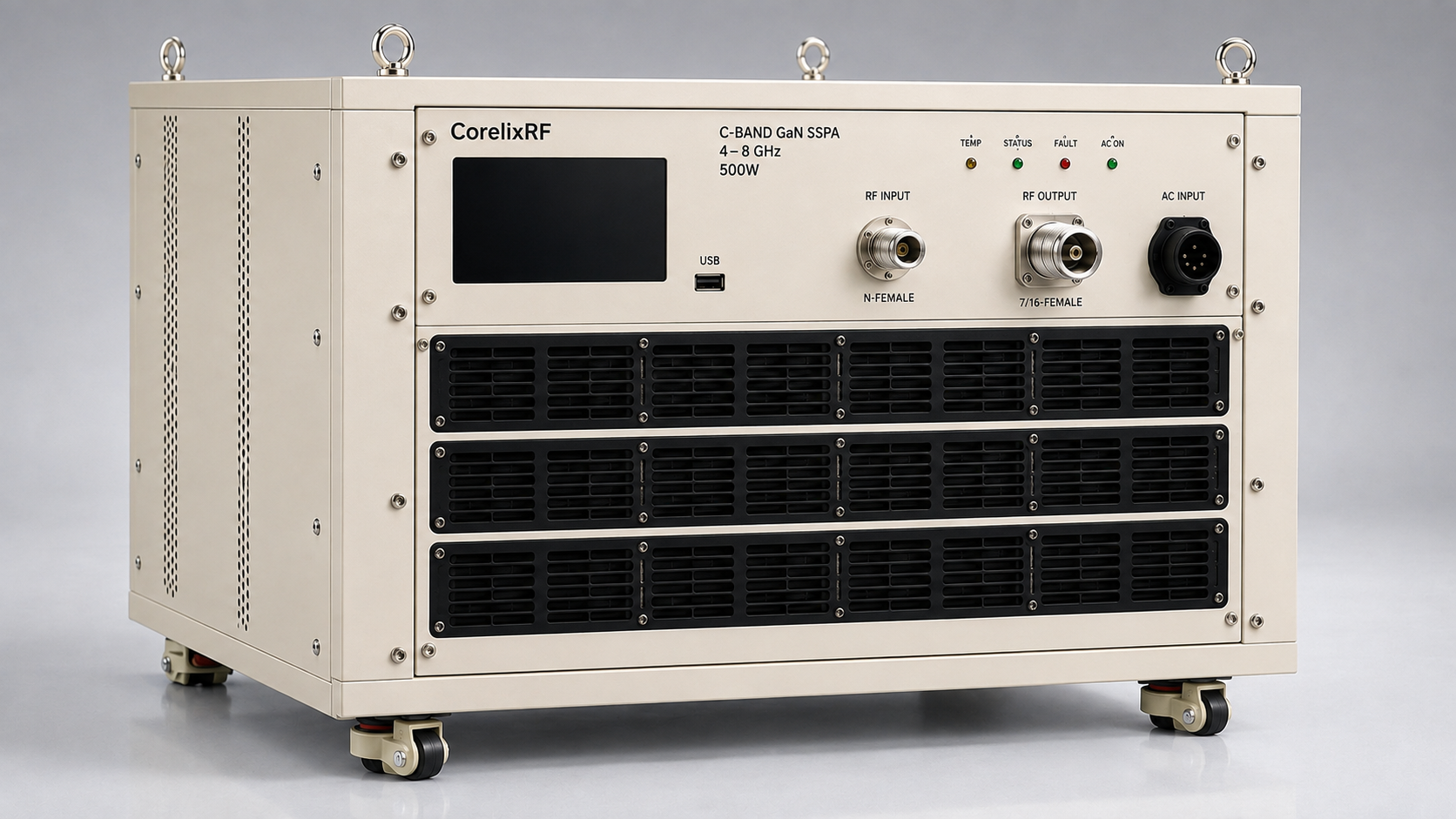
The local datasheet lists 4 GHz to 8 GHz frequency coverage, 500 W rated CW output power, GaN SSPA architecture, 60 dB minimum small-signal gain, N-Female and 7/16-Female RF connectors, air or water cooling, project-specific mechanical configuration, real-time temperature and current diagnostics, and alarm protection. This memo translates those lines into RFQ decisions.
Procurement Decision
The CRF-PA-4000M8000M-500W should be considered when the buyer needs a C-band RF power amplifier for high-power test, communication-system validation, RF interference or EW system-level work, or aerospace-control test support. It should not be purchased from the title alone. The quotation should confirm cooling, mechanical form factor, output path, control needs, and acceptance data.
Commercial Risk: Mechanical Configuration
The local datasheet identifies the mechanical form factor as project-specific. Purchasing should not assume a final rack height, cabinet style, or module package without written confirmation. Ask whether the expected delivery is a rack assembly, cabinet, module, or custom enclosure. This affects price, lead-time discussion, shipping, installation, and service access.
Technical Risk: Cooling Selection
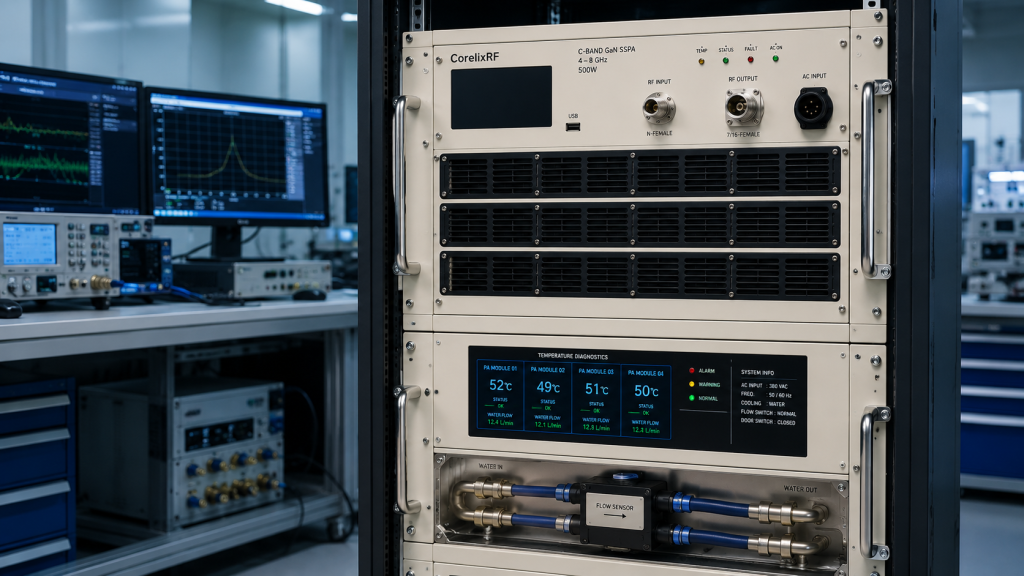
The datasheet lists air or water cooling. Air cooling may be simpler for a lab rack, but the rack must reject heat and preserve airflow. Water cooling can support dense or high-duty systems, but it adds facility plumbing, leak checks, flow monitoring, and maintenance. The RFQ should state duty cycle, ambient temperature, expected run time, and available facility cooling.
Integration Risk: Gain and Connectors
With 60 dB minimum small-signal gain, the source and attenuation plan must be controlled. The N-Female and 7/16-Female connector set should be reflected in the bill of materials, coupler selection, output cable, load, and spare adapter plan. A RF power amplifier purchase at 500 W can create avoidable rework if the output hardware is specified late.
Data Required Before Approval
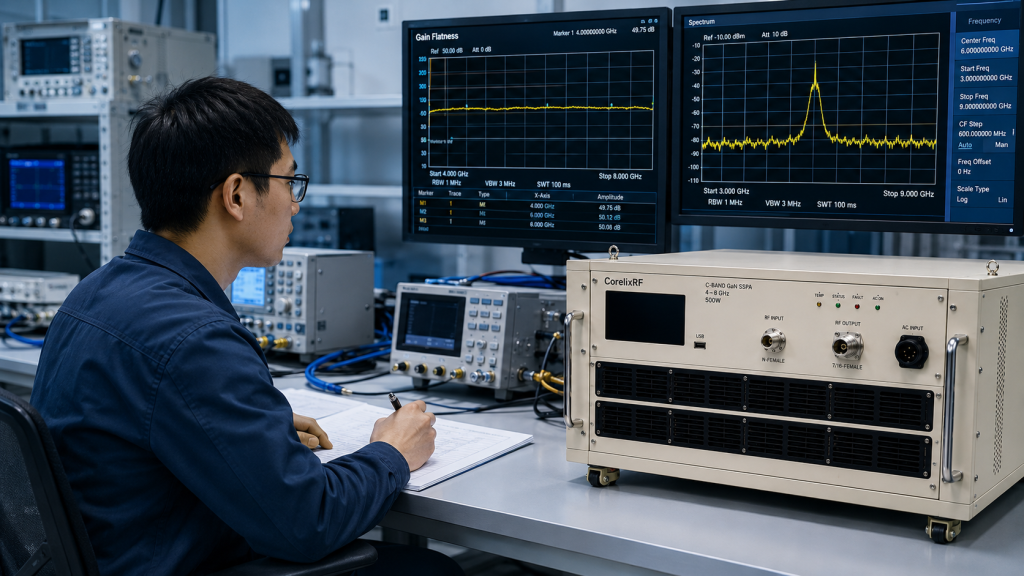
Request output power data across representative 4-8 GHz points, gain behavior, gain flatness, cooling notes, current and temperature diagnostics, alarm behavior, and the measurement reference plane. If the project has nonstandard waveform, enclosure, or control requirements, route it through a custom RF amplifier discussion before final purchase approval.
Recommended RFQ Language
The RFQ should ask CorelixRF to review a 4-8 GHz 500 W GaN SSPA requirement with stated input drive, connector preferences, cooling option, output load condition, control interface, alarm handling, rack or cabinet envelope, and acceptance data format. It should also say whether the system is for engineering test, production validation, or system-level RF evaluation.
Internal-Link Placement
Use natural anchors such as solid state power amplifier, RF amplifier, custom RF amplifier, and Contact CorelixRF where they help readers move from procurement questions to engineering review.
Buyer Questions to Resolve Before Quote Approval
Purchasing should ask whether the requested unit is air-cooled or water-cooled, whether the mechanical package is a rack, cabinet, or project-specific assembly, what control interface is expected, and how acceptance data will be delivered. The RF engineer should answer which frequencies matter, how output power will be measured, and what load condition will be used. The operations team should answer where the system will sit and how it will be serviced.
This memo format targets searchers who are not only researching a C-band RF power amplifier but also preparing an RFQ. Typical long-tail phrases include 4-8 GHz RF power amplifier, 500W C-band amplifier, GaN SSPA procurement, and RF amplifier quotation checklist. The memo keeps the article commercial and technical at the same time, which is a better fit for purchasing teams than a lab procedure.
Approval Recommendation
Approve the RFQ only after the quote package includes power, gain, frequency points, cooling choice, mechanical format, connector plan, control interface, alarm handling, and acceptance reference plane. If any of these items are left as assumptions, the purchasing file should be returned to engineering for clarification before price comparison.
A simple procurement scorecard can keep the review balanced. Score technical fit, cooling fit, mechanical fit, control fit, acceptance-data clarity, and integration risk separately. Price should be reviewed after those items are visible. Otherwise, a lower initial quotation can hide unresolved engineering work that appears later as rack redesign, adapter changes, facility work, or repeated acceptance testing.
The scorecard should also record who supplied each answer. Engineering, purchasing, and operations often care about different risks. Keeping those answers visible prevents the final decision from becoming only a price comparison.
FAQ
What is the primary search phrase for this article?
The primary search phrase is 4-8 GHz C-band RF power amplifier.
What rated output power is listed?
The local datasheet lists 500 W CW rated output power.
What cooling options should procurement confirm?
The datasheet lists air or water cooling, so the RFQ should confirm which option fits the duty cycle and facility.
What should not be claimed?
Do not claim certifications, stock status, delivery dates, or customer applications unless CorelixRF confirms them separately.