
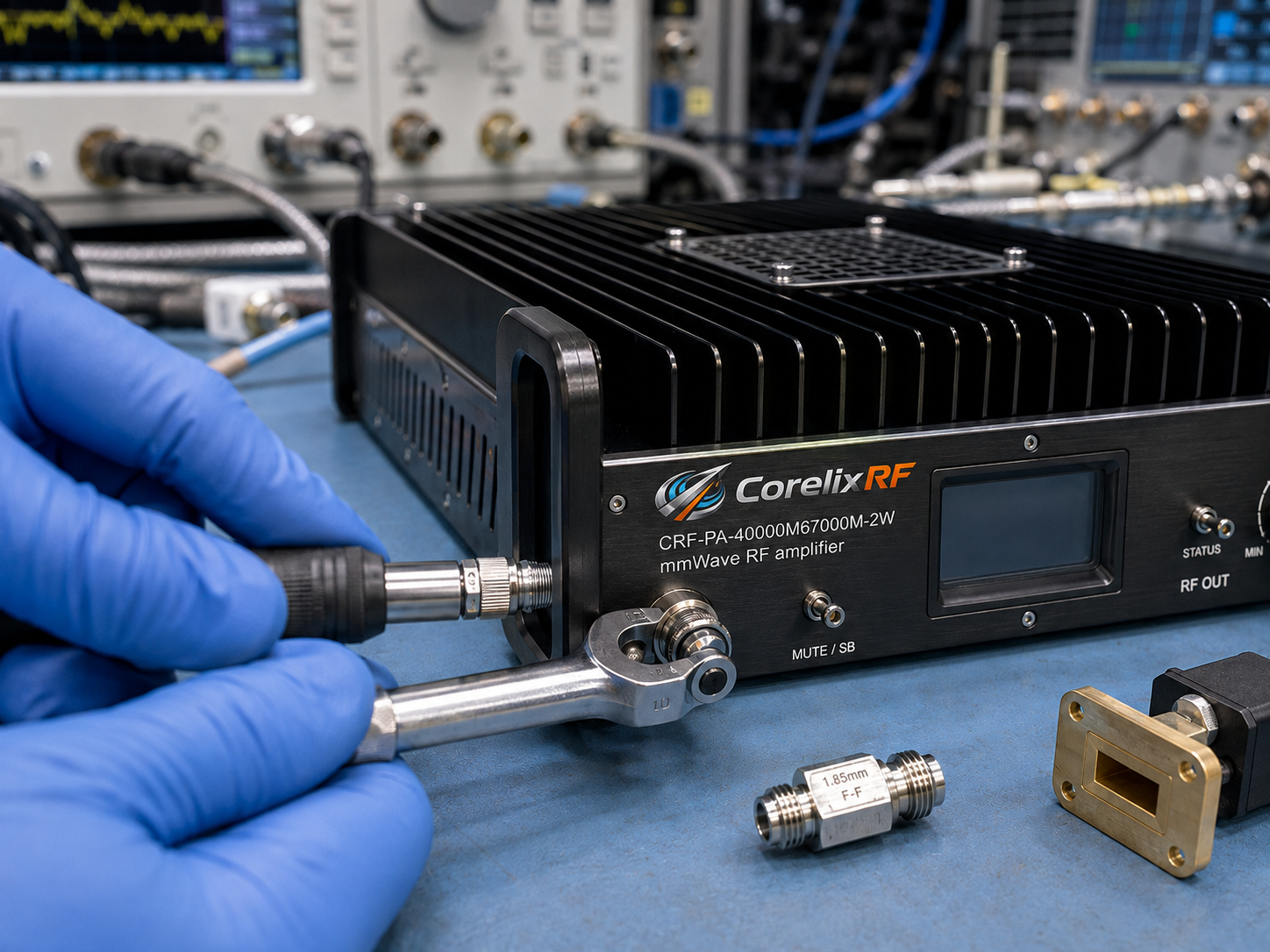
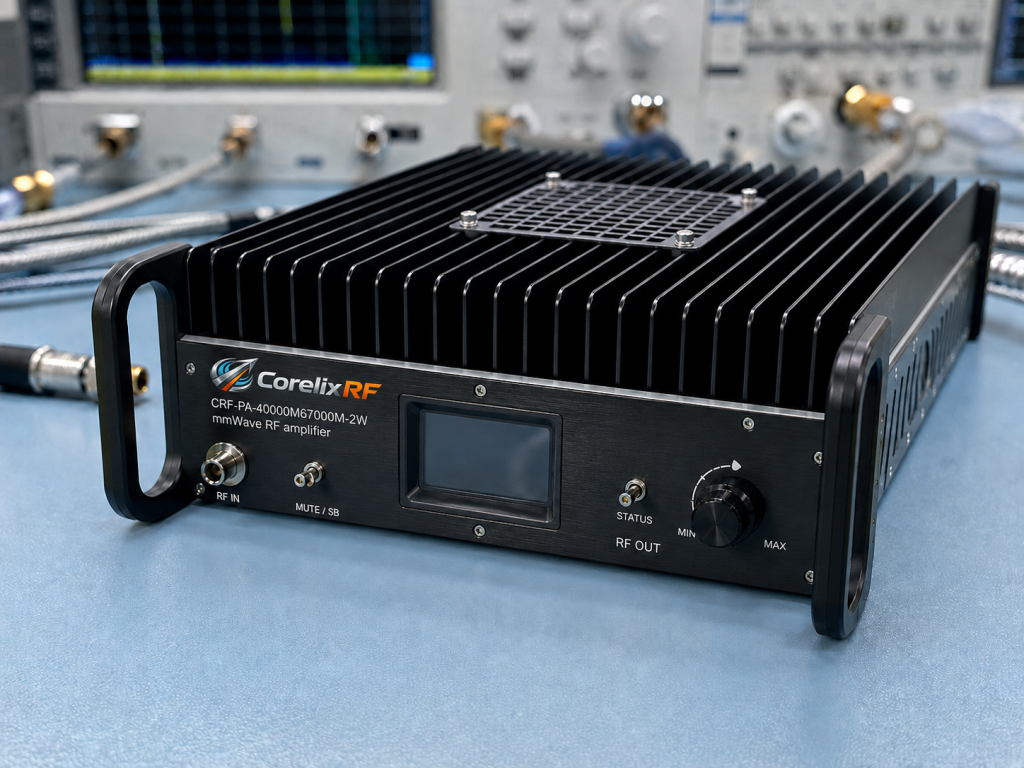
A 40-67 GHz 2W mmWave RF amplifier RFQ should do more than ask for a price. The CorelixRF CRF-PA-40000M67000M-2W gives buyers a GaN SSPA option with 40 GHz to 67 GHz coverage, 2 W rated output power, 1.85 mm female RF input/output, compact form factor, and project-review support for control, monitoring, cooling, and validation requirements.
This article is written as a procurement checklist. It is intended for engineers, buyers, and program teams who already know the approximate frequency and power class but need a complete way to request review. For context on adjacent platforms, CorelixRF’s high frequency RF capability, standard RF amplifier platform, and 18-40 GHz amplifier pages are useful internal references.
Checklist item 1: define the operating points
Do not write only “40-67 GHz” if the real project uses several fixed frequencies or a narrower sweep. List the exact operating points, expected dwell time, and whether the amplifier must perform across the full band. This helps CorelixRF review whether the 2 W configuration is the right match or whether another upper-mmWave platform should be considered.
Checklist item 2: state power at the load
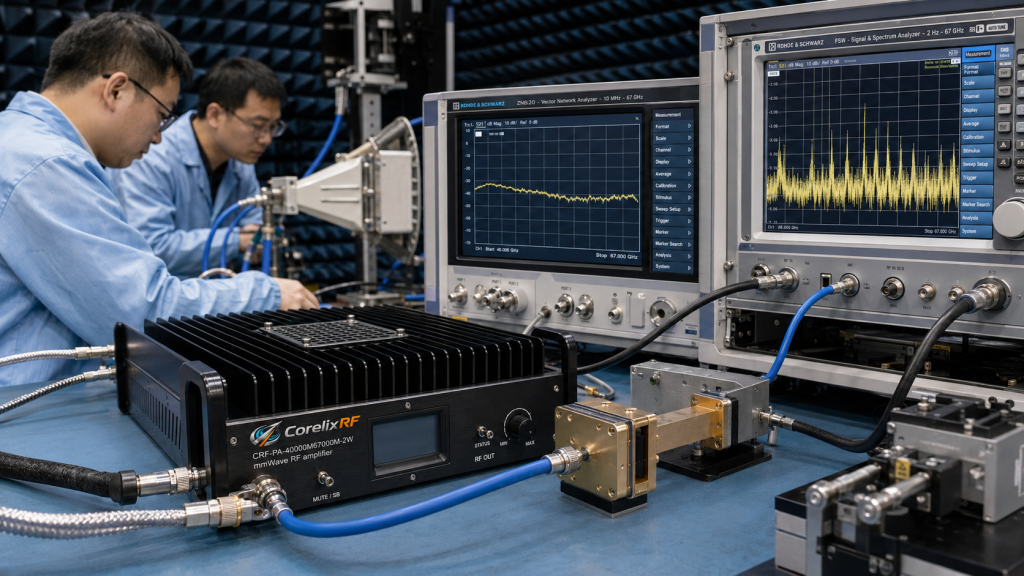
The model is specified for 2 W rated output power, but the buyer often cares about power at a device, fixture, antenna port, chamber feed, or waveguide transition. Include cable loss, adapter loss, switch loss, and coupler loss when possible. A clear loss budget turns the RFQ from a model request into a usable engineering review.
Checklist item 3: describe the signal and duty cycle
State whether the amplifier will be used for CW, swept, modulated, pulsed, or intermittent operation. Also include duty cycle, test duration, and expected ambient temperature. At mmWave frequencies, thermal and measurement conditions can affect repeatability, even when output power is moderate compared with lower-frequency systems.
Checklist item 4: identify the RF interface plan
The supplied specification lists 1.85 mm female RF input and output. The RFQ should describe cable type, connector care process, adapters, torque practice, and calibration method. If the amplifier will connect to waveguide hardware, include transition details and load rating. For validation workflow, see CorelixRF’s RF testing and validation page.
Checklist item 5: request the right project documents
- Latest datasheet for CRF-PA-40000M67000M-2W
- Mechanical outline or mounting guidance
- Connector and interface reference
- Control protocol notes where applicable
- Measured output-power and gain data
- Thermal or operating-condition assumptions
- Fault and protection behavior description
Checklist item 6: choose the conversion path
End the inquiry with a clear next step. If the team is still comparing products, use CorelixRF’s RF amplifier blog and 6-18 GHz microwave amplifier resources for background. If the team is ready for a project review, include the technical checklist and contact CorelixRF directly. CorelixRF’s engineering and manufacturing page reinforces that RF design, thermal layout, mechanical integration, and validation are connected tasks.
FAQ
What is the main RFQ keyword?
The natural buyer-intent phrase is 40-67 GHz 2W mmWave RF amplifier.
What output class is specified?
The supplied specification lists 2 W rated output power.
Why include cable and adapter loss?
The useful delivered power is power at the load or test point, not only the amplifier’s nominal output.
Does this article include non-CorelixRF links?
No. The draft uses CorelixRF internal links and a Contact CTA only.