

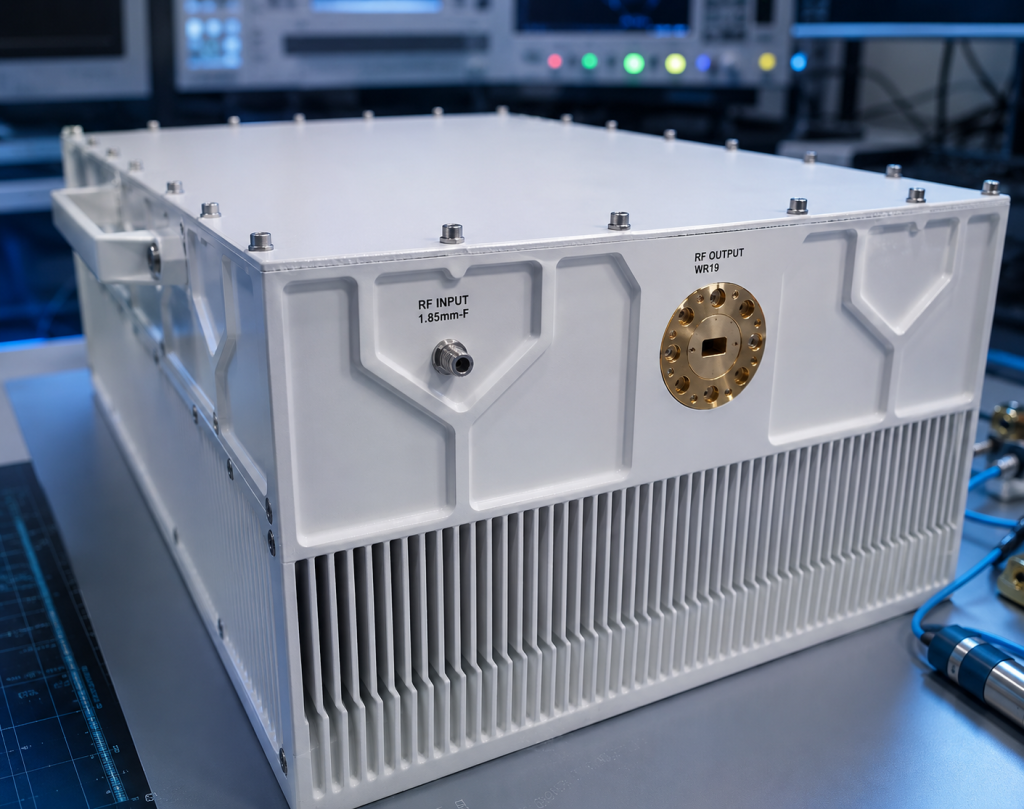
This article is written for a technical purchasing review. The CRF-PA-47000M51400M-400W, identified by the local datasheet as CRF-PA47G51.4G-400W, is specified as a GaN solid-state RF power amplifier covering 47-51.4 GHz with 400 W-class RF output power, 70 dB minimum small-signal gain, 20 dB gain control with 0.5 dB step, 1.85 mm-F input, WR19 output, forced-air cooling, high-power unit configuration, status monitoring, fault protection, and remote-control capability.
A buyer evaluating a millimeter-wave RF power amplifier at this power level should not make the decision from frequency and wattage alone. The matrix below separates must-have requirements from clarification items.
Decision Row 1: Frequency and Delivered Power
Must have: 47-51.4 GHz operating range and a defined output reference plane. Clarify: whether the 400 W-class requirement is at the WR19 output, after a waveguide path, or at an antenna/feed input. Purchasing should reject any comparison where candidates are measured at different reference planes.
Decision Row 2: RF Interfaces
Must have: compatibility with 1.85 mm-F input and WR19 output or an approved alternative. Clarify: waveguide sections, couplers, loads, antenna hardware, calibration adapters, and service access. At V-band, the output path is part of the purchase decision, not a minor accessory.
Decision Row 3: Gain and Control
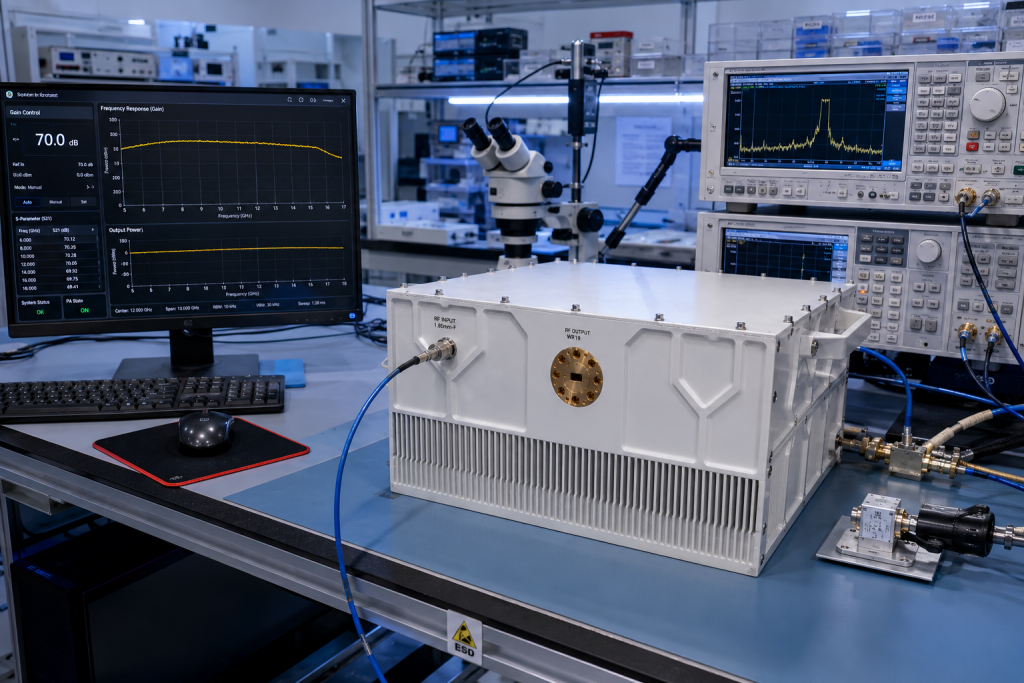
Must have: a source-drive plan that respects 70 dB minimum gain and 20 dB gain control. Clarify: remote-control interface, logged parameters, gain recipe, startup state, and fault response. Remote operation is valuable only when it produces repeatable evidence and safe system behavior.
Decision Row 4: Cooling and Rack Impact
Must have: a rack or enclosure plan that supports forced-air cooling and safe waveguide routing. Clarify: airflow direction, heat rejection, cabinet space, operator access, and whether nearby equipment recirculates hot air. CorelixRF high-frequency RF capability should be reviewed when the amplifier is part of a larger high-power mmWave setup.
Decision Row 5: Acceptance Data
Must have: output data at agreed frequencies, reference plane, gain state, thermal condition, current, and alarm behavior. Clarify: factory test scope, final drawing, control protocol, and documentation needed for internal approval. CorelixRF RF testing and validation is the natural internal support page for this evidence-based decision.
Decision Row 6: Standard or Custom Route
Must have: agreement that the standard configuration matches the project, or a clear custom review path. Clarify: mechanical packaging, output interface, control sequence, data format, and any system-level integration need. Use custom RF amplifier review when the project cannot be reduced to a standard unit plus ordinary installation.
Procurement Verdict
Shortlist the amplifier when the band, power reference plane, WR19 path, cooling plan, gain-control recipe, remote-operation needs, and acceptance data are all defined. Pause the purchase when the request still says only “high-power V-band amplifier” without stating measurement plane, load, source drive, or documentation needs. That pause prevents expensive rework.
Approval Checklist for Purchasing
Before the purchase request is released, attach the technical requirement, the expected reference plane, the planned WR19 output path, rack and cooling constraints, source-drive plan, documentation request, and acceptance criteria. Purchasing does not need to rewrite the engineering case, but it should make sure the quote request carries those details forward.
Commercial Clarifications That Affect Engineering
Lead time, configuration review, data package scope, and final drawing availability can all affect the schedule. Treat them as engineering-relevant commercial questions. If a project milestone depends on factory data or control documentation, ask for that scope explicitly. Do not assume it is included because the amplifier frequency and power rating match.
Final Risk Ranking
Highest risk: unclear output reference plane. Medium risk: undefined WR19 hardware, airflow, or remote-control requirements. Lower risk: wording details in the article or RFQ. This ranking keeps the buying discussion focused on the decisions that can actually affect test success.
Buyer Questions to Send Internally
Ask engineering whether the 47-51.4 GHz range is exact or approximate. Ask the test owner where power must be measured. Ask facilities whether rack heat and airflow are acceptable. Ask software whether remote status must be logged. Ask purchasing which documents must be attached to the order. Those internal answers should be gathered before the supplier is asked to close the quotation.
Why This Format Fits the Search Intent
A buyer searching for a 47-51.4 GHz 400W V-band power amplifier is probably comparing expensive technical options. A decision-matrix article serves that reader better than a generic overview because it names the approval criteria, risk categories, and missing information that determine whether the amplifier can move from inquiry to purchase.
Keep the matrix attached to the RFQ so later revisions preserve the same decision logic clearly.
FAQ
What frequency range is specified?
The source datasheet lists 47-51.4 GHz.
What output power class is listed?
The source data describes 400 W-class solid-state RF output power.
What RF interfaces are listed?
The datasheet lists 1.85 mm-F input and WR19 output.
Why use a decision matrix for this model?
At high-power V-band, output reference plane, waveguide routing, cooling, gain control, remote operation, and test evidence all affect purchasing risk.