
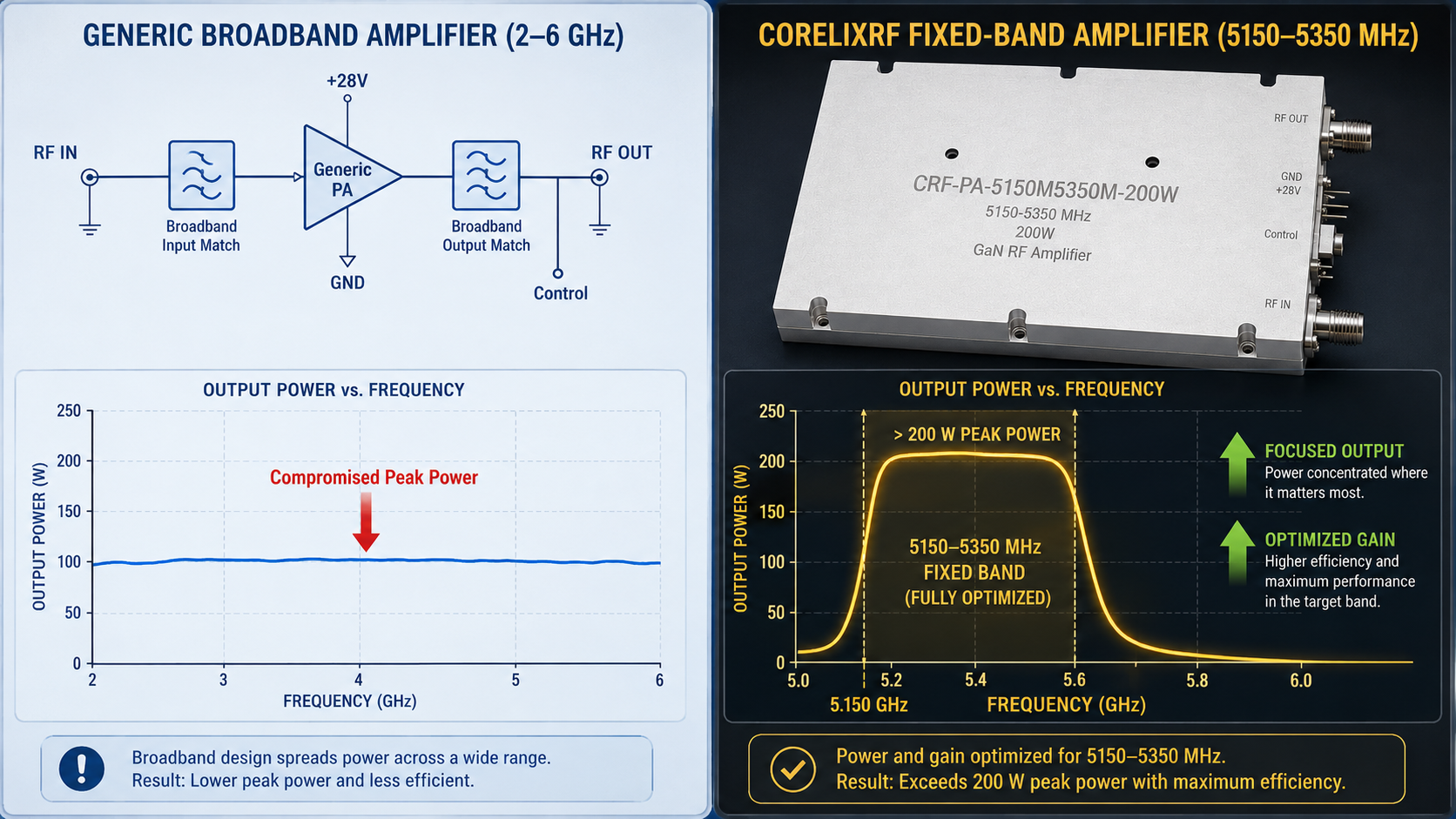
A 5150-5350 MHz 200W fixed-band GaN RF amplifier is selected when a project already knows the operating band and needs concentrated output power instead of a broad 2-6 GHz platform. This is a different buying decision from selecting a general broadband bench amplifier. The buyer must review source architecture, gain control, DC supply, external heat-sink cooling, control interface, monitoring, protection behavior and documentation.
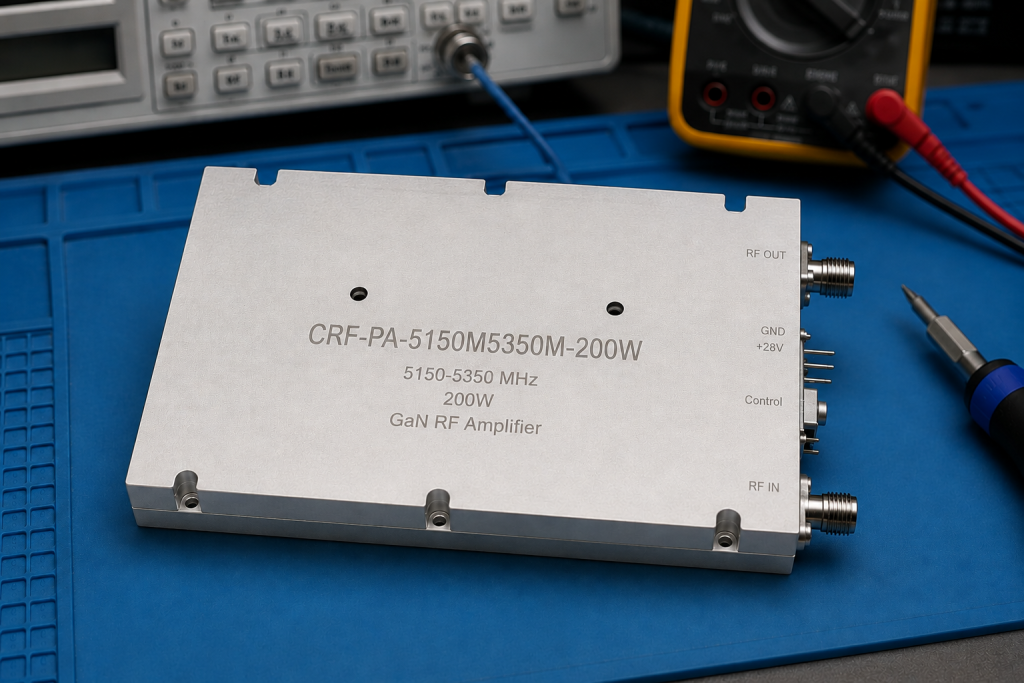
CorelixRF has published a guide for CRF-PA-5150M5350M-200W based on local specification data. The article describes a third-generation GaN solid-state RF power amplifier covering 5150 MHz to 5350 MHz with 200 W typical CW output power, 160 W minimum Psat, 49 dB minimum gain, 51 dB typical gain, 53 dB maximum gain, 20 dB gain adjustment in 0.5 dB steps, SMA-KFD46 RF connectors, a D-Sub 15-pin control/power connector, 24-32 V operating voltage and external heat-sink cooling.
Why Fixed-Band Can Beat Broadband
A broadband amplifier such as a 2-6 GHz RF power amplifier is useful when the same test platform must cover a wide range. A fixed-band 5150-5350 MHz amplifier is more relevant when the project is already locked around a 5 GHz window and wants RF output, gain adjustment and integration behavior optimized around that narrow range.
This focused approach can simplify the RFQ. Instead of comparing unrelated products, the engineering team can review the exact band, source level, output target, duty condition, heat-sink design, monitoring and protection behavior. If the final requirement changes to a different sub-band, use the custom RF amplifier path before assuming the same hardware is appropriate.
M Version and V Version Architecture
The published CorelixRF guide notes M and V configurations. The M version is described without an internal VCO, while the V version includes internal VCO source functionality with 10 Hz stepping and frequency or bandwidth adjustment references. This distinction should be decided before ordering because it affects system architecture.
If the project already has a signal generator, SDR or synthesizer, the M version may be the natural starting point. If the project needs source integration inside the RF module path, the V version should be reviewed with frequency control, software interface and bandwidth requirements. The inquiry should clearly state whether the customer is providing the RF source or asking CorelixRF to review a source-plus-amplifier structure.
Gain Adjustment and Drive-Level Planning
The listed 20 dB gain adjustment range with 0.5 dB steps is valuable for integration and calibration. It allows the system designer to manage output margin, compensate for path variation and avoid running the amplifier at an unsuitable drive level. However, gain adjustment is not a substitute for a proper gain budget.
Before RFQ, define source output level, expected input drive, target output power at the load, cable loss, attenuator plan and operating margin. If the amplifier is part of an RF front-end platform, include the source, filters, switches, couplers and load path in the review.
External Heat-Sink Cooling Must Be Designed
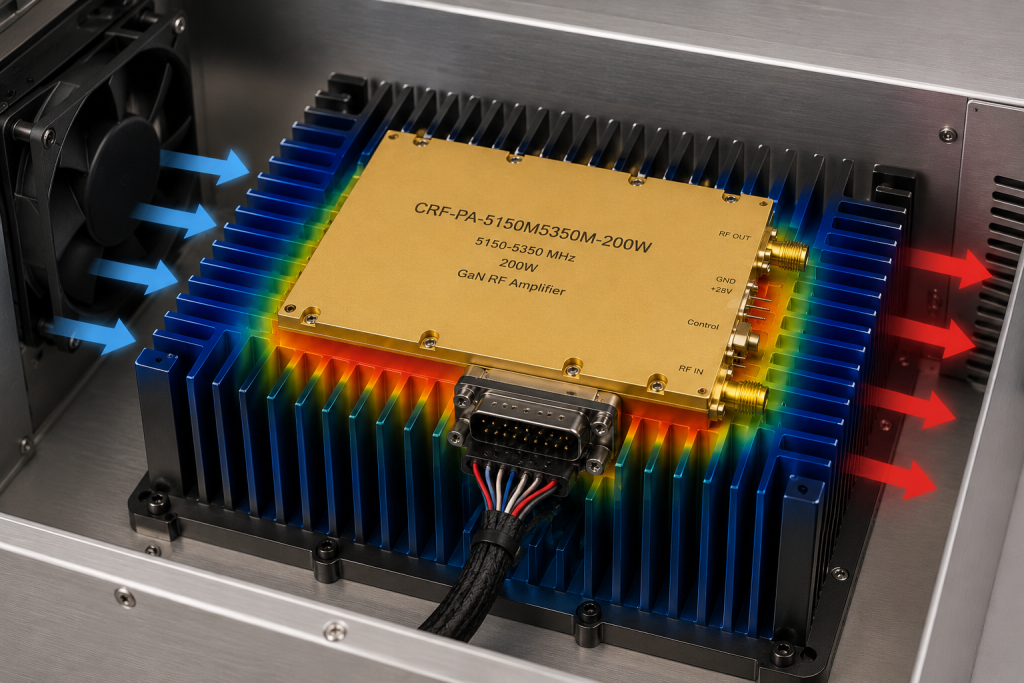
The compact 200 x 158 x 25 mm mechanical reference is attractive, but the public guide clearly points to external heat-sink cooling. That means the thermal system is part of the design. The buyer should provide heat-sink size, mounting surface, airflow, enclosure temperature, duty condition and expected operating time.
A 200 W fixed-band GaN amplifier can only perform correctly when the mechanical and thermal path match the RF requirement. If the project runs long CW intervals, high duty operation or warm enclosure conditions, those details should be included before quotation. For OEM work, request mechanical drawings and mounting recommendations.
Monitoring and Protection Review
The CorelixRF guide references optional RS485 monitoring/control, forward and reverse power indicators, temperature analog output, gain control and alarm reset options where applicable. It also references protection behavior such as over-temperature shutdown and recovery, over-VSWR locked shutdown, over-voltage lock above 32 V and over-current lock above 38 A.
These functions are important for automated test systems and integrated RF sources. The buyer should decide how the host controller will respond to alarms, temperature changes or reflected-power conditions. Operator procedures and recovery behavior should be reviewed before the amplifier is installed in a cabinet or product.
RFQ Checklist
Send exact frequency range, desired output power, M or V source architecture, input drive, duty condition, DC supply availability, heat-sink plan, enclosure temperature, connector preference, monitoring interface, load condition, documentation needs, quantity and project stage. If the project needs another mechanical shape, connector arrangement or monitoring mode, ask for a custom review through CorelixRF Contact.
FAQ
What frequency range does CRF-PA-5150M5350M-200W cover?
The published CorelixRF guide lists 5150 MHz to 5350 MHz.
What output power is listed?
The guide lists 200 W typical CW output power and 160 W minimum Psat.
Does the amplifier support gain adjustment?
Yes. The published guide lists 20 dB gain adjustment with 0.5 dB steps.
What cooling should be planned?
The guide lists external heat-sink cooling, so the buyer must design the heat-sink, airflow and enclosure thermal path.