
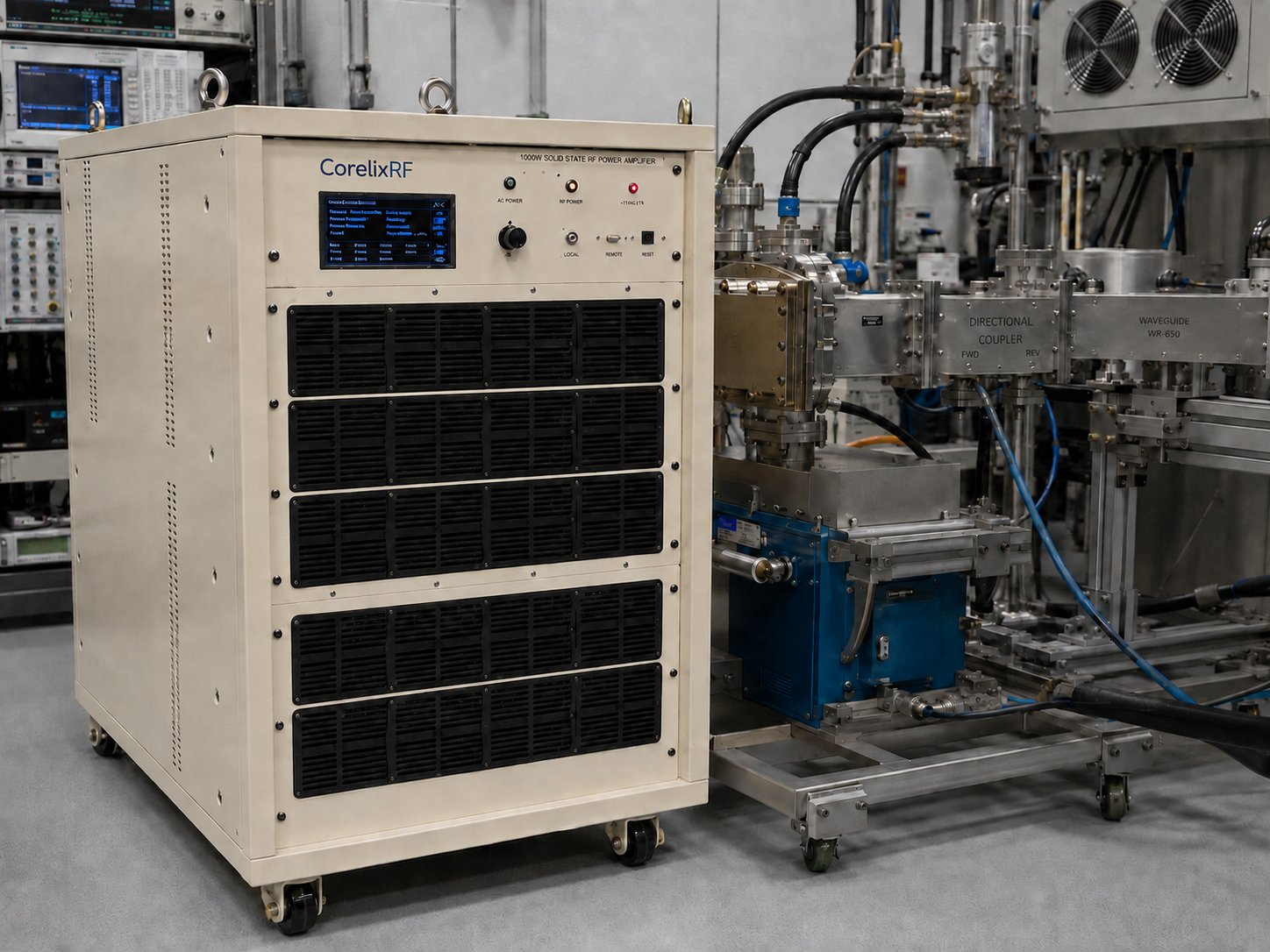
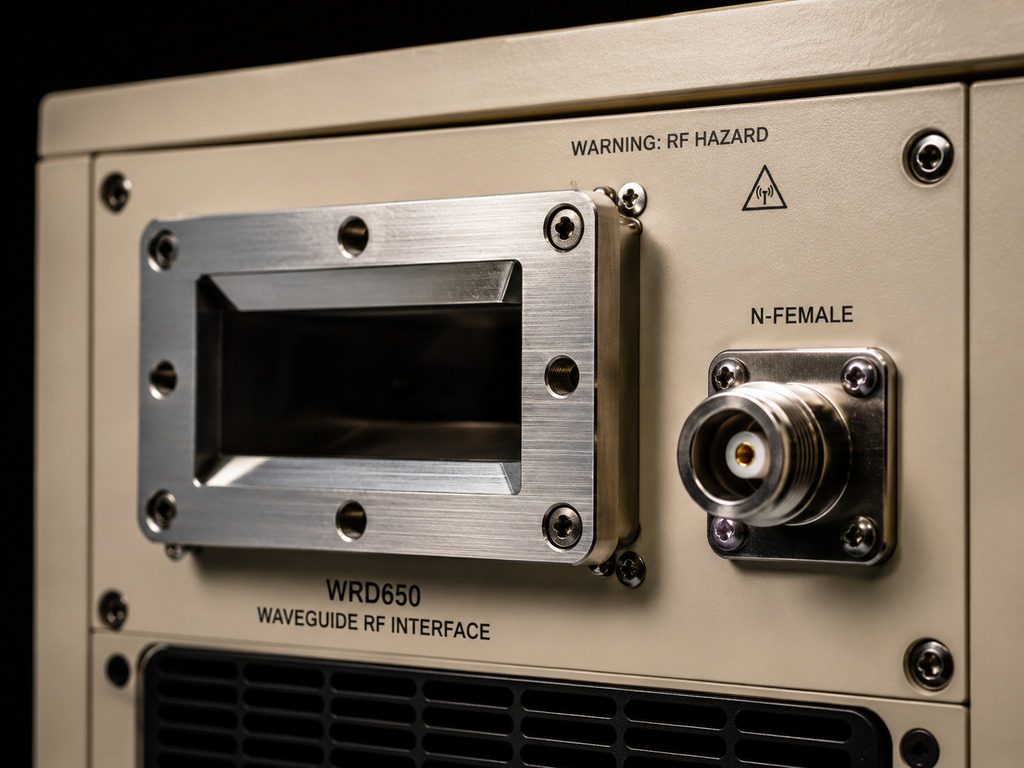
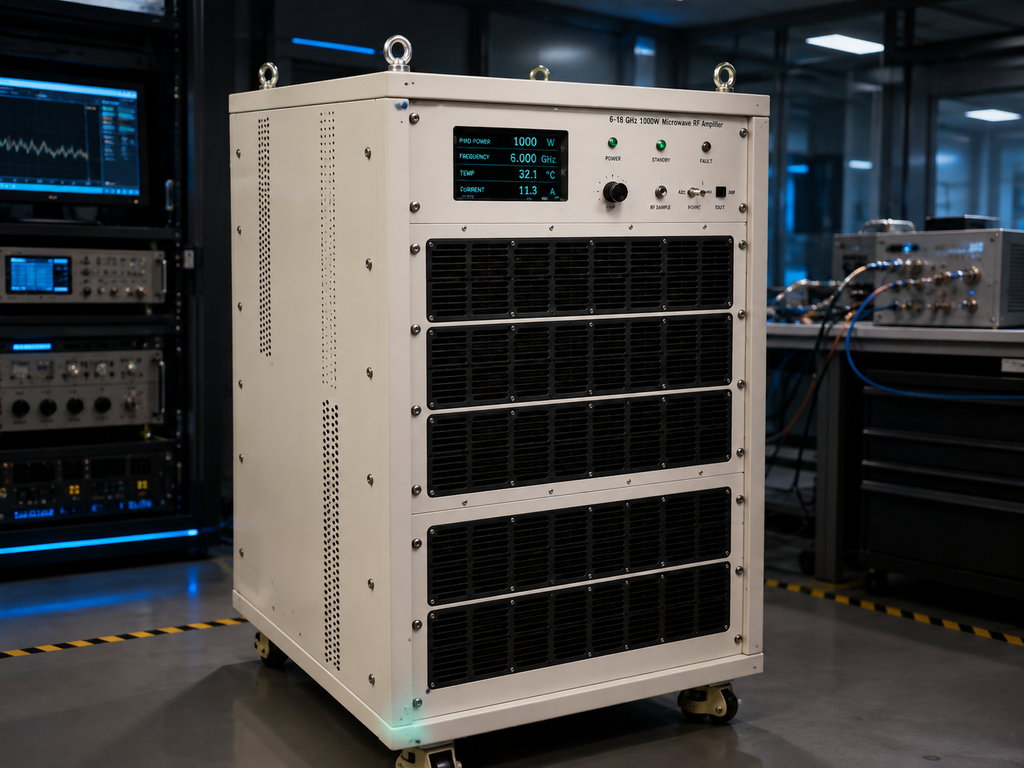
A 6-18 GHz 1000W microwave RF amplifier is not a catalog-only purchase. The CorelixRF CRF-PA-6000M18000M-1000W covers 6 GHz to 18 GHz, provides 1000 W rated solid-state RF output power, uses GaN SSPA technology, and lists 60 dB minimum small-signal gain. The local datasheet identifies N-Female / WRD650 waveguide RF interfaces, a project-specific mechanical configuration, temperature and current diagnostics, alarm protection, and project-ready control interfaces.
This RFQ brief is for buyers searching for a 1000W microwave amplifier, 6-18 GHz GaN SSPA, WRD650 waveguide amplifier, high power RF amplifier, or RF power systems planning. At this power level, the first job is to define the project, not to ask for a quick quote with only frequency and wattage.
RFQ Section 1: Operating Profile
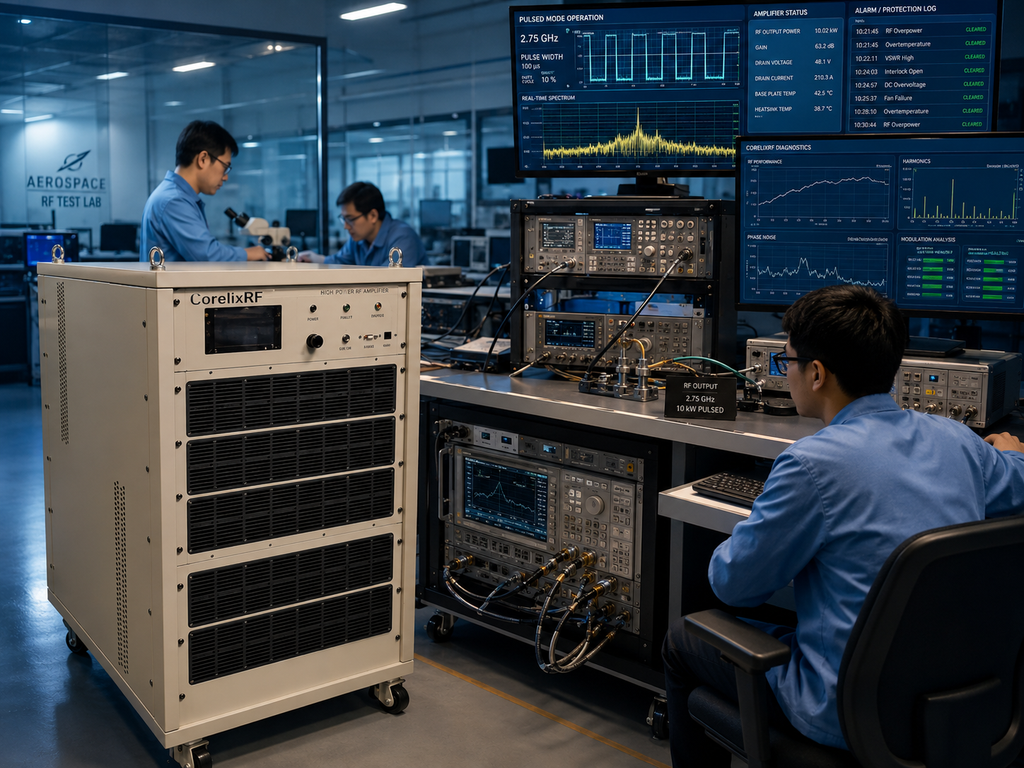
State whether the amplifier will support CW operation, pulsed work, swept testing, fixed-frequency stress points, communication-system evaluation, RF interference testing, or aerospace-control benches. Include waveform, duty condition, source type, expected run time, and output reference plane. If the project is related to a pulsed operating mode, compare requirements with CorelixRF pulsed amplifier resources rather than assuming one operating pattern covers all use cases.
RFQ Section 2: Mechanical Configuration
The source lists the mechanical form factor as project-specific. That is a clear signal that rack dimensions, cooling approach, service access, power delivery, waveguide routing, and enclosure constraints must be discussed early. A high-power RF integration solutions conversation can combine amplifier, source, switching, load, monitoring, and control needs into one review.
- Define N-Female / WRD650 interface use and output reference plane.
- Lock source drive for the 60 dB gain stage.
- Describe cooling, rack, cabinet, or facility constraints.
- Request current, temperature, alarm, and test-data records.
- State whether a standard platform or custom RF development path is expected.
RFQ Section 3: Source and Protection Logic
A 60 dB gain stage requires strict source limits and controlled enable timing. The RFQ should describe how the amplifier will be turned on, how frequency changes are handled, how alarms are reset, and how test software prevents overdrive during retries. Protection functions are important, but the operating method should prevent avoidable fault events.
RFQ Section 4: Interface and Load Planning
The N-Female / WRD650 interface line should be translated into a real RF path. Include waveguide sections, adapters, directional couplers, loads, switch matrices, antennas, and measurement sensors. At 1000 W, every downstream part must be reviewed for power rating and operating condition. If the path is not final, say so in the inquiry.
RFQ Section 5: Documentation and Review
The RFQ should request final mechanical drawing, control protocol, test data format, and project-specific notes. CorelixRF custom RF development is the right internal link when the amplifier must fit a unique rack, cabinet, control stack, or monitoring architecture.
The selected long-tail keyword set is 6-18 GHz 1000W microwave RF amplifier, 1000W microwave amplifier, 6-18 GHz GaN SSPA, WRD650 waveguide amplifier, high power RF amplifier, and RF power systems. These terms are high-intent and technically specific.
Brief Closeout
A complete brief reduces risk before engineering hours and purchasing budget are committed. It names the operating profile, mechanical configuration, RF interface, source limit, load path, cooling plan, control logic, monitoring needs, and acceptance documentation. That is the level of detail a high-power 6-18 GHz amplifier deserves.
This article avoids unsupported claims about certification, inventory, or customer deployments. It uses local datasheet facts and practical RFQ guidance so technical buyers can prepare a credible discussion with CorelixRF.
Project Review Questions
Before the inquiry is sent, the project owner should answer several questions. Is the full 6-18 GHz range required, or only defined sub-bands? Is the 1000 W target needed at the amplifier output or after the waveguide path? Will the amplifier run continuous tests, short stress points, or pulsed conditions? Who owns cooling and facility readiness? Which data must be included in the acceptance report?
These questions change the scope of the quote. A high power RF amplifier may be the correct active device, but the final project may also need load hardware, directional couplers, control software, rack drawings, safety procedure, and remote monitoring. Naming those needs early prevents a narrow product inquiry from becoming a late-stage integration problem.
The best public content for this model should be precise rather than exaggerated. The datasheet supports a powerful 6-18 GHz GaN SSPA platform with WRD650-related interface planning and project-specific mechanical review. The final installation remains an engineering project that should be defined through a careful RFQ.
High-Power System Boundary
The RFQ should draw a boundary around what CorelixRF is being asked to supply and what the customer system will provide. If the customer supplies load hardware, cooling infrastructure, control software, or rack integration, those assumptions should still be visible in the technical review. If CorelixRF is asked to support a broader system package, the inquiry should state that directly so engineering can review the complete chain.
A 1000W microwave amplifier can become the center of a large test system, so vague requirements create schedule risk. The brief should convert every important assumption into a line item: output plane, interface, cooling, waveform, duty condition, control, monitoring, protection response, and acceptance evidence.
FAQ
What frequency range does CRF-PA-6000M18000M-1000W cover?
The local datasheet lists 6 GHz to 18 GHz.
What output power and gain are listed?
The source lists 1000 W rated RF output power and 60 dB minimum small-signal gain.
What RF interfaces are listed?
The datasheet identifies N-Female / WRD650 waveguide RF interfaces.
Why is this RFQ project-specific?
The source lists the mechanical configuration as project-specific, so rack, cooling, control, and documentation requirements should be reviewed before quotation.