
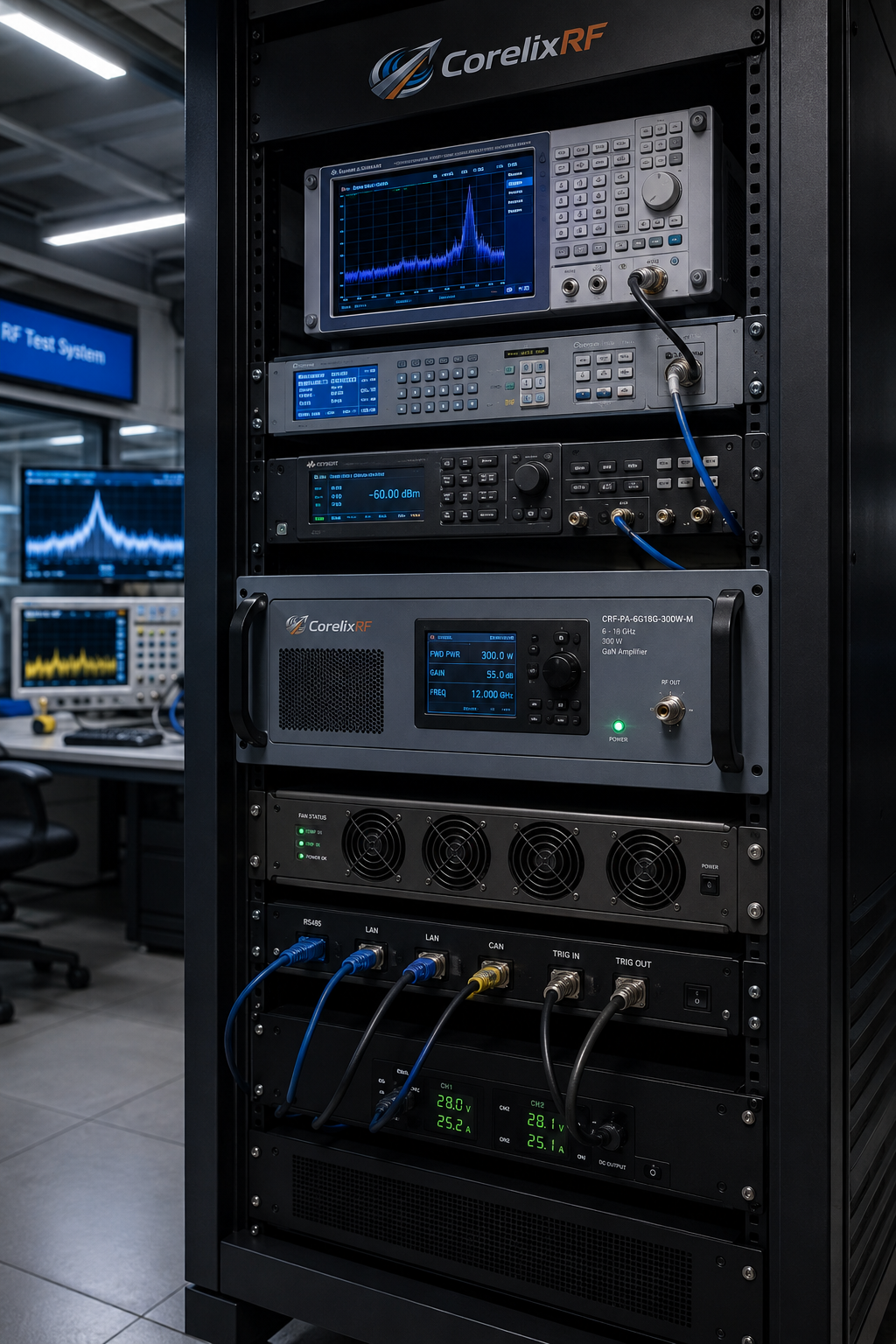
A 6-18 GHz GaN RF amplifier is selected for C-band, X-band, Ku-band-related, and broadband microwave test paths where connector transitions, power class, cooling, mechanical format, and control interface can matter as much as frequency coverage. This article is intentionally different from a 2-6 GHz SDR article or an 18-40 GHz mmWave article. The 6-18 GHz searcher is usually comparing microwave amplifier architecture: compact module, coaxial rack unit, waveguide-output platform, or a project-adjusted GaN SSPA.
CorelixRF’s public 6-18 GHz content describes a broad CRF-PA-6000M18000M family ranging from miniature 10 W and 16 W units to rack and waveguide-output systems. It also positions the 6-18 GHz amplifier platform for engineers who need datasheet-supported power classes across the full band, with GaN solid-state design, RS485 or LAN control options, and compact-to-rack mechanical formats. Those are useful public signals, but final selection still requires model-level review of the actual frequency window, output target, input drive, interface, cooling method, and measured data.
Why 6-18 GHz Is a Microwave Integration Problem
At 6-18 GHz, a broadband RF power amplifier cannot be selected only by output wattage. A test system may need stable output across a wide span, but the delivered result depends on cable loss, connector quality, adapter stack-up, gain flatness, thermal behavior, load match, and control workflow. The amplifier may be used in a bench system, an SDR-driven microwave chain, a communication test rack, a chamber input path, or an OEM subsystem.
The public CorelixRF article on 6-18 GHz RF power amplifier selection emphasizes full-band output behavior, connector path, cooling method, control interface, and validation workflow. That makes it a better internal link for this topic than a lower-frequency product page. For buyers comparing GaN technology and mechanical formats, CorelixRF’s high-power 6-18 GHz GaN RF amplifier content is also directly relevant.
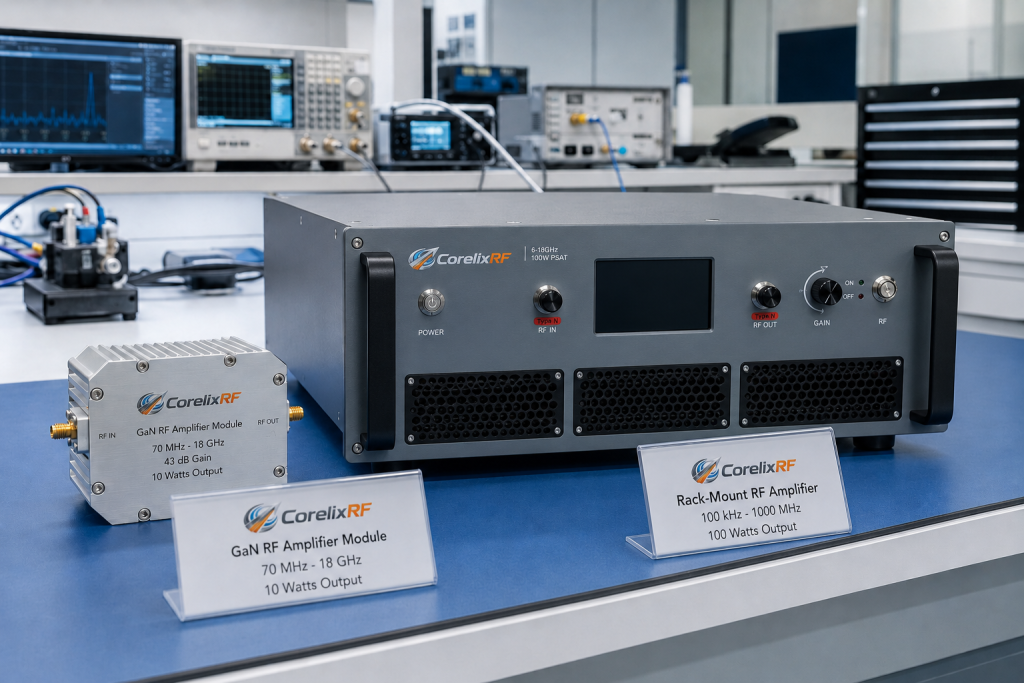
Module, Coaxial Rack, or Waveguide Output?
One reason 6-18 GHz content needs its own article is that the same frequency range may be served by very different mechanical and RF interfaces. Compact modules are useful when the amplifier must fit into a subsystem or a constrained test fixture. Coaxial rack units are more practical when the system needs front-panel access, easier lab handling, or integration into a larger microwave test rack. Waveguide-output systems may be reviewed for higher-power microwave paths where coaxial output is not the best interface.
The public CorelixRF article references compact SMA-female input/output models, N-female rack units, SMA-F/N-F module-style units, and higher-power WRD500/WRD650 waveguide-output models. Those should be treated as starting configurations for engineering review, not interchangeable parts. The output interface should match the downstream path, not simply the buyer’s preferred connector.
SDR-Driven Microwave Chains
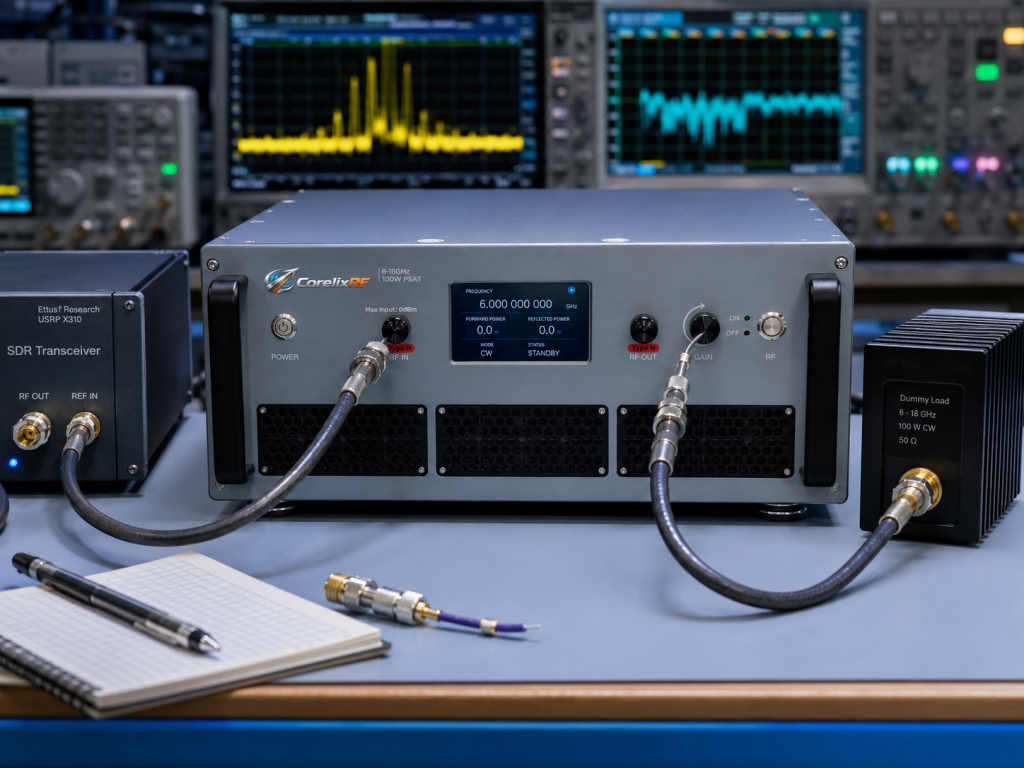
SDR-driven microwave systems create an additional matching problem. The SDR source may tune broadly, but the amplifier’s input requirement, expected drive level, gain, and linearity behavior must be checked around the actual waveform. A CW test tone, swept signal, modulated waveform, or pulsed condition can create different demands on the amplifier and thermal path.
For projects that combine an SDR source, power amplifier, and antenna/load/DUT path, CorelixRF’s RF front-end platform page is the most useful supporting internal link. It frames the system as a matched chain: source, RF power stage, and output-side condition. That is exactly how a 6-18 GHz GaN SSPA should be reviewed before procurement.
What to Include in a 6-18 GHz RFQ
A useful RFQ should include the exact frequency range, required output power, input signal level, waveform type, CW or pulse condition, output interface preference, connector or waveguide path, rack or module requirement, cooling limits, control interface, supply condition, load or antenna details, quantity, and project stage. If the project has a preferred CorelixRF model, include it; if not, submit the operating requirement and let the engineering review identify the closest platform.
The Contact CorelixRF page is the correct CTA target because it asks for the practical details needed to select or customize an RF amplifier. A buyer should also request datasheets, measured curves, outline drawings, and control interface notes during the review stage.
Avoiding Wrong-Model Selection
The most common risk in this band is treating 6-18 GHz as a single generic category. A compact 10 W module, a rack-mounted coaxial amplifier, and a waveguide-output high-power system may all belong to the same frequency family but solve different problems. The right model depends on delivered power, usable bandwidth, control environment, thermal design, and downstream RF path.
This is why the article’s main conversion action should be an engineering review rather than a simple quote request. CorelixRF can review whether the project should start from a standard 6-18 GHz GaN amplifier, a rack-mount configuration, a waveguide-output system, or a custom RF amplifier path.
FAQ
What is the focus keyword for this article?
The focus keyword is 6-18 GHz GaN RF amplifier.
Is a 6-18 GHz GaN RF amplifier the same as a 2-6 GHz amplifier?
No. A 6-18 GHz amplifier is a microwave-band platform where connector transitions, rack format, waveguide options, cooling, and measured full-band behavior usually require separate review.
What configurations are publicly described by CorelixRF?
CorelixRF public content describes compact module options, coaxial rack units, module-style SMA-F/N-F configurations, and higher-power waveguide-output systems for the 6-18 GHz family.
When should I choose a rack-mount amplifier?
Rack-mount review is appropriate when the amplifier needs lab access, system control, airflow planning, monitoring, or integration into a larger microwave test rack.
What information helps CorelixRF recommend the right 6-18 GHz model?
Send frequency range, output power, input drive, waveform, connector or waveguide path, cooling limits, control interface, rack/module preference, load condition, quantity, and project stage.