
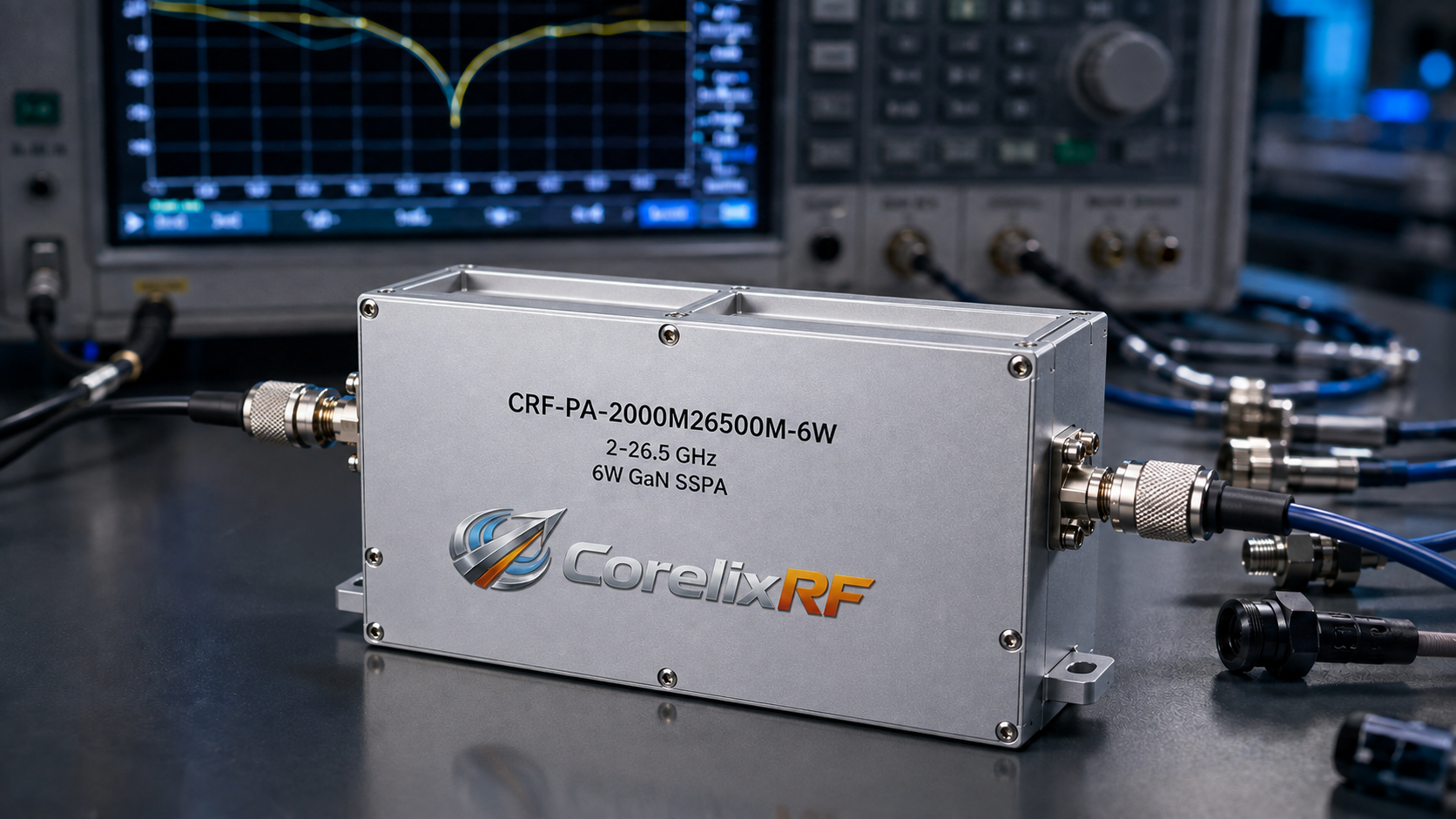
The CRF-PA-2000M26500M-6W is a 2 to 26.5 GHz wideband RF amplifier for microwave test benches, communication experiments, RF interference evaluation, and system-level integration. Based on the supplied CorelixRF datasheet, it is a GaN solid-state power amplifier with 6 W rated output power, 36 dB minimum small-signal gain, 2.92 mm-F RF input and output connectors, RS232 control, and a compact 240 x 160 x 50 mm mechanical format.
This model is useful when an engineer needs one microwave RF amplifier to span S-band, C-band, X-band, Ku-band, K-band, and the lower Ka-band edge without changing amplifier modules. It does not replace high-power narrowband hardware, but it can simplify wideband lab validation where frequency coverage and repeatable control matter.
Why specify a 2 to 26.5 GHz wideband RF amplifier?
A 2 to 26.5 GHz wideband RF amplifier reduces the number of amplifier swaps in a microwave test setup. Engineers working with swept measurements, multi-band receivers, broadband antennas, frequency converters, or microwave subsystems often need a driver or medium-power amplifier that follows the signal chain across many bands.
The CRF-PA-2000M26500M-6W is rated for 6 W output power and 36 dB minimum gain. Gain flatness is specified as -8 to +8 dB, which is a practical figure to include in the test budget because a wideband amplifier will not behave like a narrowband tuned stage. When planning a broadband RF amplifier, engineers should combine amplifier gain flatness with cable loss, switch loss, coupler response, and fixture response.
Core specifications from the datasheet
The frequency range is 2 to 26.5 GHz. Output power is listed as 6 W, and small-signal gain is 36 dB minimum. Gain control range is up to 15 dB. Input impedance / VSWR is listed as 50 ohm / 2:1 maximum. Harmonics are listed at -15 dBc, and spurious response is listed at -60 dBc maximum.
RF connectors are 2.92 mm-F for both input and output. The control interface is RS232. Power supply is 18 V / 6 A DC. The module size is 240 x 160 x 50 mm, with forced-air cooling and an operating temperature range from 0 to +40 C.
These parameters make the amplifier a strong candidate for a compact GaN SSPA role in microwave laboratories where instrument bandwidth, connector care, and thermal stability are important.
Connector and system integration considerations
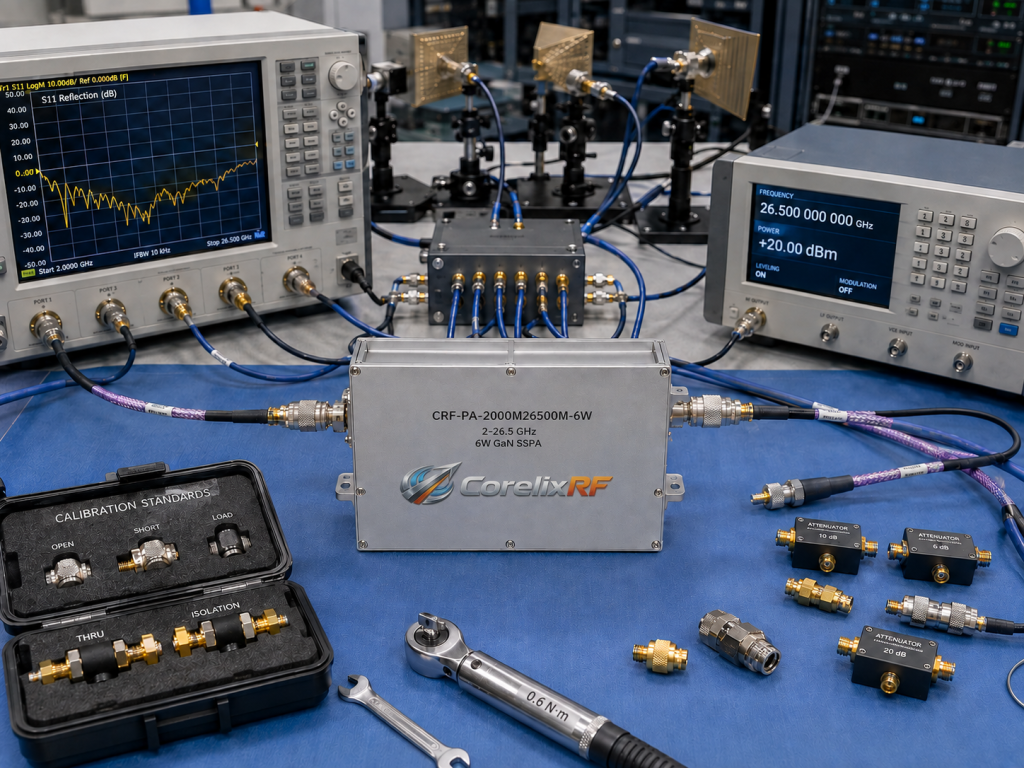
At 26.5 GHz, connector handling matters. The 2.92 mm-F RF connectors should be matched with suitable cables, torque practices, adapters, and calibration plans. A poorly selected adapter or damaged connector can distort the real output available at the DUT, especially above 18 GHz.
The module form factor also affects integration. A 240 x 160 x 50 mm amplifier can fit inside a compact RF drawer or portable test fixture, but forced-air cooling still needs defined airflow. If the amplifier will operate near maximum power for long periods, confirm the heat path, fan direction, ambient temperature, and enclosure restrictions. For a custom RF amplifier, mechanical and thermal review should happen before the purchase order.
Protection and monitoring
The CRF-PA-2000M26500M-6W includes real-time temperature monitoring and real-time current monitoring. Built-in protection includes alarm and fault protection, over-temperature protection, over-drive protection, over-voltage protection, and VSWR protection with alarm functions. Optional forward/reverse power monitoring and input power detection are listed as available where applicable.
Those capabilities are important in automated microwave testing. A high-frequency amplifier can see rapid changes in load condition as switch matrices, antennas, waveguide transitions, or fixtures are reconfigured. Monitoring helps the system controller detect faults before they become expensive hardware events.
Application fit
The datasheet lists test and measurement instrumentation, communication systems, RF interference system-level testing, and aerospace control systems as primary applications. In practice, this amplifier can be evaluated for microwave receiver testing, antenna path driving, converter chain validation, broadband sweep testing, and controlled RF stimulus generation.
For procurement teams searching for a 2 to 26.5 GHz RF amplifier, the key question is not only whether the amplifier covers the frequency range. It is whether the available output power, gain flatness, connector interface, control method, and cooling design match the final test plan.
FAQ
What frequency range does CRF-PA-2000M26500M-6W cover?
It covers 2 GHz to 26.5 GHz.
What output power is listed in the datasheet?
The rated output power is 6 W.
What connectors does the amplifier use?
The RF input and RF output are both 2.92 mm-F connectors.
What control interface is available?
The datasheet lists RS232 control.
Is this amplifier suitable for automated microwave testing?
It can be considered for automated test systems because it includes monitoring, alarm protection, and project-ready control functions, but final suitability depends on waveform, duty cycle, thermal design, and load conditions.