
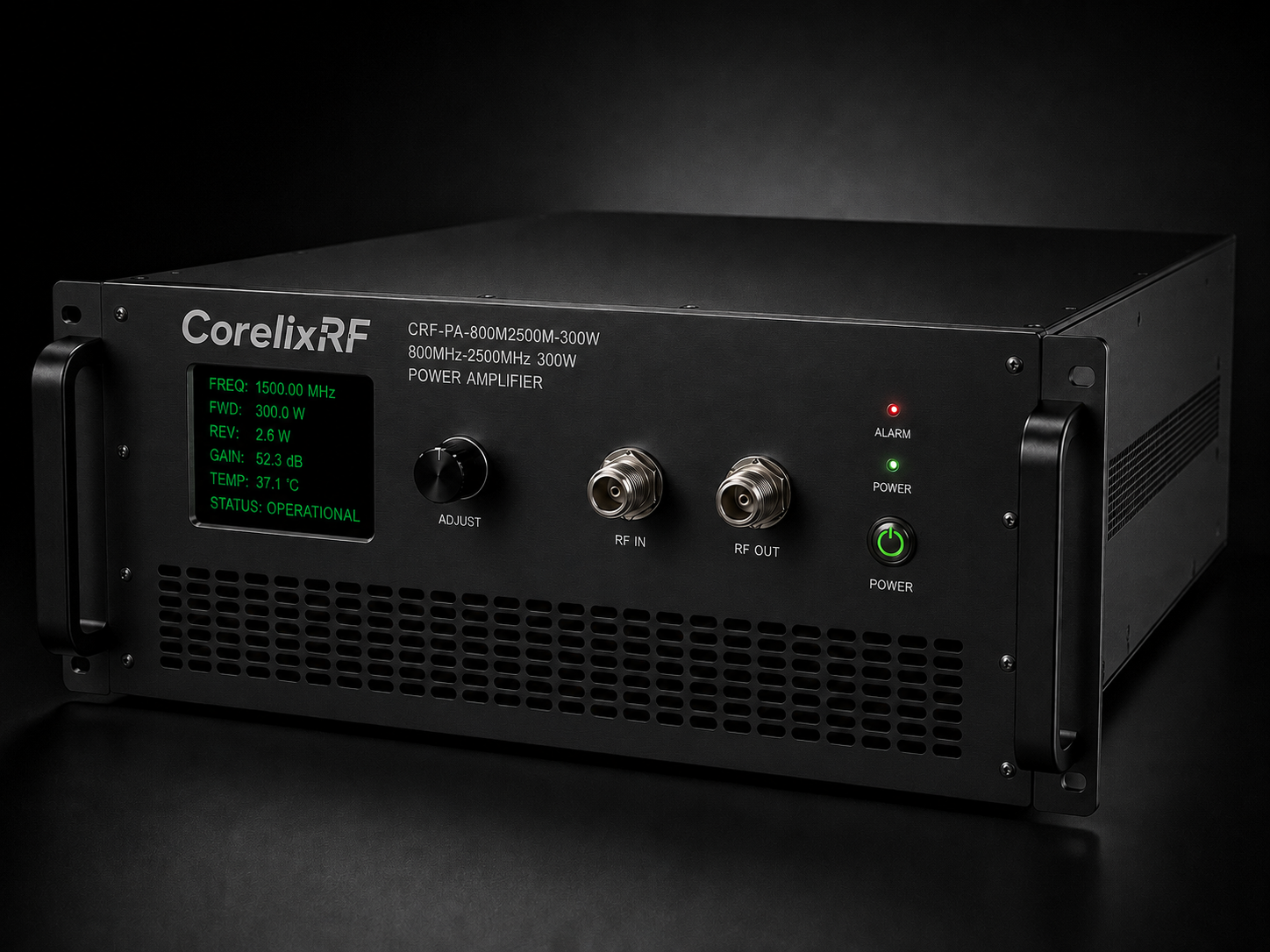
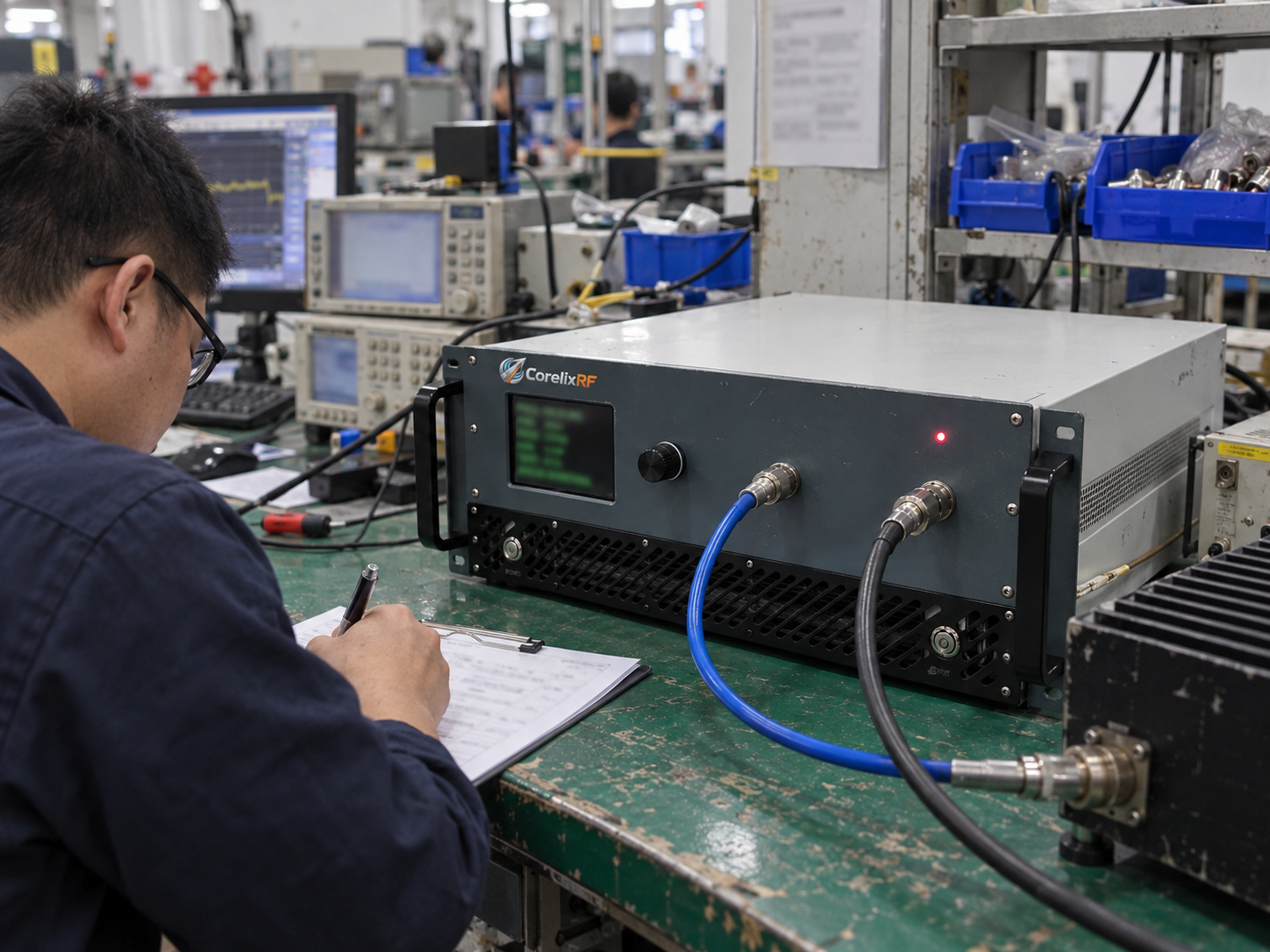
An 800 MHz-2.5 GHz 300W UHF RF power amplifier should be accepted as a rack subsystem, not as an isolated RF block. The CorelixRF CRF-PA-800M2500M-300W datasheet lists 800 to 2,500 MHz coverage, 300 W solid-state RF output power, GaN SSPA technology, 55 dB minimum gain, +/-3 dB gain flatness, 20 dB maximum gain adjustment, 5 dBm maximum input power, N-Female input and output connectors, RS485 / LAN control, AC 220 V +/-10% 50/60 Hz supply, 1,600 W typical power consumption, 4U rack-mount form factor, 35 kg typical weight, and air cooling.
Acceptance Point 1: Rack and Handling
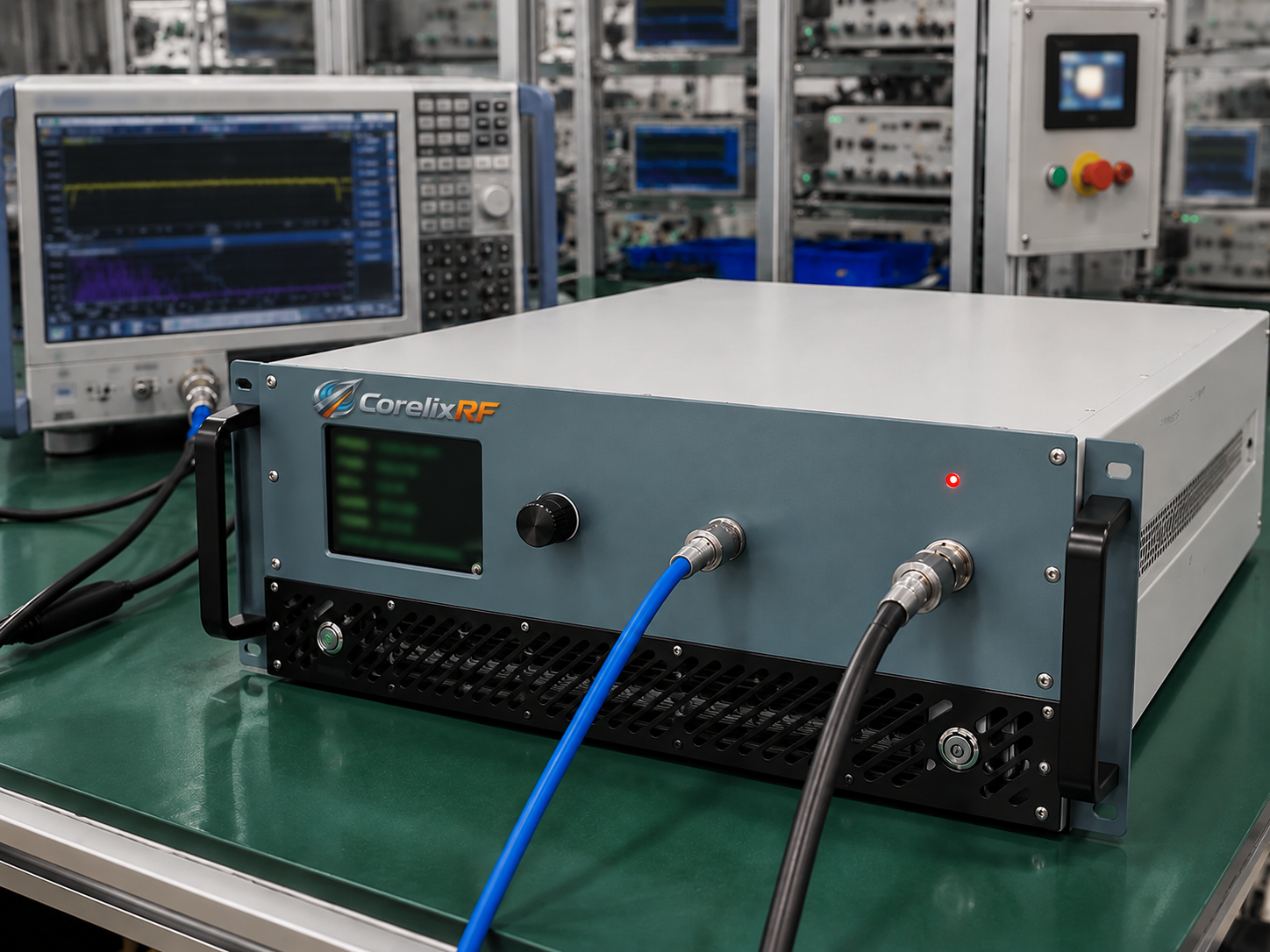
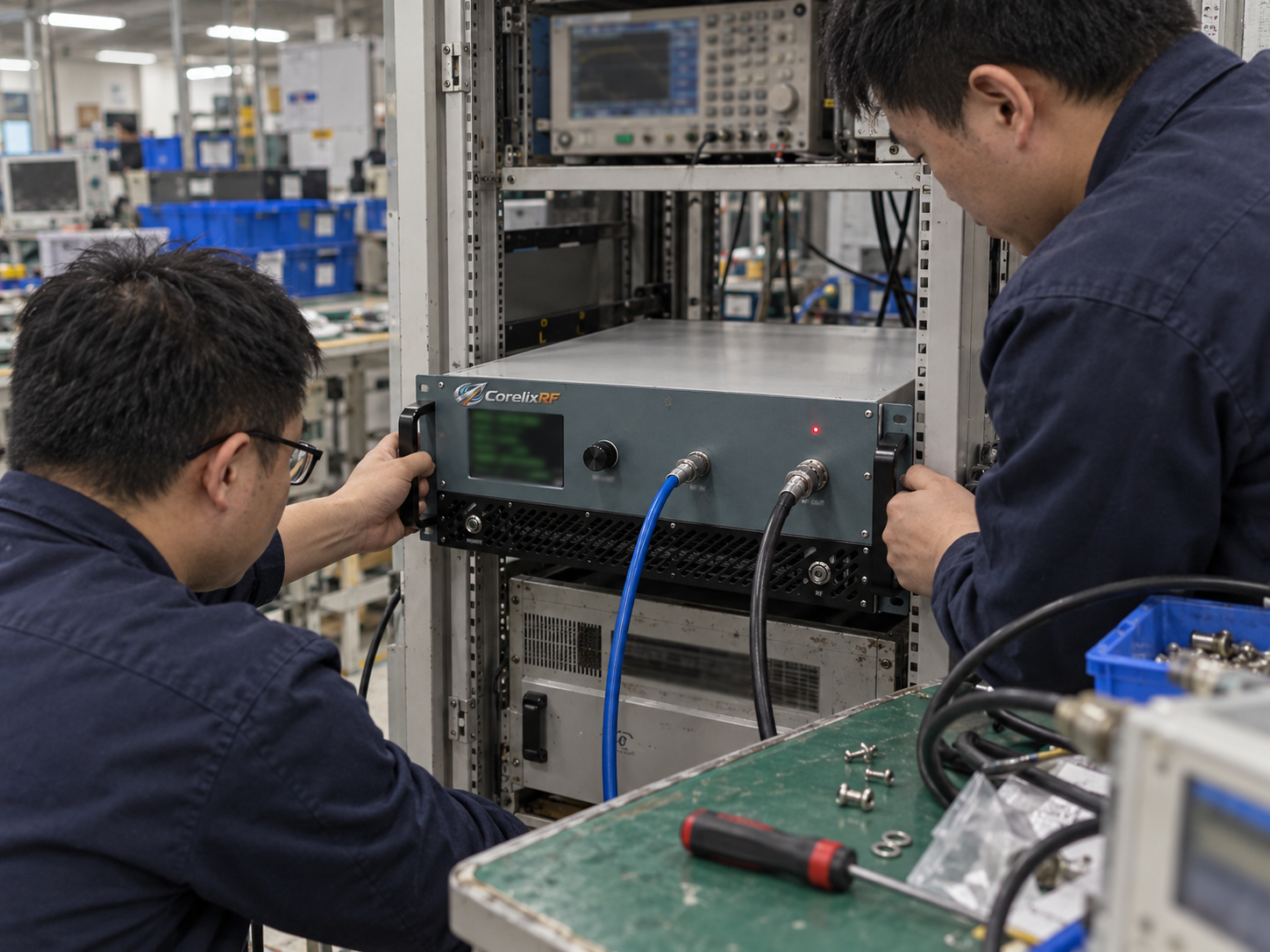
A 4U rack unit with 35 kg typical weight needs a handling plan. The acceptance brief should name the rack slot, rail support, service access, cable bend radius, front-panel connector reach, and airflow clearance. If the amplifier is part of a larger RF integration solution, the rack drawing should include the source, load, couplers, control computer, and any switching hardware before quotation is treated as complete.
Acceptance Point 2: Source Limits
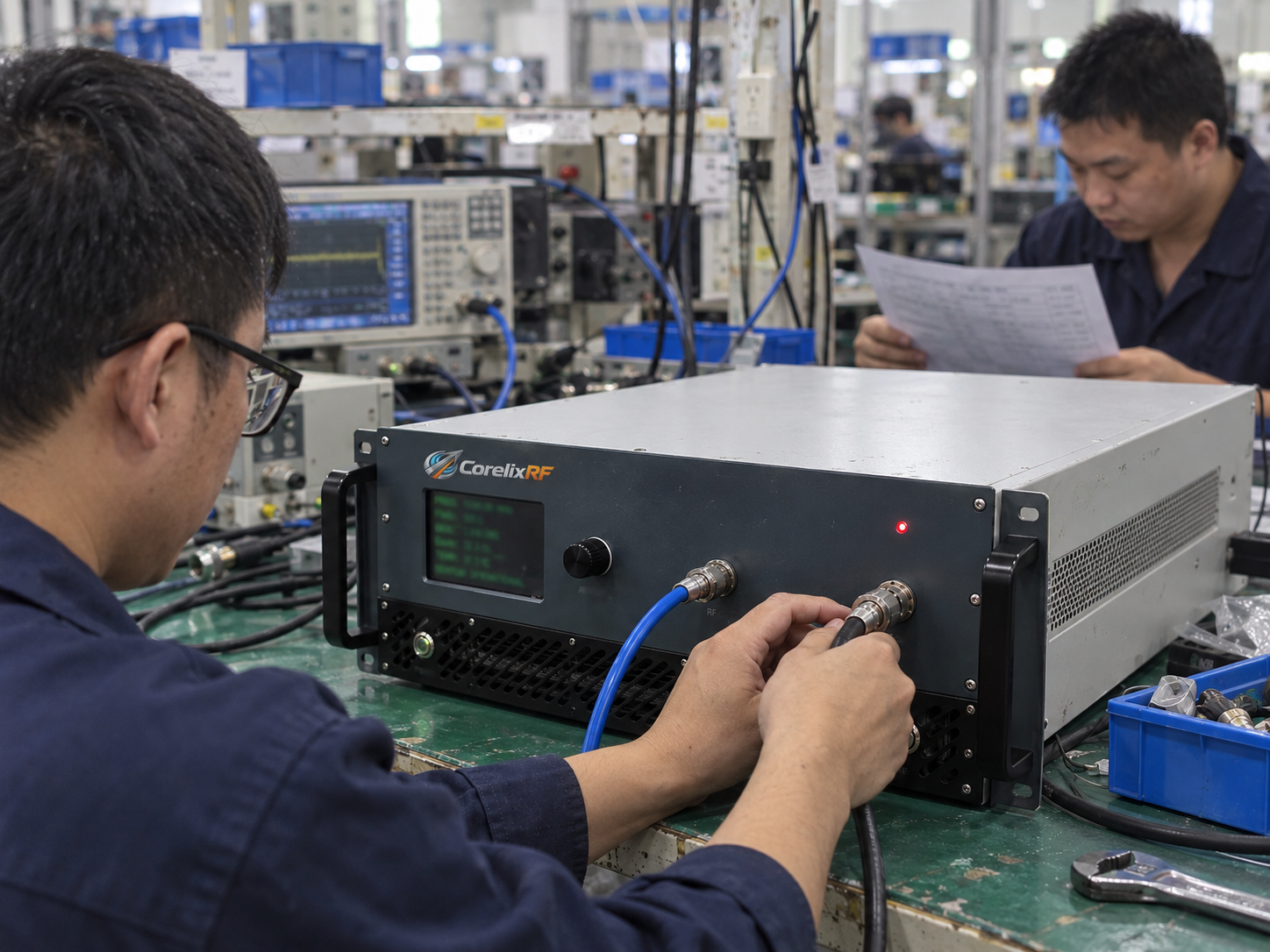
The datasheet lists 55 dB minimum gain and 5 dBm maximum input power. That combination requires a source-limit rule, especially when an SDR, signal generator, or automated sweep script drives the input. Acceptance should begin with conservative drive, a known attenuation path, and a log field for source level at every frequency point. Gain adjustment should be recorded as a test condition rather than changed informally between runs.
Acceptance Point 3: Power and Cooling
The source lists AC 220 V supply, 1,600 W typical power consumption, and air cooling. Facility readiness should therefore be documented before high-power RF operation. The team should confirm line power, grounding, airflow, ambient temperature, exhaust path, rack-door effects, and nearby heat sources. A high-power UHF rack can be electrically correct but operationally weak if heat and access are handled late.
Acceptance Point 4: Monitoring and Protection
Real-time temperature monitoring, real-time current monitoring, optional forward/reverse power monitoring, optional LAN remote monitoring, alarm/fault protection, over-temperature protection, over-drive protection, over-voltage protection, and VSWR protection are all listed in the source. The RFQ should state which monitoring values must be visible during operation and which must be included in acceptance data. For repeatable RF testing and validation, current, temperature, output reading, gain setting, and alarm state belong in the same table.
Acceptance Point 5: Application-Specific Acceptance Inputs
The datasheet-backed application categories for this 800 MHz to 2.5 GHz 300 W UHF rack amplifier are test and measurement instrumentation, communication systems, RF interference / EW system-level testing, and aerospace control systems. For a test and measurement rack, define frequency points across the band, input drive, gain setting, N-Female output reference plane, load condition, and logged current/temperature data. In a communication-system integration review, the same amplifier is evaluated as a controlled UHF power stage where gain flatness, source limits, rack airflow, and alarm handling affect repeatability.
For the selected scenario, define waveform, CW or pulse operation, duty cycle, load, control interface, mechanical limits and environmental requirements. The application category does not establish a customer deployment or a compliance result; acceptance depends on the agreed configuration and supporting test record.
- Confirm N-Female connector condition before the first run.
- Attach source limits and attenuation plan to the RFQ.
- Record rack airflow and AC supply before acceptance.
- Request final mechanical drawing and control protocol where applicable.
- Use CorelixRF review for nonstandard monitoring or integration needs.
Closeout
Close the rack acceptance brief when the team has fixed the rack location, output reference plane, source limits, gain state, cooling condition, control method, monitoring fields, alarm response and documentation requirements. Record unresolved questions before requesting a build or quote. Use custom RF development review for a nonstandard control protocol, and the engineering and manufacturing scope to identify relevant build documentation.
Buyer Review Addendum
Before approving the purchase, the buyer should ask whether the 300 W target is required at the amplifier connector or after the system loss budget. They should also ask whether optional input power detection, forward/reverse power monitoring, GPIB control, or LAN remote control must be included in the quoted build. These questions keep standard datasheet facts separate from project-specific options and prevent a high-power rack from being accepted against assumptions that were never written.
The addendum should travel with the final quote. It gives engineering a short checklist for source level, load rating, rack airflow, AC power, connector inspection, and acceptance data. It gives procurement a practical way to compare responses without reducing a complex GaN SSPA rack to frequency and watts alone.
FAQ
What frequency range and output power are listed?
The datasheet lists 800 to 2,500 MHz coverage and 300 W solid-state RF output power.
What gain and connector type are listed?
The source lists 55 dB minimum gain and N-Female input/output connectors.
What rack and power details are listed?
The datasheet lists a 4U rack-mount form factor, 35 kg typical weight, AC 220 V supply, 1,600 W typical power consumption, and air cooling.
Which protections are listed?
The source lists alarm/fault protection, over-temperature, over-drive, over-voltage, and VSWR protection and alarm functions.