
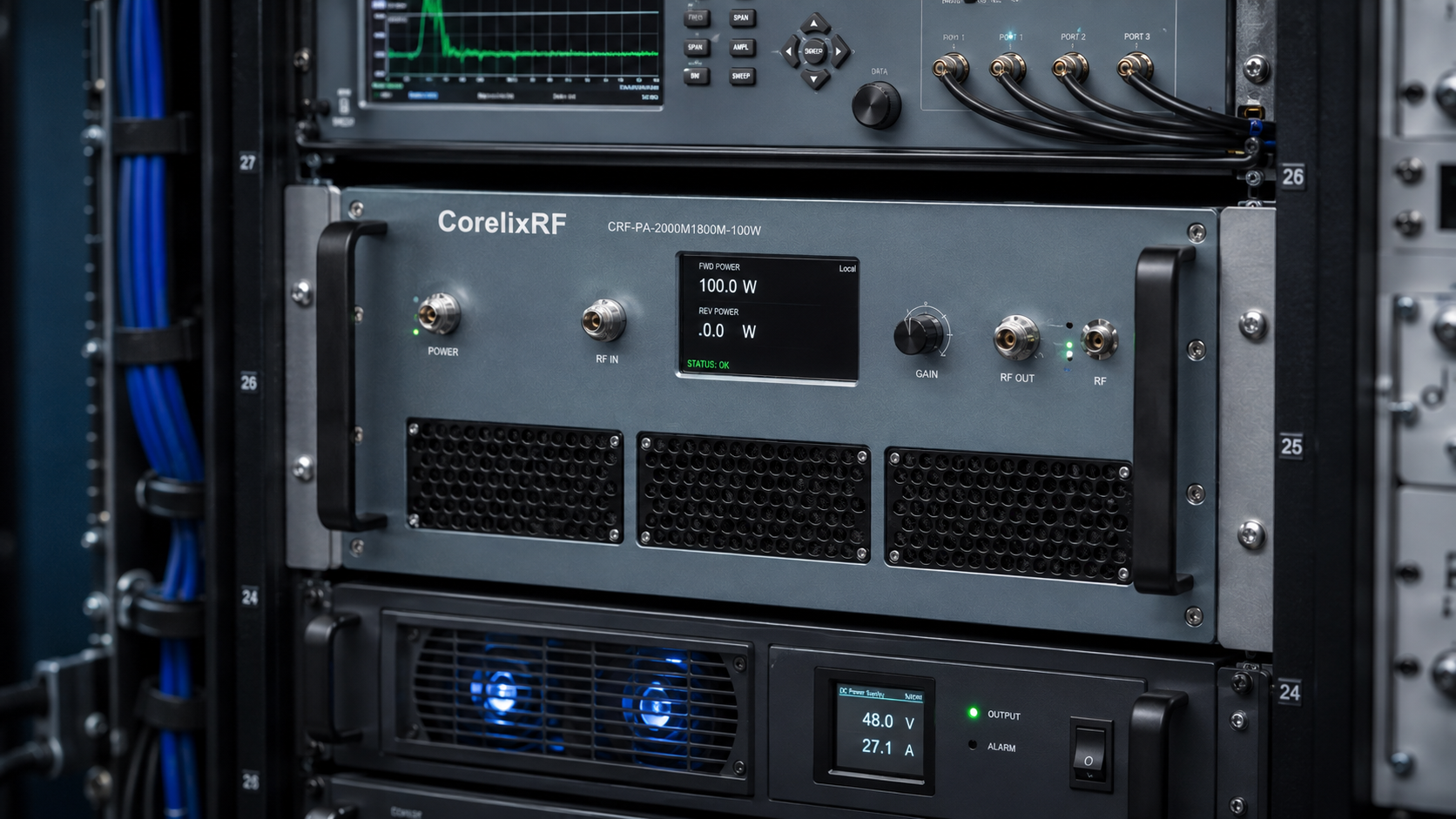
The fastest way to mis-specify a broadband RF amplifier is to treat it like a single-number purchase. “2-18 GHz, 100 W” sounds complete, but it leaves open the questions that usually decide whether the amplifier works in the real system: gain flatness, source drive, thermal conditions, remote control, reflected power, rack layout, and acceptance testing. The CRF-PA-2000M18000M-100W is a useful case study because it is a 2-18 GHz 100W broadband RF amplifier with a strong specification set and enough integration details to expose the common mistakes early.
The model covers 2,000 to 18,000 MHz, provides 100 W rated RF output power, and uses a 19-inch 4U rack-mount format. The datasheet lists 50 dB minimum small-signal gain, +/-5 dB gain flatness, up to 20 dB gain control, N-Female RF input/output, RS485/LAN control, AC 220 V supply, and operation from 0 to +40 degrees C. For buyers comparing 6-18 GHz microwave amplifier options with wider 2 GHz starting coverage, those values are only the first filter.
Mistake 1: Assuming Rated Power Is Flat Everywhere
Broadband amplifiers are often purchased for flexibility, but output behavior, gain, losses, and load effects can vary across frequency. The CRF-PA-2000M18000M-100W lists 100 W output power and +/-5 dB gain flatness. That gives engineers a planning reference, but the RFQ should still request measured data at the important frequencies.
If the system only uses five or six test points, list them. If it sweeps the full band, say so. CorelixRF’s RF testing and validation context is relevant because measured amplifier behavior should be tied to the actual source, cabling, couplers, and loads.
Mistake 2: Ignoring the Source Drive Limit
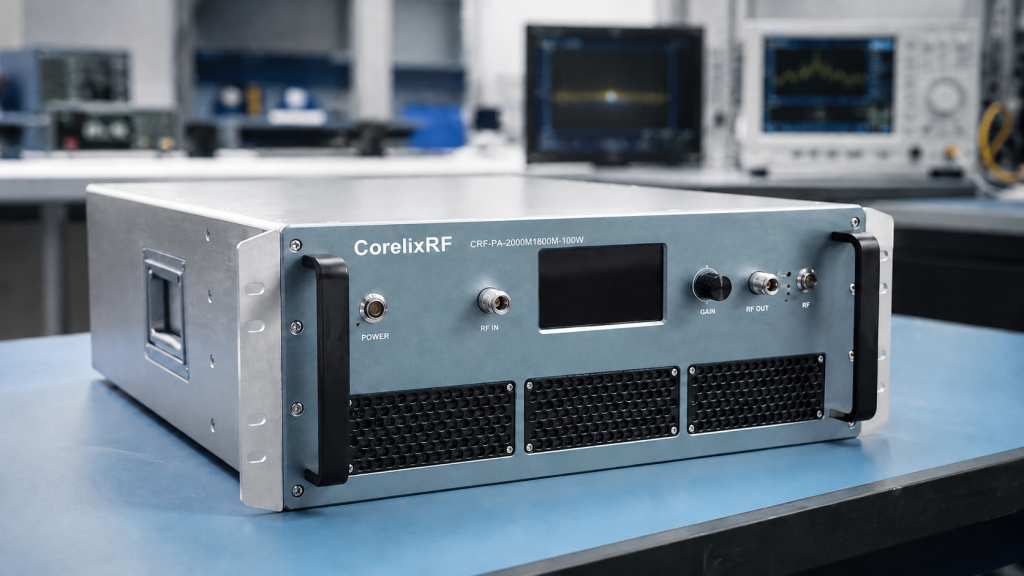
The datasheet lists 0 dBm maximum input power. A signal generator, SDR exciter, or driver stage can easily exceed this if the chain is not controlled. Overdrive can distort the signal, trip protection, or damage hardware. The RFQ should identify the source type, maximum source output, planned attenuation, waveform, modulation, crest factor, and whether operation is CW or pulsed.
This is especially important when an amplifier is used by multiple operators. A clear startup procedure and input-level check can prevent a lot of expensive debugging.
Mistake 3: Treating Control as an Afterthought
RS485/LAN control is listed for this model. That can be a simple convenience or a core system requirement depending on the project. If the amplifier must integrate with automated test software, define the expected commands, status fields, alarm handling, and logging. If forward/reverse power monitoring or input power detection is needed, request it before quotation.
For a custom RF amplifier review, software behavior can be as important as connector choice. The right time to discuss protocol support is before the rack and controller are finalized.
Mistake 4: Forgetting Reflected Power
A 2-18 GHz amplifier may drive dummy loads, antennas, switched paths, filters, couplers, or devices under test. Each output condition can create a different mismatch profile. The datasheet lists alarm and fault protection, temperature/current monitoring, over-drive protection, and optional forward/reverse power monitoring. Those features help, but the system should still be designed to avoid excessive reflected power.
When preparing a quotation request through CorelixRF Contact, describe the output path. Include load type, expected VSWR, cable length, switching events, and whether the amplifier may operate during antenna movement or fixture changes.
Mistake 5: Leaving Thermal Review Until the End
The model is a 19-inch 4U rack amplifier. It runs from AC 220 V +/-10% and is specified for 0 to +40 degrees C operation. Cooling details should be confirmed for the final configuration. In a crowded rack, poor airflow can turn a correct RF selection into a system reliability problem.
The RFQ should include rack location, ambient temperature, airflow restrictions, duty cycle, and expected run duration. If the amplifier will sit in a shielded room, mobile platform, or sealed cabinet, note that immediately.
A Better First RFQ
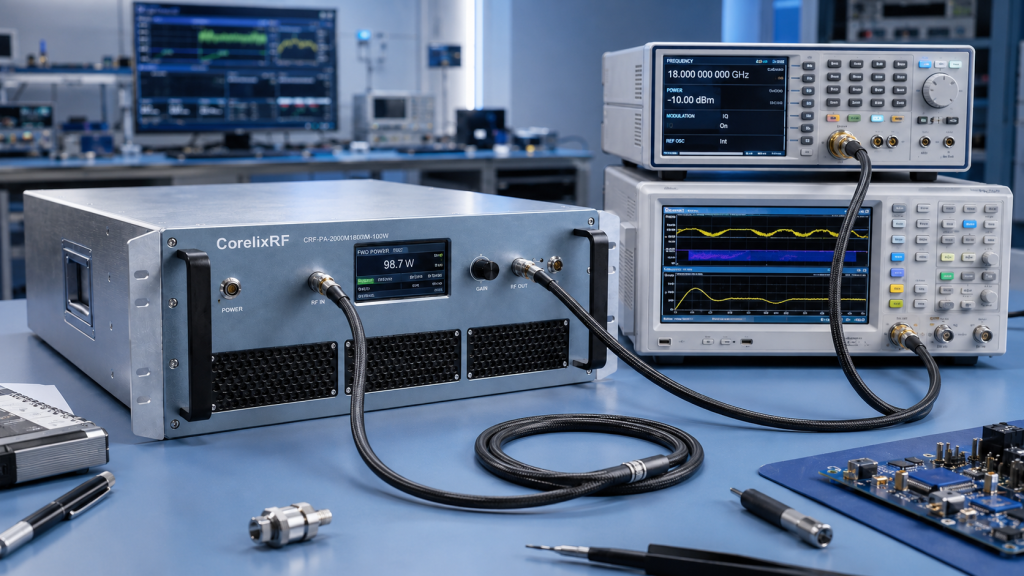
A strong RFQ for this 2-18 GHz 100 W solid state power amplifier includes frequency points, power target, source drive, waveform, duty cycle, load condition, gain-control expectations, monitoring requirements, rack and cooling limits, connector preference, and documentation needs. That kind of request lets CorelixRF review the amplifier as an engineered platform, not a generic wattage number.
What This Changes for Procurement
Procurement teams can use the same structure to compare multiple amplifier offers. Put the essential specifications in one table, then add separate columns for input drive limit, control interface, monitoring options, cooling notes, protection functions, and available test documentation. That approach makes it easier to compare a broad RF power amplifier platform against a narrower microwave alternative without reducing the decision to price and wattage.
It also reduces commercial risk. If a supplier cannot confirm gain behavior, output conditions, control protocol, or thermal assumptions, that uncertainty should be visible before purchase approval. A 2-18 GHz 100 W amplifier is usually part of a larger program, so the quotation should support engineering, purchasing, and test teams at the same time.
FAQ
What is the primary keyword?
The primary keyword is 2-18 GHz 100W broadband RF amplifier.
What model is covered?
The article covers the CRF-PA-2000M18000M-100W GaN SSPA platform.
Why is source drive important?
The datasheet lists 0 dBm maximum input power, so an uncontrolled source can overdrive the amplifier.
What control interfaces are listed?
The listed control interfaces are RS485 and LAN.
What should be checked for a wideband system?
Check measured output at key frequencies, gain flatness, load mismatch, cooling, remote control, and required acceptance data.