
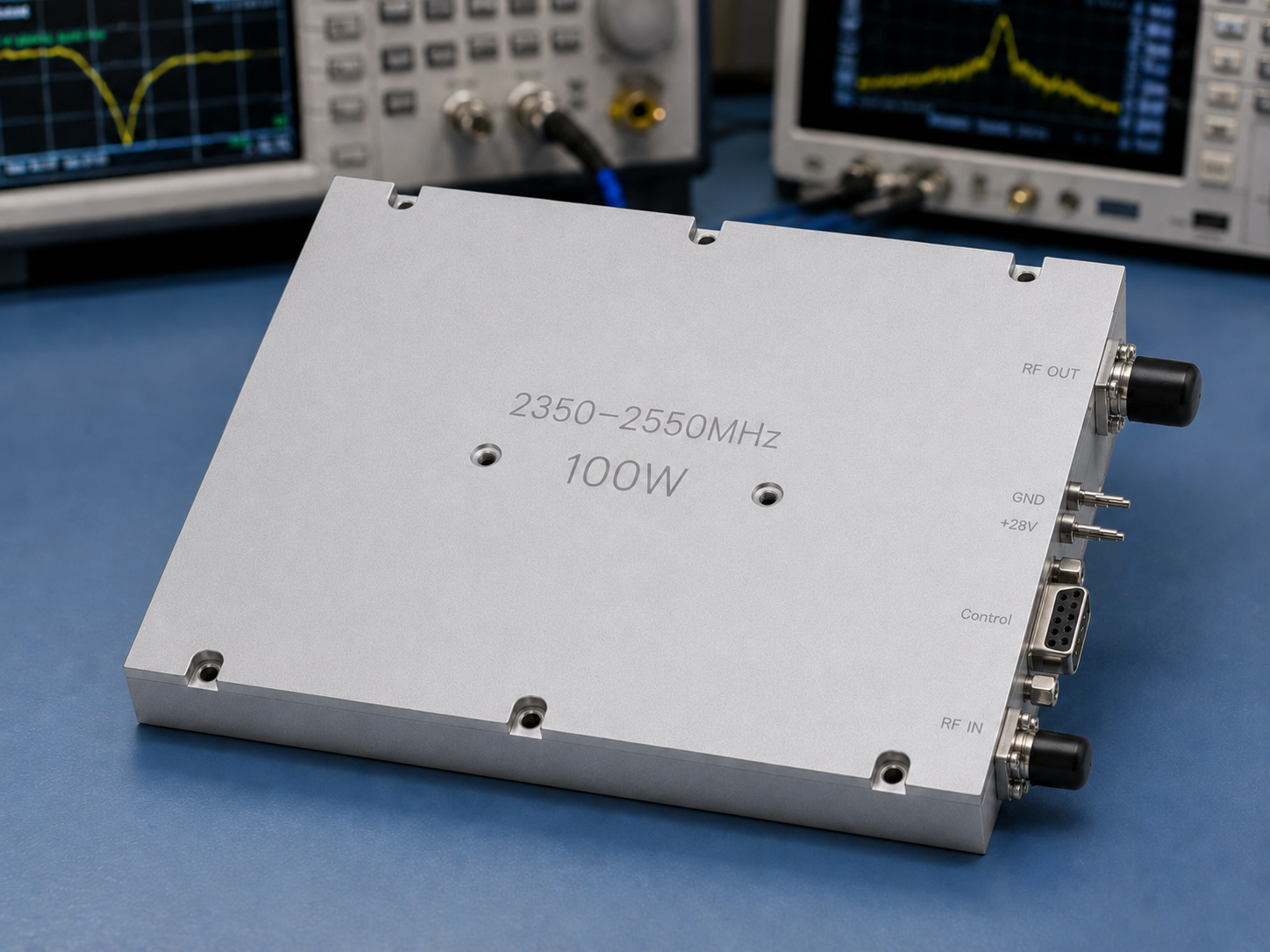
A 2350-2550 MHz 100W GaN SSPA is useful when an RF system needs a compact high-power stage with frequency-agile behavior inside a defined narrowband window. The CorelixRF CRF-PA-2350M2550M-100W combines a GaN solid-state RF amplifier with an integrated VCO, 100 W typical saturated output power, 48 dB typical gain, gain adjustment, temperature detection, optional forward/reverse power monitoring, and multiple protection functions.
The writing model here follows the engineering-friendly pattern often seen on Empower RF Systems’ website: start with the application, present the product as a concrete solution, then move into highlights, interfaces, test conditions, and RFQ guidance. For CorelixRF, every claim below is tied to the local datasheet, not to competitor content.
Product Highlights
The CRF-PA-2350M2550M-100W operates from 2350 MHz to 2550 MHz. The datasheet lists 80 W minimum and 100 W typical saturated output power, with 46 dB minimum, 48 dB typical, and 50 dB maximum small-signal gain. Gain adjustment is specified at 20 dB in 0.5 dB steps.
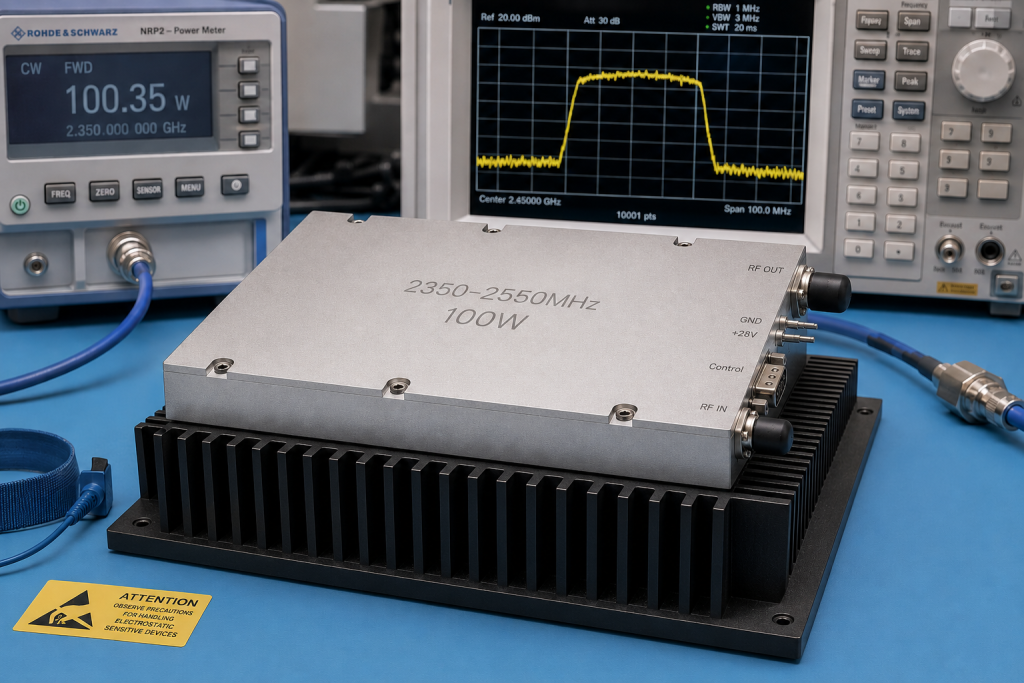
The integrated VCO supports automatic frequency scanning across the operating band after the unit is enabled. The datasheet lists a 10 Hz minimum VCO frequency step, a 2170-2560 MHz frequency adjustment range, and a 50-260 MHz bandwidth adjustment range. These details make the amplifier relevant for frequency-agile RF transmission and test scenarios.
Why the Integrated VCO Matters
Many RF amplifier purchases focus only on gain and output power. In a frequency-agile source chain, the source behavior matters just as much. An integrated VCO can simplify some system architectures because the RF source and high-power stage can be reviewed together instead of treated as unrelated parts.
That does not remove the need for system engineering. The user still needs to define the sweep behavior, channel plan, modulation or CW condition, dwell time, control timing, and output-power target. When those details are available, CorelixRF can review whether this model or another RF power amplifier platform is the better fit.
Electrical and Mechanical Integration
The module uses SMA-KFD46 connectors for RF input and RF output. Control is through a D-Sub 15-pin female interface, with optional RS485 support. The supply range is 24 V to 32 V DC, with +28 V nominal operation. Typical operating current is listed at 16 A, with 20 A maximum.
The mechanical size is 160 x 120 x 25 mm, and the datasheet lists external heat-sink cooling. This compact profile can help integration, but it also means thermal planning must be treated as part of the RF design. Mounting flatness, thermal interface material, airflow, duty cycle, and ambient temperature all affect whether the module performs as expected.
Protection and Diagnostics
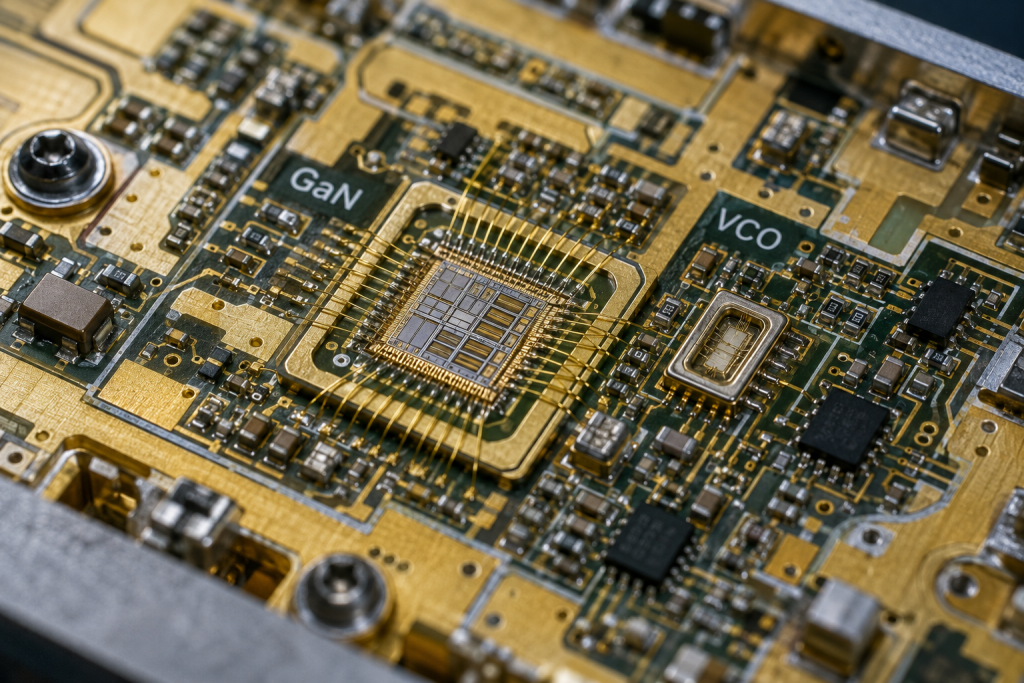
The datasheet lists over-temperature shutdown and auto-recovery, high-VSWR open/short protection, optional over-voltage shutdown above 32 V, optional over-current shutdown above 22 A, and a latched alarm reset input. It also calls out temperature detection and optional forward/reverse power monitoring.
These functions are useful for system integration because they give the host equipment a way to detect fault states instead of relying on RF output alone. For an OEM design, ask CorelixRF for the control-interface details and define how the host system should respond to alarm states.
Comparing Narrowband and Broadband Choices
If your project only needs 2350-2550 MHz, a narrowband model can offer a more focused engineering discussion than a broad multi-octave amplifier. If the same platform must cover a wider operating plan, compare this model with CorelixRF’s 300-2700 MHz RF amplifier family or request a custom RF amplifier review.
RFQ Checklist
Include the exact operating frequency range, whether VCO scanning is required, output-power target, input drive, waveform type, gain-control method, RS485 requirement, cooling approach, mechanical envelope, fault-monitoring expectations, and production-test documentation needs.
Test Data to Request Before Build Approval
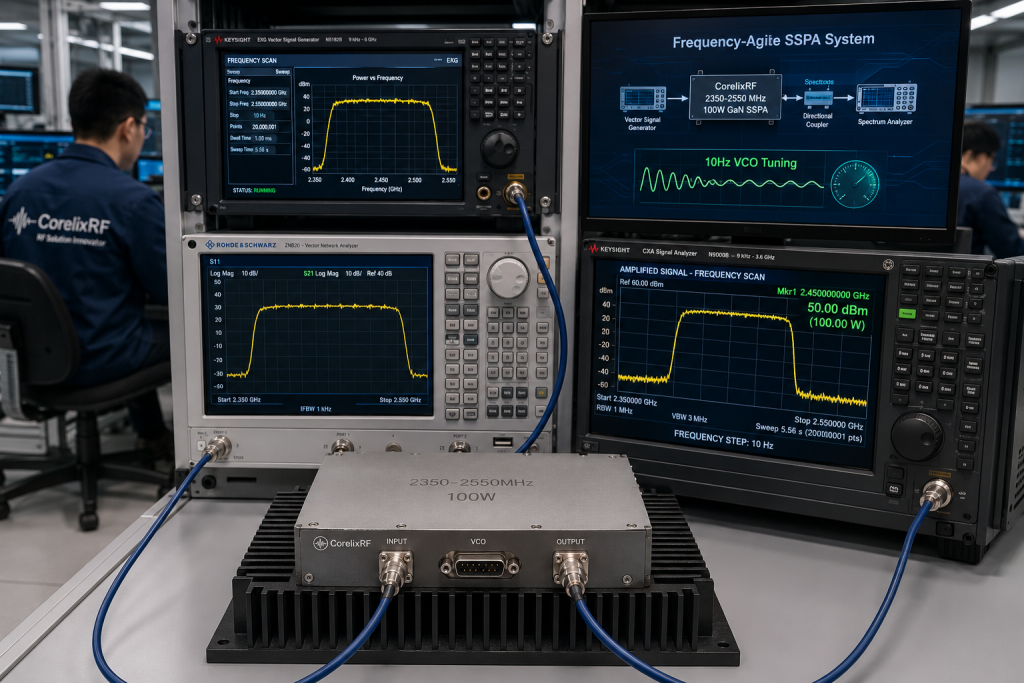
Before releasing a frequency-agile amplifier into a system build, request the swept gain behavior, output-power data, control-interface description, and any available unit-level test notes for the exact configuration. For an integrated VCO path, also confirm how the frequency command, enable state, alarm reset, and gain setting interact during startup. This prevents a late mismatch between the RF design, control software, and production test procedure.
FAQ
What is the frequency range of the CRF-PA-2350M2550M-100W?
The datasheet specifies 2350 MHz to 2550 MHz operation.
What output power is listed?
The datasheet lists 100 W typical saturated output power, with 80 W minimum.
Does it include a VCO?
Yes. The datasheet describes an integrated VCO with automatic frequency scanning and 10 Hz minimum step size.
What protections are listed?
The datasheet lists over-temperature, high-VSWR, optional over-voltage, optional over-current, and latched alarm reset support.