
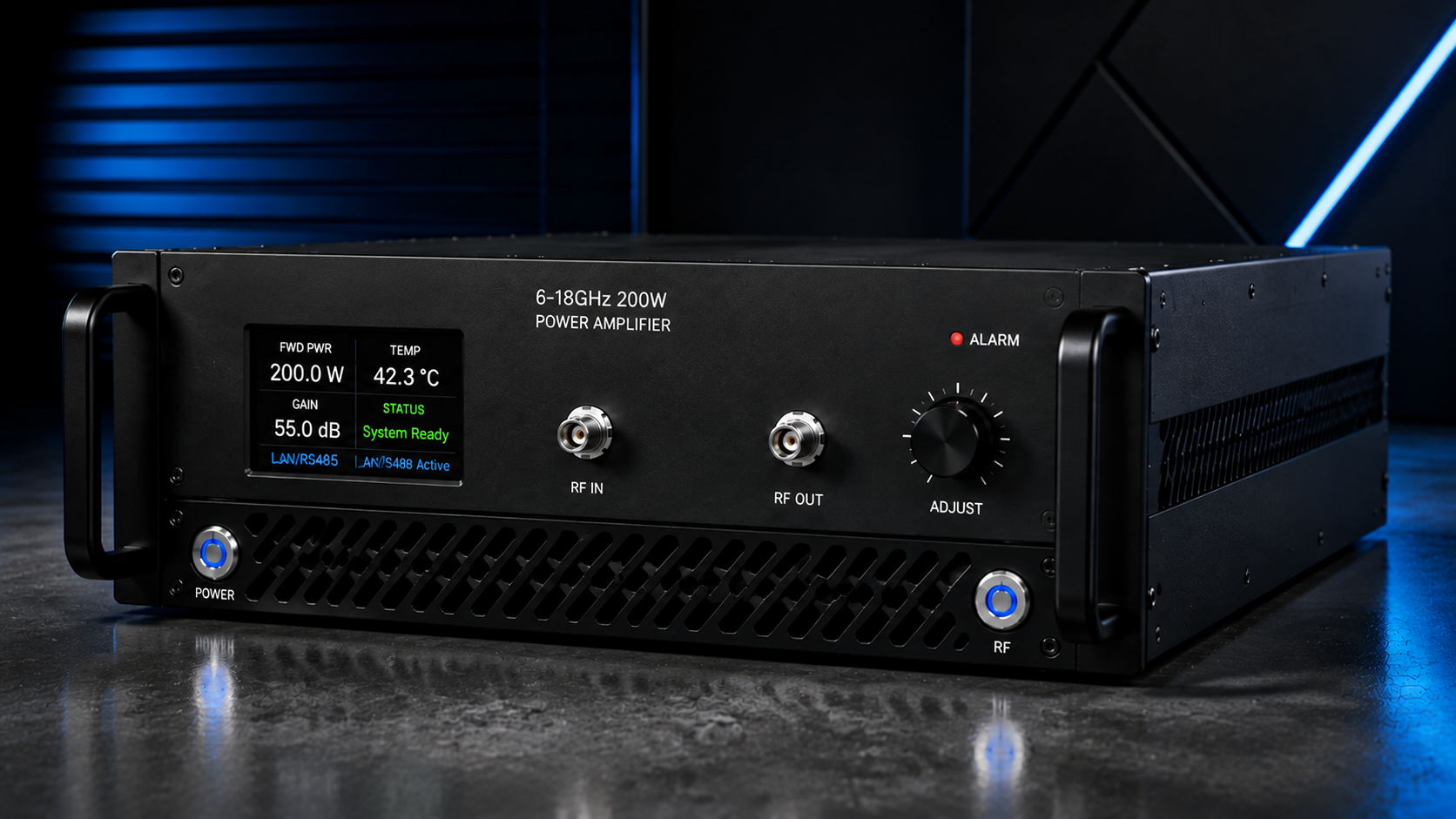
The search phrase 6-18 GHz broadband RF power amplifier signals a technically mature buyer. This is usually not early-stage browsing. It is often a request shaped by a microwave validation program, SATCOM subsystem evaluation, radar front-end work, or a high-frequency test bench that has outgrown lower-band hardware. That is why the content around this topic should stay specific and disciplined.
CorelixRF’s 6-18 GHz amplifier page is unusually helpful because it gives a clear public baseline: 10W to 1000W, GaN solid-state design, SMA, N-type, or WRD650 output options, RS485 or LAN control, and air-cooled rack or compact chassis formats. Those details are enough to build a serious selection checklist without inventing project claims or hidden specs.
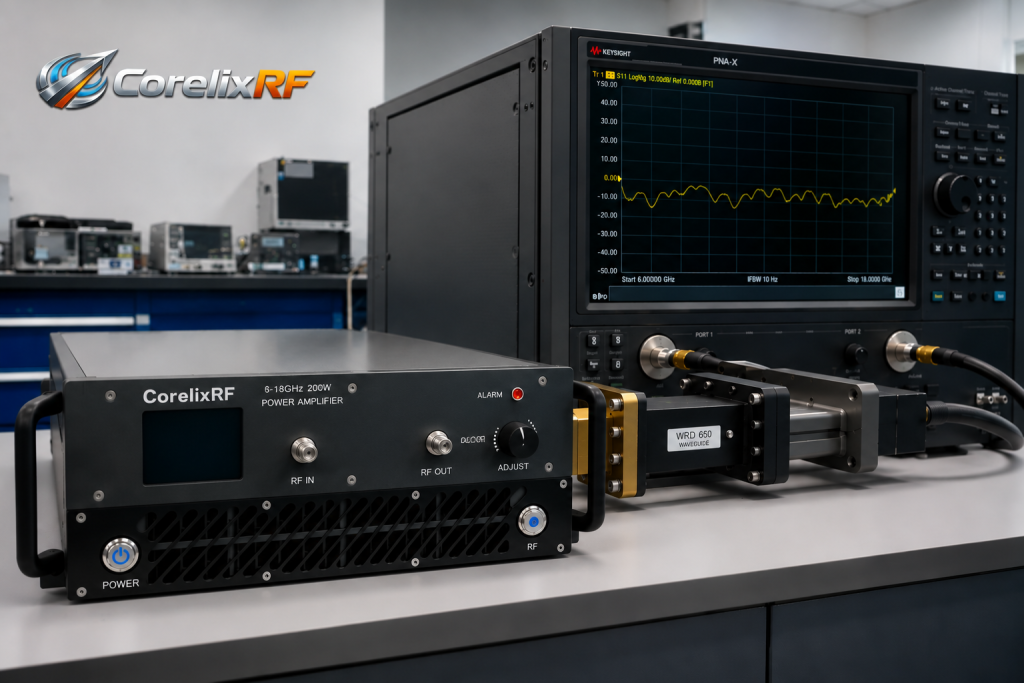
- Confirm Whether Full-Band Coverage Is Really Required
“6-18 GHz” sounds straightforward, but many projects only operate in narrower parts of the band. Some programs need wide microwave coverage for bench flexibility. Others mostly care about a narrower SATCOM or radar-related window and only want margin for adjacent validation points.
The first decision is whether the team needs a true full-band path or a more targeted sub-band approach. A full-band amplifier can simplify the bench architecture, but it may not always be the most efficient or compact route for every test plan. CorelixRF’s high-frequency capability page supports this idea by positioning 2-40 GHz as an engineering review domain rather than a one-size-fits-all product promise.
- Match Power Class to the Actual Use Case
The public 6-18 GHz range on CorelixRF covers a very wide power span. That immediately suggests the importance of application context. A lower-power unit may be suitable for front-end characterization or subsystem stimulation, while higher power classes may fit larger validation benches or more demanding RF path studies.
The useful question is not “What is the highest available wattage?” The useful question is “What delivered power is required at the DUT, load, or downstream architecture after cable and interface losses?” That keeps the review grounded in the actual system.
For article readers, this is where natural internal links matter. If the project is still defining the wider path, the reader may also need RF testing and validation support or RF signal transmission system guidance.
- Review Connectors and Physical Format Early
At microwave frequencies, connector choice and physical implementation are not housekeeping details. They are part of the technical requirement. CorelixRF’s public reference to SMA, N-type, and WRD650 output options makes this clear. The same is true for the distinction between compact chassis and rack-level air-cooled formats.
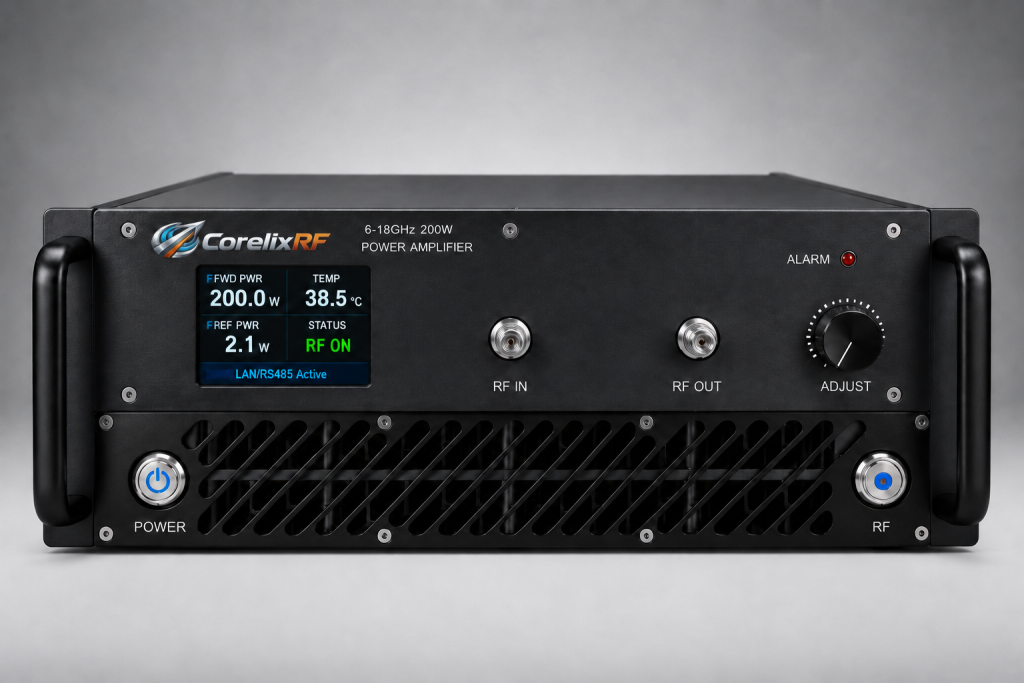
Before RFQ, teams should settle:
- Preferred RF interface
- Bench or rack integration format
- Cable and adapter assumptions
- Available airflow and mechanical envelope
This prevents a common late-stage issue where the electrical concept is acceptable but the physical integration becomes awkward or unstable.
- Don’t Ignore Control and Monitoring
One of the stronger trust signals on CorelixRF’s 6-18 GHz page is the mention of RS485 / LAN control. That indicates these amplifiers may be integrated into structured validation environments, not just manual benches. For technical buyers, that matters because remote control, enable logic, and monitoring can materially improve repeatability and operator efficiency.
If the team expects automated sweeps, remote fault handling, or multi-instrument sequencing, control should be part of the buying discussion from the start. It is much easier to specify now than retrofit later.
- GaN Architecture Is Valuable, but Still Needs Requirement Review
The page’s reference to GaN solid-state design is relevant for buyers who care about power density and high-frequency performance, but the architecture label alone should not close the decision. The more important factor is whether the platform, cooling, protection, and interface package are aligned with the use case.
That is consistent with CorelixRF’s broader messaging across custom RF development and high-frequency capability: start with the platform, then review exact project conditions before recommendation.
- Ask for Validation Evidence Appropriate to the Project
In microwave purchasing, generic catalog language creates internal friction because engineering teams still need confidence in bench behavior and integration readiness. CorelixRF repeatedly references measured data, unit-level validation, and engineering review. Those are the right talking points for a buyer-facing article.
When evaluating a microwave amplifier in this range, ask:
- Can the supplier review the intended frequency window and output target?
- Is measured test data available for the reviewed configuration?
- What protection and thermal assumptions apply?
- Which mechanical and interface options are standard versus project-based?
These questions help the article rank for practical intent, not just generic awareness.
- Keep the CTA Focused on Engineering Review
For this topic, the strongest CTA is not “buy now.” It is a request for engineering alignment. The audience is typically a design, test, or sourcing team with a real program behind the search. That makes the contact page the right conversion target because it explicitly asks for frequency range, output power, operating mode, cooling, connector preference, and control interface.
Final Selection Logic
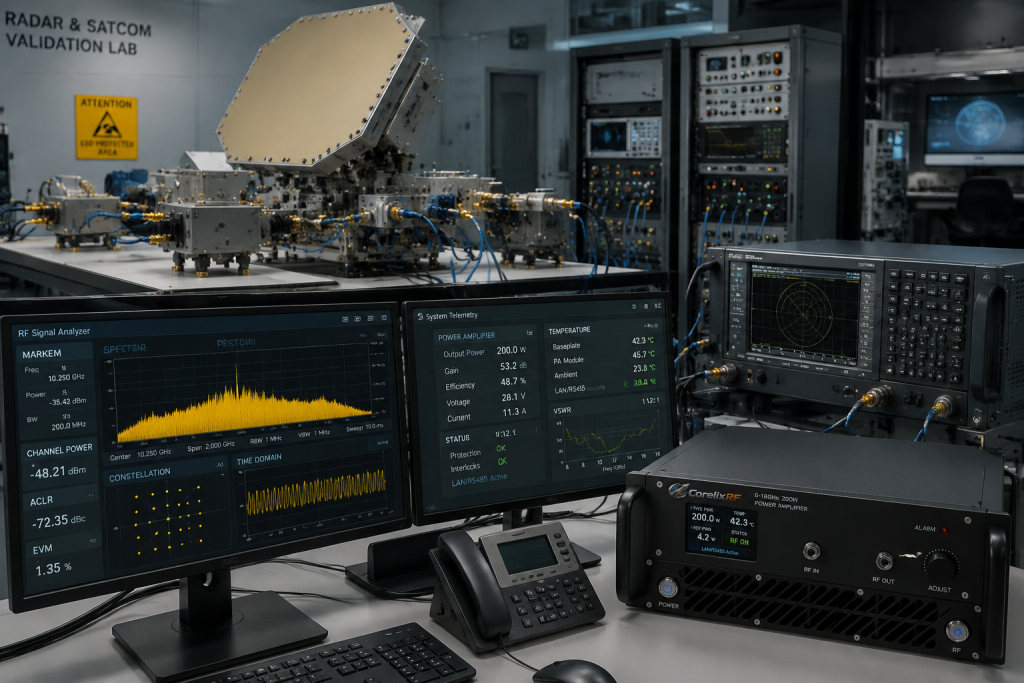
If a project is evaluating a 6-18 GHz amplifier, the cleanest workflow is:
- Confirm whether full-band or sub-band coverage is truly needed.
- Define delivered power at the actual test point.
- Set connector, packaging, and airflow constraints.
- Clarify whether manual or remote-controlled operation is expected.
- Request measured validation support before moving forward.
That process respects how microwave buyers actually work and aligns well with CorelixRF’s public positioning.
FAQ
What makes a 6-18 GHz amplifier different from lower-band broadband amplifiers?
At 6-18 GHz, connector choice, microwave integration details, control, and thermal design become more critical, and the buying process is usually more application-specific.
Why is GaN relevant in this band?
GaN platforms are often used for high-frequency solid-state amplifier designs because they support demanding power and bandwidth targets, but architecture still must be matched to the application.
Should SATCOM and radar validation teams use the same amplifier criteria?
They can share a common checklist, but each project still needs its own review of band use, power target, interfaces, and integration environment.
What is the best CTA for this kind of article?
An engineering review CTA is best because buyers in this category usually need requirement matching, not a purely transactional product page.