

The evolution of RF Amplifiers: From Past to Present is a revolutionary journey from bulky vacuum tubes to today’s highly efficient solid-state semiconductors. Imagine deploying a critical communication network, only to find weak signals causing severe connection drops over long distances. This fatal signal loss frustrates high-value clients and can ruin an incredibly expensive project. Fortunately, utilizing advanced RF Amplifiers completely eliminates these dead zones, achieving extremely reliable global connectivity for your infrastructure.
How Did the Earliest RF Amplifiers Actually Evolve?
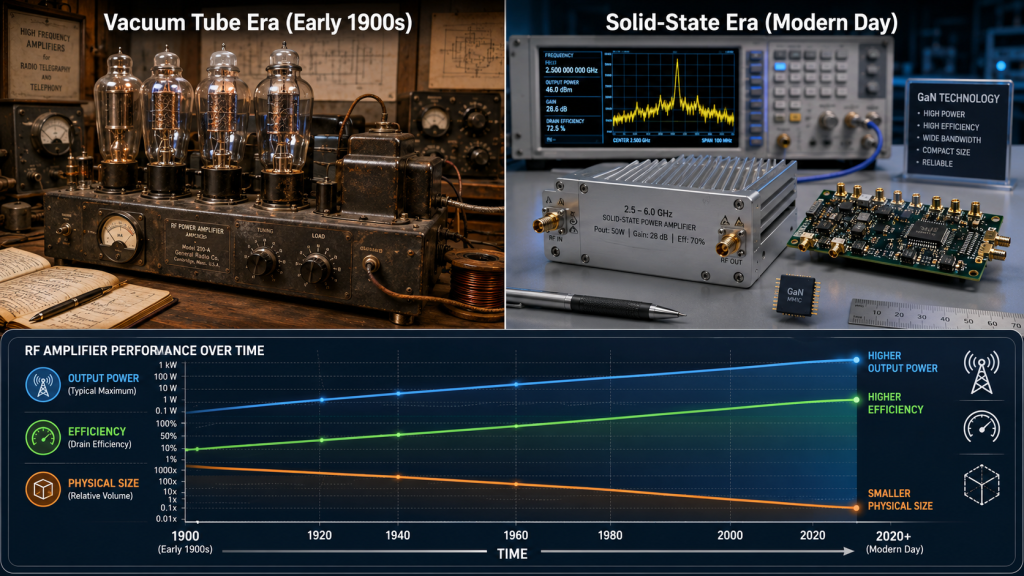
The earliest RF Amplifiers evolved through the initial, strenuous attempts to boost radio signals using vacuum tube technology. Early forward-thinking engineers actively sought powerful tools to effectively transmit transoceanic wireless signals. These massive early devices laid the solid technical foundation for modern interconnected communication systems.
What Was the Initial Impact of Vacuum Tubes?
Vacuum tubes established a highly solid technical foundation for long-distance wireless communication. Here is the secret: their existence made substantial signal enhancement a physical reality for the very first time.
- Greatly accelerated the rapid establishment of early global radio broadcast networks.
- Enabled ultra-long-distance voice signal transmission across oceans and continents.
- Provided core power support for early military radar development during World War II.
However, these early devices inevitably faced massive heat generation and unbelievably low efficiency. This meant your daily maintenance costs were incredibly high.
How Did Early Radio Systems Break Physical Limits?
Despite severe environmental limits, early designs achieved huge success in that specific era. Engineers continuously optimized complex circuit layouts to significantly reduce high-voltage energy waste.
Key Takeaway: Understanding early communication evolution helps you deeply appreciate today’s miniaturized systems and their massive achievements in reducing physical size and energy consumption.
| Early Component Technology | Core Advantage | Main Drawback |
| Early Glass Vacuum Tubes | Provided basic high power | Too bulky and highly fragile |
| First-Gen Oscillators | Offered basic frequency | Extremely sensitive to heat |
| This direct comparison shows that the physical flaws of early amplifiers rapidly drove the leap to semiconductor technology. |
Which Breakthroughs Defined Solid-State RF Amplifiers?
The invention and commercial application of transistors thoroughly defined the core breakthroughs of modern solid-state RF Amplifiers. In the mid-twentieth century, this disruptive technology revolution vastly improved overall transmission efficiency and system reliability. You no longer had to deal with extremely bulky and fragile traditional high-voltage glass tubes.
What Huge Changes Did Transistors Bring?
Introducing solid-state technology exponentially shrank the massive physical volume of amplifiers. The truth is: the long-term benefits extended far beyond mere physical size reduction.
- Greatly extended the continuous operational lifespan of core network devices.
- Significantly improved network signal processing quality and absolute clarity.
- Drastically lowered daily operational maintenance and hardware replacement costs.
This irreversible miniaturization trend allowed radio frequency modules to be easily integrated into portable electronics. Consequently, your handheld smart devices rapidly gained global popularity.
Why Did Solid-State Devices Replace Old Tech?
Solid-state devices naturally replaced old technology by offering higher operational stability and much lower thermal power consumption. This gives you unprecedented configuration flexibility when designing extremely complex broadband networks.
Key Takeaway: Firmly embracing advanced solid-state technology means you gain smaller deployments alongside far more reliable, high-quality connectivity guarantees for the long term.
| Mainstream Tech Type | Energy Efficiency | Continuous Lifespan |
| High-Voltage Vacuum Tubes | Extremely low, high heat | Short, needs replacement |
| Modern Solid-State Devices | Extremely high, cool | Extremely long, low maintenance |
| The summary clearly demonstrates that overwhelming advantages in energy and lifespan caused solid-state tech to universally replace older models. |
Why Are GaN and LDMOS Vital for RF Amplifiers?
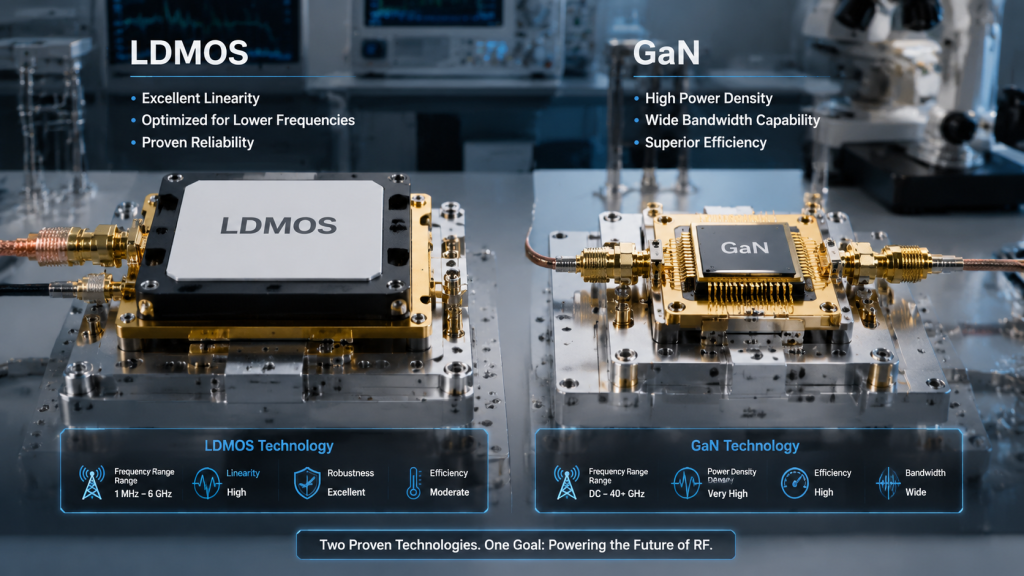
GaN and LDMOS are absolutely vital for today’s RF Amplifiers because they provide unmatched performance in extreme power density and flawless linearity. Over the past decades of fierce competition, these advanced materials have unquestionably become the entire industry benchmark. They empower you to achieve stronger, clearer signal outputs in highly complex, high-frequency environments.
How Does GaN Provide Extreme Power Density?
Gallium Nitride (GaN) naturally possesses superior physical capabilities to handle extreme voltages and high temperatures. But wait, there is more: it also features phenomenal ultra-wideband transmission characteristics.
- Delivers excellent high-frequency scanning performance in military radar systems.
- Perfectly supports the harsh continuous power demands of modern space satellites.
- Vastly expands the actual signal coverage radius of modern 5G base stations.
Leveraging these unparalleled material advantages allows you to obtain much higher output power without increasing equipment size.
What Are the Unique Advantages of LDMOS?
By contrast, LDMOS architecture demonstrates extreme commercial cost-effectiveness and exceptional signal linearity in lower frequency applications. This makes it your absolute top choice for traditional broadcast and civil communication bands.
Key Takeaway: Intelligently choosing between GaN and LDMOS based on your network frequency and power needs will directly determine your system’s ultimate performance limit.
| Semiconductor Material | Best Working Frequency | Core Technical Advantages |
| High-Performance GaN | Ultra-high (e.g., X-band) | Extreme power density, wideband |
| Traditional LDMOS | Commercial low-to-mid | Extreme linearity, cost-effective |
| This visual comparison highlights that different chemical materials play irreplaceable roles within their specialized spectrum segments. |
What Future Trends Are Reshaping Modern RF Amplifiers?
Cognitive radio technology and next-generation compound semiconductors are completely reshaping the future trends of modern RF Amplifiers. As global electromagnetic environments become increasingly crowded and complex, core devices must become intelligently proactive. This means your future network systems will possess powerful self-regulating and self-healing capabilities.
How Is Smart Processing Changing Amplification?
Combining ultra-fast digital signal processing with traditional amplification has fully opened the door to cognitive radio systems. The bottom line is: this deep cross-integration brings revolutionary network changes.
- Optimizes signal enhancement in milliseconds based on real-time environmental shifts.
- Significantly reduces unnecessary stray spectral interference and heavy noise pollution.
- Greatly improves communication success rates in extremely complex urban areas.
This fully automated adaptive processing allows your network to remain in an optimal connection state without any manual intervention.
How Will New Materials Break Efficiency Limits?
Beyond currently widely used GaN, top global engineers are rapidly exploring advanced deep compound semiconductor formulas. These highly promising new materials are expected to function stably in far more extreme deep-space conditions.
Key Takeaway: Maintaining a close watch on smart digital processing and next-gen materials will give you a major head start in building future core communication networks.
| Industry Innovation Trend | Primary Target Goal | Anticipated Disruptive Impact |
| Smart Cognitive Radio | Millisecond environmental adaptation | Drops interference, boosts connectivity |
| Deep Semiconductor Materials | Break physical efficiency limits | Supports high-frequency Terahertz |
| This detailed trend analysis points out that dual breakthroughs in smart computing and materials will heavily dominate the next decade. |
How Do RF Amplifiers Profoundly Affect Wireless Networks?
RF Amplifiers profoundly affect wireless networks by precisely ensuring absolute signal integrity and extreme strength over ultra-long distances. Without these seemingly inconspicuous core devices, modern high-speed global connectivity would instantly cease to exist. Every flawless HD video call you make relies heavily on their silent, round-the-clock support.
How Do Modern Cellular Networks Rely on Them?
Dense urban cell towers rely on highly powerful amplification arrays to cover vast and complex residential areas. Let’s look deeper: what terrifying things would happen without them?
- Urban core network coverage would shrink at a visible, rapid, and terrifying pace.
- All high-rise building interiors would be instantly filled with maddening signal dead zones.
- Users’ actual data download and upload speeds would suffer a destructive decline.
Therefore, high-power precision amplification systems installed inside base stations are the absolute core engines for your seamless network experience.
What Are the Extreme Demands of Satellites?
Extremely distant satellite communications require faint signals to successfully penetrate the thick atmosphere and cross tens of thousands of miles. This demands core devices maintain extremely high reliability at microwave frequencies.
Key Takeaway: Deeply realizing the absolute core status of precision amplifiers in infrastructure helps you plan and deploy massive urban wireless networks much more wisely.
| Communication Network Type | Infrastructure Reliance | Required Performance Metrics |
| Modern Cellular Networks | Wide coverage, massive users | Extreme linearity, high efficiency |
| Space Satellite Systems | Long-distance transmission | High-frequency bands, reliability |
| The analysis clearly shows that entirely different wireless scenarios place highly customized and stringent demands on RF performance. |
What Makes High-Power RF Amplifiers So Highly Efficient?
Extremely advanced circuit topologies and highly innovative liquid cooling technologies are what make modern high-power RF Amplifiers so incredibly efficient. When handling hundreds of watts continuously, reducing internal energy loss is your absolute top priority. This directly and closely relates to your overall base station operational electricity costs.
Which Advanced Designs Effectively Reduce Loss?
Top modern engineers extensively utilize highly complex digital circuit designs like the advanced Doherty architecture. Prepare yourself for this fact: the brilliance of these complex architectures is reflected precisely here.
- Maintains extreme efficiency even when the system operates in a low-power back-off state.
- Highly optimizes internal dynamic current distribution during peak power output.
- Drastically lowers the massive waste electricity that simply converts into useless heat.
By comprehensively deploying these advanced energy-saving technologies, you can significantly reduce power consumption in massive data centers.
How Do Modern Cooling Techs Extend Device Life?
Even the most efficient semiconductor systems generate massive heat under full load, making micro-channel liquid cooling absolutely essential. Extremely superior heat dissipation perfectly prevents sensitive devices from suffering catastrophic failure due to overheating.
Key Takeaway: Actively adopting highly energy-efficient circuits combined with advanced liquid cooling is your best strategy to slash operational costs and massively extend hardware lifespan.
| Core Efficiency Tech | Physical Mechanism | Ultimate System Benefit |
| Complex Doherty Design | Dynamic current optimization | Significantly lowers total power usage |
| Micro-channel Cooling | Rapid physical heat transfer | Greatly extends hardware life cycle |
| This table reveals that effectively combining underlying circuit design with external thermal management is the only way to achieve high power and efficiency simultaneously. |
How to Ensure RF Amplifiers Perform in Extreme Conditions?
To ensure RF Amplifiers perform flawlessly in extreme conditions without degradation, you must strictly enforce military-grade testing standards and utilize heavy-duty ruggedized enclosures. Whether in freezing deep space or scorching hot deserts, the equipment must maintain stable operation. This is absolutely crucial for your mission-critical, life-saving applications.
What Are Strict Aerospace and Military Tests?
All core components designed for extreme environments must mandatorily pass severe alternating thermal shock and high-intensity mechanical vibration tests. The truth is: these incredibly brutal tests strongly guarantee vital results.
- Independent heat dissipation capability in extreme oxygen-deprived vacuum environments.
- Perfect defense against lethal cosmic radiation in deep space orbits.
- Absolute internal connection integrity during the violent shaking of rocket launches.
Only by successfully passing these rigorous screening tests can you confidently send priceless communication equipment into orbit or the modern battlefield.
Which Packaging Tech Resists Severe Conditions?
Fully hermetic heavy ceramic or special metal alloy packaging is the best choice to completely protect tiny semiconductor chips from heavy moisture and chemical pollution. This powerful physical isolation layer acts as your solid first line of defense against destruction.
Key Takeaway: Never compromise on physical packaging quality and military-standard certifications when procuring crucial RF components for harsh environments to ensure absolute safety.
| Environmental Threat | Strong Protection Measure | Final Achieved Protection |
| Lethal Space Radiation | Top anti-radiation hermetic seals | Long-term stability in satellite orbits |
| Extreme Heat & Vibration | Strict military ruggedized casing | Powerful resistance against physical damage |
| The contrast in protection measures clearly explains that rigorous packaging and brutal testing are the ultimate foundation for overcoming extreme challenges. |
Why Is Linearity Crucial in Today’s RF Amplifiers Design?
Extremely perfect linearity is absolutely crucial in modern RF Amplifiers design because it is the only technical safeguard preventing complex modulated signals from severely distorting during long-distance transmission. In today’s highly dense data networks, any minor waveform deformation leads to massive data loss. You must ensure the absolute precise and lossless transmission of critical information.
What Disasters Do Severely Distorted Signals Cause?
When base station transmission equipment lacks sufficient linearity margin, the emitted signal waveforms become severely compressed and twisted. It is shocking to realize: this instantly triggers catastrophic chain reactions across the board.
- Generates severe adjacent channel electromagnetic interference, destroying nearby communications.
- Causes the receiving end’s bit error rate to rise exponentially and rapidly.
- Forces the entire network system to constantly retransmit data, wasting precious bandwidth.
This uncontrollable electromagnetic interference directly causes your network’s overall performance to plummet, severely damaging the end-user experience.
How to Balance Extreme Efficiency and Linearity?
Top-tier engineers usually rely on extremely complex Digital Pre-Distortion (DPD) algorithms to correct non-linear chip behavior in real-time. This perfectly restores the waveform without sacrificing too much power efficiency.
Key Takeaway: Deeply understanding and fully utilizing the latest DPD digital calibration technologies is your key to perfectly balancing system amplification efficiency and absolute signal clarity.
| Key Measurement Metric | Core Challenge Faced | Advanced Solution Applied |
| Final Signal Linearity | Highly prone to waveform compression | Complex Digital Pre-Distortion (DPD) |
| Overall System Efficiency | High linearity usually ruins efficiency | Joint application of Doherty and DPD |
| This precise summary illustrates how top-tier modern designs cleverly use digital computation to perfectly resolve the traditional physics conflict between energy and linearity. |
What Key Challenges Must Modern RF Amplifiers Overcome?
Severe global electromagnetic spectrum congestion and extreme heat generated by high-frequency chips are the two most severe physical challenges modern RF Amplifiers must thoroughly overcome. With billions of IoT devices connecting to the network, available wireless spectrum becomes extremely scarce. You must confront these strict physical and spectrum limits head-on in your future architecture designs.
How Does Crowded Spectrum Affect Architecture?
Operating in a highly congested modern spectrum environment means your equipment must possess extremely high electromagnetic frequency selectivity. The bottom line is: this absolutely requires your architecture design to enforce strict rules.
- Maintain extremely low or near-zero illegal out-of-band emissions at all times.
- Strongly support wider instantaneous bandwidths to simultaneously capture more channels.
- Swiftly switch between different working bands with ultra-low latency.
This forces you to face unprecedented technical architecture complexity when planning and designing future multi-band base station systems.
How to Manage Dense Heat in Ultra-High Frequencies?
The tiny physical size of millimeter-wave equipment causes massive heat to concentrate in minuscule areas. This absolutely requires the comprehensive adoption of advanced micro-channel cooling technologies to dissipate deadly temperatures rapidly.
Key Takeaway: Proactively planning and utilizing new technologies to handle severe spectrum congestion and extreme heat management is your prerequisite for launching highly reliable wireless products.
| Modern Core Challenge | Catastrophic System Impact | Mandatory Response Strategy |
| Severe Spectrum Congestion | Channels suffer from massive cross-interference | Increase frequency selectivity vastly |
| Concentrated Dense Heat | Tiny millimeter-wave devices rapidly overheat | Adopt nano-scale liquid cooling tech |
| This deep analysis uncovers that solving spatial spectrum crowding and localized heat accumulation is vital to breaking high-end RF technical bottlenecks. |
How Will RF Amplifiers Lead the Next Tech Revolution?
By providing the absolute strongest core power for global 5G/6G networks and high-end medical equipment, RF Amplifiers will undoubtedly continue to lead humanity’s next massive technological revolution. Every future leap in society’s communication technology will heavily depend on highly efficient signal enhancement. Your future lifestyle and working methods will be thoroughly changed by these invisible yet powerful waves.
What RF Tech Do 5G and Future 6G Networks Need?
Next-generation smart networks require seamless coverage in higher Terahertz bands alongside near-zero ultra-low latency physical connections. There is no doubt: this relies immensely on the following advanced technological breakthroughs.
- Highly integrated active antenna arrays strongly supporting massive spatial MIMO technology.
- Entirely new semiconductor materials functioning stably in extreme Terahertz bands.
- Miniaturized communication devices featuring extreme energy efficiency for global IoT.
This lays the most fundamental core hardware foundation for you to build future holographic smart cities and global autonomous driving networks.
What Are the Prospects in Quantum Computing?
Beyond shining brightly in traditional communications, extreme-precision RF enhancement is strongly driving massive progress in high-end medical MRI imaging. Furthermore, it is currently utilized in cutting-edge quantum computers to precisely control highly fragile qubits.
Key Takeaway: By unreservedly embracing the most cutting-edge amplification developments, you can secure an unshakable leadership position in future global communications and frontier quantum tech.
| Promising Future Application | Urgent Underlying Tech Need | Incalculable Core Value Created |
| Future Global 6G Networks | Precise amplification in Terahertz bands | Achieves zero-latency holographic calls |
| Cutting-Edge Quantum Tech | Extreme precision control of microwaves | Maintains absolute long-term qubit stability |
| This table makes it extremely clear that next-gen amplification technology is breaking traditional physical boundaries and boldly marching toward advanced frontier science. |
FAQ
1. How do I know if I need to upgrade to a GaN amplifier?
Yes, you need to upgrade when you require extremely high frequency and extreme power density. This is because GaN semiconductor materials exhibit excellent heat dissipation and broadband performance when handling extremely high frequencies, far surpassing any traditional materials.
2. Can I perfectly cover all different frequency bands using just one amplifier?
Absolutely not recommended. Because the physical characteristics of signals across different bands vary massively, making it incredibly difficult for a single device architecture to simultaneously balance low-frequency linearity and high-frequency extreme power demands.
3. What’s the best way to extend the lifespan of my system equipment?
The best method is to strictly employ superior system-level liquid cooling or highly efficient heat pipe sink systems. Because extreme accumulated heat is the absolute number one killer causing premature thermal failure and permanent physical damage to expensive semiconductors.
4. How do I solve severe performance drops caused by device overheating?
You must immediately re-optimize your base station’s system-level thermal management strategy. Because once core heat accumulation exceeds physical design thresholds, overall amplification efficiency drops off a cliff and can instantly ruin the chip completely.
5. When must I use Digital Pre-Distortion (DPD) technology?
Whenever you face extremely strict channel signal distortion limits. Because highly complex modern modulated networks absolutely forbid any waveform distortion, and DPD perfectly corrects this non-linear error without sacrificing your precious power efficiency.
Conclusion
Undoubtedly, this article has deeply analyzed the entire evolutionary process of radio frequency technology from bulky vacuum tubes to today, completely resolving your technical confusion regarding which semiconductor architecture to choose and how to tackle complex thermal management. We can provide you with the world’s most cutting-edge, customized signal amplification systems, precisely meeting all severe physical challenges from urban cellular base stations to extreme aerospace communications. Contact us today to initiate your next great technological upgrade. We always adhere to the most outstanding product quality and frontline technological innovation, standing firm in our vision to make every RF transmission across the globe infinitely stronger and completely unstoppable.