
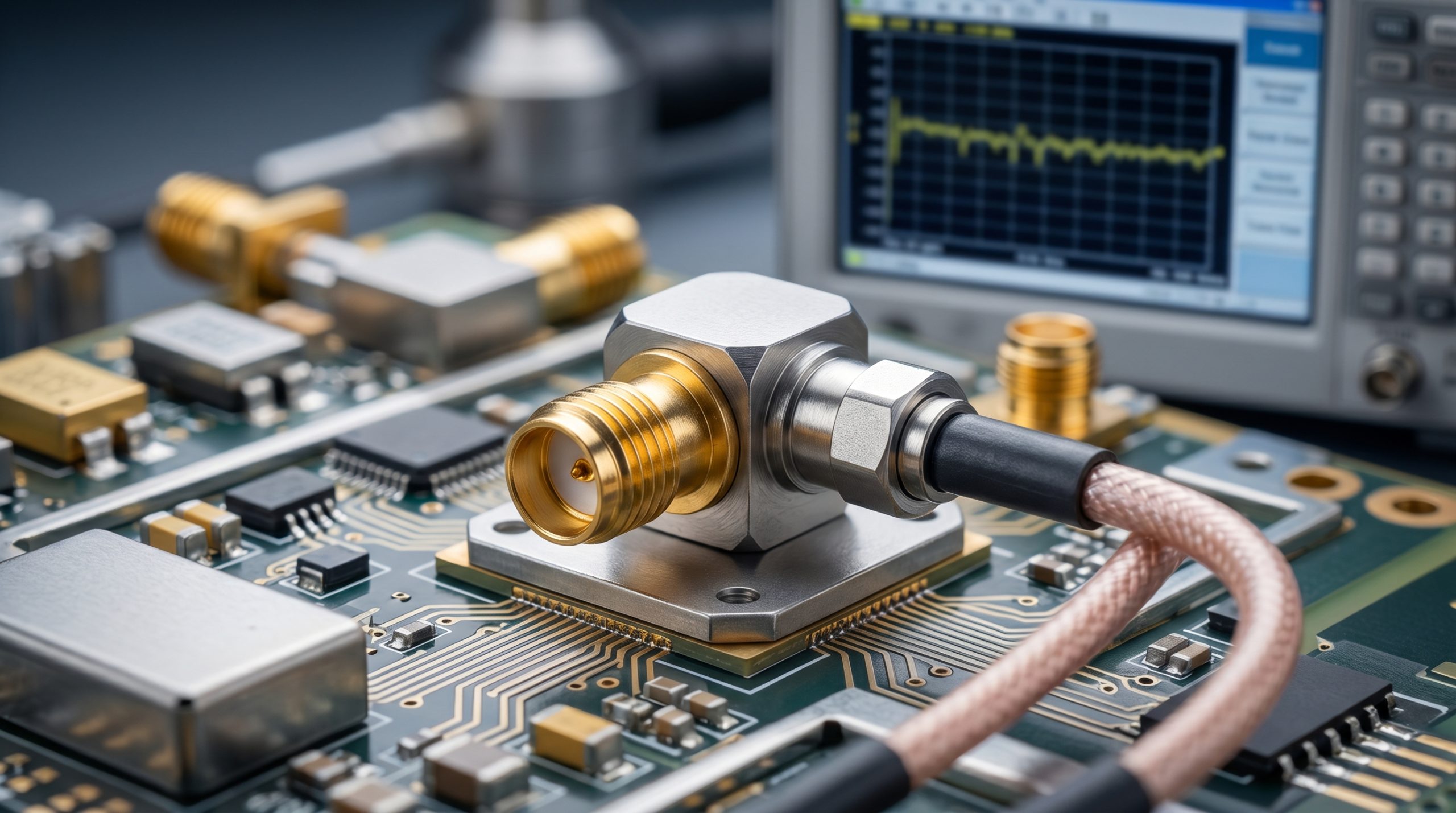
Right angle Millimeter Wave RF adapters act as critical junction components enabling seamless electromagnetic wave propagation through physically restrictive ninety-degree corners. B2B engineers constantly encounter severe packaging constraints demanding highly creative spatial problem-solving strategies during complex aerospace design cycles. You desperately require robust connecting mechanisms preventing disastrous signal attenuation scenarios predictably ruining expensive military-grade radar networks. Our analytical guide analyzes numerous fundamental operational characteristics defining premium microwave routing hardware effectively today, guaranteeing absolute trust demanding rigorous scientific verification protocols alongside uncompromising manufacturing standards continuously protecting your valuable electronic assets against completely unforeseen catastrophic field failure events happening unexpectedly during critical orbital satellite deployment missions worldwide.
Connect mmWave adapters to the full RF test path
When connector and adapter selection affects a real test system, CorelixRF can review frequency band, insertion loss, VSWR, amplifier interface, signal source output and delivery evidence before quotation.
How Do Right Angle Millimeter Wave RF Adapters Function?
Right angle Millimeter Wave RF components flawlessly route high-frequency electrical currents around sharp physical corners inside densely packed telecommunication enclosures. Modern hardware developers frequently battle extremely limited chassis spaces where conventional linear interconnects simply cannot fit physically anymore. You must identify perfectly engineered corner-turning devices capable of transmitting delicate analog waveforms without generating massive reflective power spikes. Implementing incredibly precise internal chamfering techniques allows these remarkable mechanical joints seamlessly preserve critical 50-ohm characteristic impedances flawlessly under massive thermal stress environments.
What Makes Internal Geometry Design So Critical?
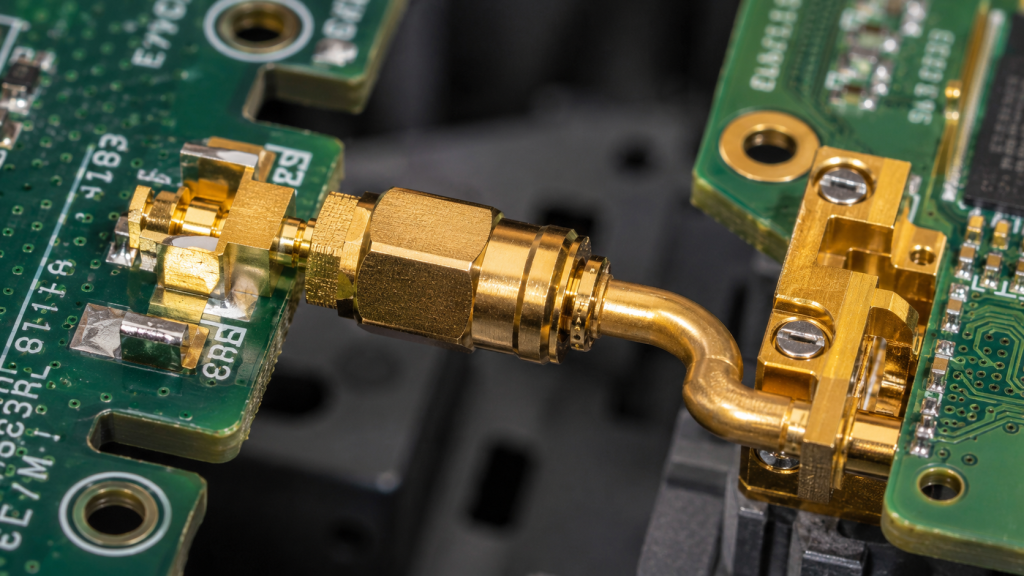
Crafting perfectly angled inner transmission lines demands absolutely flawless micrometer-level machining tolerances during automated production runs globally. Improperly calculated corner radii immediately create highly destructive standing waves predictably ruining sensitive downstream receiving amplifiers permanently. Brilliant RF engineers routinely deploy sophisticated finite element analysis software predicting complex electromagnetic behaviors accurately before fabricating costly physical prototypes.
- Advanced cavity resonance suppression minimizes unwanted harmonic distortion artifacts efficiently.
- Polished dielectric supporting beads multiply broadband frequency transmission capabilities phenomenally.
- Thickly applied gold plating guarantees incredibly low contact resistance values continuously.
Why Must Voltage Standing Wave Ratios Remain Low?
Here is the kicker: evaluating reflected power percentages helps technicians accurately diagnose hidden transmission line faults during rigorous quality assurance inspections. Dangerously elevated VSWR readings strongly indicate catastrophic impedance mismatches causing potentially lethal heat accumulation inside compact radio transmitters. Maintaining exceptionally minimal reflection coefficients guarantees absolute maximum forward energy transfer rates achieving phenomenal total network efficiency effortlessly.
Key Takeaway: Specifying exceptionally low-VSWR connecting hardware predictably guarantees vastly superior communication link reliability across demanding industrial applications continually.
| Performance Metric | Operational Impact Description |
| Low Insertion Loss | Preserves delicate signal amplitudes effectively |
| Minimal VSWR | Prevents destructive reflected energy surges |
| High Phase Stability | Maintains accurate timing characteristics reliably |
This brief analytical table clearly demonstrates exactly how fundamental electrical parameters dictate ultimate system reliability profoundly.
Why Choose Right Angle Designs For High Frequency Systems?
Integrating compact Millimeter Wave RF assemblies profoundly improves incredibly scarce board real estate within modern miniaturized avionics modules. Forward-thinking system architects consistently utilize these clever ninety-degree turning mechanisms drastically reducing total packaging footprints efficiently during conceptual design phases. You can successfully eliminate dangerously tight coaxial cable bending radii commonly causing hidden micro-fractures inside delicate fluoropolymer insulation layers. Utilizing rigid corner-angled joints completely eradicates unpredictable mechanical stress concentrations vastly improving long-term physical durability across harsh vibrational environments.
How Do Ninety Degree Bends Save Board Space?
Routing thick semi-rigid cabling horizontally across crowded printed circuit boards consumes massively disproportionate amounts of valuable physical territory unnecessarily. Strategically deploying vertically oriented receptacle jacks paired alongside appropriately angled mating plugs instantly reclaims previously wasted volumetric areas intelligently. Brilliant layout designers routinely exploit such multidimensional routing strategies successfully accommodating significantly higher component densities effortlessly.
- Vertical stacking configurations dramatically decrease horizontal footprint requirements practically.
- Eliminated cable loops prevent accidental snagging damages during maintenance procedures.
- Streamlined internal wiring harnesses promote remarkably better convective cooling airflow.
When Should Engineers Specify These Angled Interconnects?
What’s the real story? Selecting properly angled mating interfaces becomes absolutely mandatory whenever adjacent mechanical structures physically block straight-line connector insertions entirely. Attempting forced cable bends severely degrades delicate inner shielding layers eventually leading toward catastrophic electromagnetic interference leakage issues. Implementing factory-formed corner joints guarantees mathematically perfect geometric transitions preserving pristine electrical characteristics indefinitely under severe operational conditions.
Key Takeaway: Proactively choosing intelligently angled interconnect solutions elegantly solves extremely complex mechanical packaging dilemmas while simultaneously protecting delicate transmission properties.
| Packaging Benefit | Engineering Advantage Summary |
| Reduced Cable Stress | Prevents internal dielectric layer micro-fracturing |
| Enhanced Airflow | Lowers ambient operating temperatures effectively |
| Increased Density | Allows smaller total chassis dimensions |
This concise structural evaluation proves exactly why compact angled joints easily outperform forcefully bent linear cables functionally.
What Are Common Connector Types For These RF Adapters?
Selecting appropriate Millimeter Wave RF interfaces heavily depends upon your specific maximum operating frequency requirements governing complex telecommunication networks. Experienced procurement specialists carefully analyze dozens of intricately standardized mechanical mating profiles identifying perfectly matched hardware pairings reliably. You must fully understand subtle dimensional differences separating superficially similar precision threaded couplings preventing accidental permanent physical damages. Adopting widely recognized international standardization protocols guarantees absolute mechanical interoperability seamlessly across diverse multinational component manufacturing supply chains.
How Does The 1.85mm Interface Perform Technically?
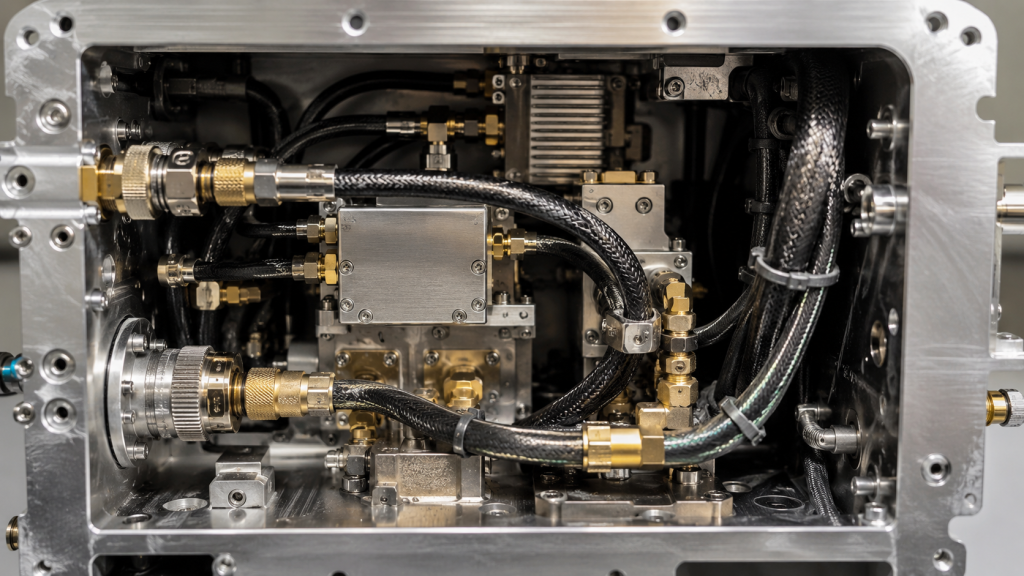
Deploying incredibly precise 1.85mm threaded mechanisms allows brilliant electronic engineers effortlessly push upper transmission boundaries beyond 65 gigahertz reliably. Extremely ruggedized air-dielectric internal structures completely eliminate lossy solid polymer insulators increasing forward energy propagation rates phenomenally well. Careful handling remains strictly mandatory since microscopic center pin deformations predictably ruin expensive laboratory calibration equipment permanently.
- Extra thick outer conductor walls provide massive mechanical strength enhancements.
- Precision mating threads guarantee extremely repeatable electrical contact resistances.
- Air dielectric designs minimize detrimental high-frequency signal absorption profoundly.
Why Do Systems Utilize 2.4mm Couplings Frequently?
Ready for the good part? Integrating popular 2.4mm coupling hardware reliably supports extremely demanding broadband data streams operating flawlessly up through 50 gigahertz spectrums. These versatile connecting elements perfectly balance exceptional electrical performance alongside robust mechanical durability enduring thousands of repetitive mating cycles. Fully compatible 1.85mm inter-mating capabilities offer tremendous architectural flexibility effectively saving massive capital expenditures during subsequent equipment upgrade initiatives.
Key Takeaway: Deeply understanding specific mating interface capabilities empowers engineering teams confidently build highly scalable next-generation wireless infrastructures today.
| Interface Type | Maximum Frequency Capability |
| 1.85mm V-Connector | Supports ultra-high speeds up toward 67 GHz |
| 2.4mm Connector | Delivers reliable performance reaching 50 GHz |
| 2.92mm K-Connector | Operates flawlessly across bands hitting 40 GHz |
This technical reference chart clearly delineates absolute maximum operational thresholds governing popular precision threaded coupling standards accurately.
How Does Frequency Range Impact RF Adapter Performance?
Pushing Millimeter Wave RF signals through poorly optimized routing joints invariably causes devastating energy losses across upper spectral bands. Seasoned acoustic physicists thoroughly understand exactly how shrinking electromagnetic wavelengths interact aggressively against microscopic internal mechanical imperfections continuously. You absolutely cannot utilize cheap lower-frequency hardware expecting acceptable performance characteristics during incredibly demanding broadband laboratory measurements. Selecting ultra-premium precision-crafted routing devices magically suppresses unwanted higher-order transverse modes completely guaranteeing pristine dominant wave propagation flawlessly.
What Happens When Wavelengths Become Extremely Short?
Transmitting exceedingly short electromagnetic waves functionally forces electrical currents tightly outward toward metallic conductor surfaces via known skin effects. Microscopic surface scratches suddenly become massive physical obstacles reflecting substantial portions of forward-traveling energy backwards toward sensitive sources. Achieving ultra-smooth internal polishing finishes remains an absolutely critical manufacturing requirement preventing catastrophic high-frequency signal degradation events.
- Advanced electropolishing techniques create virtually flawless inner conductive pathways.
- Suppressed transverse electromagnetic modes prevent destructive resonant energy cancellations.
- Stabilized phase characteristics guarantee incredibly accurate digital symbol decoding.
Why Do Connectors Feature Specific Cutoff Frequencies?
This is where it gets interesting: designing coaxial transmission lines inherently involves carefully balancing center conductor diameters against corresponding outer shielding tube dimensions perfectly. Exceeding mathematically calculated theoretical cutoff boundaries instantly permits chaotic multi-mode wave propagation destroying encoded digital information instantly. Strictly obeying manufacturer-specified operational bandwidth limits reliably guarantees completely stable pure transverse electromagnetic field modes continuously.
Key Takeaway: Respecting fundamental physics laws governing short-wavelength propagation ultimately guarantees highly successful broadband communication network deployments globally.
| Frequency Phenomenon | Operational Consequence Description |
| Skin Effect Shifting | Concentrates electrical currents along outer surfaces |
| Transverse Moding | Corrupts data through multipath interference |
| Wavelength Shrinking | Magnifies microscopic surface imperfection impacts |
This scientific overview perfectly explains precisely why higher operational frequencies rigorously demand vastly tighter manufacturing tolerances unconditionally.
Which Applications Rely On Millimeter Wave RF Technology?
Integrating sophisticated Millimeter Wave RF networks powerfully enables extraordinary technological advancements across highly diverse modern industrial sectors globally. Visionary product developers aggressively utilize these massive available bandwidths effectively transmitting unprecedented volumes of critical encrypted information instantaneously. You probably access these invisible electromagnetic highways daily while streaming ultra-high-definition multimedia content directly toward mobile cellular devices. Implementing precisely angled routing components seamlessly solves incredibly complex spatial packaging challenges inside next-generation autonomous vehicular radar platforms.
How Do Aerospace Systems Use These Adapters?
Constructing robust orbital satellite communication payloads strictly requires incredibly lightweight yet phenomenally durable electronic routing subassemblies unconditionally. Extreme vibrational forces experienced during violent atmospheric launch phases easily destroy conventionally soldered linear connections almost instantly. Utilizing ruggedized right-angle routing joints intelligently eliminates catastrophic cable whipping phenomena effectively protecting delicate active amplification modules securely.
- Miniaturized phased array antennas demand extremely tight physical spacing.
- Hardened internal shielding prevents devastating cosmic radiation interference events.
- Hermetically sealed interfaces survive harsh zero-gravity vacuum environments perfectly.
Why Do 5G Cellular Networks Need Them?
Here is the deal: deploying ultra-dense terrestrial cellular base stations involves installing thousands of highly complex multiple-input multiple-output antenna arrays rapidly. Crowded urban deployment scenarios frequently force telecom technicians into utilizing extremely restrictive rooftop equipment cabinets requiring clever spatial optimization. Strategically positioned corner-turning connectors neatly route thick feeder cables allowing dramatically increased hardware densities inside compact enclosures.
Key Takeaway: Recognizing diverse industry applications profoundly highlights exactly how critical reliable connecting mechanisms remain toward advancing modern technological progress.
| Industry Sector | Primary Usage Application |
| Aerospace Defense | Orbital satellite payload communication links |
| Telecommunications | High-density 5G cellular base stations |
| Automotive | Autonomous driving collision avoidance radars |
This categorized application matrix successfully illustrates beautifully how specific vertical markets intensely utilize advanced broadband routing hardware.
How Do You Select Suitable RF Adapters For Tight Spaces?
Choosing perfect Millimeter Wave RF solutions demands extensively analyzing exact three-dimensional spatial constraints surrounding your specific installation environment. Diligent hardware integrators meticulously measure available clearance gaps preventing disastrous mechanical interference issues during final assembly procedures. You must carefully verify exact connector genders perfectly matching existing female receptacles securely without requiring ridiculous daisy-chained adapters. Prioritizing sweep-radius right-angle designs over sharp mitered corners vastly improves total electrical performance across extremely high frequency bands.
What Mechanical Properties Require Close Attention?
Evaluating fundamental structural integrity guarantees your chosen routing devices easily survive repetitive mechanical stressing without experiencing catastrophic failures. Fragile center coupling pins bend incredibly easily if technicians accidentally apply excessive lateral forces during awkward blind-mating operations. Specifying exceptionally robust stainless-steel external housings guarantees tremendously improved physical survivability compared against cheaper brass alternative materials.
- Heavy-duty coupling nuts prevent accidental loosening under severe vibrations.
- Captivated center contacts guarantee perfectly repeatable insertion depth positioning.
- Thickly knurled gripping surfaces allow easier manual tightening procedures.
How Does Plating Material Affect Long Term Reliability?
You might be wondering: applying premium metallic coatings directly onto base structural metals drastically improves both electrical conductivity alongside critical corrosion resistance. Standard commercial installations might temporarily survive using inexpensive nickel finishes before rapidly degrading oxidation layers inevitably ruin transmission qualities. Demanding aerospace contractors universally mandate heavily applied gold plating guaranteeing absolutely pristine long-lasting low-resistance electrical pathways continuously.
Key Takeaway: Meticulously evaluating specific mechanical construction details completely prevents extremely expensive premature field failures across deployed communication systems.
| Selection Criteria | Important Engineering Consideration |
| Gender Matching | Prevents unnecessary intermediate coupling components |
| Housing Material | Determines total physical crush resistance |
| Plating Quality | Guarantees long-lasting environmental corrosion protection |
This practical selection guide deliberately helps systems engineers quickly identify highly effective hardware configurations efficiently during procurement.
Can Right Angle RF Adapters Prevent Signal Degradation?
Deploying premium Millimeter Wave RF corner joints successfully prevents devastating energy attenuation traditionally associated with sharply bent coaxial cables. Competent electrical inspectors thoroughly document exactly how severely stressed polymer dielectrics fundamentally alter critical 50-ohm characteristic impedances negatively. You clearly save substantial diagnostic troubleshooting hours simply avoiding unpredictable phase-shifting anomalies caused by physically abused transmission lines. Implementing precisely machined internal transitional cavities magically preserves delicate waveform geometries flawlessly across massive environmental temperature fluctuations continuously.

How Do Mitered Corners Compare Against Swept Radii?
Designing perfect right-angle transitions generally involves choosing between cheaper mitered geometries versus vastly more expensive swept-radius internal pathways. Standard mitered joints utilize an abrupt angled internal reflector plate causing slightly higher VSWR spikes at extreme upper frequencies. Premium swept-radius architectures physically curve inner conductors seamlessly mimicking an ideal gentle cable bend perfectly eliminating reflections.
- Swept designs provide vastly superior high-frequency return loss measurements.
- Mitered architectures offer much tighter external mechanical packaging dimensions.
- Precision tuning screws allow microscopic post-manufacturing impedance adjustments accurately.
Why Is Phase Stability Critical During Routing?
Here is a secret: maintaining mathematically perfect signal timing relationships remains absolutely mandatory across sophisticated multi-channel phased array radar systems globally. Deformed coaxial cables introduce highly unpredictable electrical length variations immediately destroying delicate spatial beamforming calculations completely. Rigid mechanical corner connections guarantee incredibly consistent phase-delay characteristics allowing brilliant radar operators continuously track supersonic targets flawlessly.
Key Takeaway: Intelligently replacing forcefully bent wiring with rigid engineered joints effectively guarantees absolute maximum electrical performance unconditionally.
| Design Architecture | Primary Electrical Characteristic |
| Swept Internal Radius | Delivers maximum broadband phase stability |
| Sharp Mitered Joint | Provides extremely compact physical dimensions |
| Tuned Cavity Bend | Minimizes high-frequency insertion loss effectively |
This brief architectural comparison definitively proves exactly why internal geometric designs heavily influence total transmission fidelity dynamically.
What Materials Guarantee Maximum High Frequency Performance?
Constructing highly reliable Millimeter Wave RF routing devices requires selecting exceedingly exotic metallurgical compounds perfectly balancing electrical and mechanical properties. Experienced material scientists continuously formulate incredibly advanced alloy mixtures resisting extreme physical deformation while simultaneously conducting electromagnetic energy flawlessly. You simply cannot build military-grade communication hardware utilizing easily degradable consumer-grade plastics or cheap porous metallic castings. Utilizing specialized beryllium-copper alloys for center spring contacts phenomenally improves repetitive mating-cycle longevity without sacrificing critical electrical conductivity.
Why Do Manufacturers Prefer Stainless Steel Housings?
Machining external protective shells from hardened passivated stainless steel provides absolutely unparalleled mechanical crush resistance protecting delicate internals securely. Softer brass alloys easily deform permanently if clumsy technicians accidentally drop expensive testing equipment onto hard concrete laboratory floors. Passivation chemical treatments intelligently strip away surface iron molecules creating an invisible microscopic chromium-oxide layer preventing destructive rusting entirely.
- Non-magnetic steel variants prevent unwanted electromagnetic field distortions beautifully.
- Superior tensile strength easily withstands massive torqueing wrench forces.
- Excellent thermal expansion characteristics match internal dielectric materials closely.
How Do Advanced Dielectrics Improve Signal Flow?
Listen closely: supporting central conducting pins precisely inside outer tubular shells strictly demands utilizing highly specialized low-loss insulating materials. Standard polytetrafluoroethylene performs adequately across lower spectrums before inevitably absorbing unacceptably massive amounts of microwave energy at higher frequencies. Cutting-edge aerospace engineers frequently employ proprietary modified polymers featuring incredibly low dielectric constants functionally mimicking pure air flawlessly.
Key Takeaway: Specifying meticulously formulated exotic construction materials effectively pushes ultimate hardware performance boundaries far beyond conventional theoretical limits.
| Material Component | Key Performance Contribution |
| Beryllium Copper | Maintains excellent spring-contact mating forces |
| Passivated Steel | Provides massive external environmental protection |
| Modified Polymers | Minimizes detrimental high-frequency energy absorption |
This concise metallurgical summary clearly identifies exactly which specialized materials primarily drive superior broadband electrical performance continuously.
How Do Environmental Factors Affect RF Adapter Longevity?
Deploying sensitive Millimeter Wave RF networks outdoors forcefully exposes vulnerable routing hardware against profoundly destructive atmospheric weather conditions constantly. Seasoned field technicians intimately understand exactly how aggressively salt-laden coastal fogs rapidly corrode poorly protected metallic mating interfaces completely. You absolutely must implement extensive environmental sealing strategies protecting expensive digital transmission equipment against microscopic water vapor intrusions. Specifying rigorously tested hermetically sealed connector variants intelligently prevents disastrous internal condensation events occurring during rapid barometric pressure changes.
What Happens During Extreme Temperature Fluctuations?
Cycling electronic assemblies repeatedly between freezing cryogenic lows toward scorching operational highs induces massive internal mechanical shearing stresses continuously. Differing thermal expansion coefficients between metallic conductors alongside insulating polymers inevitably cause microscopic structural tearing over extended deployment lifecycles. Precision engineered compensating mechanisms effectively allow internal subcomponents sufficient breathing room preventing catastrophic physical ruptures predictably.
- Captivated internal contacts prevent disastrous thermal-induced pin backing out.
- Specialized fluorocarbon O-rings maintain strict watertight seals continuously.
- Vented outer housings intelligently equalize dangerous internal pressure differentials.
Why Is Vibration Resistance Absolutely Critical?
But wait, there is more: mounting sensitive broadband communication hardware directly onto heavily vibrating heavy industrial machinery introduces highly destructive persistent mechanical shaking forces. Poorly secured threaded couplings will predictably loosen themselves completely without employing specialized mechanical locking mechanisms actively preventing rotational backing. Incorporating advanced anti-vibration safety wire holes allows cautious maintenance personnel physically tie down critical connection points securely.
Key Takeaway: Proactively addressing severe environmental threats deliberately guarantees phenomenal long-term reliability across incredibly harsh global deployment scenarios.
| Environmental Threat | Effective Engineering Countermeasure |
| Extreme Temperature | Implementing matched thermal expansion materials |
| Heavy Vibration | Utilizing physical safety wiring techniques |
| Moisture Intrusion | Deploying specialized fluorocarbon sealing rings |
This focused environmental analysis strongly demonstrates exactly how robust engineering design easily defeats extreme atmospheric operational challenges.
What Are Future Trends In Millimeter Wave RF Designs?
Developing next-generation Millimeter Wave RF architectures aggressively pushes brilliant global researchers toward investigating completely revolutionary sub-terahertz frequency bands continuously. Visionary technology forecasters confidently predict massive imminent leaps regarding highly miniaturized monolithic microwave integrated circuit manufacturing capabilities shortly. You will inevitably witness completely unprecedented data transmission speeds supporting highly immersive virtual reality telepresence applications flawlessly worldwide. Investigating incredibly exotic metamaterial dielectric structures magically promises virtually lossless electromagnetic wave propagation across profoundly complex nanoscale routing environments.

How Will 6G Networks Influence Adapter Engineering?
Designing hardware supporting upcoming 6G cellular standards strictly requires handling phenomenally wide spectral channels operating well above 100 gigahertz. Traditional coaxial mechanical interfaces become extraordinarily difficult manufacturing challenges considering microscopic physical dimensions required at such extreme frequencies. Engineers enthusiastically investigate radically innovative rectangular waveguide routing joints offering vastly lower insertion losses compared against tiny fragile coaxial pins.
- Artificial intelligence algorithms will optimize incredibly complex internal routing geometries.
- Advanced 3D metal printing enables previously impossible swept-radius architectures.
- Integrated photonics might eventually replace traditional metallic center conductors.
Why Are Automated Manufacturing Processes Improving?
Look at this: meeting rapidly exploding global market demands strictly necessitates developing incredibly efficient fully automated robotic precision assembly lines globally. Human manual dexterity simply cannot consistently achieve absolute microscopic tolerances demanded by bleeding-edge sub-terahertz communication networks continuously. Implementing highly sophisticated optical machine vision inspection systems flawlessly guarantees absolutely perfect quality control across millions of manufactured units.
Key Takeaway: Embracing radically advanced manufacturing technologies decisively empowers humanity toward building phenomenally faster global communication infrastructures tomorrow.
| Future Technology | Expected Industry Impact |
| AI Optimization | Generates perfectly efficient internal wave routing |
| 3D Metal Printing | Allows incredibly complex internal geometries cheaply |
| Sub-Terahertz Bands | Delivers phenomenally massive data transmission speeds |
This forward-looking trend analysis brilliantly highlights exactly where advanced broadband connectivity hardware fundamentally evolves next universally.
FAQ
Q1: Can I use lower frequency adapters for millimeter wave applications?
No, you cannot. Lower frequency adapters lack microscopic precision required, leading directly toward catastrophic signal reflection and data loss.
Q2: What’s the best way to clean these sensitive high-frequency connectors?
Use compressed air first. Chemical solvents combined alongside specialized lint-free swabs safely remove stubborn microscopic debris without damaging delicate plating.
Q3: How do I know if my right angle adapter is causing signal loss?
Test using vector network analyzers. Unexpectedly high voltage standing wave ratio measurements clearly indicate a faulty or improperly mated connection.
Q4: Can I mate a 2.4mm connector with a 1.85mm adapter safely?
Yes, you can safely interconnect them. Closely matching thread pitches alongside similar mechanical designs allow reliable mating without causing physical damage.
Q5: What’s the best material for preventing corrosion in outdoor environments?
Specify passivated stainless steel housings. Specialized chemical treatments create microscopic chromium-oxide barriers preventing destructive iron oxidation entirely.
Final Thoughts
Deploying reliable right angle Millimeter Wave RF solutions successfully resolves incredibly complex spatial packaging constraints efficiently across diverse industrial applications. Thoroughly understanding intricate internal geometric designs empowers your engineering teams toward building phenomenally robust broadband telecommunication architectures securely. We remain strongly committed toward pushing absolute ultimate boundaries defining modern high-frequency technological progress continuously. Please contact us today discussing exactly how our advanced precision-machined routing hardware decisively accelerates your next critical project.