
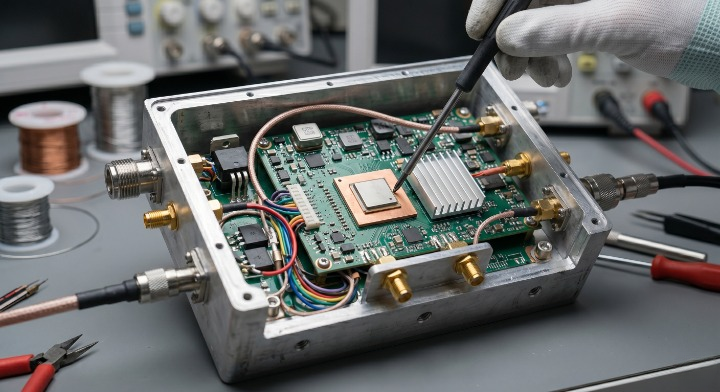
Unauthorized drones and rogue surveillance devices present a growing threat to secure airspaces and private infrastructure worldwide. This vulnerability can lead to catastrophic data breaches or physical security compromises if left unaddressed by modern defense protocols. By integrating a high-performance Counter-UAS strategy, you can deploy these specialized RF components to effectively sever the digital links between a remote operator and their device.
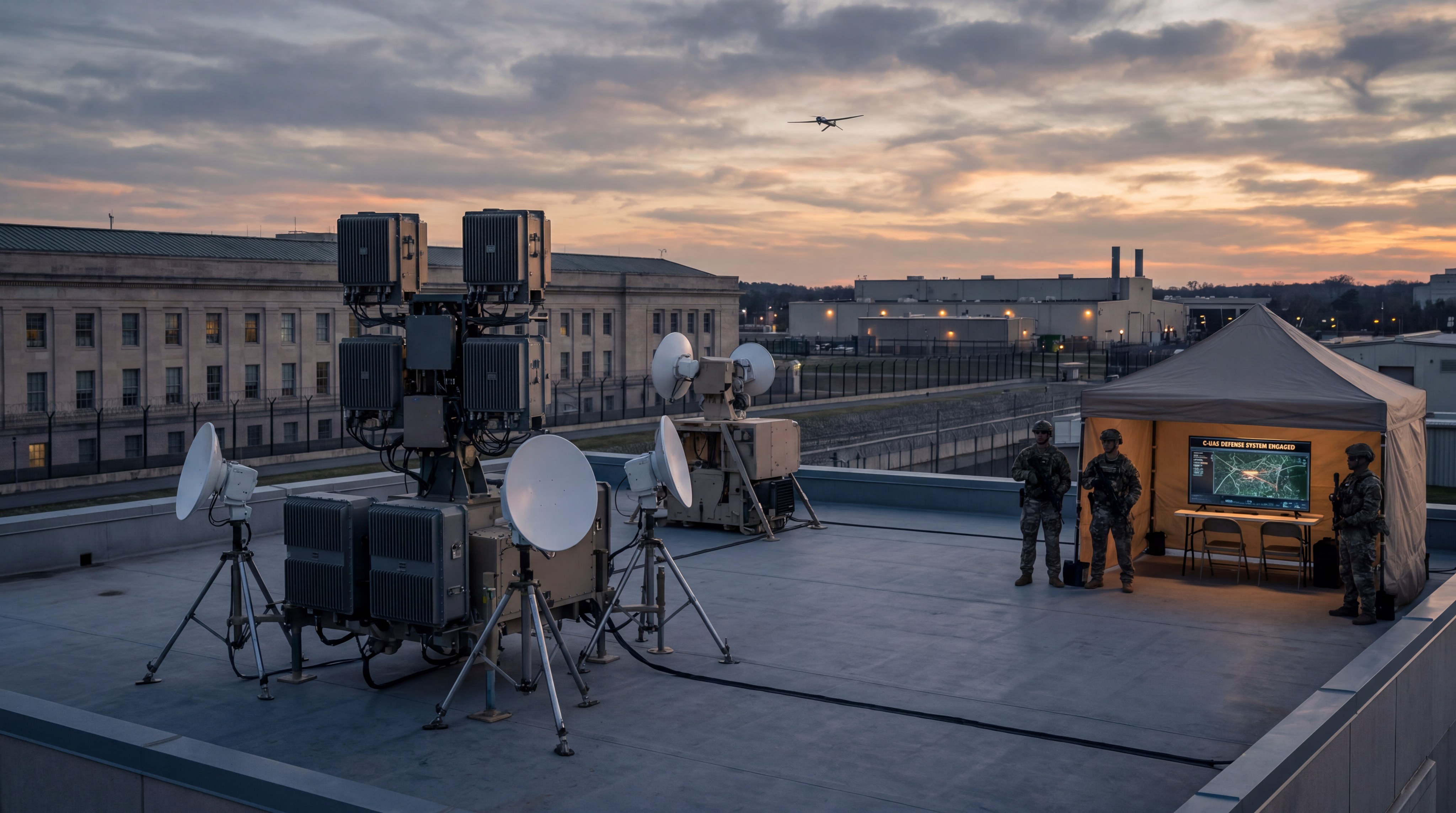
What is a signal jammer module exactly?
A signal jammer module is the fundamental electronic heart of any RF denial system, responsible for creating the “noise” that blocks incoming or outgoing signals. In the field of Counter-UAS, these modules are the primary engines that turn electrical energy into targeted electromagnetic interference. They are often integrated into larger housings to protect sensitive areas from unwanted wireless intrusion.
Defining the Core Module
You should view the module as the engine of your security system. It consists of high-precision circuitry that generates specific waveforms to saturate a target frequency.
Consider this:
Without a high-quality module, your defense system is merely an empty shell with no power to act.
- Frequency generation components.
- Signal modulation logic.
- Input power regulation.
- Output ports for antenna connection.
The Distinction Between Module and System
You must understand that a module is a component, whereas a system is the completed product. A system includes the module, power supply, antennas, and cooling housing working together.
The bottom line?
You need to select the right module first to ensure the entire system meets your operational requirements.
- Modules offer integration flexibility.
- Systems provide “plug-and-play” utility.
- Custom modules allow for specific frequency tuning.
| Feature | Module | System |
|---|---|---|
| Form Factor | Component PCB/Brick | Full Enclosure |
| Integration | Requires engineering | Ready for deployment |
| Customization | Very High | Fixed Specs |
The module serves as the functional unit while the system provides the necessary environment for it to operate safely.
Key Takeaway
By choosing a high-quality signal jammer module, you gain the ability to customize your defense architecture to meet specific threats while ensuring maximum RF efficiency.
How do these modules disrupt frequencies?
These modules disrupt frequencies by transmitting a powerful signal on the same bandwidth as the target device, causing a signal-to-noise ratio failure. Effective Counter-UAS operations rely on the module’s ability to “drown out” legitimate signals with superior white noise or pulse interference. This prevents the receiver from interpreting the original data stream sent by the controller.
Signal Detection and Matching
You need to match the module’s output to the exact frequency used by the intruder. Most modern modules can sweep across a range of frequencies to ensure no “holes” are left in your defense perimeter.
Check this out:
If the module isn’t precisely tuned, the target signal might bypass your interference entirely.
- Sweeping frequency logic.
- Targeted band jamming.
- Signal synchronization.
The Physics of RF Interference
You are essentially creating a wall of electromagnetic noise that the target device cannot penetrate. This noise is amplified to a level that overwhelms the sensitive electronics of a drone or radio.
Here is the deal:
Power density is the secret to making sure your jamming signal reaches the target before it can transmit data.
- Gaussian white noise generation.
- Carrier wave disruption.
- Phase-locked loop stability.
| Interference Type | Mechanism | Effectiveness |
|---|---|---|
| Spot Jamming | Focus on one frequency | High |
| Sweep Jamming | Rapidly moves through bands | Moderate |
| Barrage Jamming | Wide spectrum coverage | High Power Demand |
Disruption effectiveness is a direct result of the module’s ability to maintain a consistent and powerful noise floor across the target spectrum.
Key Takeaway
You benefit from a module that uses advanced wave generation techniques to ensure that no matter how the target signal moves, your interference remains dominant.

Which core components drive these units?
The core components of a jammer module include a voltage-controlled oscillator, a power amplifier, a control circuit, and a thermal management interface. Inside every high-performance Counter-UAS hardware setup, these four critical parts work in unison to ensure the unit functions reliably under stress. Without high-grade components, the module may fail due to frequency drift or overheating.
The Role of the Voltage-Controlled Oscillator
You rely on the oscillator to define the exact “color” or frequency of the noise you are generating. It converts a DC voltage into an AC signal at the desired radio frequency.
But wait, there’s more:
A high-quality oscillator ensures your module doesn’t drift into frequencies you aren’t authorized to block.
- Frequency stability.
- Low phase noise.
- Wide tuning range.
Power Amplifiers and Signal Strength
You use power amplifiers to take the small signal from the oscillator and boost it to levels capable of traveling long distances. This is the component that consumes the most power and generates the most heat.
It gets better:
The stronger the amplifier, the larger the “no-fly zone” you can create around your facility.
- High gain output.
- Efficiency ratings.
- Lineal performance.
Heat Sinking and Thermal Management
You must keep these modules cool because they generate significant thermal energy during operation. Most high-power modules feature a flat copper or aluminum base to transfer heat to a larger sink.
Believe it or not:
Heat is the number one killer of RF modules, so your cooling strategy is just as important as your power.
| Component | Primary Function | Impact on Performance |
|---|---|---|
| Oscillator | Frequency Generation | Accuracy |
| Amplifier | Signal Boosting | Range |
| Control Logic | Operation Management | Stability |
| Heat Base | Thermal Dissipation | Longevity |
The synergy between generation, amplification, and cooling determines the overall reliability and mission success of the hardware.
Key Takeaway
When you invest in a module with superior internal components, you ensure long-term stability and consistent range, reducing the risk of equipment failure during a security event.
What frequencies do these modules target?
Jammer modules typically target common communication bands like 2.4GHz, 5.8GHz, 900MHz, and various GNSS satellite frequencies. Managing the vast spectrum for Counter-UAS platforms requires modules capable of targeting everything from low-frequency remote controls to high-frequency video feeds. By covering these bands, you can neutralize the majority of commercial and consumer drones.
Civil and Commercial Drone Bands
You will find that most consumer drones operate on standard Wi-Fi or ISM bands. Modules are specifically built to saturate these frequencies so the drone loses its “home” connection.
Think about it:
If you block the 2.4GHz and 5.8GHz bands, most off-the-shelf drones will immediately enter an automated landing or “return-to-home” mode.
- 2.4 GHz (Standard Control).
- 5.8 GHz (Video Feed).
- 433 MHz (Long Range RC).
Disrupting GPS and GNSS Signals
You can also target the navigation systems that drones use to find their way. By jamming L1 and L2 satellite bands, you prevent the drone from knowing its own position.
Here is the kicker:
A drone without GPS becomes “blind,” making it much harder for an operator to navigate or for the drone to fly an autonomous path.
- GPS L1 (1575.42 MHz).
- GLONASS.
- Galileo frequencies.
| Band | Primary Use | Security Impact |
|---|---|---|
| 900 MHz | Long Range Telemetry | Extended Control |
| 2.4 GHz | Short Range Control | Common Threat |
| 1.5 GHz | Satellite Navigation | Navigation Denial |
Targeting the correct frequency bands is essential for creating a comprehensive shield that accounts for both control signals and navigational aids.
Key Takeaway
By deploying multi-band modules, you ensure that your defense system is capable of stopping a wide variety of threats, from simple toys to advanced autonomous aircraft.

Are there different types of jammer modules?
Yes, jammer modules come in various types including analog sweep, digital logic, wideband, and narrowband configurations. Not all Counter-UAS requirements are the same, leading to a variety of specialized hardware designs for different mission profiles. Your choice depends on whether you need a broad shield or a surgical strike against a specific frequency.
Wideband vs. Narrowband Modules
You would use a wideband module to cover a massive range of frequencies simultaneously, which is great for general area denial. Narrowband modules are used when you want to hit a specific target without interfering with nearby friendly communications.
The best part?
You can combine multiple narrowband modules to create a “comb” of protection that is highly efficient.
- Wideband: Multi-threat coverage.
- Narrowband: Higher power density.
- Application-specific tuning.
Digital vs. Analog Jamming Logic
You can choose between older analog systems that use simple noise or modern digital modules that can mimic real signal protocols. Digital jamming is often more effective at confusing advanced drones that can filter out simple noise.
Imagine this:
Digital modules can “trick” a drone into thinking it is receiving a valid signal that tells it to land immediately.
- Analog: Simple and reliable.
- Digital: Sophisticated and adaptive.
| Module Type | Primary Advantage | Typical Use Case |
|---|---|---|
| Analog Sweep | Low Cost | Basic Security |
| SDR-Based | Re-programmable | Military Defense |
| High-Power CW | Maximum Range | Perimeter Protection |
Selecting the right logic and bandwidth ensures that your interference is effective against the specific technology employed by the threat.
Key Takeaway
You gain a tactical advantage by selecting a module type that matches your specific environment, ensuring you don’t cause collateral interference to your own systems.
How are modules used in defense settings?
In defense settings, modules are integrated into vehicle-mounted systems, man-portable backpacks, and fixed-site installations to create protective bubbles. In military environments, Counter-UAS jammer modules are integrated into electronic warfare suites to neutralize remote-controlled threats and explosive devices. These modules act as a non-kinetic weapon that can stop a threat without firing a single bullet.
Electronic Warfare and SIGINT
You use these modules as part of a larger electronic warfare strategy to dominate the electromagnetic spectrum. They are often paired with detection modules that tell the jammer exactly when and where to fire.
Look at it this way:
In a modern conflict, the side that controls the radio waves usually wins the encounter.
- Proactive area denial.
- Reactive threat neutralization.
- Integration with radar systems.
Neutralizing Remote Detonation Risks
You can deploy these modules to prevent the remote detonation of improvised explosive devices (IEDs). By flooding the area with noise, you ensure that no radio trigger can reach its destination.
Wait, it gets better:
These modules save lives by creating a safe corridor for convoys and personnel in hostile environments.
| Defense Application | Deployment Method | Mission Goal |
|---|---|---|
| Base Protection | Fixed Mast | 24/7 Airspace Denial |
| Convoy Jamming | Vehicle Mounted | IED Prevention |
| Personnel Safety | Backpack/Handheld | Tactical Mobility |
Military-grade modules are designed for extreme environments where reliability and high power output are the most critical factors.
Key Takeaway
Using these modules in defense allows you to provide a layer of invisible protection that can be deployed rapidly to safeguard both personnel and high-value assets.
Can modules integrate with SDR systems?
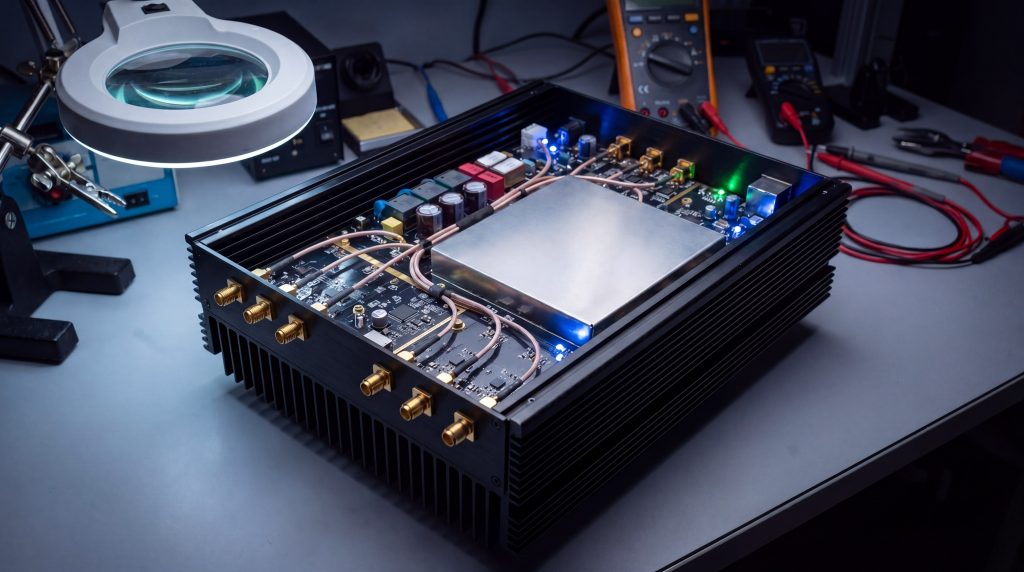
Yes, modern jammer modules can be integrated with Software Defined Radio (SDR) systems to allow for real-time frequency hopping and waveform updates. The future of Counter-UAS lies in this integration, allowing modules to be reprogrammed for emerging threats instantly via software. This makes your hardware “future-proof” as it can be updated to handle new drone models without changing physical parts.
Flexibility of Software Control
You can use software to change the jamming pattern, power levels, and frequency bands on the fly. This means your hardware can adapt to a changing threat landscape in seconds.
Keep in mind:
The hardware provides the “muscle,” but the SDR provides the “brain” that tells it exactly how to behave.
- Remote updates.
- Multi-protocol support.
- Adaptive jamming patterns.
Real-Time Waveform Adaptation
You have the ability to analyze an incoming signal and immediately generate a counter-waveform that is perfectly tuned to disrupt it. This surgical approach uses less power and is harder for the enemy to detect.
Check this out:
Reactive jamming only turns on when a threat is detected, which saves energy and keeps your location hidden.
| Feature | Traditional Module | SDR-Integrated |
|---|---|---|
| Update Method | Hardware Swap | Software Patch |
| Threat Response | Static | Dynamic/Adaptive |
| Complexity | Low | High |
The integration of SDR technology transforms a simple noise generator into a sophisticated, intelligent defense asset.
Key Takeaway
By choosing SDR-compatible modules, you ensure that your investment remains relevant for years, as you can simply download new “threat libraries” to keep your airspace secure.
What determines the module’s effective range?
The effective range is determined by output power, antenna gain, frequency, and environmental factors like line-of-sight. The success of a Counter-UAS mission is often dictated by the module’s output power and the gain of the attached antenna system. If you have a 10W module with a high-gain directional antenna, you might reach further than a 50W module with a poor antenna.
Power Output and Decibel Calculations
You measure the “punch” of a module in Watts or dBm. Every time you double the power, you theoretically increase the range, though the relationship is governed by the inverse-square law.
Here is the deal:
More power isn’t always better; you need enough power to reach the target, but not so much that you burn out your own equipment.
- Watts to dBm conversion.
- Link budget planning.
- Amplifier saturation levels.
Environmental and Line-of-Sight Factors
You must consider the terrain and obstacles between your module and the target drone. Buildings, trees, and even heavy rain can absorb RF energy and reduce your effective jamming radius.
Think about this:
An elevated position for your antenna will almost always provide better range than a more powerful module placed on the ground.
| Factor | Impact on Range | Solution |
|---|---|---|
| Output Power | High | Use high-efficiency PAs |
| Antenna Gain | High | Use directional dishes/Yagis |
| Obstacles | Negative | Increase antenna height |
Range is a product of both the module’s internal raw power and the external engineering of the antenna system and deployment location.
Key Takeaway
You can maximize your protection area by balancing high-power modules with optimized antenna placement, ensuring the signal reaches the threat before it gets too close.
Is GaN technology better for jammer modules?
Gallium Nitride (GaN) is superior for jammer modules because it offers higher power density, better thermal conductivity, and greater efficiency than traditional silicon. Modern Counter-UAS hardware is shifting toward GaN modules due to their ability to provide more “punch” in a smaller physical footprint. For you, this means your equipment can be smaller, lighter, and more powerful than ever before.
Efficiency Gains with GaN
You will notice that GaN modules convert more of the input electricity into RF power and less into wasted heat. This efficiency is critical for battery-powered or portable jamming systems.
The best part?
GaN modules run cooler while providing significantly more signal strength than older silicon-based alternatives.
- Lower energy consumption.
- Higher operational voltage.
- Reduced cooling requirements.
Reducing Footprint for Portable Units
You can build much smaller jamming devices when using GaN because the components themselves are smaller and require less bulky heat sinks. This is ideal for man-portable or drone-mounted applications.
Believe it or not:
A GaN module can often do the work of a silicon module twice its size and weight.
| Metric | Silicon (LDMOS) | Gallium Nitride (GaN) |
|---|---|---|
| Power Density | Moderate | Very High |
| Max Frequency | < 4 GHz | > 40 GHz |
| Efficiency | ~30% | ~60%+ |
Switching to GaN technology represents a major leap forward in RF performance, offering both higher power and improved reliability.
Key Takeaway
By selecting GaN-based modules, you ensure that your defense system is at the cutting edge of technology, offering the highest power-to-weight ratio available on the market.
What are the legal risks of using jammers?
The primary legal risks include heavy fines, equipment seizure, and potential imprisonment if you operate a jammer without explicit government authorization. Navigating the regulatory landscape for Counter-UAS technology is critical, as unauthorized RF jamming is strictly prohibited in most civilian jurisdictions. You must ensure you fall under a specific legal exemption before activating any jamming equipment.
FCC and International Regulations
You should be aware that the FCC in the US and similar bodies globally have strict bans on the sale and use of jammers by civilians. These laws are in place to prevent interference with emergency services, cell towers, and aviation navigation.
Don’t forget:
Even having a jammer in your possession can lead to legal scrutiny in certain high-security jurisdictions.
- Title 47 of the FCC Rules.
- Radio equipment directives.
- Civil liability for interference.
Government and Law Enforcement Exemptions
You may only operate these modules if you are part of an authorized government agency, military unit, or specifically licensed federal entity. These groups use jammers for public safety, national security, and VIP protection.
Here is the kicker:
Laws are changing to allow more entities to use this tech, but for now, the rules remain very restrictive for private companies.
| User Category | Legal Status | Requirements |
|---|---|---|
| Private Citizen | Prohibited | None (Illegal) |
| Local Police | Restricted | State/Federal Approval |
| Military | Authorized | Mission-Specific Orders |
Understanding the legal landscape is the only way to ensure that your security solution doesn’t become a legal liability for your organization.
Key Takeaway
You must consult with legal experts and regulatory bodies to ensure your use of jammer modules is fully compliant with local and federal laws to avoid severe penalties.
*
Frequently Asked Questions (FAQ)
- Can I build my own jammer module for personal privacy?
It is illegal in nearly all countries to operate jamming equipment without specific government authorization due to potential interference with emergency services. - What’s the best way to cool a high-power jammer module?
Active cooling via high-CFM fans or liquid-cooled cold plates is recommended for modules exceeding 50W to prevent thermal shutdown or component degradation. - How do I know if my module is targeting the right frequency?
You must identify the control and video transmission links—typically 2.4GHz, 5.8GHz, or 900MHz—used by the target aircraft using an RF analyzer. - Can I use a module to block cell phone signals in my office?
Doing so is a violation of federal law in most regions and can result in significant fines or criminal charges if it disrupts public communication networks. - What’s the best material for a module’s housing?
Milled aluminum or copper is the gold standard because it provides both electromagnetic shielding and excellent thermal conductivity.
*
Conclusion: Future-Proofing RF Security
Understanding the intricacies of the signal jammer module is the first step in deploying a reliable defense system. As drone technology evolves, these modules must become more agile, efficient, and powerful. By prioritizing high-quality components and Counter-UAS best practices, security professionals can ensure their airspace remains protected against the growing spectrum of wireless threats. We are committed to advancing the frontier of RF defense to protect global security interests. To explore custom RF solutions tailored to your specific operational needs, contact us today.