
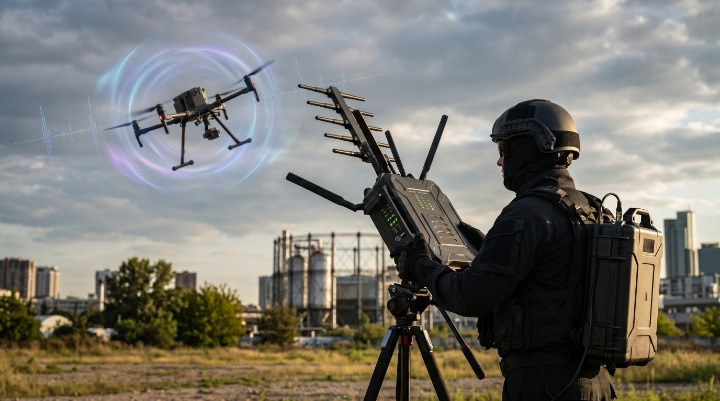
What makes a jammer effective for your needs?
To choose a jammer, you must evaluate the target’s frequency bands, the required signal-to-noise ratio for suppression, and the specific environmental constraints of your deployment site. Security threats are evolving rapidly, leaving your sensitive facilities vulnerable to unauthorized surveillance and data breaches. You may feel that traditional perimeter security is no longer sufficient to stop modern, agile threats from above. Fortunately, a high-performance drone jammer offers a sophisticated electronic shield to neutralize these risks before they reach your airspace.
Why is standard security insufficient?
Modern intruders use diverse technologies to bypass physical walls and cameras. Without electronic countermeasures, your facility remains an open target for RF-controlled devices.
How do you solve the threat?
You need a system that targets the specific communication links used by intruders. Here is the deal: identifying these links is the only way to ensure 100% protection.
- Radio frequency disruption
- GNSS signal blocking
- Remote control link severing
Key Takeaway: Effective selection begins by understanding that electronic threats require a specialized electronic response to maintain total site integrity.
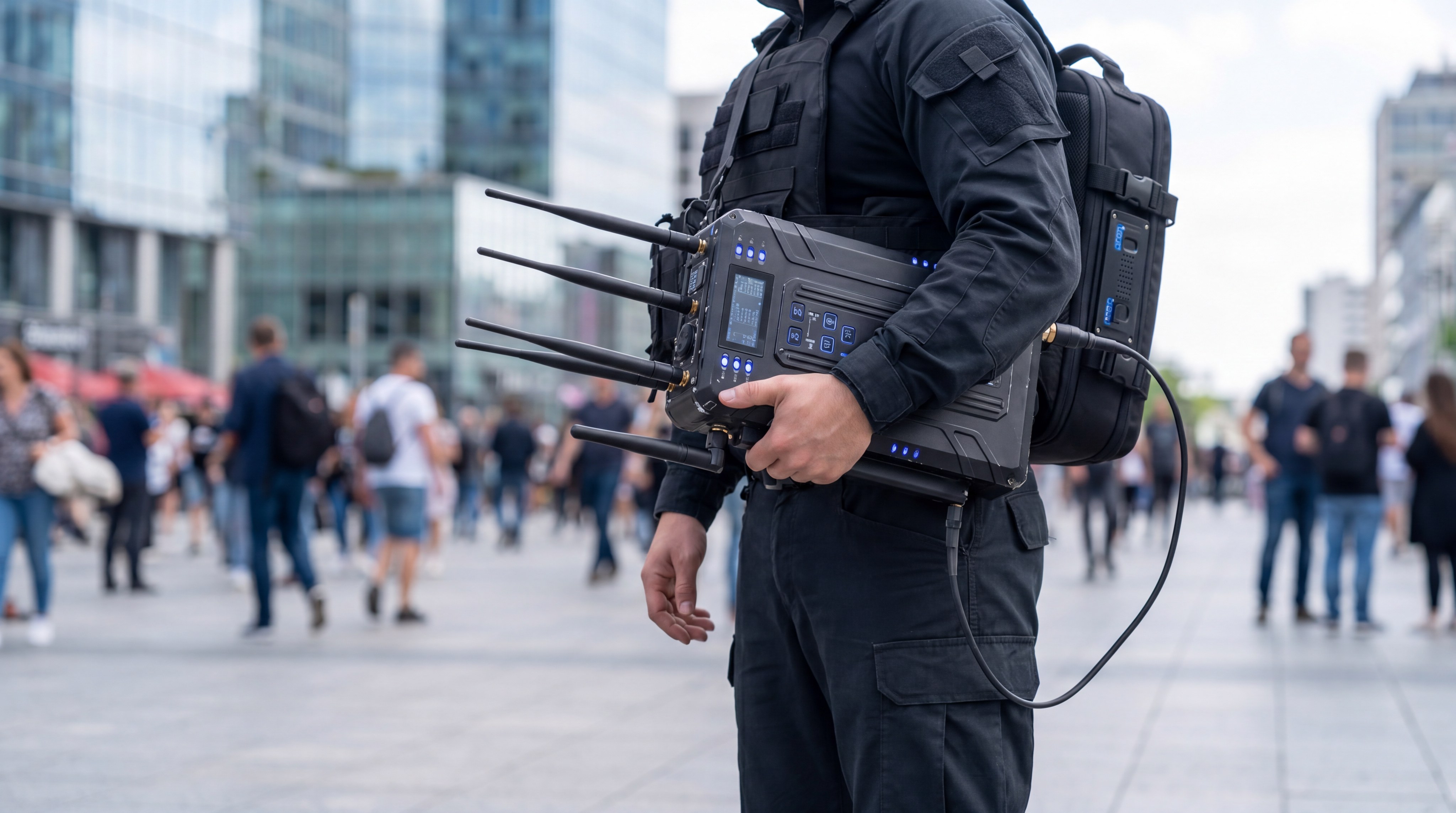
| Selection Criteria | Importance | Operational Impact |
|---|---|---|
| Threat Analysis | High | Determines hardware specs |
| Environment | Medium | Influences range and power |
This initial assessment ensures that your hardware capabilities align perfectly with the risks you face daily.
What are the primary types of signal blockers?
The primary types of signal blockers include wireless communication inhibitors, GPS/GNSS interference units, and comprehensive drone jammer systems. Each category serves a distinct purpose depending on whether you are protecting data, preventing tracking, or securing airspace. Selecting the wrong type can leave gaps in your security or cause unintended interference with local authorized signals.
Wireless signal and mobile blockers
These devices are engineered to disrupt 4G, 5G, and Wi-Fi signals within a localized area. They are most commonly used in boardrooms or high-security government offices to prevent eavesdropping.
Specialized drone jammer solutions
These systems are tailored to sever the specific RF links between an operator and their aircraft. Think about it: without a control link, most threats are immediately neutralized.
- Multi-channel disruption
- Directional antenna arrays
- Omni-directional coverage
Key Takeaway: You must choose a device that targets the specific signal—cellular, satellite, or RF control—that poses the greatest risk to your operations.
| Jammer Type | Target | Best Use Case |
|---|---|---|
| Mobile Blocker | Cellular/Wi-Fi | Meeting room privacy |
| Drone Jammer | 2.4GHz/5.8GHz | Perimeter defense |
Categorizing your specific threat model allows you to invest in the most efficient and cost-effective technology available.
Why is frequency range the most critical factor?
Frequency range is the most critical factor because a jammer only works if its output matches the exact spectral bands used by the target device. If your drone jammer does not cover the specific frequency hopping range of an intruder, the interference will be completely bypassed. You must verify the RF specifications of potential threats in your region before making a final purchase.
Identifying target signal frequencies
Commercial and industrial devices typically operate on standardized bands like 2.4GHz or 5.8GHz. However, advanced threats may use non-standard or custom frequencies to evade basic security.
Multi-band vs. single-band capabilities
Single-band units offer focused power but lack the versatility needed for modern security. You should look for multi-band systems to ensure comprehensive coverage.
- 433MHz/915MHz bands
- 2.4GHz/5.8GHz ISM bands
- GPS L1/L2 navigation bands
Key Takeaway: Always prioritize a wide-spectrum device to ensure that your security system can adapt to evolving signal technologies and frequency-hopping tactics.
| Band Type | Versatility | Efficiency |
|---|---|---|
| Single-Band | Low | High per channel |
| Multi-Band | High | Balanced across bands |
Selecting the correct frequency coverage is the fundamental baseline for any successful signal interference strategy in professional settings.
How does output power affect interference success?
Output power determines the jammer’s ability to overwhelm the incoming signal from the original transmitter at the receiver’s location. To successfully deploy a drone jammer, your device’s signal strength must exceed the strength of the command signal reaching the target. Higher wattage generally allows you to project this “noise” over greater distances or through more dense environments.
Balancing jammer and target power
If an intruder is close to their transmitter, they will have a very strong signal. You must ensure your hardware has enough wattage to drown out that high-intensity link.
Managing signal-to-noise ratios
Jamming is essentially a battle of signal-to-noise ratios within a specific area. Make no mistake, the higher your output, the more difficult it is for the target to hear commands.
- High-gain amplification
- Targeted beamforming
- Sustained power output
Key Takeaway: Choosing sufficient output power ensures that your interference is “loud” enough to be effective even against powerful or close-proximity transmitters.
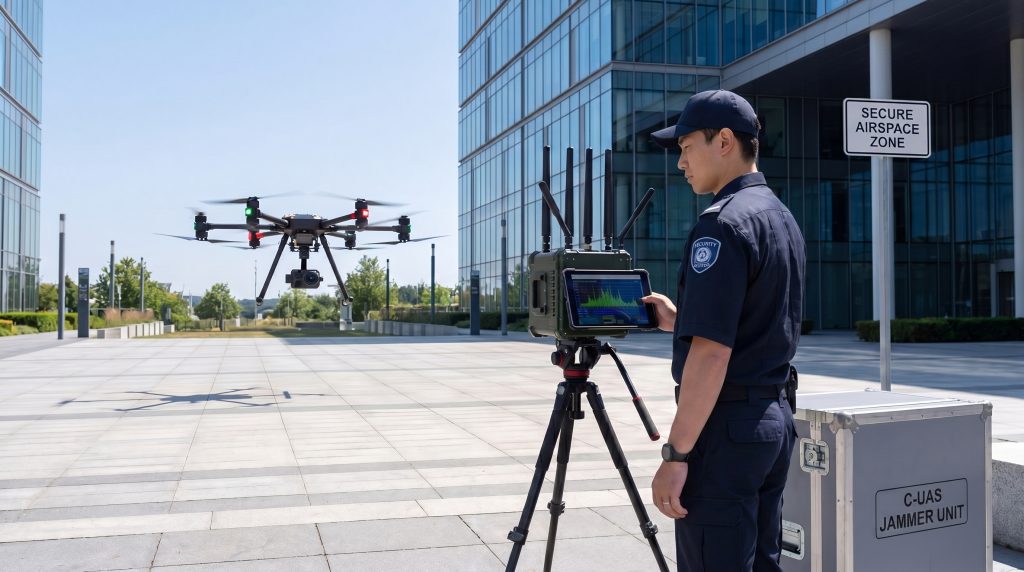
| Power Rating | Effective Range | Application |
|---|---|---|
| <20 Watts | Short Range | Personal protection |
| >50 Watts | Long Range | Industrial security |
Increasing power levels provides a necessary margin of safety when facing unknown or high-energy signal sources.
What determines the effective coverage distance?
Effective coverage distance is determined by the combination of output power, antenna gain, and the physical characteristics of the surrounding landscape. To maximize the reach of your drone jammer, you must consider how antenna types concentrate energy toward the threat. While high-power units cover more ground, the choice between directional and omni-directional antennas significantly alters the shape of your protected zone.
Calculating the interference radius
The radius is not just a number on a spec sheet but a result of environmental physics. You need to account for signal drop-off as the distance from the source increases.
Dealing with environmental obstacles
Trees, buildings, and hills act as physical attenuators that weaken your signal. Believe it or not, even heavy rain can reduce your effective interference range.
- Line-of-sight requirements
- Signal reflection (multipath)
- Atmospheric attenuation
Key Takeaway: You should always select a range rating that exceeds your actual perimeter requirements to provide a buffer for environmental interference.
| Distance Factor | Influence | Mitigation |
|---|---|---|
| Antenna Gain | Positive | Use high-gain arrays |
| Obstacles | Negative | Elevate the device |
Optimizing coverage distance requires a strategic approach to hardware placement and a realistic understanding of local geographic challenges.
How do you evaluate the required operating time?
Required operating time is evaluated by analyzing your mission duration, whether it involves continuous 24/7 protection or short-burst tactical deployments. If you are using a portable drone jammer, the battery life dictates how long your security personnel can remain active in the field. For stationary systems, operating time is often measured by the reliability of the internal cooling and power conversion hardware.
Continuous vs. intermittent operation
Fixed installations require high-grade components designed for constant thermal stress. In contrast, tactical units are built for high performance during short, intense periods of use.
Battery capacity and runtime metrics
For mobile units, the density of the lithium-ion cells is the most important metric. You need to know exactly how long you have before the shield drops.
- Total watt-hours (Wh)
- Charge-to-use ratio
- Standby time efficiency
Key Takeaway: Match your device’s power endurance to your specific operational tempo to avoid hardware failure during a critical security event.
| Operation Mode | Power Source | Primary Metric |
|---|---|---|
| Permanent | AC Mains | MTBF Hours |
| Mobile | Battery | Runtime per charge |
Calculating these metrics in advance prevents the disastrous scenario of a security system powering down in the middle of a threat.
Which power supply options fit your environment?
The power supply options that fit your environment depend on your need for mobility versus the requirement for an uninterrupted, permanent signal shield. If your security team moves frequently, a drone jammer with high-capacity internal batteries and fast-charging capabilities is essential. For protecting fixed infrastructure, direct-current (DC) installations with battery backups provide the highest level of reliability.
Portable battery-powered units
These units provide maximum flexibility for rapid response teams in diverse locations. You should prioritize models with hot-swappable batteries to ensure the system never has to go offline.
Fixed direct-current installations
Permanent sites benefit from being hardwired into the facility’s power grid. It’s worth noting that these systems are usually more powerful since they aren’t limited by battery weight.
- AC/DC power converters
- Integrated UPS backups
- Solar-powered options
Key Takeaway: Your power source choice should reflect the location of the threat and the availability of local infrastructure for recharging or constant supply.
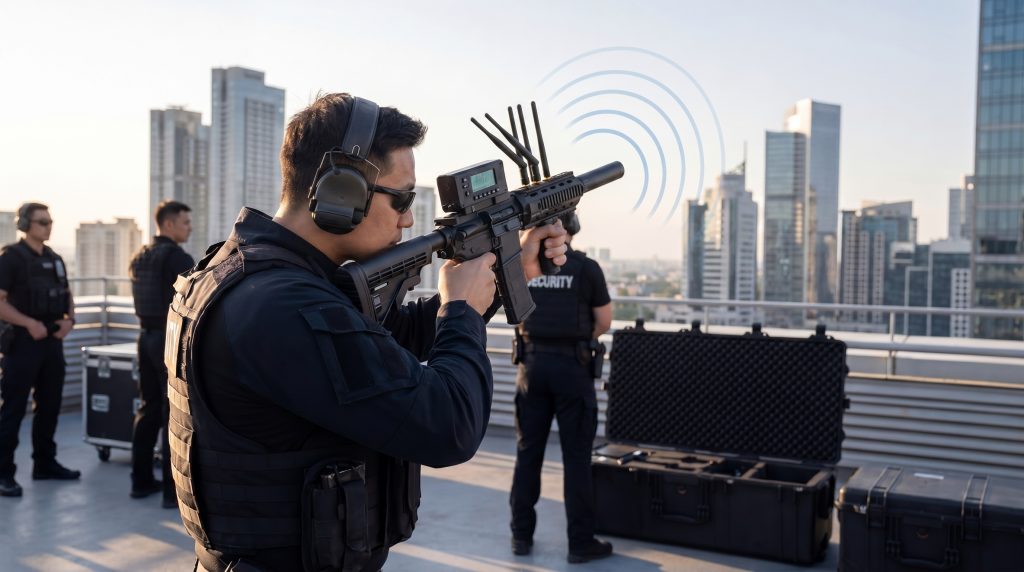
| Supply Type | Mobility | Runtime |
|---|---|---|
| Battery | High | Finite (2-4 hours) |
| Hardwired | Low | Infinite (Continuous) |
Choosing the right power architecture ensures that your electronic countermeasures are always ready for deployment when a threat appears.
Why is a cooling system vital for performance?
A cooling system is vital because high-power jammers generate intense internal heat that can lead to frequency drift, reduced power, or total component failure. Without efficient thermal management, a drone jammer will automatically throttle its output to protect its circuitry, leaving you vulnerable. Modern designs use a mix of active and passive cooling to maintain peak performance during long-duration operations.
Preventing thermal degradation
High-frequency amplifiers are sensitive to temperature spikes that can permanently damage the hardware. You must ensure the device can dissipate heat faster than it creates it.
Active vs. passive cooling designs
Active cooling uses fans to force airflow over heat sinks, which is necessary for high-wattage systems. You might be wondering, is passive cooling enough? Only for very low-power units.
- Multi-fan arrays
- Large surface area heat sinks
- Thermal cutoff switches
Key Takeaway: Invest in a device with robust cooling to ensure that your jammer maintains its full effective range even during extended use in hot climates.
| Cooling Type | Reliability | Noise |
|---|---|---|
| Active (Fans) | Very High | Audible |
| Passive (Sinks) | Moderate | Silent |
Proper thermal management is the unsung hero of reliable interference technology, ensuring consistent protection regardless of the external temperature.
How do surroundings impact jammer effectiveness?
Surroundings impact effectiveness by causing signal attenuation, reflections, and multi-path interference that can create “dead zones” in your coverage. In an urban environment, a drone jammer must compete with a high density of other radio waves and physical obstructions. Conversely, open-field deployments allow signals to travel further but may require more power to cover a wider, unobstructed horizon.
Signal attenuation in urban settings
Concrete and steel structures absorb and reflect radio waves, significantly shortening your effective radius. You need to strategically place antennas to overcome these urban “canyons.”
Open-field vs. indoor deployment
Indoor use requires careful power management to avoid disrupting your own internal Wi-Fi or communication networks. The truth is, environment dictates your entire strategy.
- Terrain mapping
- Material interference analysis
- Frequency congestion checks
Key Takeaway: Perform a thorough site survey to understand how local geography and building materials will influence the propagation of your interference signal.

| Environment | Signal Behavior | Strategy |
|---|---|---|
| Urban | High reflection | Multi-angle placement |
| Open Field | Linear travel | Maximize output power |
Tailoring your hardware choice to your specific surroundings is the only way to guarantee a reliable electronic perimeter.
What regulations and threats must you consider?
You must consider local communication laws and the limitations of RF technology, as jammers cannot stop threats that do not rely on external signals. In many jurisdictions, deploying a drone jammer is strictly limited to authorized government or military entities due to the risk to public safety. Additionally, pre-programmed threats that use inertial navigation may ignore RF interference entirely, requiring a multi-layered security approach.
Navigating local communications laws
Unauthorized signal interference can disrupt emergency services and aviation, leading to severe legal consequences. You should always consult with legal experts before implementing these solutions.
Challenges with pre-programmed paths
If a device is set to follow a GPS-independent path, standard jamming will have no effect. The bottom line is, you need a comprehensive about strategy for all threat types.
- Autonomous flight paths
- Legal compliance permits
- Side-effect mitigation
Key Takeaway: Combine your jammer with detection and physical barriers to create a defense-in-depth strategy that addresses both RF-controlled and autonomous threats.
| Regulation/Threat | Impact | Solution |
|---|---|---|
| Federal Laws | Legal risk | Proper licensing |
| Autonomous Tech | Tech gap | Layered detection |
By addressing the technical and legal realities of signal interference, you can build a security posture that is both effective and compliant.
*
Summary of Solutions
Navigating the complexities of interference technology requires a partner who understands the high stakes of modern security. We have addressed the critical need for frequency precision, power management, and environmental adaptability in your counter-measure strategy. Our team is dedicated to providing the technical expertise and robust hardware necessary to secure your critical infrastructure against emerging aerial and electronic threats.
At CorelixRF, our vision is to empower organizations with the invisible tools needed to maintain absolute sovereignty over their airspace and data environments. We don’t just sell hardware; we provide peace of mind through advanced engineering and strategic insight. To ensure your facility is fully protected against the next generation of intruders, contact us today for a professional consultation.
Frequently Asked Questions
Can I use a jammer to protect my private home?
No, in the vast majority of countries, using jamming equipment for private residential protection is strictly illegal and carries heavy penalties. These devices are generally reserved for authorized government, military, or high-security industrial applications where special permits are held.
What’s the best way to determine my power requirements?
The most effective way is to conduct a professional RF site survey to measure existing signal strengths and identify potential interference sources. This data allows you to calculate the exact signal-to-noise ratio needed to successfully suppress unauthorized links at your specific perimeter.
Can I stop a drone that doesn’t use GPS?
Yes, but only if you are targeting the radio frequency control link (2.4GHz or 5.8GHz) used by the pilot. If the drone is fully autonomous and does not communicate with a remote or a satellite, traditional jamming will not be effective, and you will need kinetic or spoofing alternatives.
What’s the best antenna type for a fixed site?
A combination of directional and omni-directional antennas is usually the best approach for a permanent installation. This allows you to maintain a general “bubble” of protection while also being able to focus high-intensity energy toward a specific detected threat.
Can I jam multiple frequencies at the same time?
Yes, most professional-grade systems are multi-band units that can broadcast interference across several channels simultaneously. This is essential for modern security because many devices can automatically hop between frequencies to find a clear signal.
Authorized C-UAS selection review
Choose C-UAS RF hardware through compliance-aware engineering review
C-UAS RF hardware selection should start with authorization, deployment boundary, RF chain architecture, antenna/load condition, ruggedization, documentation and procurement evidence rather than public operating instructions.
Authorization scope, operating environment, documentation owner, procurement policy and review limits.
RF front-end platform, amplifier band/power class, antenna/load matching, thermal design and protection behavior.
RFQ checklist, FAT records, delivery documentation, case profiles and engineering review notes for approval.