
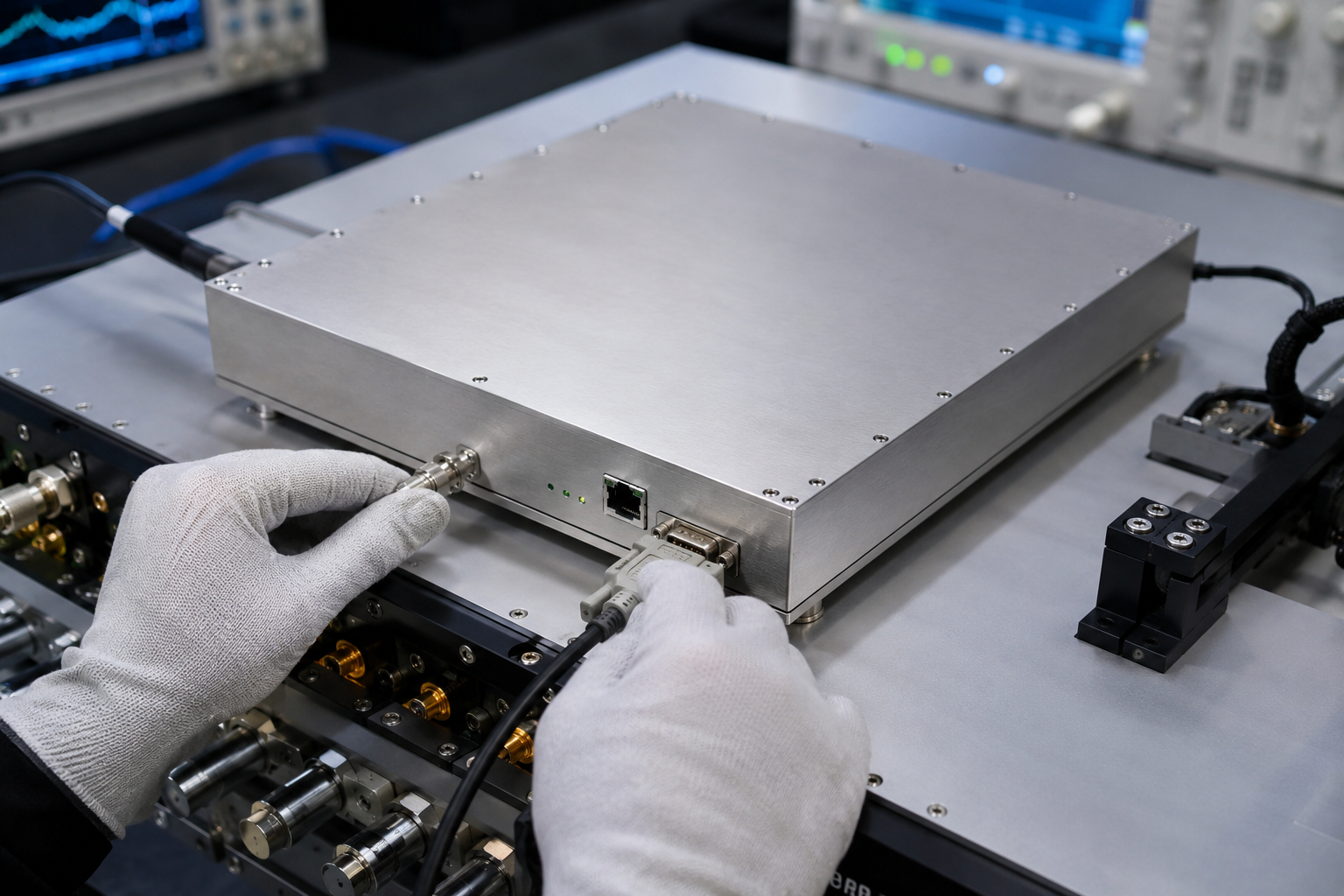
A 2-26.5 GHz 6W GaN SSPA is useful when an RF bench, system demonstrator, or integration fixture needs one compact amplifier path across S-band, C-band, X-band, Ku-band, and the lower Ka-band region. Instead of switching several narrow amplifier modules during early validation, engineers can use a broadband solid-state power amplifier to keep the signal chain consistent while they evaluate frequency response, connector transitions, control logic, cooling margin, and protection behavior.
CorelixRF model CRF-PA-2000M26500M-6W is specified for 2 GHz to 26.5 GHz operation with 6 W rated output power, 36 dB minimum small-signal gain, 2.92 mm female RF input/output connectors, RS232 control, 18 V / 6 A DC power, and a 240 x 160 x 50 mm module form factor. For projects that need a broader product starting point, CorelixRF’s RF power amplifier platform page provides the higher-level selection path before a model-specific engineering review.
Why a 2-26.5 GHz 6W GaN SSPA Fits Broadband Test Benches
The main reason to choose this class of amplifier is coverage continuity. A 2-26.5 GHz frequency span reaches across common microwave test bands without requiring a separate amplifier for every segment. That helps when the device under test, antenna path, mixer chain, or filter bank is still changing. A single broadband RF power amplifier can simplify the first phase of test planning because the same gain block, control interface, and cooling arrangement stay in place while the RF team changes other parts of the setup.
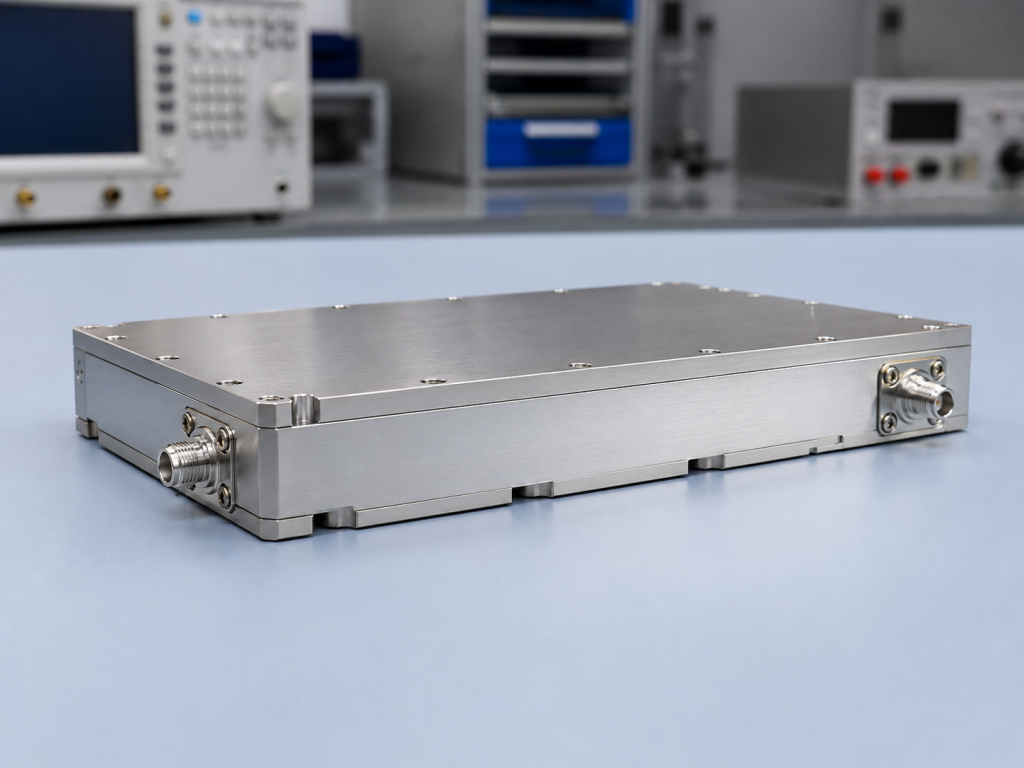
The 6 W output rating is best understood as an integration-level power class, not as a high-power immunity or transmit final stage. It can support component evaluation, subsystem stimulus, interference path development, communication-chain testing, and aerospace-control related RF work where a stable solid-state platform matters more than kilowatt-level output. Because the amplifier uses GaN technology, it is positioned for efficient microwave power delivery in a compact mechanical envelope.
Core Electrical and Mechanical Parameters to Confirm
For a technical RFQ, start with the parameters that determine whether the amplifier fits the bench. CRF-PA-2000M26500M-6W covers 2-26.5 GHz, provides 6 W rated output power, and lists 36 dB minimum gain. Gain flatness is specified as -8 to +8 dB, which matters when the system is sweeping a broad band and the test engineer must decide whether to compensate drive level by frequency.
The RF connector path is also important. The model uses 2.92 mm female connectors on both input and output, which is appropriate for microwave frequencies up to the top of the specified range. Control is RS232, and the DC supply is 18 V / 6 A. Cooling is forced air, so the mechanical plan should allow airflow around the 240 x 160 x 50 mm module rather than treating it as a sealed component.
Protection, Monitoring, and Integration Notes
Broadband amplifiers are often used in changing lab setups, so protection details are not secondary. The source specification lists real-time temperature monitoring, real-time current monitoring, alarm and fault protection, over-temperature protection, over-drive protection, over-voltage protection, and VSWR protection/alarm functions. Optional forward/reverse power monitoring may be discussed where applicable.
These functions are useful during early integration because load conditions may not be fully stable. A bench antenna, attenuator stack, coupler, or fixture can change the reflected-power condition seen by the amplifier. Protection features do not remove the need for proper RF practice, but they give the system integrator a clearer path for diagnostics and control interlocks.
Where This Amplifier Sits in the CorelixRF Portfolio
The model sits above standard lower microwave modules such as the 2-6 GHz RF power amplifier family and below higher-power dedicated microwave rack platforms. It is a good discussion point when a project is not yet ready to lock one band, but it still needs real output power beyond a small signal driver. If the project later settles into a narrower high-frequency band, CorelixRF’s 18-40 GHz amplifier path may be a better next comparison point.
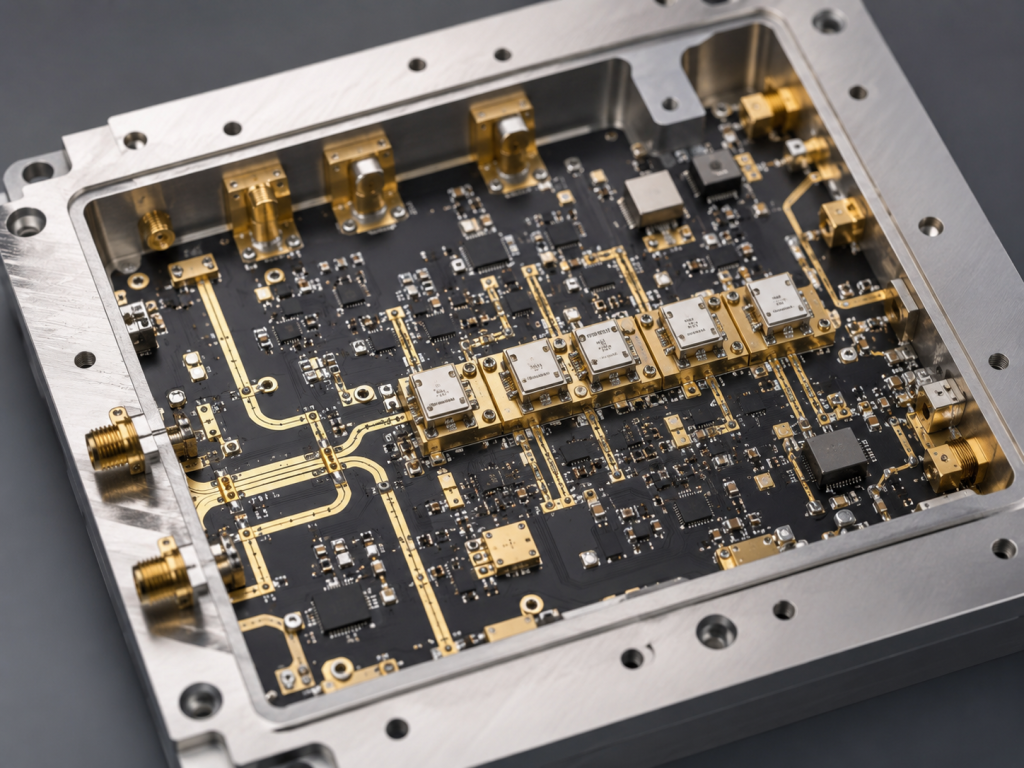
For SDR-driven systems, the same logic applies: wideband amplifier selection should consider output power, gain control, waveform crest factor, duty cycle, and reflected-power handling. The amplifier should be reviewed as part of the complete RF chain, not as an isolated gain number.
RFQ Checklist for a 2-26.5 GHz Amplifier Review
Before requesting a quotation, define the required operating sub-bands, waveform type, continuous or intermittent operation, expected input power, output power target at the load, maximum allowable gain ripple, cooling constraints, control protocol preference, and enclosure limitations. Include the connector plan for both the signal source and the load path.
If the amplifier will be used in RF interference evaluation or aerospace-control related testing, also describe the duty profile, test duration, fault response requirement, and whether forward/reverse power telemetry is needed. CorelixRF can review project details through its RF testing and validation and engineering inquiry workflow.
FAQ
Is the CRF-PA-2000M26500M-6W a 2-26.5 GHz amplifier?
Yes. The source specification lists a 2 GHz to 26.5 GHz operating range with 6 W rated RF output power.
What RF connectors does this 2.92 mm RF amplifier use?
The listed RF input and RF output connectors are both 2.92 mm female.
Is the amplifier suitable for high-power EMC immunity testing?
It is more appropriate as a broadband microwave test and integration amplifier. Higher-power EMC requirements should be reviewed through CorelixRF’s broader amplifier path.
What should I provide for a custom RF amplifier recommendation?
Share frequency range, output power, waveform, duty cycle, control interface, cooling limits, mechanical constraints, and load condition.