

A 2-4 GHz 1000W RF power amplifier is selected when an S-band or lower C-band project needs far more than driver-level output. This power class changes the engineering conversation: the amplifier is no longer just a convenient bench accessory, but a cabinet-level RF subsystem with AC power, thermal management, protection logic, remote control, connector planning, and safety procedures around the load path.
CorelixRF CRF-PA-2000M4000M-1000W is specified for 2,000-4,000 MHz operation with 1000 W rated solid-state output power, 60 dB minimum small-signal gain, RS485/LAN control, N-female RF input, 7/16-female RF output, forced-air cooling, and AC 380 V power. For buyers comparing standard and project-based paths, CorelixRF’s RF power amplifier page is the safest starting point because high-power systems often require engineering review rather than a simple catalog match.
Why 2-4 GHz 1000W RF Power Requires Cabinet-Level Planning
The 2-4 GHz band is common in RF testing, communication-system evaluation, interference simulation, and aerospace-related subsystem work. At 1000 W, the amplifier must be planned as part of a controlled test environment. The system must handle RF output routing, load mismatch, cable loss, heat removal, AC power availability, access control, and emergency shutdown behavior.
The CorelixRF source data lists a cabinet form factor of 1100 x 560 x 1250 mm and typical weight of 230 kg. That alone changes the project workflow. Procurement and engineering teams should review facility access, rack or floor placement, airflow path, AC power distribution, grounding, and whether the amplifier will be moved between labs.
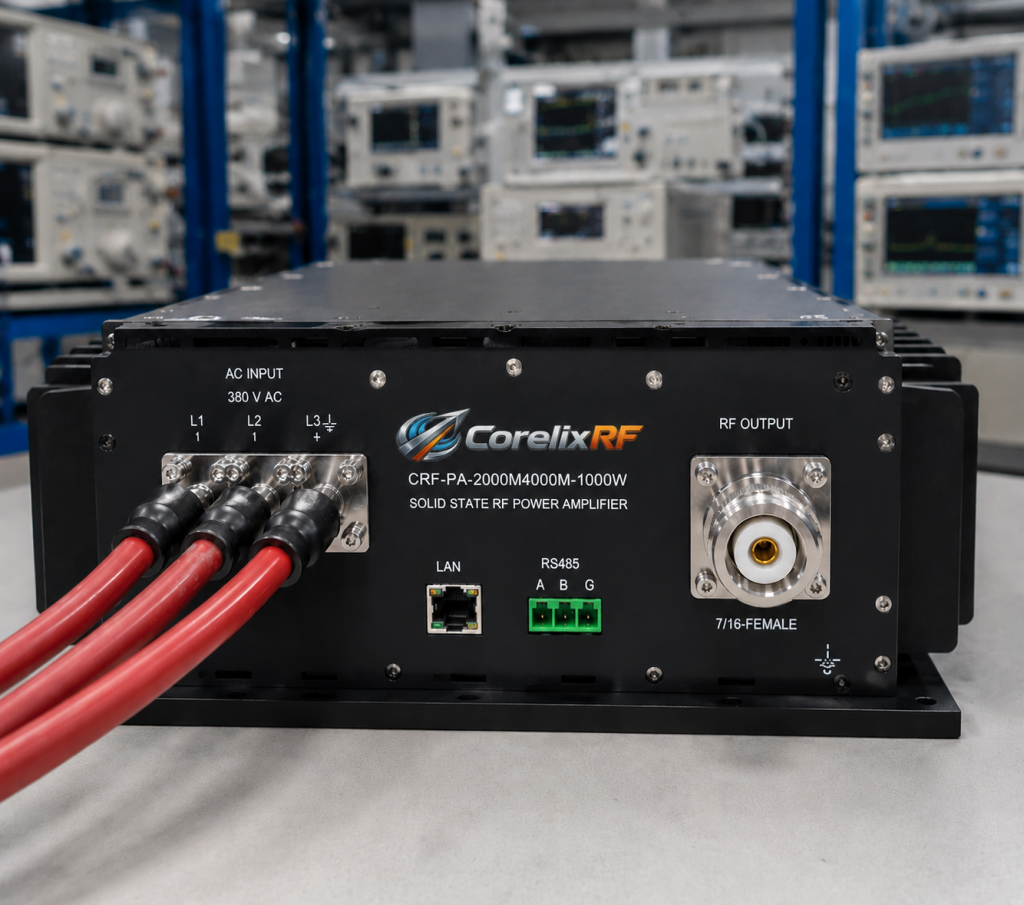
Key Specification Points for CRF-PA-2000M4000M-1000W
The amplifier covers 2,000-4,000 MHz and is rated at 1000 W output power. Minimum small-signal gain is 60 dB, with gain flatness of -4 to +4 dB. Maximum input power is listed as 0 dBm, which means the drive chain should be reviewed carefully; over-driving a high-gain kilowatt amplifier is a preventable integration risk.
The model uses N-female input and 7/16-female output connectors. This connector split is practical: the input side supports a controlled low-power drive signal, while the output side uses a higher-power connector format. Control is RS485/LAN, which is appropriate for system cabinets, automated testing, and remote monitoring.
Power consumption is listed as 6 kW typical, with AC 380 V +/-10%, 50/60 Hz supply. Cooling is forced air. Before ordering, the user should confirm heat rejection, room airflow, inlet/outlet clearance, and whether the duty cycle is continuous or application-specific.
Protection and Monitoring for High-Power RF Systems
The source specification includes real-time temperature monitoring, real-time current monitoring, alarm and fault protection, temperature/current alarms, and optional forward/reverse power monitoring and input power detection. These functions are valuable because the load path in a 1000 W RF system can change due to antenna condition, cable heating, switching networks, couplers, or test fixture mismatch.
A high-power broadband RF power amplifier should be reviewed with the complete RF chain. That includes signal generator level, pre-driver output, interlock logic, attenuator ratings, coupler directivity, load power rating, reflected power handling, and shutdown procedure. The amplifier can include protection functions, but the system still needs responsible RF design.
Applications and Selection Context
This 2-4 GHz amplifier is relevant for test and measurement instrumentation, communication systems, RF interference or EW system-level testing, and aerospace control projects. For smaller S/C-band work, CorelixRF’s 2-6 GHz RF amplifier series may be a more compact entry point. For custom high-power or non-standard interface needs, the engineering review should be started through the Contact CorelixRF page.
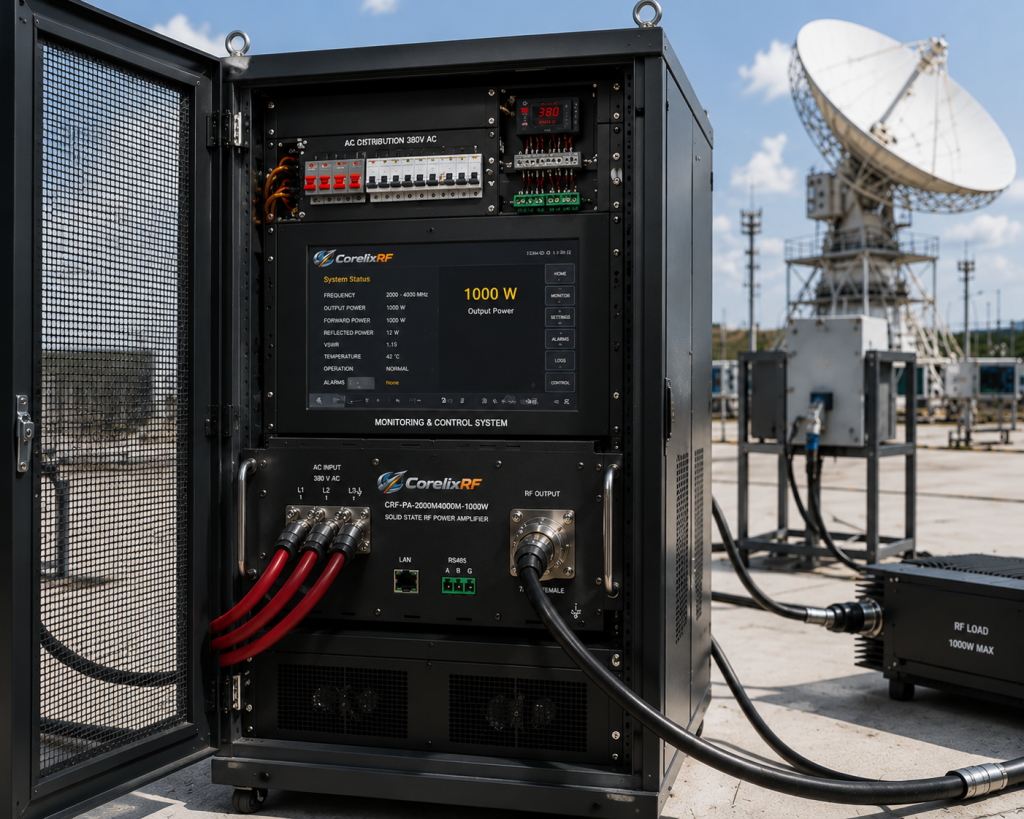
The practical question is not only whether 1000 W is available. The question is whether the amplifier, power supply, cooling path, control method, RF connector path, load protection, and documentation package fit the project stage. Early review reduces the risk of buying an amplifier that meets a headline power number but does not fit the system.
RFQ Checklist
Send the exact frequency range, output power target, CW or pulse requirement, duty cycle, input drive available, connector preference, load or antenna type, VSWR expectation, control interface, room power, cooling constraints, and documentation needs. If the system will use automated test scripts, include LAN/RS485 requirements and fault-state handling.
Also describe whether the project is bench validation, production test, system demonstration, or installed operation. CorelixRF can then review whether the CRF-PA-2000M4000M-1000W is the right starting model or whether a modified custom RF amplifier path is more appropriate.
FAQ
What is the frequency range of CRF-PA-2000M4000M-1000W?
The source specification lists 2,000 MHz to 4,000 MHz.
What output power does this 2-4 GHz amplifier provide?
It is specified for 1000 W rated RF output power.
What control interfaces are listed?
The source data lists RS485 and LAN control interfaces.
What should be checked before selecting a 1000W RF amplifier?
Confirm AC power, cooling, connector ratings, input drive, duty cycle, reflected-power handling, control logic, and load conditions.