
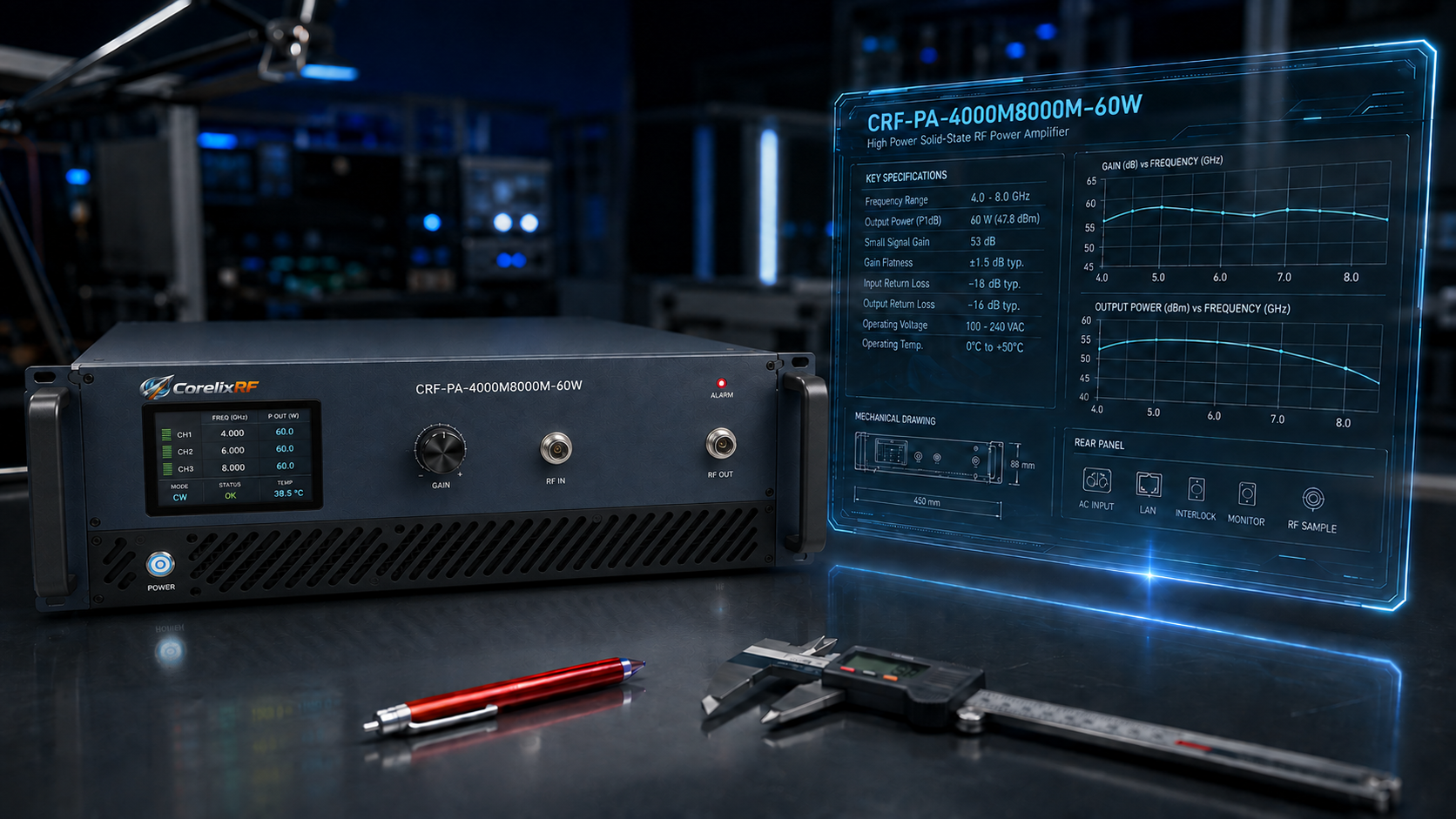
This article takes a datasheet-reading approach. Instead of presenting CRF-PA-4000M8000M-60W as a generic product article, it walks through how an engineer should interpret the verified CorelixRF specification. The verified CorelixRF datasheet identifies the model and headline specifications. For buyers comparing broadband RF power amplifier options, the important work is understanding what each line of the datasheet means in the real system.
Frequency Range
The 4 GHz to 8 GHz range places this model in the C-band / microwave test space. Do not read the frequency line as a promise that every bench setup will behave the same across the band. Cable length, connector condition, adapter stacks, switches, and fixtures can create different loss and mismatch conditions at different frequencies.
Output Power
The 60 W output rating should be converted into a complete system budget. If the DUT needs a defined level, subtract downstream losses and add margin for measurement uncertainty. The amplifier may be correctly specified while the test plan still fails because too much power is lost after the output connector.
Technology Platform
The datasheet positions this type of amplifier around solid-state GaN technology. A GaN RF amplifier is often selected for broadband microwave power, compact power density, and integration flexibility. That does not remove the need to define cooling, drive level, and protection logic.
Interface and Control
Control details should be reviewed before ordering. Ask whether the project needs local enable, remote enable, gain control, current monitoring, temperature monitoring, forward/reverse power monitoring, or alarm outputs. If the amplifier is part of an automated bench, the software team needs those details early.
How to Use the Specification in Procurement
Procurement teams can use the datasheet to compare frequency, power, connector style, control method, and mechanical form. Engineering teams should add operating context: waveform, duty cycle, source drive, load VSWR, cooling environment, and calibration method. Both views are needed for a clean purchase decision.
Practical Review Checklist
- Confirm the full 4 GHz to 8 GHz span is required.
- Calculate power at the DUT, not only at the amplifier port.
- Confirm input drive and gain-control needs.
- Define thermal environment and airflow.
- List remote monitoring and alarm requirements.
- Ask for final drawing and control protocol review when needed.
How Engineers Should Read the Limits
Every datasheet number has a test context. Frequency range is measured under defined conditions, output power is normally referenced to the amplifier output, and gain is tied to drive level and operating state. When a project moves from datasheet review to system build, the same numbers must be translated into source settings, cable tables, calibration routines, and acceptance limits.
The safest reading method is to mark each specification as either a selection filter or an integration requirement. Frequency and rated power are selection filters. Control interface, cooling, connector type, alarm behavior, and monitoring signals are integration requirements. Treating all lines the same leads to weak RFQs because the supplier cannot see which details drive the system.
Procurement Notes
For procurement, the datasheet walkthrough should become a comparison matrix. Add columns for frequency, output power, gain, connectors, cooling, control, monitoring, drawing availability, and customization needs. The lowest-cost option is not necessarily the lowest-risk option if it creates fixture changes, thermal uncertainty, or automation gaps.
From Datasheet to Test Plan
After reading the specification, convert each important line into a test-plan item. Frequency range becomes the list of test points. Output power becomes a measured port-power requirement. Gain becomes a source-drive planning item. Connectors become a cable and adapter checklist. Cooling becomes an installation requirement. Control interface becomes a software and operator workflow requirement.
This translation step is useful because it exposes missing information quickly. If the team cannot say where power will be measured, how source drive will be limited, or how alarms will be handled, the datasheet review is not finished. Those gaps should be resolved before a purchase order is placed.
Line-by-Line Review Method
A datasheet walkthrough should be read with a marker in hand. Mark frequency, power, gain, connectors, control, cooling, and protection as separate review items. Then assign each item to an owner: RF engineer, mechanical engineer, software engineer, buyer, or test operator. This prevents the datasheet from becoming a passive document. It becomes a work list that moves the project from specification reading to a stable RF bench.
For this model, the useful lesson is that a microwave amplifier specification is both an electrical document and an integration document. Treating it that way improves quotation quality and reduces late-stage changes.
Final Engineering Review
Before the article is used as a WordPress draft, the engineering message should remain conservative: the amplifier is a candidate based on verified datasheet information, not a universal fit for every system. Final selection still depends on the complete RF path, operating environment, waveform, duty cycle, control needs, and mechanical constraints. That framing keeps the content useful for engineers while avoiding unsupported promises.
FAQ
Is CRF-PA-4000M8000M-60W an actual datasheet model?
Yes. It was extracted from the local CorelixRF datasheet path listed above.
Why not compare only rated power?
Rated power is only one part of the RF chain. Loss, mismatch, duty cycle, and calibration can change usable power.
Can this model support automated testing?
It can be reviewed for that role if the RFQ defines control, monitoring, alarms, and reset behavior.
Where should a custom request go?
Use the CorelixRF custom RF amplifier path for nonstandard mechanical, connector, or control needs.
Next Step
Use the datasheet as a starting point, then ask CorelixRF to review the full RF path before final selection.