
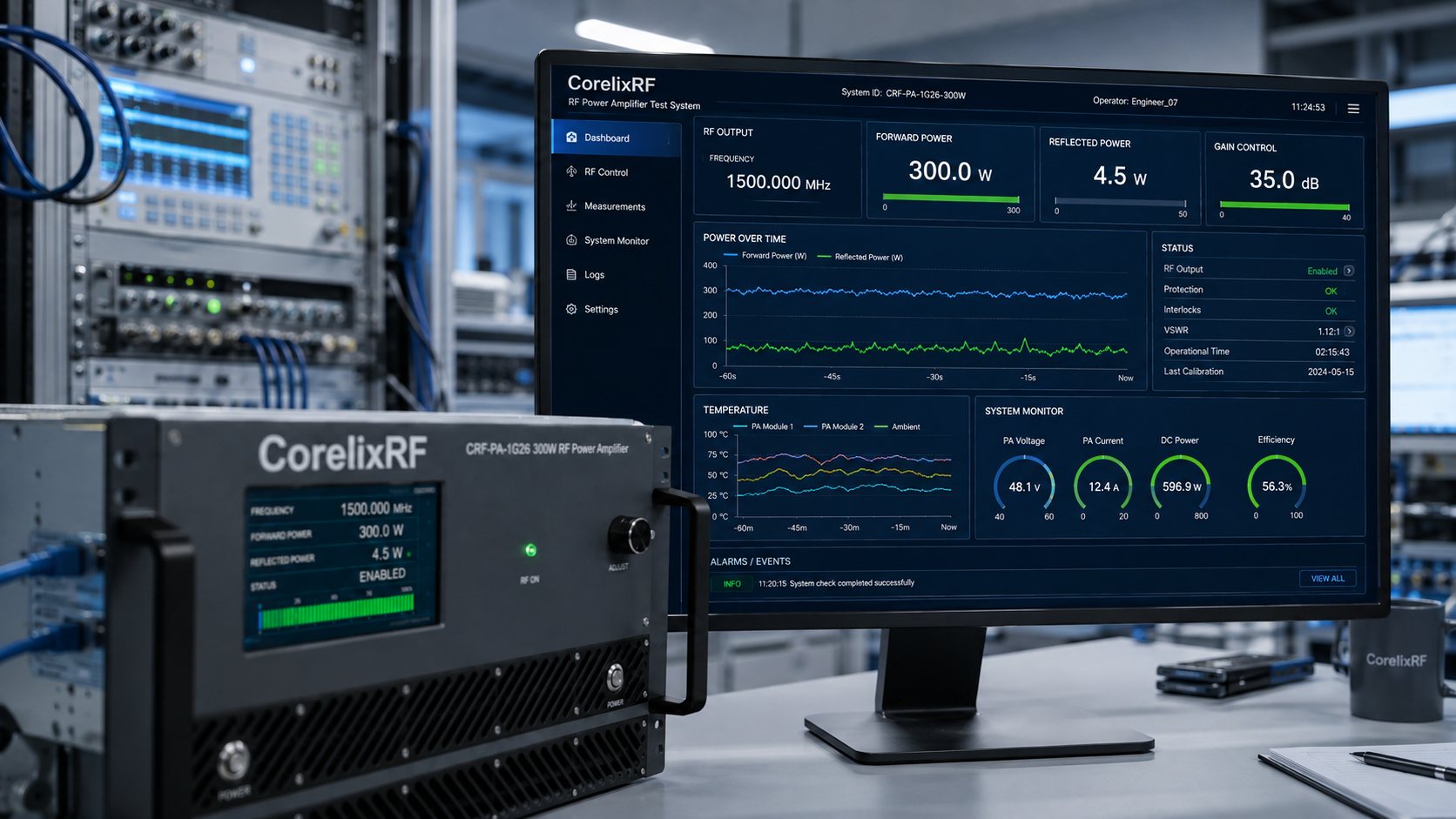
Procurement teams often receive a short requirement that looks deceptively complete: “1-2 GHz, 300 W, rack mount.” For a real RF power amplifier purchase, that is only the start. The useful question is whether the amplifier can meet the frequency, power, gain, cooling, interface, protection, and documentation needs of the complete L-band test platform. The CRF-PA-1000M2000M-300W gives buyers a concrete specification baseline for that review: 1,000 to 2,000 MHz coverage, 300 W rated RF output power, 55 dB minimum gain, up to 20 dB gain adjustment, N-Female RF input/output, RS485/LAN control, AC 220 V supply, air cooling, and a 6U rack-mount configuration.
This article is written as an RFQ checklist rather than a general guide. Use it when comparing CorelixRF’s UHF / specialized RF amplifier options or when preparing a formal request through the CorelixRF Contact page. The goal is to help the buyer send enough information for a useful engineering review on the first pass.
1. State the Exact RF Requirement
Begin the RFQ with the operating band and output target:
- Frequency range: 1,000-2,000 MHz
- Rated RF output power target: 300 W
- Gain reference: 55 dB minimum
- Gain control expectation: up to 20 dB adjustment
- RF interface preference: N-Female input and output
If the project does not need the entire 1-2 GHz band, state the actual operating channels or test points. If the amplifier must hold performance across the full band, say that clearly. A broad request for “L-band amplifier” can point to several different paths, while “1-2 GHz 300W RF power amplifier with RS485/LAN control” points to a much sharper review.
2. Describe the Signal Source and Input Drive
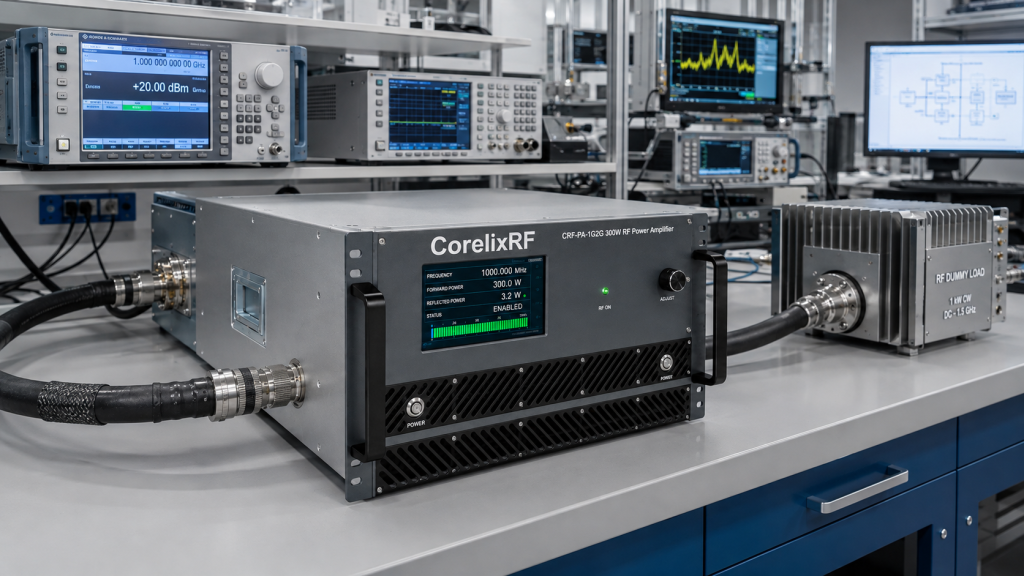
The source datasheet lists 5 dBm maximum input power. That value should shape the upstream source plan. Tell CorelixRF whether the amplifier is driven by a signal generator, SDR, exciter, upconverter, or driver amplifier. Include expected drive level, modulation type, crest factor, bandwidth, switching behavior, and whether operators will adjust source level manually.
For SDR-driven systems, add a short note about waveform behavior and control timing. CorelixRF’s RF testing and validation workflow is relevant here because the amplifier must be reviewed with the source, attenuation, couplers, load, and measurement path.
3. Define the Load and Mismatch Environment
A 300 W solid state power amplifier should not be specified without a load discussion. State whether the output connects to a dummy load, antenna, chamber feed, switching network, filter bank, or system input. If an antenna is involved, include expected VSWR, cable length, connector transitions, and any operating cases where the load may be disconnected or poorly matched.
The CRF-PA-1000M2000M-300W includes over-temperature, over-drive, over-voltage, VSWR protection, and alarm functions. Those protections are valuable, but they are not a substitute for correct RF path design. The better the mismatch environment is described, the easier it is to review whether standard protection and optional monitoring are enough.
4. Confirm Rack, Power, and Cooling Conditions
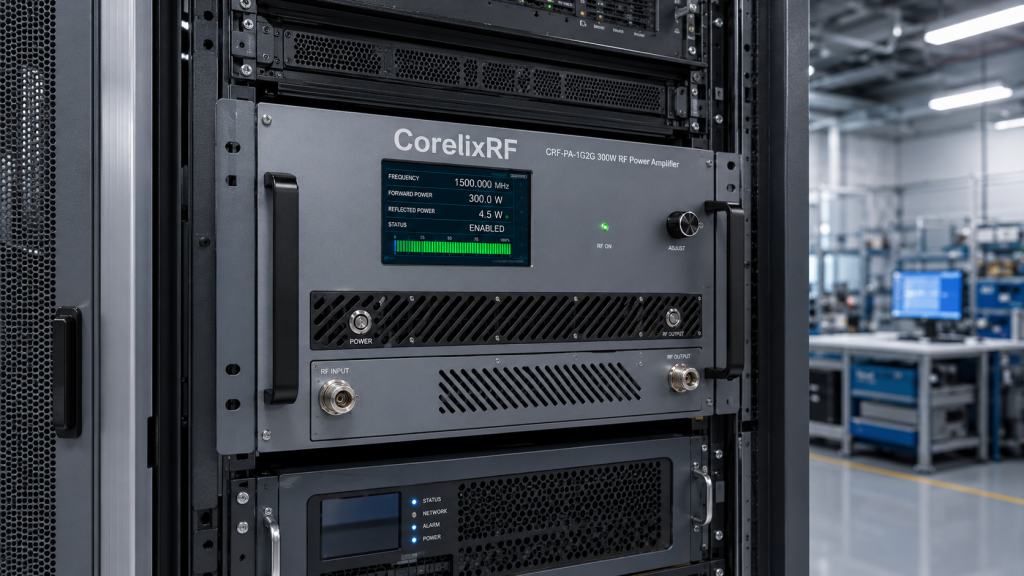
This model is a 6U rack-mount amplifier with a typical weight of 50 kg and typical power consumption of 2,000 W. That puts the amplifier firmly in system equipment territory. Include cabinet depth, airflow direction, inlet air temperature, exhaust clearance, AC power availability, and any installation constraints.
Air cooling should be planned before purchase, not after installation. If the rack sits inside a vehicle, shielded room, high-ambient lab, or crowded cabinet, share those details. A custom RF amplifier review may be useful if mechanical layout, cooling, control, or monitoring needs differ from the standard platform.
5. Decide Which Monitoring Options Matter
The standard listed interfaces include RS485 and LAN. Optional features include forward/reverse power monitoring, input power detection, LAN remote monitoring, and GPIB programmable control. For a manual lab setup, basic control may be enough. For an automated test system, status readback and alarm handling may be required.
In the RFQ, list the values the controller must read and the actions it must take. Examples include RF enable, gain setting, temperature, current, forward power, reflected power, alarm status, and reset behavior. This prevents late changes after software work has already begun.
6. Ask for the Right Documentation
For a procurement file, request the final mechanical drawing, connector/interface definition, control protocol, test data, and project-specific compliance documentation where applicable. The datasheet notes ISO 9001 quality management support and RoHS-compliant materials where applicable. Do not imply unsupported certifications in the public article or RFQ; ask CorelixRF which documents match the final configuration and destination market.
FAQ
What is the main keyword for this article?
The main keyword is 1-2 GHz 300W RF power amplifier.
What model is discussed?
The article discusses the CRF-PA-1000M2000M-300W GaN SSPA platform.
What should buyers include in the RFQ?
Include frequency range, output power, source drive, waveform, duty mode, load condition, rack space, cooling, control interface, and documentation needs.
Does the amplifier support remote control?
The datasheet lists RS485 and LAN control, with optional monitoring and programmable control features available for project review.
Why is cooling part of the purchase decision?
At 300 W RF output and 2,000 W typical power consumption, airflow and rack layout directly affect integration risk.