
Engineers often search wideband RF amplifier when they want flexibility, but flexibility has trade-offs. A wideband platform can cover multiple UHF and L-band tasks without changing hardware. A narrowband option may be better when the system operates on a fixed channel and needs tighter optimization. This comparison-style guide explains when an 800 MHz-2.5 GHz wideband RF amplifier makes sense and when another CorelixRF category may be a better starting point.
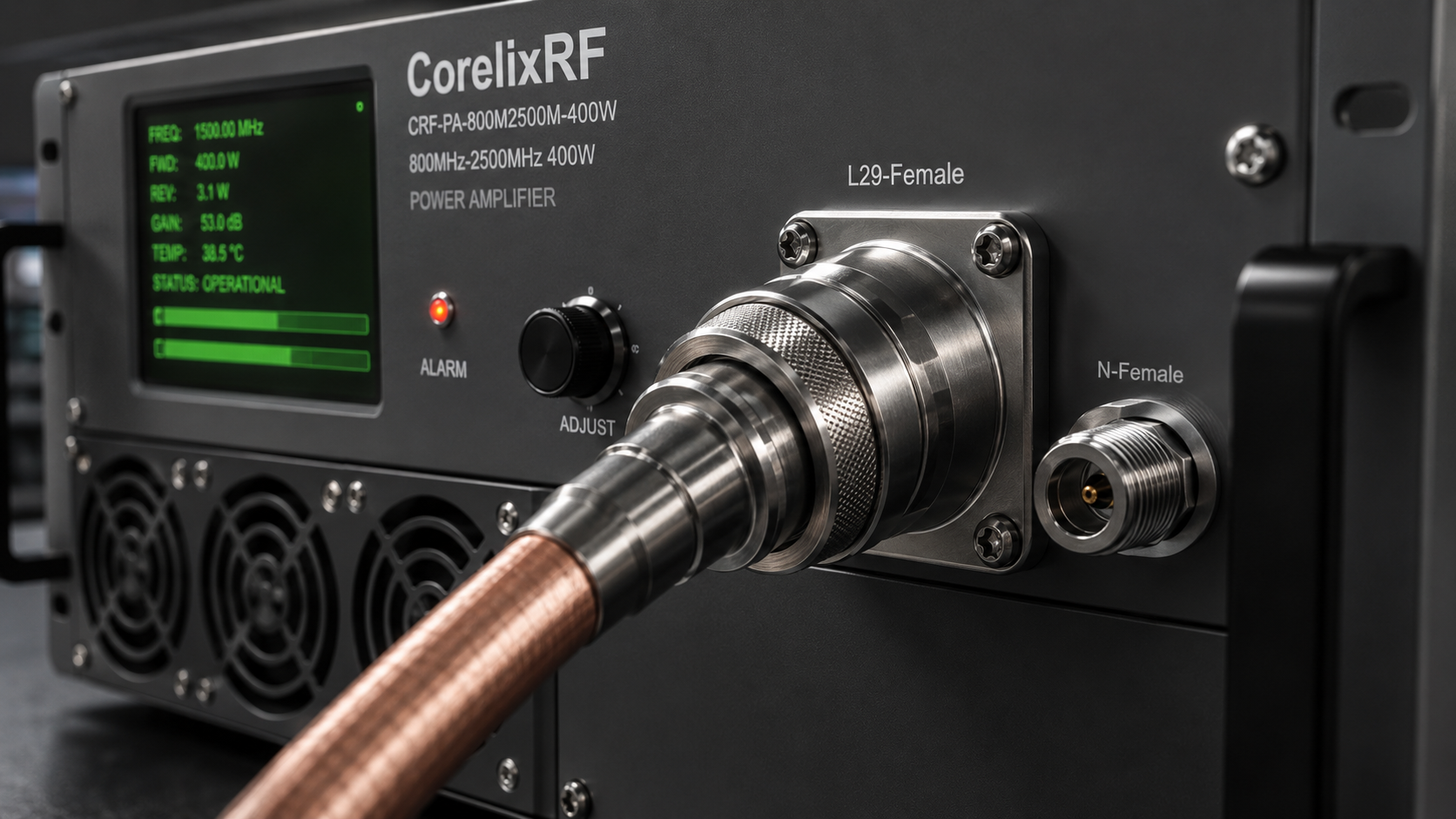
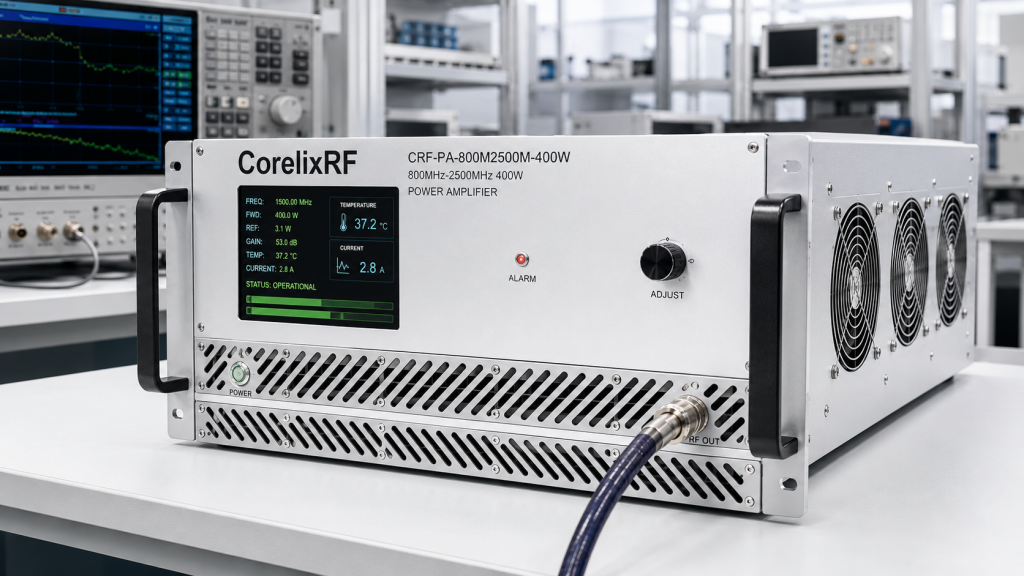
The CorelixRF CRF-PA-800M2500M-400W is a GaN solid-state RF power amplifier covering 800 MHz to 2.5 GHz with 400 W rated output power. The local datasheet lists N-Female input, L29-Female output, 6U rack-mount configuration, air cooling, 56 dB minimum gain, up to 20 dB gain adjustment, -3 to +3 dB gain flatness, temperature/current diagnostics, and alarm protection. These details support high-value SEO terms such as UHF RF amplifier, 400W RF power amplifier, SDR RF amplifier, and 800 MHz to 2.5 GHz amplifier.
Choose Wideband When the Test Plan Changes Often
A wideband amplifier is attractive when one rack must support multiple programs, changing frequency plans, or SDR-based validation. The CRF-PA-800M2500M-400W covers 800 MHz to 2.5 GHz, which can reduce the need for several fixed-band amplifiers. For labs and integrators, that can simplify rack planning and improve equipment utilization.
If the team needs a flexible UHF RF amplifier, the RFQ should list all intended bands, not just the total range. Include fixed channels, sweep ranges, waveform bandwidth, duty cycle, and required output power at the reference plane.
Choose Narrowband When the Channel Is Fixed
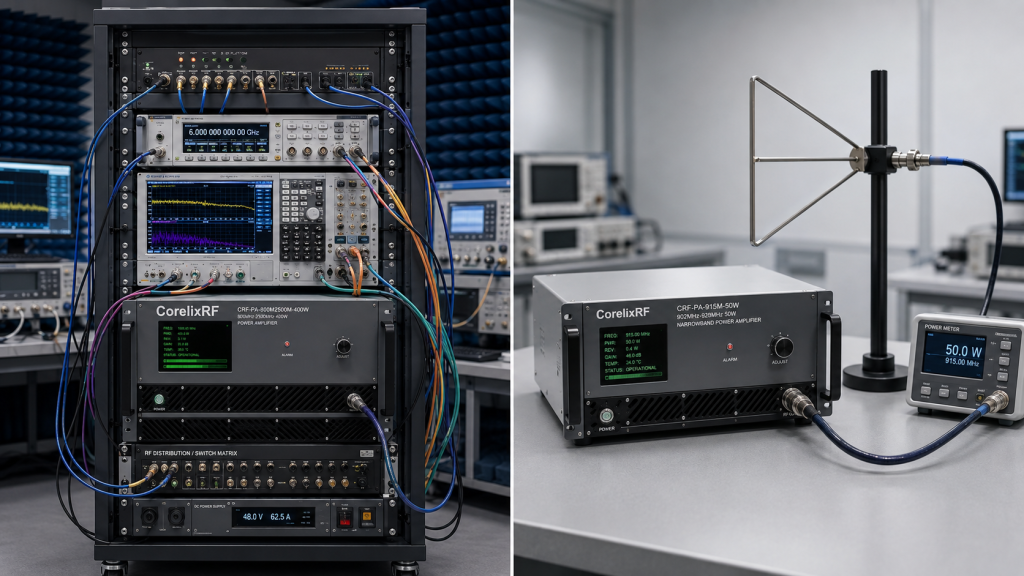
A narrowband amplifier may be more appropriate when the system operates at one defined frequency range and does not need broad coverage. Narrowband designs can be aligned with a specific channel plan, compact packaging, or source-control requirement. If the project is fixed-channel, review CorelixRF’s narrowband RF amplifier options before assuming wideband is required.
The practical rule is this: choose wideband for multi-band flexibility, choose narrowband for fixed-band specialization, and choose custom when the mechanical, thermal, or control requirement is unusual.
Compare Gain and Level Control
The CRF-PA-800M2500M-400W lists 56 dB minimum gain and up to 20 dB gain adjustment. This helps when a rack has to operate across several bands with different source levels and losses. For SDR RF amplifier use, gain adjustment can help normalize output across different waveform tests.
Still, the input chain must be calculated. Source output, attenuators, cable loss, switching, couplers, and software limits determine whether the amplifier can be driven safely and repeatably. A RF power amplifier should never be selected without an input and output power budget.
Compare Connector and Rack Requirements
The datasheet lists N-Female input and L29-Female output interfaces. The unit is identified as a 6U rack-mount platform with air cooling. That makes it suitable for rack-based test and system integration, but the output path must be rated for 400 W class operation. Cable, load, coupler, switch, and antenna choices should be verified before the amplifier is installed.
If the system requires different connectors, a smaller enclosure, special environmental design, or a controller-specific interface, a custom RF amplifier discussion should happen before procurement.
Compare Application Fit
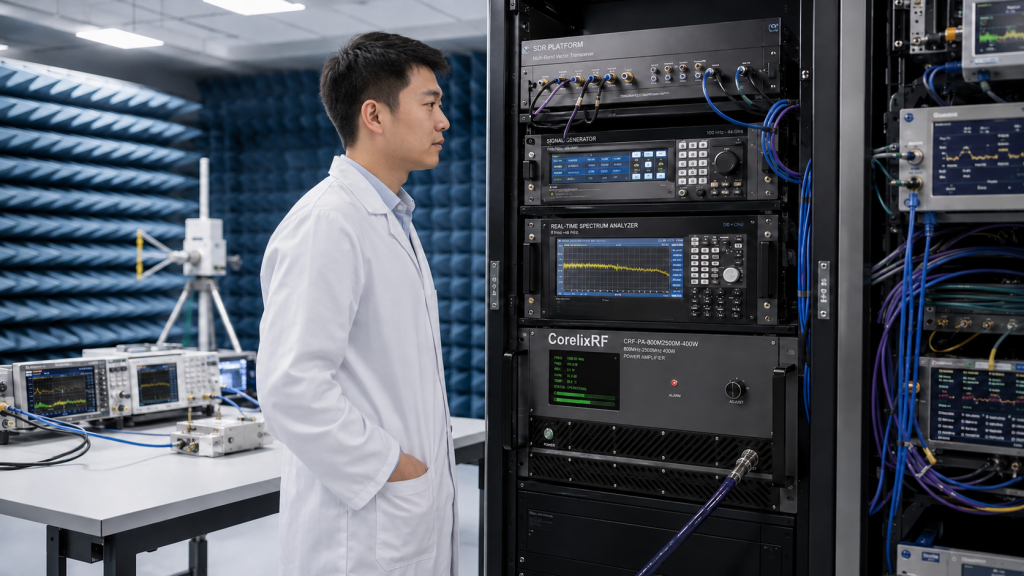
Choose this 800 MHz-2.5 GHz wideband amplifier when the project needs high-power coverage across several UHF/L-band operating cases, test and measurement instrumentation, communication system validation, RF interference or EW system-level testing, or aerospace control support. Choose an EMC RF amplifier when the main task is compliance or immunity testing over EMC bands. Choose CW solid-state RF amplifier platforms when the requirement moves into other broadband microwave ranges.
The best selection is the one that matches the operating profile, not the one with the broadest label.
Selection Table
Wideband 800 MHz-2.5 GHz amplifier: best for changing bands, SDR validation, multi-use racks, and broad UHF/L-band coverage.
Narrowband amplifier: best for fixed-channel systems, compact integration, and projects that need a more targeted frequency window.
Custom amplifier: best for special mechanics, thermal constraints, control protocols, or nonstandard acceptance requirements.
RFQ Checklist
Include operating bands, output power, source drive, gain adjustment needs, waveform bandwidth, duty cycle, output reference plane, connector requirements, rack space, airflow, diagnostics, alarm response, and acceptance data format. If the amplifier will support multiple programs, include future frequency ranges that may influence the design.
FAQ
What is the focus keyword?
Use 800 MHz-2.5 GHz wideband RF amplifier, supported by wideband RF amplifier, UHF RF amplifier, SDR RF amplifier, and 400W RF power amplifier.
What output power is listed?
The local datasheet lists 400 W rated output power.
When should I choose wideband over narrowband?
Choose wideband when the rack must support multiple bands, changing tests, or SDR validation. Choose narrowband when the frequency plan is fixed.
What cooling format is listed?
The datasheet lists a 6U rack-mount configuration with air cooling.
SEO and Selection Notes
For organic search, the primary phrase should remain 800 MHz-2.5 GHz wideband RF amplifier. It has better buying intent than a broad phrase like amplifier because it includes the frequency range and amplifier type. Related high-intent terms include wideband RF amplifier, UHF RF amplifier, SDR RF amplifier, 400W RF power amplifier, and 800 MHz to 2.5 GHz amplifier. These should appear in the article where they describe real selection criteria.
For engineering selection, the buyer should decide whether the amplifier is being purchased for flexibility or for one fixed band. If flexibility is the goal, wideband coverage and gain adjustment matter. If one channel dominates the project, a narrower option may reduce unnecessary complexity. If the system has unusual controls, connectors, or thermal limits, the RFQ should move quickly into a custom review instead of forcing the requirement into a generic comparison.