
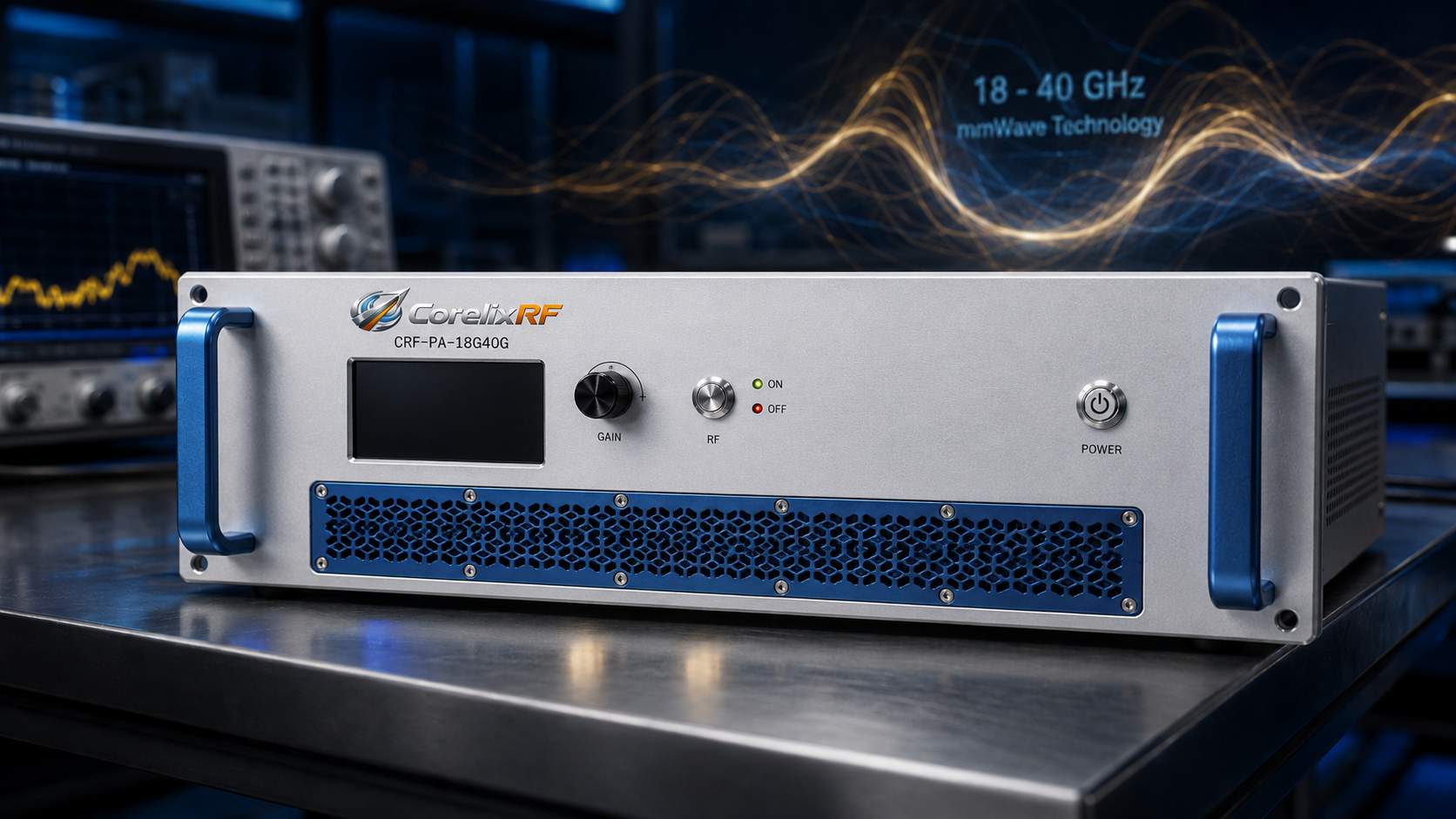
An 18-40 GHz RF power amplifier sits in a more demanding engineering category than lower-frequency broadband amplifiers. At K/Ka-band and adjacent mmWave test frequencies, connector loss, waveguide transitions, rack airflow, measurement setup loss, gain behavior, and control interface can affect the usable result as much as the amplifier’s rated output power.
CorelixRF presents the 18-40 GHz full-band model family with public power classes of 5 W, 20 W, 40 W, and 70 W. In article copy, model references should follow the CorelixRF naming style CRF-PA-18000M40000M-5W, CRF-PA-18000M40000M-20W, CRF-PA-18000M40000M-40W, and CRF-PA-18000M40000M-70W. The product page references gain from 37 dB to 55 dB depending on model, 2.92 mm-F input, 2.92 mm-F or WRD180 output depending on power class, 19-inch rack formats from 3U to 8U, and RS485 / LAN / GPIB control options. These details make the series relevant for mmWave communication testing, radar front-end validation, broadband RF chain evaluation, and rack-mounted RF test platforms.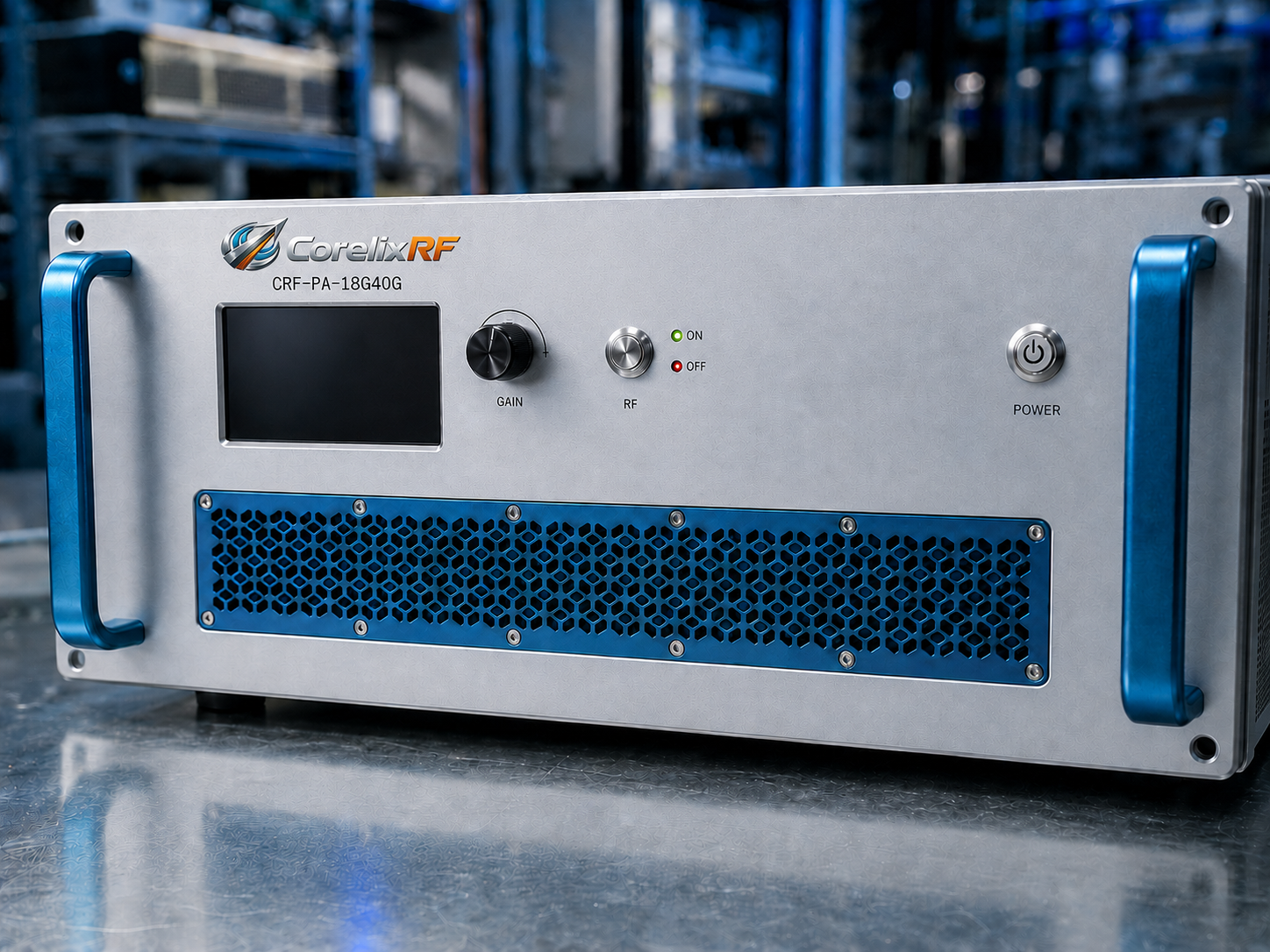
Why mmWave amplifier selection needs system-level review
At 18-40 GHz, a few adapters or a poorly planned cable path can reduce delivered power and create uncertainty in the measurement. The amplifier may meet its datasheet behavior, but the test setup may still fail to deliver the intended power to the device under test or antenna path. This is why connector and waveguide planning must happen before final model selection.
CorelixRF’s public guidance emphasizes full-band power behavior, connector or waveguide path, measurement setup loss, rack and cooling fit, control interface, and data review. Those are the correct topics for an engineering conversation because they define real usability. A high frequency amplifier is not just a higher-frequency version of a low-frequency module; it is part of a complete measurement environment.
Main selection factors
Frequency window
The standard series covers 18-40 GHz, but some applications may only need a focused range such as part of K-band or Ka-band. CorelixRF states that frequency window, connector, waveguide, control, chassis, and cooling review are custom options. A narrower custom window may be worth discussing when full-band coverage is not required.
Output power class
CorelixRF lists standard classes of 5 W, 20 W, 40 W, and 70 W. The lower-power CRF-PA-18000M40000M-5W model is positioned for compact lab testing, low-power integration, and driver-stage validation. The CRF-PA-18000M40000M-20W and CRF-PA-18000M40000M-40W classes fit broader mmWave communication testing and RF validation. The CRF-PA-18000M40000M-70W class is a higher-power rack-mounted option for demanding test systems.
Connector and waveguide path
The public specifications identify a 2.92 mm-F input and either 2.92 mm-F or WRD180 output depending on power class. The engineer should confirm adapter plan, waveguide transition, cable loss, load condition, and whether the output path supports the intended test fixture. At these frequencies, mechanical detail and RF detail are inseparable.
Rack height, airflow, and control
CorelixRF lists 19-inch 3U, 4U, and 8U rack formats. Rack height affects cabinet planning, cable routing, and airflow. Control options such as RS485, LAN, or GPIB should be matched to the test automation environment before order. If the amplifier must be integrated into an automated RF testing and validation rack, command and monitoring requirements should be defined early.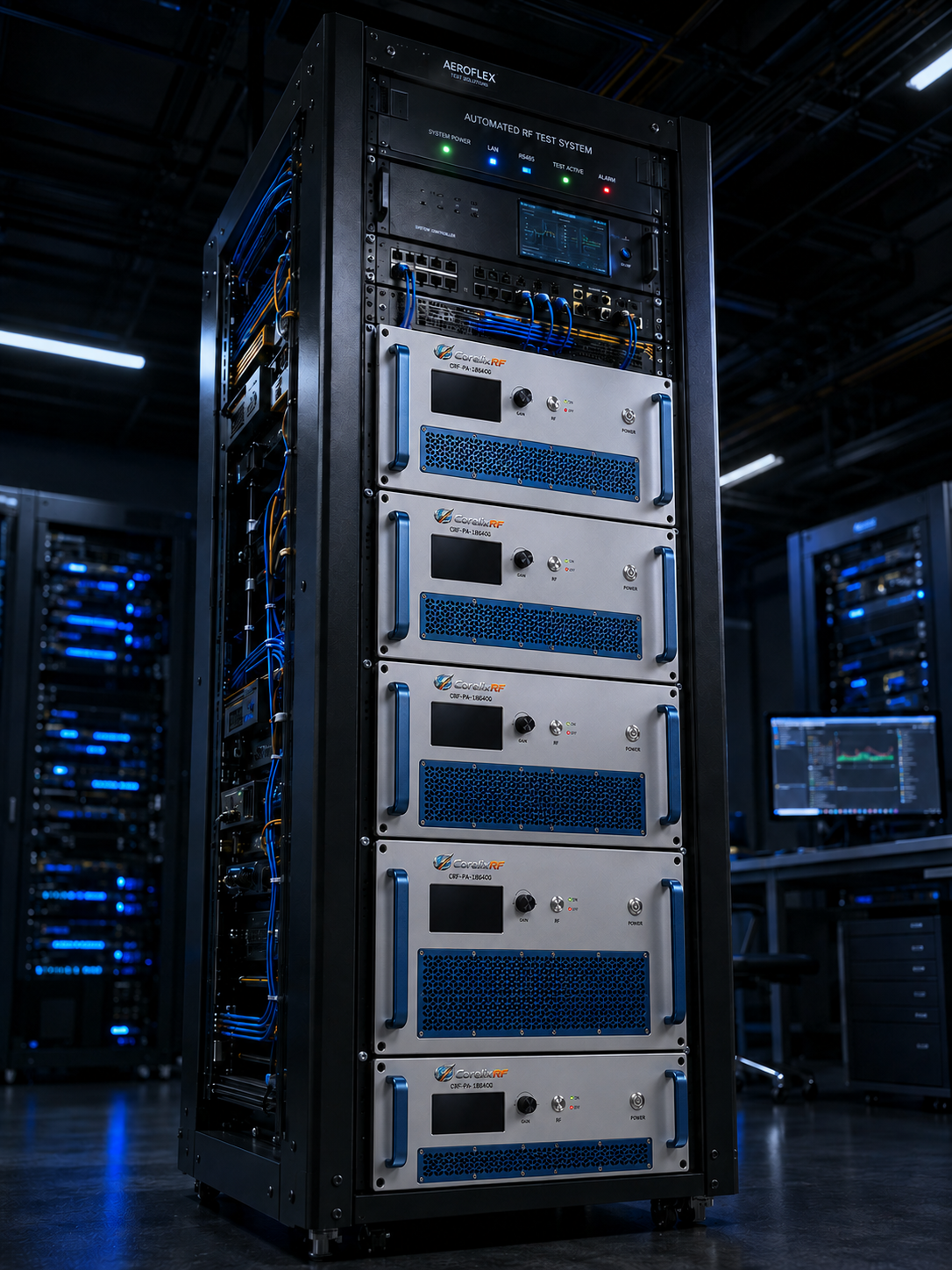
Procurement checklist
Before requesting a quote, prepare the required frequency window, minimum output power at the load, acceptable gain variation, measurement setup diagram, input source level, connector or waveguide requirement, rack constraints, cooling environment, control interface, and documentation needs. If the project includes a custom RF chain, use CorelixRF’s custom RF systems review path to discuss amplifier, source, antenna, enclosure, and control interface together.
Suggested AIOSEO configuration
Set the focus keyword to “18-40 GHz RF power amplifier.” Use the SEO title and meta description from the front matter. Additional keywords should include “mmWave RF amplifier,” “K band amplifier,” “Ka band amplifier,” and “rack mounted RF amplifier.” Use Article or BlogPosting schema plus FAQ schema.
FAQ
What output classes does CorelixRF list for 18-40 GHz amplifiers?
CorelixRF’s public page lists 5 W, 20 W, 40 W, and 70 W standard classes for the CRF-PA-18000M40000M series.
Why are connector and waveguide details important at 18-40 GHz?
At mmWave frequencies, adapters, cables, and waveguide transitions can create meaningful loss and mismatch. The delivered power at the test point may differ from the amplifier output if the RF path is not planned carefully.
Can the amplifier be customized for a narrower frequency window?
Yes. CorelixRF states that custom frequency windows, connector paths, waveguide configuration, control, chassis, and cooling can be reviewed by project.
Which control interfaces should be considered?
CorelixRF references RS485, LAN, and GPIB options. The right choice depends on rack automation, monitoring needs, and the customer’s existing test software environment.