
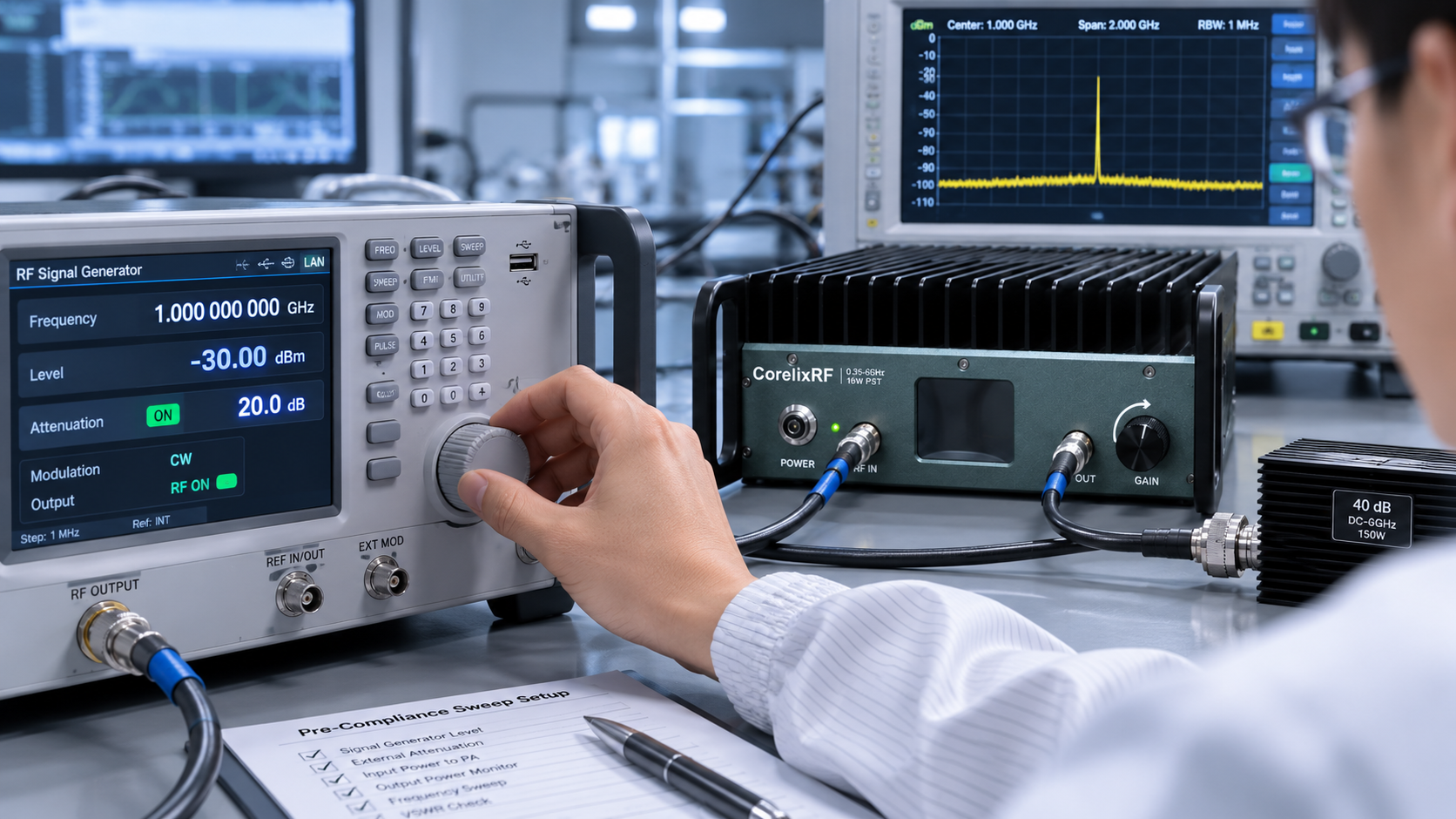
Purpose
This standard operating procedure describes how to prepare a bench request around the CRF-PA-350M6000M-16W. The local datasheet lists a GaN SSPA covering 350 MHz to 6 GHz with 16 W rated output power, 46 dB minimum small-signal gain, 20 dB maximum gain adjustment, SMA-Female input and output, compact air-cooled enclosure configuration, temperature and current monitoring, alarm protection, and project-ready control interfaces.
The SOP format is intentionally different from a review memo or buyer checklist. It is written for a lab user who needs a repeatable method for a compact EMC RF amplifier or broadband validation bench.
Scope
Use this procedure for short engineering checks, pre-compliance style sweeps, SDR or communication-chain validation, and controlled RF output tests where the amplifier operates within its listed frequency and power class. Do not use this SOP to claim final certification, field performance, customer deployment, or inventory status.
Equipment Boundary
The setup includes signal source, attenuation, optional switching, the amplifier, cable set, coupler if used, load or fixture, and measurement receiver. The RF power amplifier should be treated as part of that chain. Record the approved cable set and adapter list before testing starts.
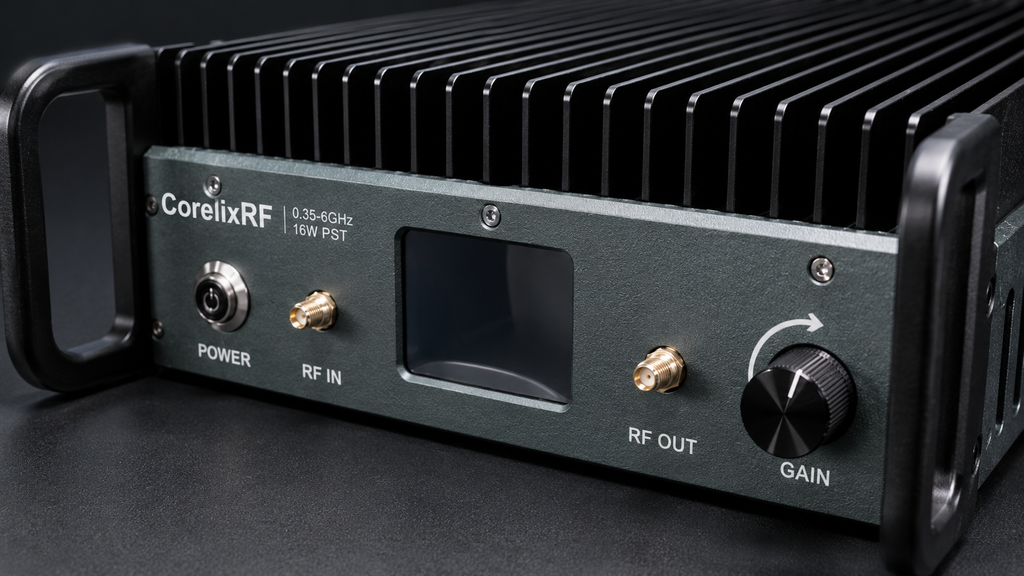
Procedure
- Disable the RF source and confirm the load or fixture is connected.
- Confirm the frequency point or sweep plan inside 350 MHz to 6 GHz.
- Set the starting source level conservatively and verify attenuation state.
- Confirm airflow around the compact enclosure and remove cable clutter from intake or exhaust paths.
- Enable the amplifier according to the project control sequence.
- Increase drive only according to the written limit and record gain state when adjusted.
- Log frequency, source level, output reading, run duration, temperature/current indications if available, and alarm state.
- Return the source to a safe state before changing the load, cable, fixture, or frequency plan.
Deviations
Any changed cable, adapter, load, fixture, source limit, or cooling condition creates a new run condition. Mark it as a deviation instead of blending the data into the original record. This is the small piece of discipline that makes a shared lab bench usable after the first operator leaves.
Data Record
The lab record should be compact but complete. Capture frequency, source level, amplifier gain state, measured output, output reference plane, load identity, cable set, run duration, ambient condition, temperature or current reading if available, alarm state, and operator initials. If the run supports an RFQ, attach the drawing or bench photograph that shows the physical chain. If the run supports a comparison between amplifier options, use the same reference plane and load for every candidate.
Acceptance Criteria
Acceptance should be written before the test starts. Define whether the goal is basic operation, output verification at selected points, sweep repeatability, thermal observation, or control-interface validation. A compact 16 W amplifier may be used in many ways, so the criterion must match the actual bench. Do not turn a quick functional check into a claim that the complete project is qualified.
Operator Handoff
At the end of the run, leave the next operator the source limit, approved cable set, load identity, last gain state, and any deviation. If the next run requires a different fixture or continuous operating profile, treat it as a new procedure. This is what separates a real SOP from a paragraph that merely sounds procedural.
Maintenance Note
Keep the SOP near the bench rather than inside a private project folder. Shared RF benches fail quietly when only one engineer knows the source limit, the preferred cable set, or the reason a certain adapter is avoided. A visible maintenance note should list approved accessories, cleaning or inspection expectations, and the person responsible for updating the method after hardware changes. This makes the SOP useful after the first commissioning week. Review the note after any amplifier move, fixture change, software update, or repeated operator confusion during setup. If uncertainty repeats, freeze the bench and request engineering review before collecting more data.
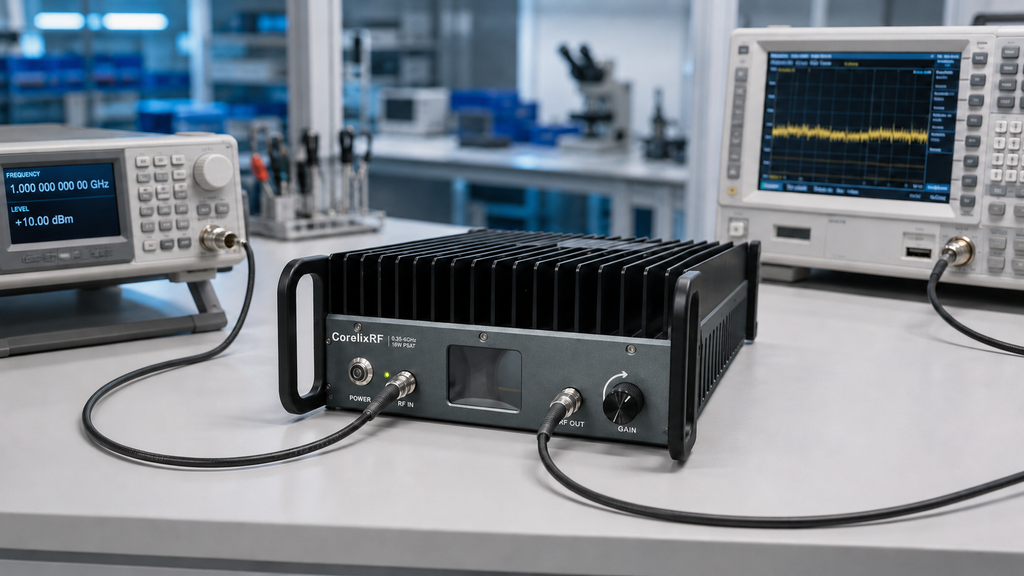
RFQ Attachment
When the SOP supports procurement, attach the frequency plan, bench topology, operating limits, and requested evidence to the RFQ. If the project needs a special enclosure, extended run profile, different connector, or integrated control behavior, send those details through Contact CorelixRF. The high-frequency capability and 2-6 GHz amplifier pages provide adjacent context for broader microwave requirements.
FAQ
What frequency range is listed for CRF-PA-350M6000M-16W?
The local CorelixRF specification evidence lists 350 MHz to 6 GHz.
What output power is listed?
The local datasheet lists 16 W. The usable condition should still be reviewed against waveform, reference plane, load, thermal boundary, and acceptance method.
What should be included in the RFQ?
Include frequency points, waveform, source level, output reference plane, load condition, connector path, cooling boundary, control interface, alarm behavior, and requested test data.
Does this article claim stock, certification, or customer deployment?
No. It stays inside local product specifications and general engineering guidance.
What is the main integration caution?
The SOP should preserve source limits, gain state, cooling condition, and deviation notes for every run.