
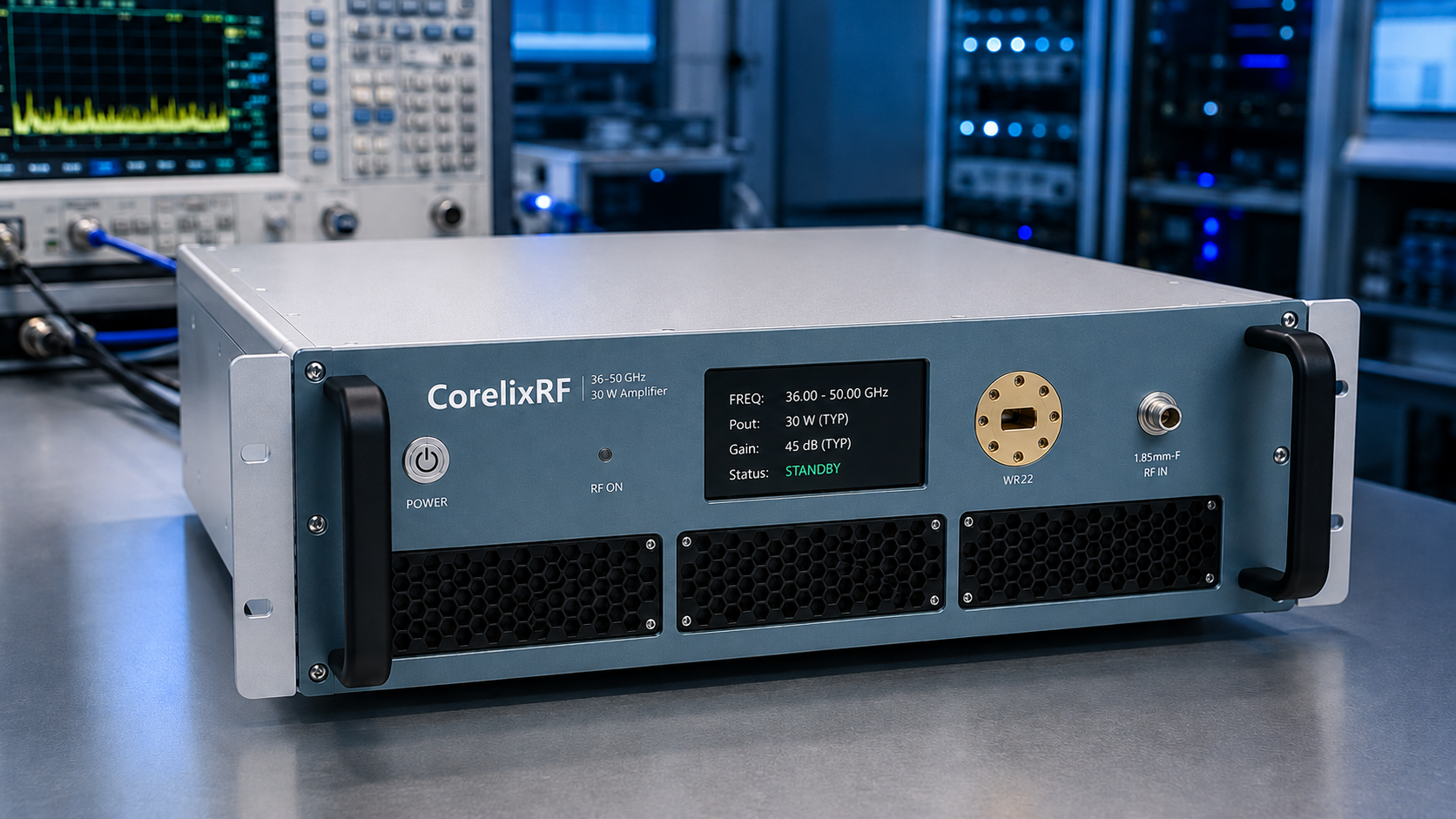
Subject: preparing a concise engineering brief for the CRF-PA-36000M50000M-30W. The local datasheet file identifies the source as CRF-PA36G50G-30W and lists a GaN solid-state mmWave amplifier covering 36-50 GHz with 30 W rated output power, 48 dB minimum small-signal gain, -8 to +8 dB gain flatness, 1.85 mm-F input, WR22 output, 15 dB gain control, forced-air cooling, and a 19-inch 4U form factor.
Recommendation: treat this as a system-level review, not a stand-alone part-number request. A buyer evaluating a millimeter-wave RF power amplifier in this band needs to document reference plane, source drive, WR22 routing, cooling, and acceptance evidence before asking CorelixRF for final confirmation.
Decision Context
The amplifier is relevant when a lab needs 36-50 GHz coverage for high-frequency test, communication validation, RF interference system-level testing, or aerospace control work. The 30 W output level is useful only when tied to a defined measurement point. If the project needs power after a coupler, waveguide run, antenna feed, or fixture, those elements must be named in the inquiry.
Known Datasheet Facts
Known values include 36-50 GHz frequency range, 30 W rated output, 48 dB minimum small-signal gain, 1.85 mm-F input, WR22 output, 15 dB gain control, forced-air cooling, monitoring, protection, and 19-inch 4U packaging. These are the facts that can be safely used in the article. Do not add unsupported certification, stock, customer case, or performance claims.
Open Questions for the Engineering Team
First, is the system swept across the whole 36-50 GHz range or operating at fixed points? Second, where must output power be measured? Third, what source level is available and how is overdrive prevented? Fourth, how will the WR22 path be calibrated? Fifth, what data must purchasing receive before approval?
System Risk Notes
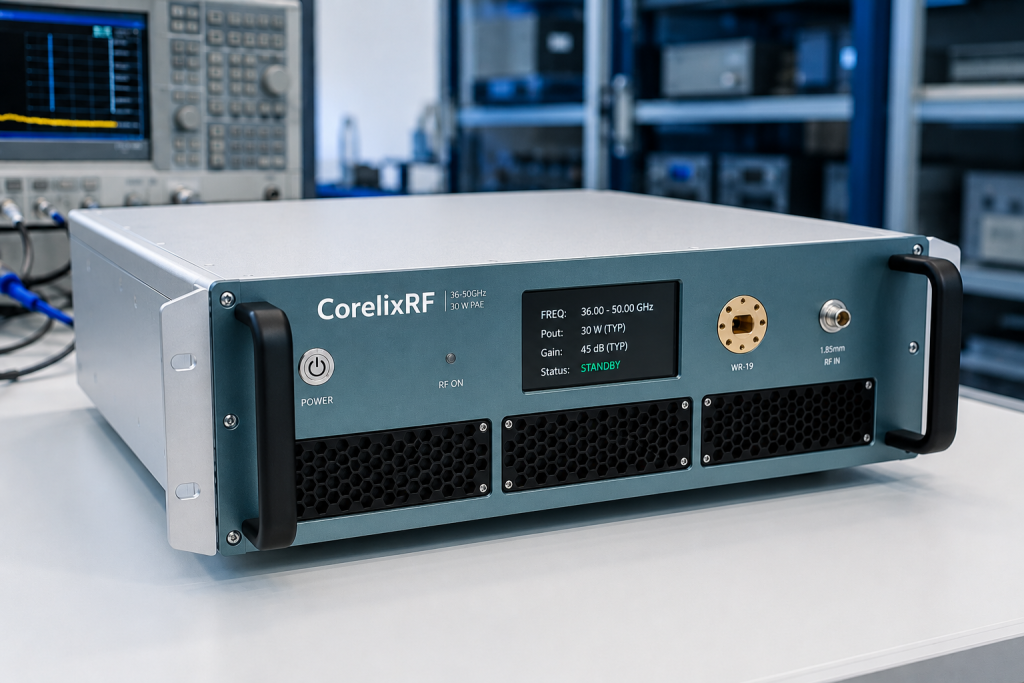
The main risks are not exotic. They are ordinary mmWave integration issues: unclear output reference plane, waveguide path changes after quotation, insufficient airflow, and incomplete source-drive limits. CorelixRF high-frequency RF capability should be reviewed when the amplifier is one element in a larger high-frequency chain.
Recommended RFQ Wording
Ask for review of a 36-50 GHz WR22 mmWave amplifier for the listed operating points. Include waveform or CW mode, required output at the named reference plane, source power, WR22 path, load or antenna, rack environment, cooling clearance, gain-control requirement, monitoring needs, and requested test data. If nonstandard packaging or control is needed, flag that as a custom RF amplifier requirement rather than a later change.
Acceptance Evidence
The acceptance package should include representative output data, gain behavior, thermal state, current monitoring, and alarm behavior where applicable. For internal testing practice, CorelixRF RF testing and validation is the natural supporting page because it focuses on measured chain behavior instead of nominal catalog values.
Closing Memo
The useful buyer angle is not “30 W is available.” The useful angle is that a 36-50 GHz mmWave amplifier must be specified with enough context for engineering review. If the team can answer the open questions above, CorelixRF can compare the standard configuration against the real system instead of guessing from a short quote request.
Memo Appendix: Review Table
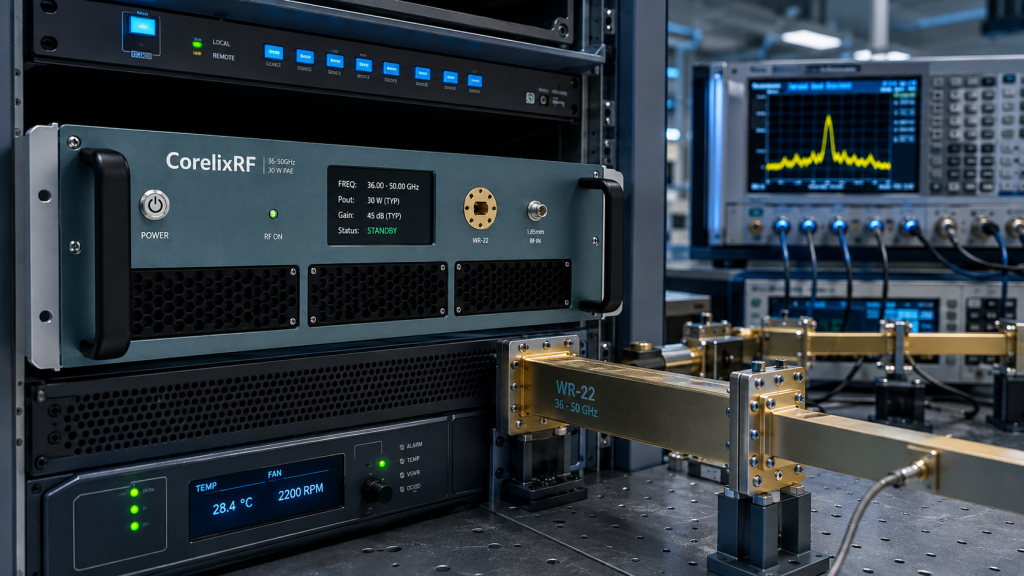
Frequency plan: full-band sweep or fixed channels. Output reference: WR22 flange, after coupler, or DUT input. Source plan: maximum output, attenuation, software limits, and startup state. Mechanical plan: 4U rack location, airflow direction, waveguide service access, and cable strain relief. Data plan: output power, gain setting, current, temperature, alarm state, and any required factory records.
Memo Appendix: Language to Avoid
Avoid broad phrases such as “best mmWave amplifier,” “guaranteed performance,” or “ready for every test.” They are not useful and can imply unsupported claims. Better wording is specific: “36-50 GHz operation, 30 W rated output power, WR22 output, defined reference plane, 15 dB gain control, and forced-air 4U rack integration for engineering review.” That phrasing stays close to the source data.
Memo Appendix: Owner Assignments
Assign one owner for the RF path, one for rack cooling, one for source control, and one for purchasing documents. When those responsibilities are not assigned, the RFQ often leaves gaps that only appear during installation. A short ownership table can save days of back-and-forth.
Memo Appendix: Acceptance Trigger
The team should not trigger acceptance until the source path, WR22 path, rack position, airflow, load condition, and measurement sensor are fixed. If any of those items change after the first measurement, the result should be marked as preliminary. That rule protects the project from accepting data that cannot be repeated.
Memo Appendix: SEO Angle
For article quality, the engineering memo format also prevents the piece from reading like a copied product page. It gives the reader decisions, open questions, and risk notes while still using the main technical search phrase naturally in the title, opening, body, FAQ, and CTA.
FAQ
What frequency range does this mmWave amplifier cover?
The source datasheet lists 36-50 GHz.
What output interface is specified?
The source data lists WR22 output and 1.85 mm-F input.
What output power is listed?
The datasheet lists 30 W rated output power.
Why does the RFQ need system details?
Waveguide routing, calibration reference plane, cooling, gain control, and source drive can all affect the final result.