
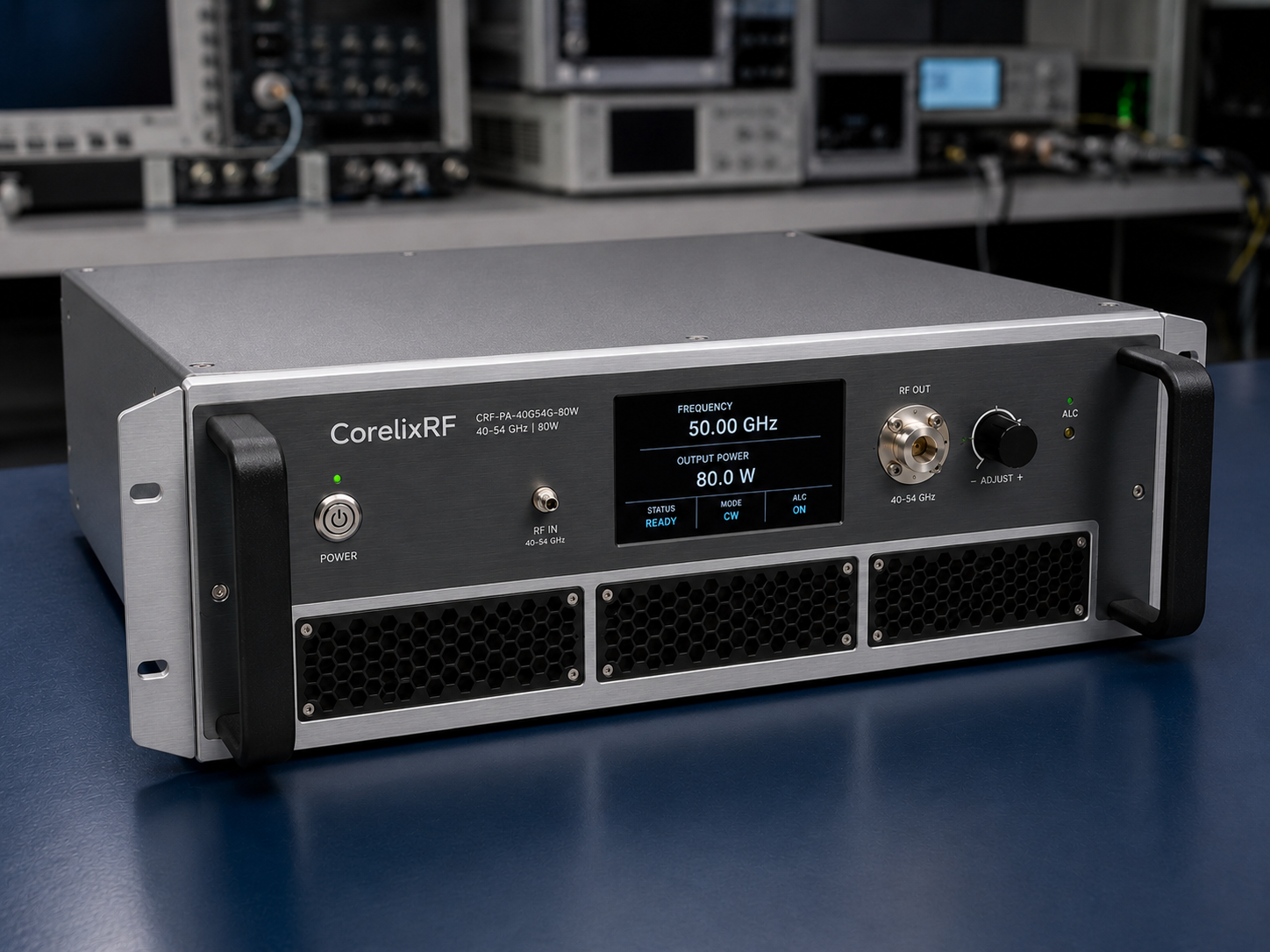
The CRF-PA-40G54G-80W is a public representative model name within CorelixRF’s 40-54 GHz millimeter-wave amplifier family. CorelixRF identifies the 40G54G family as a high-power mmWave project platform and lists representative power options including 6W, 10W, 20W, 40W, 80W, 120W, and 200W. Since detailed electrical data is released after inquiry review, the CRF-PA-40G54G-80W should be approached as an engineering-review model, not as a fixed catalog purchase with all integration answers already known.
High-power mmWave amplifiers require more front-end planning than lower-frequency modules. Output path, cooling structure, test load, interface, control logic, and measured data can determine whether the amplifier fits the system. A complete RFQ helps CorelixRF determine whether the public 40-54 GHz family is appropriate or whether another custom configuration should be reviewed.
Confirm Whether 40-54 GHz Is the Real Band
The first RFQ line should state the exact operating window. If the project needs full 40-54 GHz coverage, say so. If it only needs a narrower channel or several spot frequencies, that should also be clear. Full-band output at mmWave frequencies is a different engineering problem than a focused-band high-power requirement.
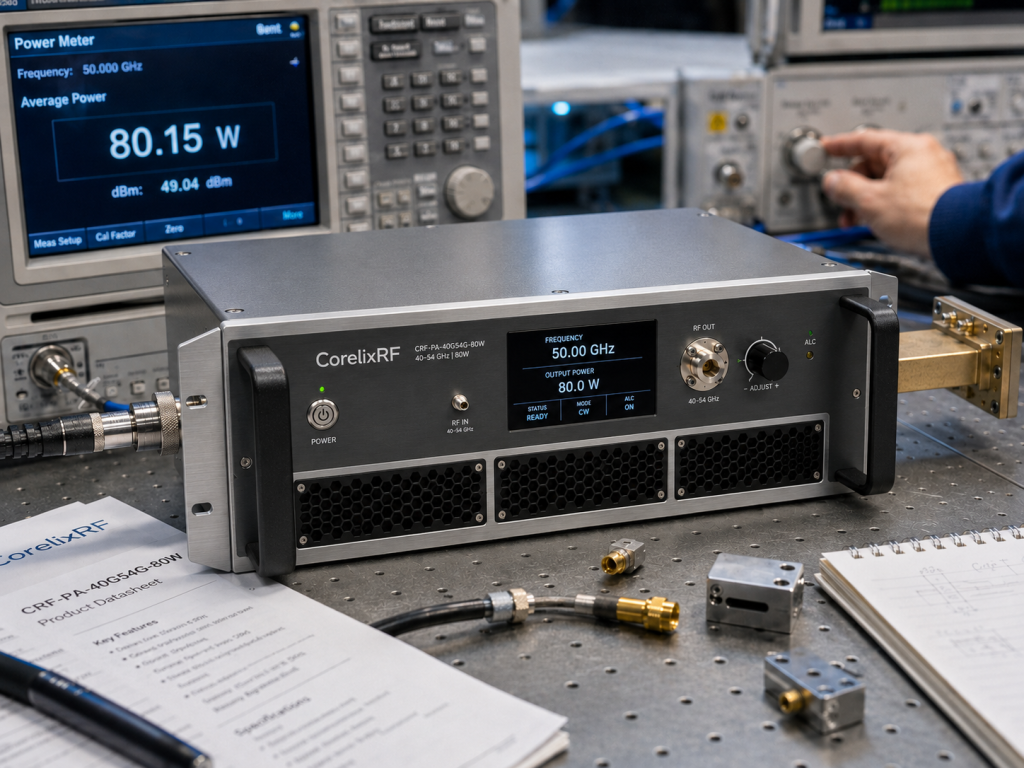
Buyers should also state whether the amplifier will be used for swept testing, fixed-frequency operation, communication waveform evaluation, component stress testing, or OEM transmitter-path integration. Application context helps engineering evaluate duty cycle, cooling, and documentation needs.
Define the 80W Requirement
The public model name includes 80W, but the RFQ should still define how that power is used. Is 80W required at the amplifier output, after a waveguide transition, at an antenna input, or at a fixture input? Does the requirement apply across the full band, at a center frequency, or at selected frequencies?
At 40-54 GHz, every adapter, transition, cable, waveguide component, switch, and load can affect usable power. Include the full RF chain so that CorelixRF can review feasibility and recommend relevant measured data.
Interface and Mechanical Review
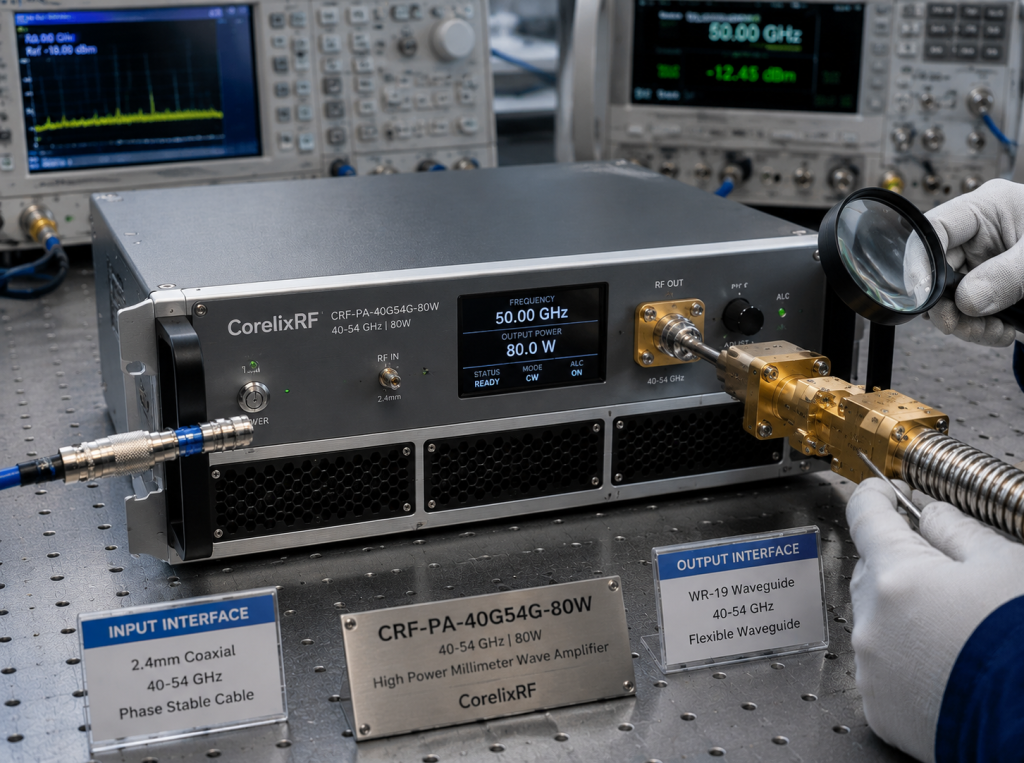
CorelixRF’s mmWave page emphasizes coaxial or waveguide interface review, mechanical structure, cooling, control, and test documentation. For a high-power 40-54 GHz request, interface selection is central. Provide preferred waveguide or coaxial connection, flange or connector standard if known, load type, cable or waveguide length, and physical constraints around the amplifier.
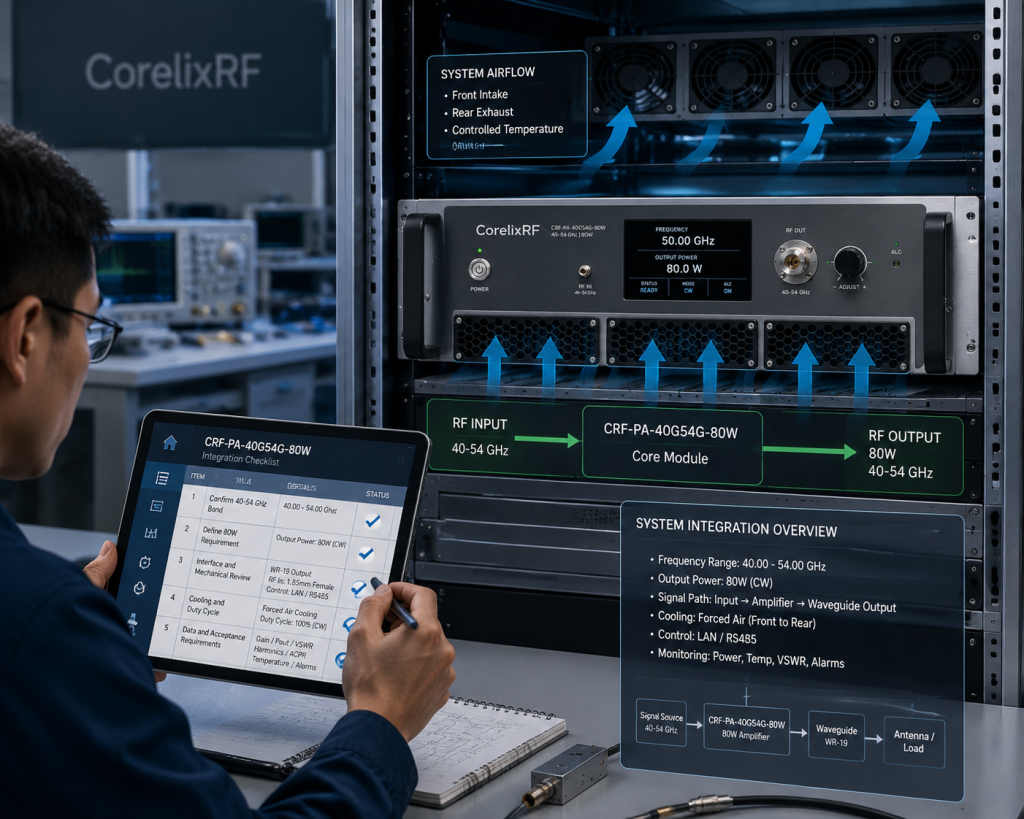
Mechanical review should include available space, rack or module preference, airflow direction, ambient temperature, mounting limits, and service access. If the project has a drawing, share it with the RFQ.
Cooling and Duty Cycle
High-power mmWave operation creates thermal risk. The RFQ should state CW or pulsed operation, duty cycle, expected operating duration, ambient temperature, rack airflow, and whether the amplifier will run near maximum output. Do not assume that a public power-class name automatically defines the thermal condition.
If the system uses bursts, sweeps, or modulated signals, include waveform information. Cooling design must match the real operating profile, not only a headline output rating.
Data and Acceptance Requirements
Ask for datasheet release, output power data, gain response, interface drawing, mechanical outline, control documentation, and factory test evidence relevant to the project. If internal acceptance needs specific measurement points, list them before quotation.
For related system-level content, CorelixRF’s RF signal transmission page can support internal linking around RF output chains and application review.
FAQ
Is CRF-PA-40G54G-80W publicly listed?
CorelixRF publicly lists CRF-PA-40G54G representative power options, including 80W, on its millimeter-wave amplifier page.
Does CorelixRF publish full specifications for this model online?
No. The public page states that detailed specifications, datasheets, mechanical information, and test data are provided after inquiry review.
What makes the RFQ stronger?
Provide frequency, required output point, input level, waveform, duty cycle, interface, load, cooling condition, mechanical limits, control needs, and documentation requirements.
Should this be compared with 18-40 GHz amplifiers?
Only if the real operating band is at or below 40 GHz. A 40-54 GHz requirement belongs in the mmWave custom platform review path.