
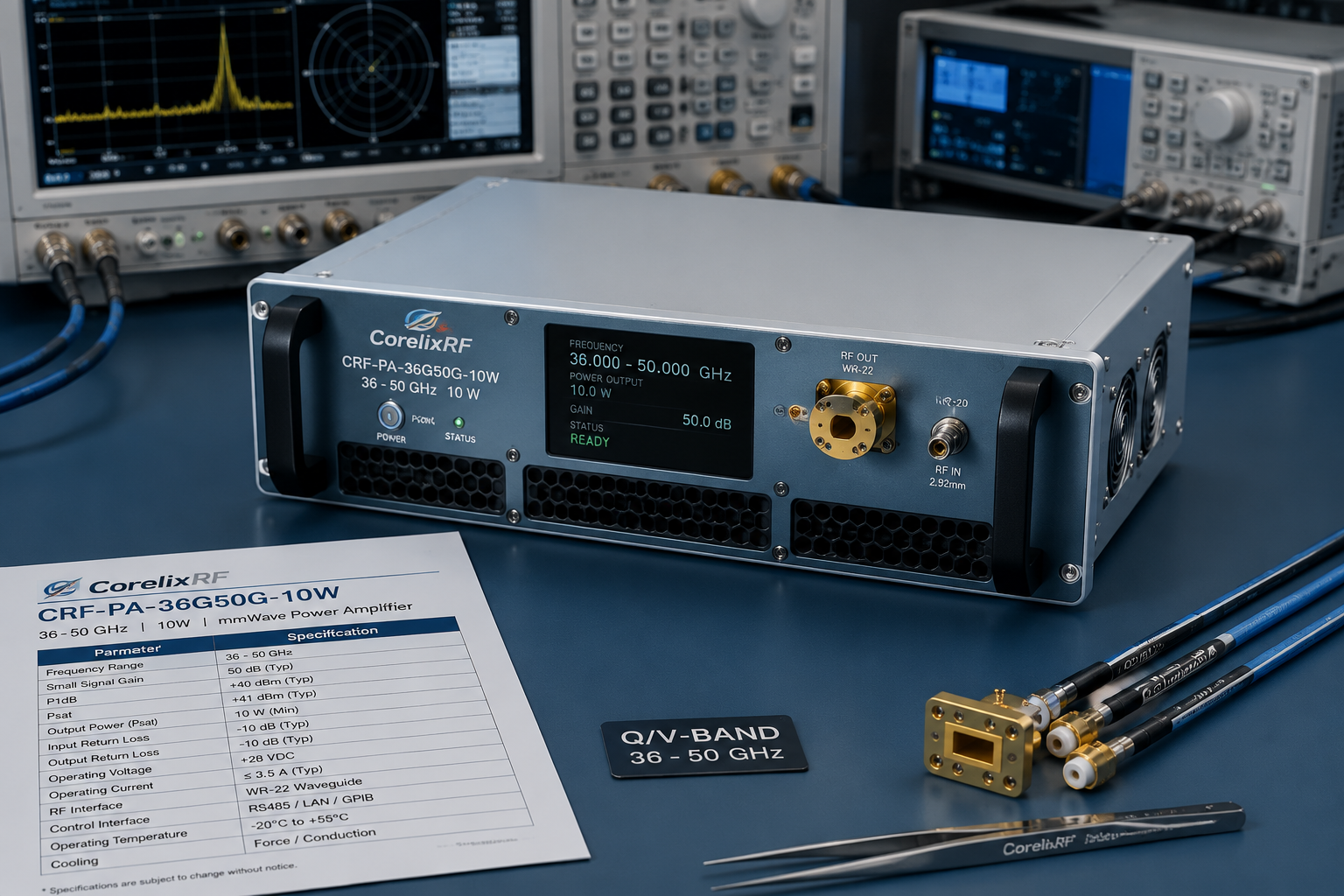
The CRF-PA-36G50G-10W is one of the public representative model names listed in CorelixRF’s millimeter-wave RF power amplifier platform. It sits in the 36-50 GHz family, which CorelixRF presents as a Q/V-band engineering platform. Because the public page uses these model names for initial screening only, the right way to discuss this amplifier is through a structured RFQ rather than unsupported claims about detailed gain, connector loss, linearity, or measured output.
For engineering and procurement teams, the value of a 36-50 GHz model is its ability to start a mmWave review around a defined high-frequency test window. The buyer still needs to define whether the project needs full 36-50 GHz coverage, a smaller Q-band or V-band section, a specific output interface, a cooling structure, a control method, and factory test evidence.
Why 36-50 GHz Needs Inquiry-Based Review
CorelixRF publicly states that detailed electrical specifications, test data, mechanical information, and datasheets for mmWave model series are provided after inquiry review. That matters at 36-50 GHz because system performance depends heavily on interface selection, adapter loss, waveguide or coaxial transition, cable routing, calibration method, and load condition.
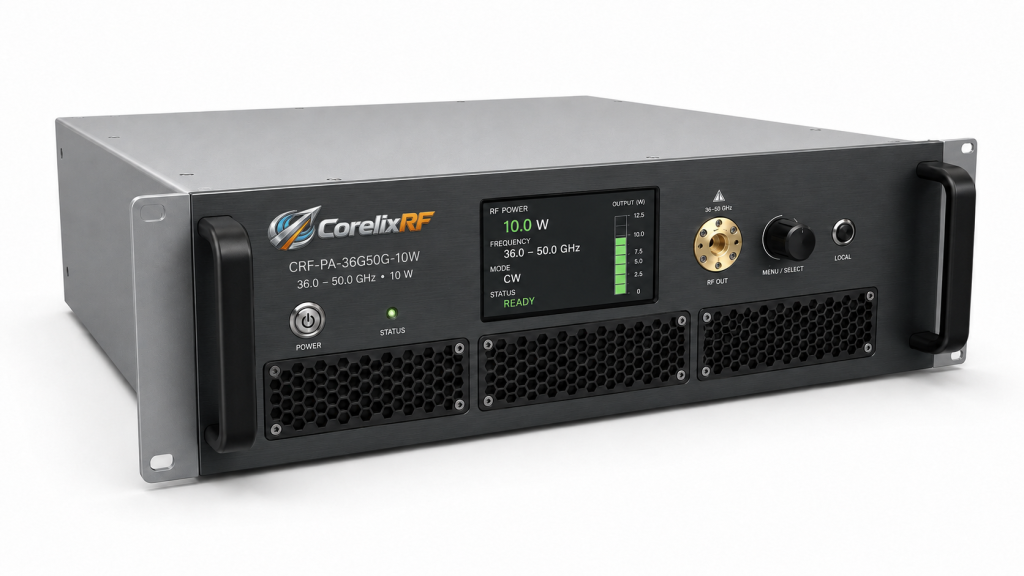
If a buyer simply asks for “10 W at 36-50 GHz,” engineering still needs context. Is the 10 W requirement needed across the whole band or only in a narrower window? Is the measurement point at the amplifier output, waveguide flange, antenna input, or device under test? Does the system need pulsed operation, CW operation, swept testing, or modulated signal validation? These questions determine whether the CRF-PA-36G50G-10W path is suitable.
Define the Frequency Window First
The public family range is 36-50 GHz. Many projects do not need the full span. Some are focused around Q-band research, high-frequency communication validation, component testing, or a specific downlink/uplink evaluation window. A narrower operating window may change output path, cooling requirement, and data review.
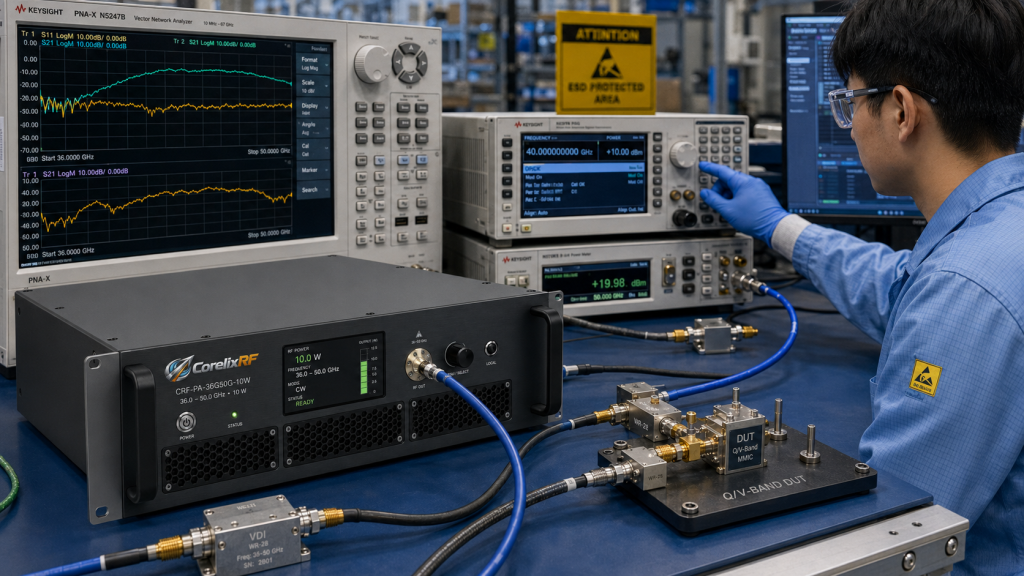
The RFQ should state the required start and stop frequency, whether full-band power is required, whether frequency sweep is continuous or stepped, and whether the amplifier will operate at spot frequencies. If the project includes future expansion, mention that separately so CorelixRF can review whether a broader platform is still useful.
Output Requirement and Drive Level
The public model name includes 10W, but buyers should still define the required output condition clearly. At mmWave frequencies, fixture loss and interface loss can be significant. State where the output power must be achieved and provide the expected RF path from source to load.
Input signal level is equally important. Provide source output level, frequency-dependent source roll-off, any driver amplifier, attenuator setting, and desired operating margin. This helps engineering determine whether the selected platform can reach the intended output under real chain conditions.
Interface, Cooling, and Control
CorelixRF states that mmWave projects require coaxial or waveguide interface review, cooling consideration, control logic, and validated RF performance before integration. The CRF-PA-36G50G-10W inquiry should therefore include preferred RF input and output interface, available mechanical space, heat removal plan, control interface preference, monitoring expectations, and enclosure constraints.
If the unit will be used in an automated lab, include LAN, RS485, GPIB, or other control needs. If it will be integrated into an OEM system, provide drawings, airflow limits, supply constraints, and expected duty cycle.
Documentation to Request
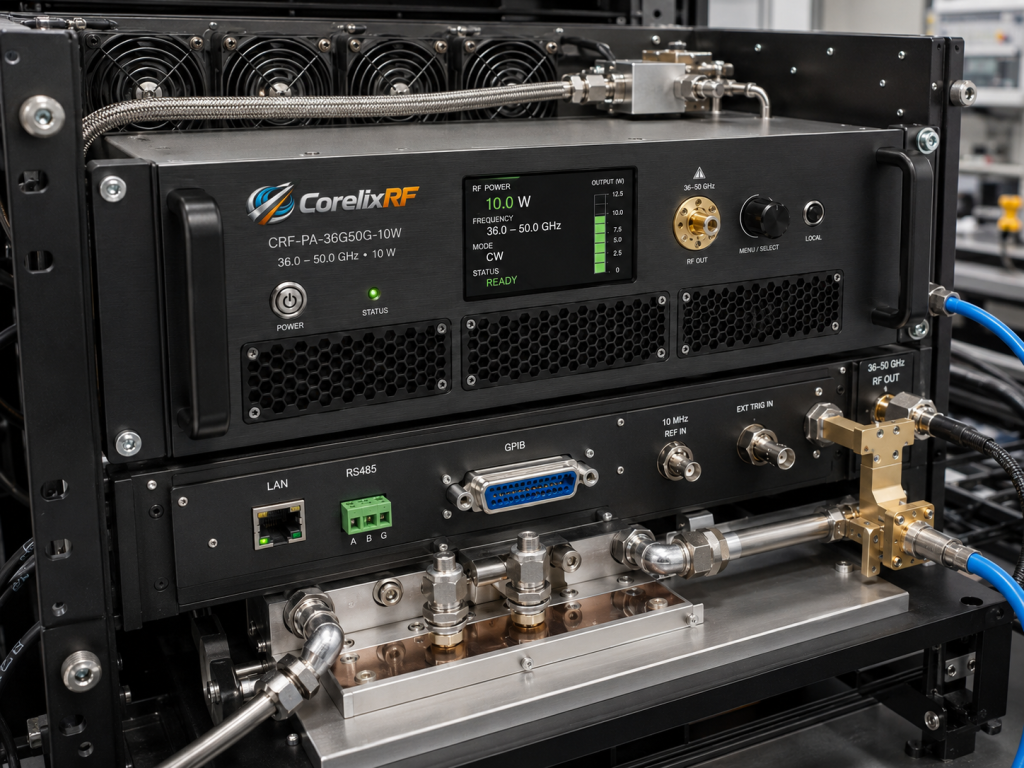
Ask for datasheet, output power data, gain response, mechanical outline, interface drawing, cooling requirement, control notes, and any factory test record that supports internal approval. CorelixRF’s RF testing and validation page is a useful internal reference when discussing measured output, gain, VSWR, spectrum, and validation records.
FAQ
Is CRF-PA-36G50G-10W a public CorelixRF model name?
Yes. CorelixRF publicly lists CRF-PA-36G50G model options including 10W on its millimeter-wave amplifier page.
Are detailed specifications publicly downloadable?
No. CorelixRF states that detailed specifications, datasheets, and test data for mmWave models are provided after inquiry review.
What should I include in the RFQ?
Include frequency window, output target, input level, interface preference, cooling condition, control method, load path, documentation requirement, quantity, and project stage.
When should I compare this with 18-40 GHz models?
If the required band stays below 40 GHz, CorelixRF’s 18-40 GHz page may be a more direct starting point. If the system extends above 40 GHz, the 36-50 GHz family is more relevant.
CTA: Request Q/V-Band Amplifier Review