
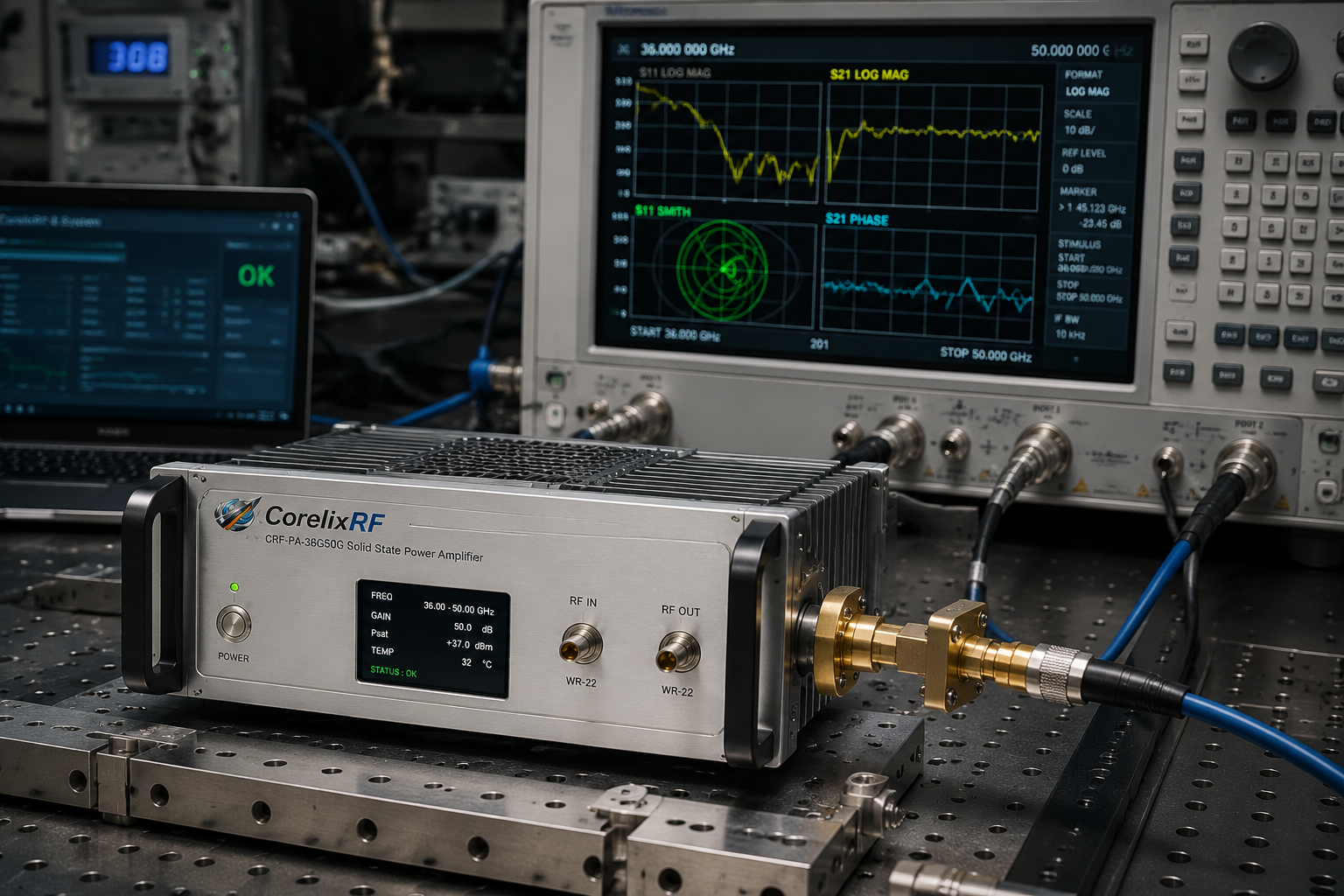
The CRF-PA-36G50G mmWave amplifier series is a public CorelixRF screening name for 36-50 GHz Q/V-band engineering projects. It is not a simple catalog item with one fixed public datasheet. At millimeter-wave frequencies, the correct amplifier configuration depends on frequency window, interface type, output condition, cooling, control, package, load environment, and acceptance data.
CorelixRF’s millimeter-wave RF power amplifier page states that its mmWave platforms cover 18-110 GHz for custom configuration, engineering review, and factory test validation. The public representative table lists the CRF-PA-36G50G Series as a 36-50 GHz Q/V-band engineering platform. Available representative model names include CRF-PA-36G50G-3W, 5W, 10W, 20W, and 30W. Detailed electrical specifications, test data, mechanical information, and datasheets are provided after inquiry review.
Why inquiry review matters at 36-50 GHz
At 36-50 GHz, small changes in frequency window can affect amplifier design, interface choice, output path, and validation method. A buyer asking for a “36-50 GHz amplifier” may need full-band coverage, a Q-band subset, a V-band-adjacent window, a driver stage, or a higher-power output path. Those are different engineering problems.
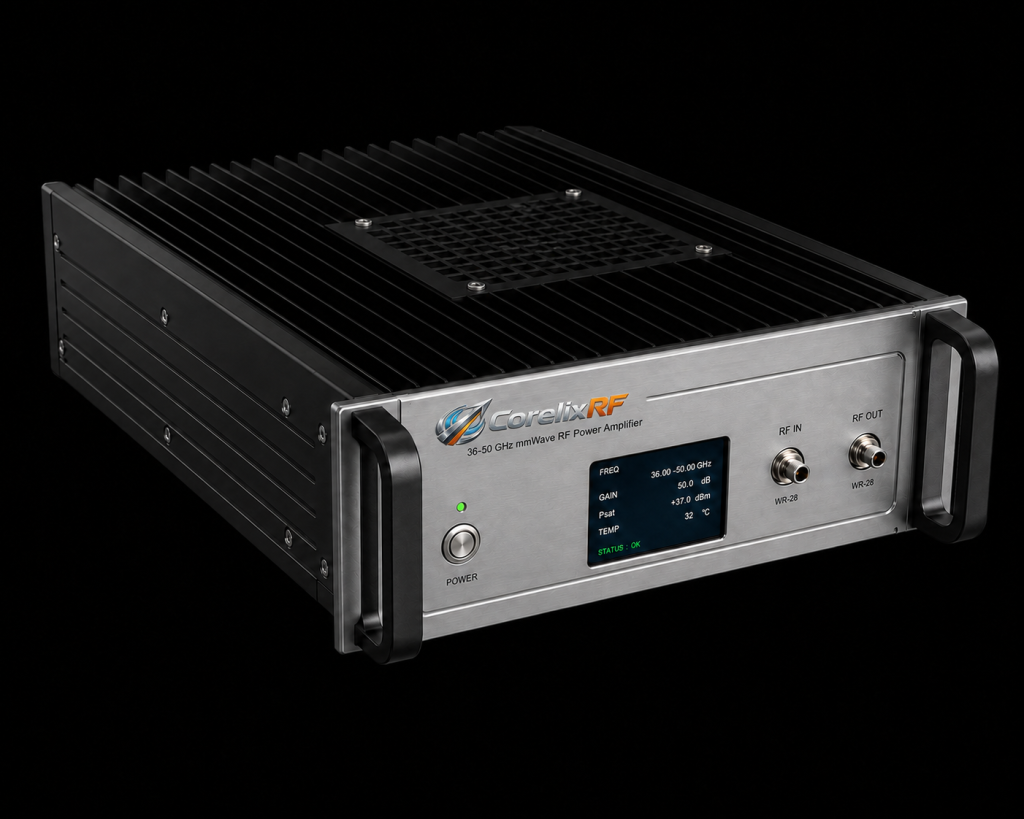
CorelixRF explains that mmWave datasheets are provided after inquiry to avoid incorrect model selection. That is a practical policy for high-frequency projects because connector or waveguide path, cooling, control, and load condition can all change the final configuration.
Define frequency window and output class
The public model names list 3 W, 5 W, 10 W, 20 W, and 30 W options for the CRF-PA-36G50G family. Use these as starting references only. The RFQ should define required frequency range, target output power, minimum acceptable output power, calibration plane, waveform, duty condition, and downstream loss.
If a project overlaps lower mmWave ranges, CorelixRF’s 18-40 GHz amplifier page may be a useful comparison. If the project is clearly above 40 GHz, the CRF-PA-36G50G or other mmWave screening series can be referenced in the inquiry.
Interface selection is a core RF decision
The mmWave page emphasizes coaxial and waveguide interface review. This matters because connectors, adapters, transitions, and waveguide runs can dominate insertion loss and repeatability at 36-50 GHz. The RFQ should define preferred input and output interface, existing test equipment, adapters, fixture connection, and whether the amplifier will be used in a bench, rack, antenna path, or integrated subsystem.
For high-frequency projects, avoid selecting an amplifier before the output path is understood. The amplifier, interface, cable or waveguide, fixture, and measurement setup should be reviewed together.
Cooling, control, and validation data
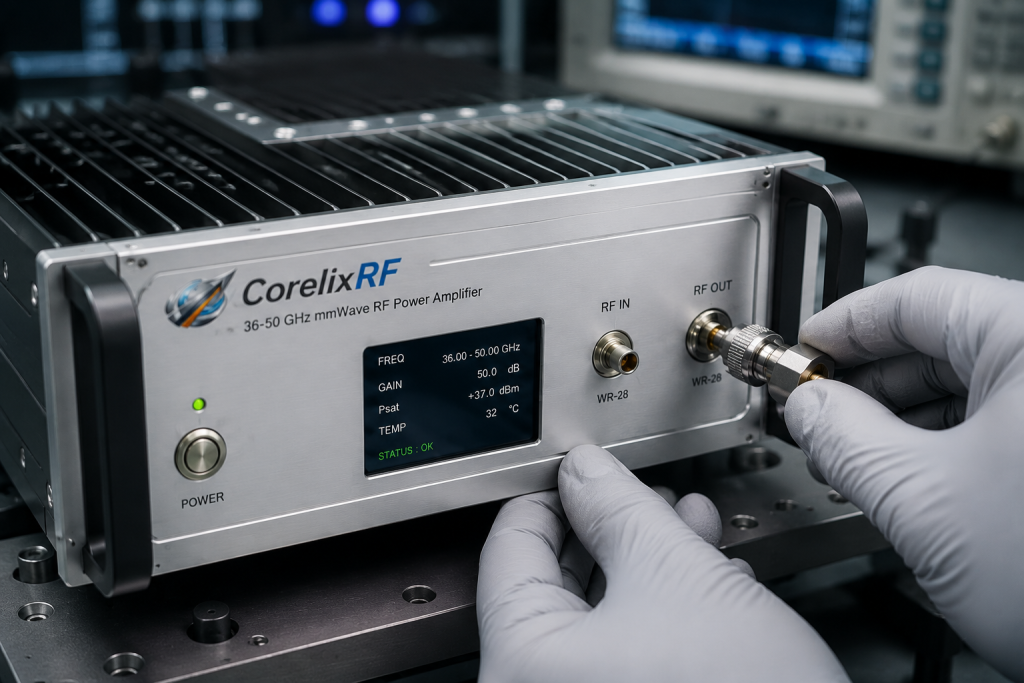
CorelixRF notes that higher-frequency platforms require careful thermal, power supply, and operating-condition review before selection. Provide ambient temperature, duty cycle, operating time, enclosure format, airflow or conduction path, and any rack or module constraints.
Control requirements should include enable behavior, remote interface, monitoring, alarm reporting, and test automation needs. Validation requests should be specific: gain, output power, flatness, harmonics, spurious behavior, match data, mechanical information, and factory test records should match the exact frequency range and acceptance condition.
FAQ
What is the CRF-PA-36G50G mmWave amplifier?
It is a CorelixRF public representative model series for 36-50 GHz Q/V-band engineering review.
Are detailed datasheets public?
No. CorelixRF states that detailed specifications, test data, mechanical information, and datasheets are provided after inquiry review.
What model power names are publicly listed?
The mmWave page lists CRF-PA-36G50G-3W, 5W, 10W, 20W, and 30W representative model names.
What should be included in an inquiry?
Send frequency window, output power target, waveform, duty condition, interface preference, cooling method, control needs, load path, acceptance data, and project stage.
Why are interfaces so important at 36-50 GHz?
At mmWave frequencies, coaxial or waveguide choices affect loss, repeatability, power handling, mechanical fit, and measurement confidence.
Conclusion
The CRF-PA-36G50G mmWave amplifier series should be treated as an engineering-review path for 36-50 GHz Q/V-band projects. Use the public model name to start the conversation, then define the frequency window, output class, interface path, cooling, control, and validation data needed for the real system.